Generally, it’s good if wages follow labor productivity, not politics. No one is prohibiting central agreements in the future either, but rather guaranteeing the freedom to negotiate locally instead. When local agreements aren’t made, the biggest problem (in my opinion) is that it kills competition and slowly but surely starts increasing unnecessary bureaucracy.
It’s a bit like if, say, Fortum were granted a monopoly tomorrow and other operators were banned, I don’t believe electricity production would hit a brick wall next week, but in 10, or even 50 years, the situation would be, to put it mildly, terrible. This tends to happen naturally if the incentive to do things better, which usually arises from competition, is removed.
If wages are at the same level in companies, then competition arises from the quality of the product sold, not from who exploits their employees more. Which do you think is more sustainable?
In my opinion, this is a good thing, and I hope others follow suit. A better worker can be paid a little more, and a less productive one a little less . This doesn’t mean that wages will start to be driven down competitively. You can always change jobs if you feel your employer doesn’t appreciate your work, or even change fields Employers want skilled employees to stay with their company, not go to competitors, for example.
Then again, if a paper machine is threatening to close, it’s probably a lower threshold to cut average higher wages by a few grand – if that would still save your job?
Of course, there are also other cost factors (ahem, the government ) – so this couldn’t be practiced indefinitely. Anyway, hopefully, it would slightly increase interest in investing in the Finnish forest industry and thereby create new jobs!
According to Statistics Finland’s Labour Force Survey, there were 65,000 fewer employed people in August than a year earlier.
Lately, with co-determination negotiations, it seems that the 30,000 jobs promised by the “Government” have already been cut (Negotiations for almost all companies do not become public knowledge)
Add to this all the travel industries, restaurants, etc. Some jobs will ‘come back’ – but not all. Unfortunately, the trend in Finland is currently . Changes are needed, and quickly.
To this, add an aging population, declining birth rate, stagnant productivity, rising taxes, growing debt… (This is from a young person’s perspective; it feels like change is feared.)
I know, but unfortunately, it doesn’t always work that way.
So you mean it almost never works that way, because employers usually don’t directly tell employees that they could get more pay if they just asked. I still don’t understand what local bargaining achieves.
Well, since you seem so strongly against this, what are the downsides it brings? Are you afraid of public salary discussions at your own workplace, or what exactly is so frustrating? If an employee doesn’t dare to ask for a raise themselves, they probably don’t need it… Or if you need a union to advocate for employee X’s interests, and you can’t advocate for them yourself My own employer has raised my salary 3 times without me even asking (this was within 2 years of joining the company - not index-based increases).
My attitude towards work is that I only compete with other people for the same job; unfortunately, many people, once they get the job, just lean against the walls - because how would you be fired?
Additionally, for me, a workplace/employer has other criteria besides just the “visible salary.” For example, the work itself, colleagues, employer-provided benefits, etc. I wouldn’t change jobs for 1€/hour if I knew there would be bad colleagues and worse work.
Changes are inevitably required here in Finland. We need more investments and jobs. Low-wage sectors can certainly start complaining, but for that reason, tax cuts should come (especially for low-wage earners), and smaller benefits for the unemployed.
If our government cannot make those solutions, then the solution-makers must be found elsewhere.
I listed the benefits of centralized collective bargaining for both parties above. I can also add that it’s not as easy to bring cheap labor from abroad to Finland, because foreign temporary workers must also be paid according to collective agreements. This reduces human trafficking and prevents foreign workers from being crammed into dirty construction site barracks, living on five euros an hour (in theory, of course, in practice it’s different).
This whole discussion has nothing to do with my situation, as I don’t even live in Finland. The current situation is that employer associations are trying to push wages down and/or get more of those famous corporate subsidies (which, by the way, have been found to be almost useless for increasing employment) from the Finnish government. Lowering wages will only lead to deflation and an increase in wealth disparities.
You apparently didn’t think this through, so I won’t even waste time on this talking about people’s situations. You should try to develop empathy for your fellow human beings.
Nice. What does this anecdote add to this?
Others simply do not share your worldview about the importance of your work.
Of course. However, if you already have bad colleagues and bad work and no visibility of anything better, is it nice to add a pay cut, which is most likely to result from local bargaining?
Everyone understands that it would be good to get investments. But companies cannot be forced to invest in Finland. Nor do I see that local bargaining would bring any investments.
The Non-discrimination Act is quite strict. It is legally very difficult to pay different wages for the same job, except if there are agreed criteria. For example, length of service, etc. There are often also bonuses (heko) with agreed rules for their distribution.
The new Working Hours Act is also quite strict. Even our company had to reorganize at the beginning of this year because the new law does not allow for agreements on even flexible working hours unless tied to a national collective agreement.
This Working Hours Act was enacted by the Sipilä government.
An individual/local worker is in a weaker position in negotiations. That’s why. Since making money is the only purpose of existence, you always have to grind it out of something. Doesn’t matter what. Then people get annoyed when the prime minister questions corporate social responsibility. This “Look at me, I’m a victim, but don’t even glance this way when I’m doing all sorts of bad things” mentality is pure narcissism. Then, if they get caught doing something crappy, they put a public apology in the newspaper and continue in the same vein.
One advantage is that workplaces are not all the same across Finland. As an exaggerated example, consider whether it makes sense for a shop employee in Helsinki, who has plenty of customers, to earn the same salary as a shop employee in Ilomantsi, who has no customers for most of the day. In such a situation, the productivity of these employees is not the same, but the salary would be.
Local bargaining also allows, for example, longer working days in the restaurant industry during the Christmas party season, which can then be compensated with longer holidays in July. Also, changing holiday bonuses into extra days off is local bargaining, and it’s quite difficult to see that possibility as negative from any perspective.
In an ideal world, wages should be determined in the labor market according to the employee’s productivity. Just as we pay more for a higher quality product, an employer is willing to buy labor from a more efficient employee at a higher price.
Market-based wages improve employment. If many people can do a certain job, there’s no reason to pay a high wage for it because the supply of labor is greater than the demand. In Finland, the market economy works well for products, but not for the labor market.
In a utopian world, it would go like this:
All wages are lowered
More is invested in Finland (because profitability improves)
Employment increases (unemployment decreases)
Taxes can be lowered, leaving more disposable income from wages
I don’t see why this couldn’t be agreed upon by the central federations.
In my opinion, it’s a bit 19th-century to assume that an employee could somehow influence their own productivity and thus their salary should also be agreed upon. The only field where I can still see it working is sales, but even there, salaries are heavily commission-based. Nowadays, productivity is mainly based on how quickly machines can do a certain job, and the employee’s contribution to this productivity is negligible. If a company wants better productivity, it needs to invest in better equipment, but in my opinion, we have reached a saturation point where with an ever-larger investment, you only get a small advantage over before, which means that investments are not made at the same pace as in previous decades because the benefit would not cover the cost. Automation may increase productivity, but it also reduces the number of employees.
In reality, it would go like this:
Everyone’s wages are lowered
Tax revenues decrease
There’s whining about how the Finnish state has to take on more debt
No more is invested in Finland, because the market is so small
The small investments go into automation
Unemployment increases
A right-wing government takes power
More debt to increase useless corporate subsidies and lower unemployment benefits, “because they don’t want to work anyway.”
Return to point 1.
Finland is consistently ranked as one of the world’s most competitive nations, so I see no reason to start lowering wages. If this were to be done, it should be done between the central federations, to ensure that the entire society is behind it.
Wouldn’t the capitalist model always return to point 1, again and again, to maximize profits? Why would anyone ever leave wages “hanging” at a certain level when they could squeeze out every last cent, so to speak?
e. Personally, I might not want to see such a “utopia,” which would result in a total decay of society and insane inequality, as all welfare produced with tax revenues would have been cut.
I’m on the same page with you and I’d add, what does low unemployment matter to a person if the standard of living is like that of a medieval serf? In the US, some people work 2-3 jobs and can barely support themselves. Unemployment is a really good metric, but it shouldn’t be considered an end in itself.
So, agree on what by the central federations? That all restaurant workers do 10-hour days in December and extra days off in July? What about the restaurants for whom Christmas isn’t a peak season? Tough luck for them. This is precisely what local bargaining tries to prevent.
A rather bleak view, that an employee cannot influence their own productivity. Do you mean, for example, that all coders are equally good and diligent? At most, an age bonus added to the salary as years accumulate? Certainly, in some factory work, an employee cannot influence their productivity that much, but in most jobs, they can. From doctors to retail workers and chefs, one can significantly influence their own productivity. I think it’s entirely right that a diligent employee in these jobs should be paid better than a slacker. This too is local bargaining instead of a centrally controlled system.
Finland isn’t doing that badly in competitiveness rankings. In recent years, for example, ranks 11 and 15. The trend has only been downwards since the turn of the millennium.
This Finnish central federation-led system is also, as I understand it, quite unique in Europe. Probably thanks to the influence of our eastern neighbor. It’s quite difficult to see why a centrally managed labor market would be the best option while everyone knows how centrally managed price regulation works for everything else.
Central organizations can, for example, agree on the timing of seasons, allowing employees and employers more freedom to choose working hours. Central organizations can also agree on the possibility of modifying holiday bonuses, just as employees and employers can.
A rather bleak perspective that an employee cannot influence their own productivity. Do you mean that, for example, all coders are equally good and diligent? At most, an age supplement is added to the salary as years accumulate? Surely in some factory work, an employee cannot influence their own productivity that much, but in most jobs, they can. From doctors to retail workers and chefs, one can significantly influence their own productivity. I think it’s perfectly fair that a diligent employee in these jobs should be paid a better salary than a slacker. This too is local bargaining instead of a centrally managed system.
My view is based on the idea that a person has only a limited amount of time to produce work, and an employee’s productivity largely depends on circumstances. If a doctor has been told they can spend 10 minutes per patient, they can only see six patients an hour. If a shopkeeper has one customer an hour, they cannot create customers out of thin air. A coder can develop their own skills, but a coder’s abilities and time to produce code will eventually run out. Through these three examples, productivity can be increased by improving mechanisms where a doctor can see more than six patients an hour, a shopkeeper can get more customers through marketing, and a coder’s workstation and training can be improved, and even the development stack changed. These things are, in any case, external matters, independent of the employee.
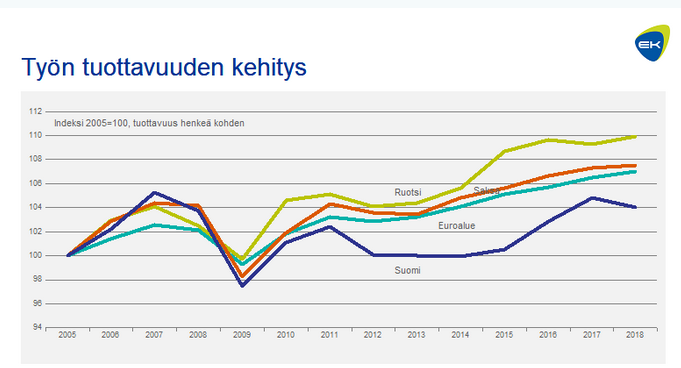
This graph, by the way, is quite tendentious and doesn’t really tell much, as the reader has no idea where those numbers came from. Is productivity calculated from the input of those working or based on the entire population, in which case a higher unemployment rate would lower productivity per capita? Probably everyone knows that Sweden and Germany have better employment because there are more immigrants who create a younger age structure. However, you won’t improve labor productivity by lowering anyone’s salary. For example, if you pay me 80% of my current salary, you’ll get 80% effort.
In Germany and France, unions are very strong, and bargaining, to my knowledge, also happens through them, but I could be wrong. In Britain, unions don’t really have any power, and company-specific bargaining is the norm. This has led to a situation where, in certain sectors, trainees don’t get paid, because there are so many people who want those internships, and thus free labor is obtained.
This is just so wrong. During my career, I’ve had about 30 different jobs, and only in one place could I not significantly affect my own productivity. I have never done sales work.
I can list examples to make it more concrete; most were temporary jobs I did before or alongside university.
-Corrugated cardboard factory, machine assistant. The machine operator was my friend, who had not previously worked in this capacity. We were really bad and slow. Production was about 35% of what other shifts produced, and the quality was worse, so more went to scrap. Same machine, same products. More experienced veterans produced three times better. Luckily, production bonuses were tied to the entire factory’s production, not our own blunders.
-Construction cleaner. No matter how fast I tried to work, the boss cleaned two houses in the same amount of time I cleaned one. And with more consistent quality. I just couldn’t do it.
-Bricklayer’s assistant. I worked with a British bricklayer. Our boss didn’t speak English, so I translated. I didn’t know the professional vocabulary. We bricked walls for a week. The Brit quit. The next week, they had to be torn down because they were crooked. Two weeks went to waste.
-Mail carrier. I struggled all summer with how tough and rushed the job was. I heard that my route had previously been part-time. On top of that, in the summers at that time, there was less than half the normal amount of mail.
And there would be countless more stories. The point is that skill and experience genuinely lead to productivity in almost any field. And the proportion of these professions only grows as expert jobs increase and assembly line jobs decrease.
In my current profession as a game coder, our small team of 6 competes equally successfully with the output of teams more than ten times larger. The productivity differences among coders are absolutely enormous. Some produce diamonds very quickly, while others can’t even get mediocre stuff out in any amount of time. Productivity differences can therefore concretely be infinite.
So it’s a known fact that experience and knowledge make any worker better, but whether an employee can influence these things is a different question. The anecdotes you listed suggest that you, too, didn’t make your work result any better, even though you tried. Instead, guys who have been given the opportunity to accumulate experience and know-how, without a doubt, produce better results. In these situations, too, it would be good for the employer to invest in the employee and train them to be better, instead of lowering their salary. Primarily, I would start from the premise that you have been in a completely wrong field on several occasions, and your personal attributes (genes) simply have not been suitable for those jobs.
These haven’t been my dream jobs, but I don’t see any reason why I wouldn’t have succeeded in all of them once I gained experience. Even in those assistant jobs, it was more about the other half of the team than me. But the point is that in all these jobs, I received the same standard pay as more experienced workers (minus seniority bonuses), even though I didn’t always feel I deserved it.
But in any case, you made the positive claim that an employee cannot influence their productivity. The burden of proof is therefore on you.
“So, it’s a known fact that experience and knowledge make any worker better, but whether an employee can influence these things is a different question.”
The question is: is the employee motivated to develop their own skills? Everyone has the opportunity to develop their own skills if they have the motivation. And yes, money is not the best motivator for nearly all people, but I dare to say for sure that removing the financial motive with some centrally managed “everyone doing this job gets sum x as salary” agreement does not encourage self-improvement or working “harder.”
In my opinion, everyone should get what they deserve; it’s quite natural. If someone is willing to saw one extra tree, write one extra line of code, treat one extra patient, etc., even if they don’t feel like it, of course they should receive appropriate compensation for it. On a general level, this Finnish attitude where the individual has no responsibility and work is not encouraged (in my understanding, in some cases it’s even punished) simply pisses me off. To top it all off, the public sector is being bloated(?), and then people are just gawking around contentedly because the employment rate was raised a bit. Give me a break!
Well, now that’s been said too, have a good weekend everyone!
Whether I am right about an employee’s ability to influence their own productivity is a bit beside the point, and I can concede on that part, because I overgeneralized a bit too much. However, the basis of the argument is that the employer should have the motivation for an employee’s productivity growth, not the employee – employees rarely take it upon themselves to increase their productivity. I agree with @Diviner that money can increase motivation, but a decrease in it (which I believe arises from local bargaining) will result in the opposite. Here’s some reading: https://www.forbes.com/sites/forbesbooksauthors/2019/09/12/the-impact-of-wages-on-employee-productivity/
Employee involvement has been found to play a big part in work productivity, and this is influenced by working conditions and the workplace culture (more on this here: https://www.sunlight.is/post/3-crucial-factors-which-influence-employee-productivity). My anecdote: I’ve worked as an expert in construction, where several experts avoided work for several days a week and were completely open about it, because the working conditions and salary did not meet the employees’ education level (Bachelor’s and Master’s degree holders). Salaries in this field are generally 20-50% lower than those of uneducated construction workers, because the union has no power to raise them. There isn’t a huge rush of employees into the field either, but employers simply don’t pay more. So, if you want to work in your educated field, you do it for that “sock juice” salary or not at all.
To @Diviner, I’d also add that yes, you can work extra hours, and that’s how you earn more. Working extra hours doesn’t increase work productivity, but rather the amount of work done.
 . This doesn’t mean that wages will start to be driven down competitively. You can always change jobs if you feel your employer doesn’t appreciate your work, or even change fields
  Employers want skilled employees to stay with their company, not go to competitors, for example.
 ) – so this couldn’t be practiced indefinitely. Anyway, hopefully, it would slightly increase interest in investing in the Finnish forest industry and thereby create new jobs!
 (Negotiations for almost all companies do not become public knowledge)
 . Changes are needed, and quickly.
 (this was within 2 years of joining the company - not index-based increases).