It’s time to bring a major taboo among analysts and other professionals to the table: Mr. Index. Who admits to following it so closely that they’ve set up an index portfolio alongside their own stock picks and compare the returns at the end of the year? And if so, how has it turned out? Does this annoying fellow take the win year after year?
Is it possible that only some of the “nobility” at Inderes and Mr. Heikkilä from Taaleri emerge as winners? Or?
Masse has only beaten Mr. Index once, but draws and slight losses are all too familiar. And because of this, putting Masse’s efforts into reading and playing the market doesn’t seem like a sensible use of time, at least not in terms of earnings. Uncle Masse’s philosophy is: “investing is entertainment that you can occasionally even pay for.”
I follow the index, even though I’m not interested in index investing. Somehow, I feel that the general market sentiment can be summed up by the index’s performance. I beat the index with my investment, but it’s difficult to interpret who’s ahead when the amount exposed to risk changes with buys and sells. Are opportunity costs also included here, meaning do we continue calculating even if the investor has sold their last investment?
I consider it rational to sell a stock if its market price no longer corresponds to the realistic growth opportunities or riskiness of the business. It could also be a matter of speculation: often, you can buy your shares back cheaper and acquire more of them after making a profit. A buyer of dividend companies will likely lose if only share prices are measured (PI = Price Index, GI = Gross Index). However, I wouldn’t focus too much on the index when considering investment success. If a company or industry goes into a bubble based on weak fundamentals, are you smart for guessing correctly or foolish for not being involved? I prefer Warren Buffett’s rule number 1: Don’t lose money.
Neither Inde nor other professionals fell for Masse’s taunting about Mr. Index’s superiority. So we all continue to live in the nice bubble that picking and analysis pays off
Uncle Masse will still throw a good dose into OMX25 in the next stock market crash to await the bliss of an investment savings account.
VPkin certainly thumbs up Massen’s ramblings diligently, but doesn’t reveal his own score against Mr. Index at all. Perhaps it’s good that way, when working in a house where the omnipotence of expert picking cannot be questioned
If the index doesn’t yield, it means there are more companies with share losses than profit-making companies within it. The question, of course, is whether you can consistently pick only those companies that yield share gains for your portfolio and leave the loser companies that incur share losses for your ordinary pals. If so, congratulations! And please tell others how this brilliant stock picking succeeds year after year
Uncle Masse just fears that, as stated above, “Year after year, this nasty fellow takes the win.” It seems that only some of Inderes’ nobles and Mr. Heikkilä from Taaleri emerge as winners.
The joke is that a cyclical company that produces fabulous share price gains over a certain period (like Finnair or Outokumpu) can produce devastating share price losses over another period and lie dormant for years. Beating the index thus requires sensing turning points and timing purchases/sales. No one is going to say, “Here’s this boring airline whose share price hasn’t moved in years; buy it because you’ll soon get 3x.” Amazon’s share price was also valued between $30-40 for years (now nearly $1900).
Speculative index beating is one game, but you can’t really form a strategy out of it. Buying stocks at multiple book values is more or less riding a favorable market. Then, when the market turns and half of your earthly possessions (100% stock weight) are gone, people are no longer interested in Martin Paasi’s no-fee index funds and blogs touting enrichment through stocks. “Yes, there’s a bankruptcy risk in Endomines and former investors’ capital has been squandered, but if gold is found then…” No. Sometimes beating the index means realizing profits and avoiding long positions.
“Uncle Massi will still throw a good portion into OMX25 in the next stock market crash, waiting for the bliss of an investment savings account.”
Well, did you bet a lot on Thursday?
Let me guess: only a small part of that “good portion.”
Why? Because the value of “Mr. Index” is impossible to predict. And because predicting the changes in “Mr. Index” is an excellent way to get to the “average” profit side, and in hindsight, you can always be right.
Exactly ::)) The drop was so small that the “big” drop was also small.
It’s impossible to reliably predict the future value of Mr. Index, just like any company within it. If we could, we’d all be rich and the stock market would only have winners :
The forward success forecast for an index is, of course, based on history, and a glance back shows that over the YEARS, Index(es) have grown almost continuously. This is a much more reliable predictor than the corresponding stock chart of any single company.
So, if you want to be a reasonable winner with your portfolio in, say, 5 years, you should put your money into Mr. Index. It’s the surest guarantee of success in the stock market. An annoyingly large number of us ordinary folks lose to it or break even. Even Uncle Masse does. Uncle’s only comfort in this cold truth is his investment philosophy: “Investing is entertainment, and sometimes you just have to pay for it”
The matter isn’t quite that simple. There’s nothing magical about an index; it’s just a collection of companies. You’d get an “index investment” by diversifying your portfolio with stock picks evenly across several company stocks. Investing in an index is easy if the investor doesn’t know how or doesn’t bother to research individual companies and their valuations. For these people, the alternatives are practically bank’s high-fee funds or not investing at all.
It bothers me a bit that in mainstream financial theory, risk is considered volatility both upwards and downwards. With stock picking, you can get good upward volatility. For example, Fortum’s valuation of 13€ was based on the idea that the company’s management wouldn’t find good acquisition targets and the cash-rich treasury wouldn’t produce anything → low valuation. Fortum did find Uniper, and an investor with a more optimistic view of Fortum’s management capabilities made a +50% profit. An index doesn’t grow this way. On the other hand, today you would have lost to the index by investing in Fortum at the beginning of 2009.
Timing has a very significant impact on success. In every trade, there is both a buyer and a seller, and the index has grown over the long term, so the index cannot be beaten, by definition. If you are an index investor, the question is whether you buy a cheap or expensive index and whether you sell your purchase cheaply or expensively. The index is now historically very expensive.
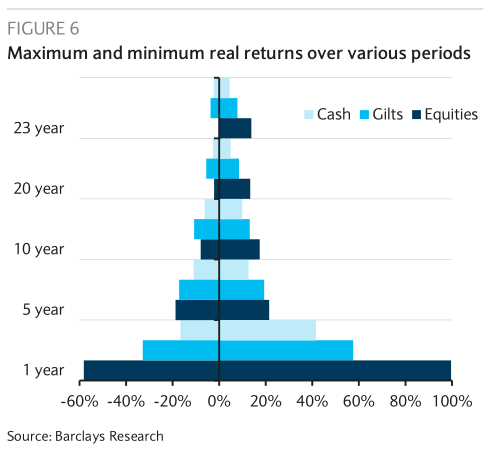
The index yields in the long term, but the situation looks different in the short term. Here’s a Barclays Research chart from 2016 on real returns of UK assets over different time horizons between 1899 and 2015.
The good news is that there is not a single 23-year period when stocks would have yielded negatively, and this is probably what is meant when it is said that stocks are a long-term investment. But let’s be honest: how many readers of this forum will sit on a red portfolio for 10 years? That’s certainly not an 8% compound interest.
I claim that very few people can actually do that without lightening their stock allocation along the way, especially if the decline is long and gradual. In a sharp crash, one might not get frustrated in the same way, and the feeling is like someone who has received shock therapy.
And I don’t believe I’m an exception; I’ve tried to internalize it before the situation is upon me. I haven’t been through a single bear market, and neither have many of those whose “most important thing is to start” hype I’ve been reading in all possible financial media for some time. While we are definitely on the right track, it’s irresponsible to (often) ignore that humans are not emotionless machines, and losing money hurts most people very badly. “Monthly saving without caring about anything, just compound interest and so on.” It’s true on paper, but reality is something else. If the average blue-collar worker watches their savings melt away by, say, 50% or more a year, and at the same time has to fear for their job, what will that do? They will probably monthly save into expense-free index funds and calmly watch every euro they save turn into tens of cents. Or they will sell at the bottom and return to the market at the next peak. And another guess: the “most important thing is to start” stories will diminish at the same rate as the index eventually comes down.
More on Mr. Index. I think it’s likely expensive. At this stage of the cycle, there must be many more companies on the stock exchange whose earnings are “at too high a level” than those whose earnings look weaker than normal. Given the prevailing conditions, that’s the only option. I don’t know if I’ll choose better by picking stocks myself (this year, at least, it has gone well so far), but the index definitely doesn’t look like an attractive option right now. At some point, it certainly will be again.
You wrote: “Still about Mr. Index. I think it’s most likely expensive.” Exactly. And that’s why Masse wrote above: “Uncle Masse will still throw a good dose into OMX25 in the next stock market crash to await the bliss of an investment savings account.” The emphasis was on the word “crash”
The crash hasn’t come yet, but Uncle Masse is constantly on alert with buying pants on and a cash pot ready. But since this isn’t entertainment and doesn’t bring excitement, you always have to put some into small, high-risk growth stories like Titanium, Gofore, and Avidly. And Mr. Heikkilä in that video just taught Sauli and us commoners that they should be held for a loooooong time. Just like Mr. Index.
It wasn’t. The emphasis was on the words “Uncle Masse”, just like in all your other writings.
Like others who constantly refer to themselves in the third person (e.g., the King of Sweden), you will continue to be right, as you have been so far. Regardless of what comes your way.
Exactly. When Uncle Masse doesn’t take investing too seriously, he often sees things more clearly than others At least through slightly rose-tinted glasses.
One has to understand Uncle Masse’s sarcastic humor a little, otherwise, these posts are not worth reading. Of course, sometimes there’s a piercing truth among them, like the difficulty of beating the Index.
Brother Verneri at least seems to understand Uncle Masse’s ramblings, as he gives a thumbs-up to almost every post. Of course, Verneri, for understandable reasons, didn’t respond to Masse’s request to tell how his own portfolio performs compared to Mr. Index :))