I’ve decided to create my own thread under macroeconomics for the discussion that has already been diligently cultivated in the Stock Market Direction thread. That is, the new normal for the economy: low inflation, aggressive stimulus, and weakening productivity.
Regarding the first topic, Helsingin Sanomat (Hesari) last weekend had a good overview of weak inflation development (under the headline “Inflation measures the economy’s pulse, but now something feels wrong.” I won’t link the article here as it’s for subscribers only). In it, the weak price development is justified by four reasons: 1) New technology and globalization (technological development pushes prices down, as does increased global competition), 2) Aging population (changes consumption habits), 3) Monetary policy constraints (the equilibrium interest rate has fallen, which limits the central bank’s ability to stimulate), and 4) Gloomy economic outlook (working-age population is shrinking, labor productivity is even weaker).
Based on this, inflation doesn’t seem to be recovering anytime soon, and monetary policy has also become increasingly ineffective. I might be repeating myself, but I would also highlight China’s role and how China’s price development is reflected in Western countries with a delay (related to increased competition) and how China has brought disinflation to Europe in recent years.
Scarcity drives up prices. For a while now, I’ve considered a few drivers significant for low inflation:
Technological development, economies of scale, and automation: The concentration of physical production in China and robotization means that the production costs of physical products are lower. Competition/globalization, in turn, leads to lower profit margins => lower consumer prices.
Change in consumption behavior in the West: I believe that materialism is declining in the West. FIRE (Financial Independence, Retire Early) and saving as phenomena, eBay/Tori (Finnish marketplace)/recycling/circular economy… In the West, people might prefer more durable products, repairing, and general thriftiness/price awareness?
More flexible labor markets: Digitalization, zero-hour contracts, lower incomes for the younger generation, etc… Leads to a situation where even if the employment rate is higher, inflationary pressure is not the same as before.
Running infrastructure to its limits: As the maintenance backlog grows, in the medium term, low investments in infrastructure also reduce inflationary pressure. However, this might cause a yo-yo effect at some point when the infrastructure breaks down?
If the situation continues like this, i.e., that the economy is primarily kept alive by monetary policy, inflationary pressure might come from the scarcity of natural resources. Arable land, the impact of climate change on harvests, the amount of clean water, etc…
On the other hand, there’s also pressure for tax increases, because Western countries have such significant public budget deficits. Rising taxes can reflect in wage levels – wages must rise for the take-home pay to remain the same.
Edit: Oh yes, and oil. Is it still a scarce resource, because large quantities of it should be left unmined due to climate concerns, while extracting it from the ground is getting cheaper through technological development? At the same time, we still produce all products with old oil-based infrastructure… The price of oil is kept low to keep it attractive. A war of attrition…
Good points, I think you’ve mentioned these! The change in the labor market is also likely affected by the structural change of the economy towards a more service-oriented direction, meaning jobs are shifting to service sectors where wage levels are lower.
The reason for low inflation in Finland: Goods are not moving.
Example: I ordered 5 one-meter iPhone charging cables from China.
The price delivered to my home was about 6 euros, delivery time about a week. (Everything works)
Aggressive stimulus is directed to the stock market, housing…
Unemployment in the EU is kept at about 10% => no wage inflation.
Productivity does improve in industrial activity (fewer workers are needed).
The increasing productivity of services does not bring added value but savings, which are also directed to things other than increasing wage inflation. Through the growth of owners’ wealth, it flows to the capital markets.
Yeah, I’m actually referring to this with the 0-hour contracts. Perhaps a slightly extreme example, but in service sectors, employees often work the hours they get/want; Wolt couriers are probably an extreme example.
Yeah, I was just at Prisma buying an RCA cable. 10€ from the shelf, when it’s 2.15€ delivered from AliExpress.
When the price difference is 80%, it’s no wonder the 2% inflation target is a bit sticky!
How uneducated and dangerous is my thought that couldn’t the economy start to collapse (or at least take a Friday bottle’s worth of a nosedive) so that zombie companies and such would be purged, and we could, in a way, start over?
Day by day, it seems more and more likely that by 2025, there will be proposals to switch to five-year plans.
Of course, the ECB certainly can’t tell anyone this, but isn’t this already quite a bit of artificial respiration for growth that has been given a resuscitation ban a long time ago?
The situation isn’t that bad yet, others (Italy, France, Spain) besides Germany have already turned upwards.
Germany’s rise could be destroyed by Trump, although it would also cause problems in the US.
Of course, the situation is challenging with Trump as an opponent.
However, growth is credible.
Competition is tough and getting tougher. Investment in education and research/development in the EU must be prioritized, using public funds. EU export companies can be granted tax breaks, like in the USA.
Let’s switch to a 6-day work week like in China. etc… The measures mentioned by the Times are politics, they won’t lead anywhere.
Yes, “creative destruction” seems to be slowing down due to current stimulus measures. A good example of indebtedness is US corporate debt, which even the Federal Reserve is warning about.
Well, yes, maybe “huge,” but it depends more on what the money is used for. If it’s used for investments, then good. If it’s for, say, share buybacks, then bad.
I have criticized Italy as a problem economy in the Eurozone, as structural reforms are not wanted due to politicking. Here is again a picture of what this has partly led to. No wonder the economic growth outlook is not very good:
What about carbon taxes/carbon offset payments as a source of inflation? Combined with tariffs and protectionism, that could be a pretty epic inflation cocktail.
An interesting report popped into my inbox. I thought I’d share it here, as there are a couple of interesting charts (exhibit 3 and 4) related to US corporate debt levels, which you can get the gist of even without reading the whole thing:
A couple of sectors have seemingly taken on a lot more debt (energy and telecom). I don’t know about the energy sector, but in telecom, there has definitely been some big shopping.
In other sectors, debt growth has been much more moderate. McKinsey’s estimate is that 75-80% of the debt is fixed-rate. This means it shouldn’t cause problems before refinancing, as the EBITDA/interest expense ratio is generally at such a good level.
What happens to Italy if the interest rate rises above 3%? Where do they get the money for the interest?
Debt 2500 billion => 75 billion/year. Who gets the interest payments?
Apologies for the delay in responding, I was on a short vacation. It’s a good question where the interest payments come from. Practically all Eurozone countries have enjoyed record-low interest rates due to monetary easing, which has given national governments the opportunity for “easy” spending increases at a low interest rate, even though the central bank’s goal was to get governments to implement more far-reaching structural reforms. In Germany, the 10-year interest rate has already turned negative, and in Italy, the 10-year rate is at 2.5%.
The central bank has thus acted as a certain guarantor in the bond market by promising to keep interest rates low, which has ensured sufficient demand for bonds even in Italy, despite a less-than-rosy economic outlook and elevated political risk. The central bank’s readiness has also reduced the likelihood that market confidence would genuinely start to waver and interest rates would skyrocket, although this is still possible, of course. The interest payments go to those who have bought the bonds: the largest owner of Italian debt is (not so surprisingly) the central bank system, which owns a fifth of the entire debt (situation at the end of 2018, source here). The banking sector is also a significant owner of bonds.
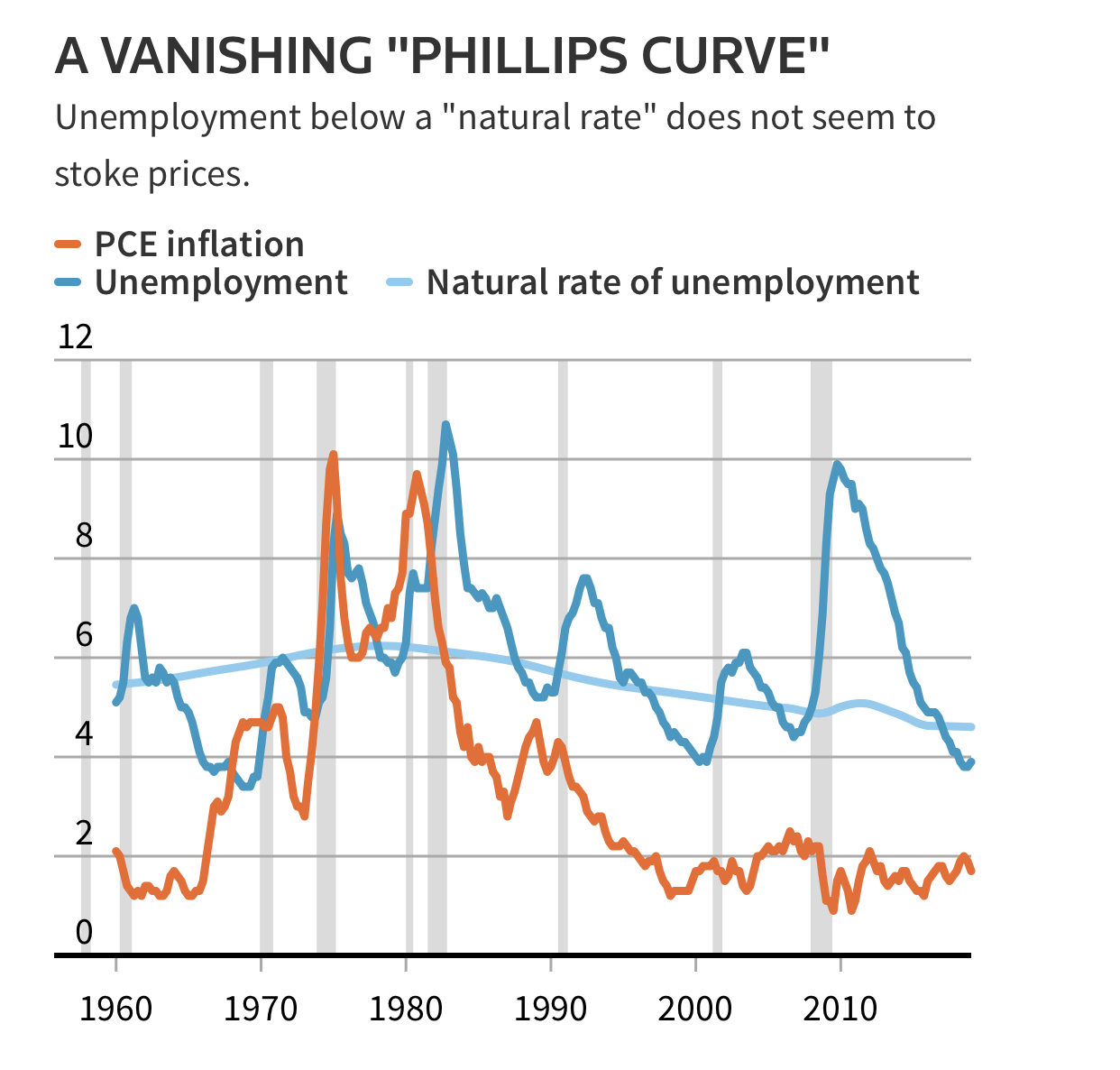
Reuters has a good article for this thread about what central bankers are now pondering regarding the relationship between inflation and unemployment. Although the unemployment rate is at a record low in the United States, many people are still “at home” not looking for work.
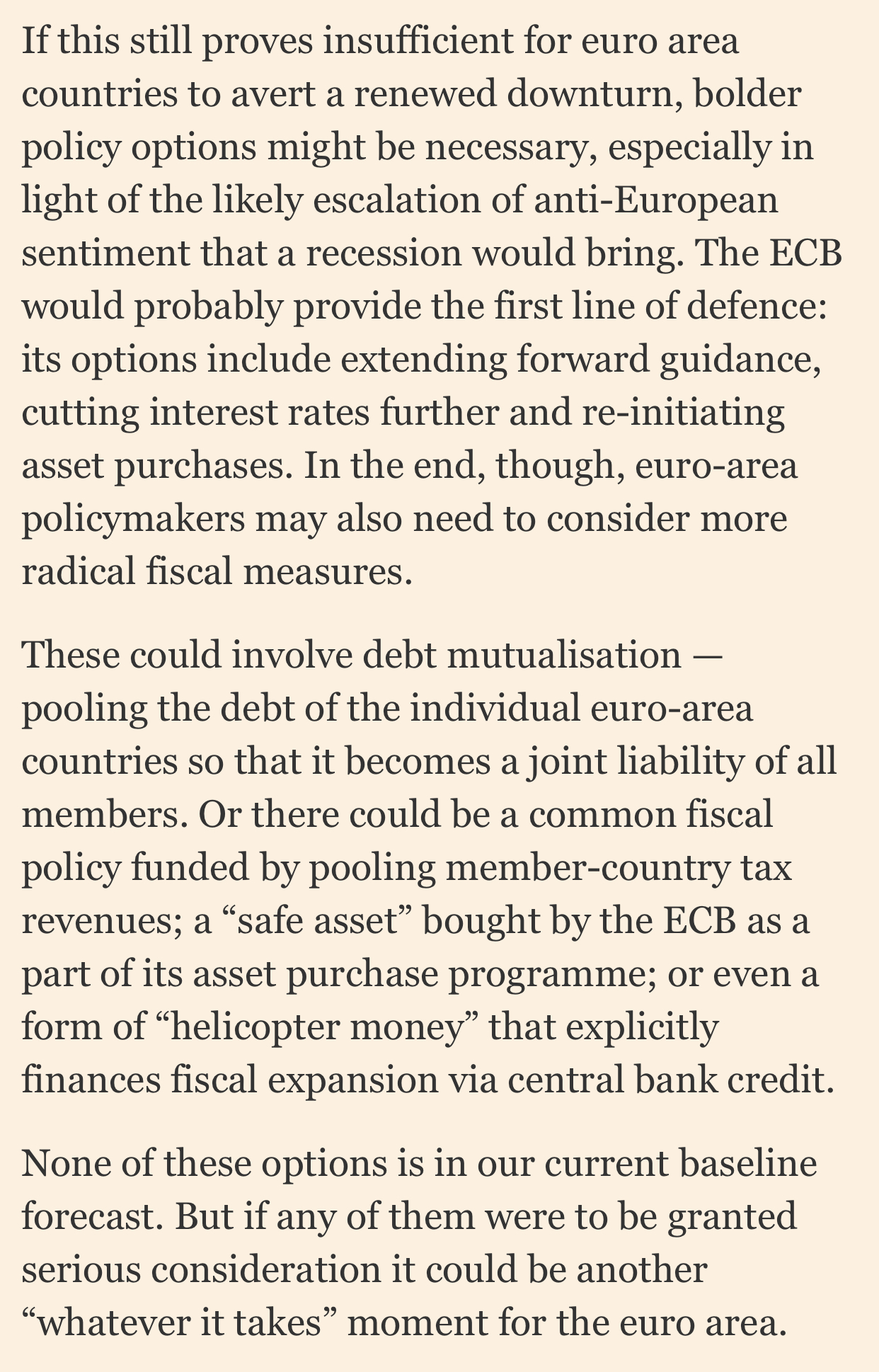

 I think this is the core message of the story:


 I recalled that there has been research on this, and I dug up a text from the archives from last year that discusses it: