To me, paying a dividend seems like a strange decision. Wouldn’t there be a better use for that money…?(granted, I am in favor of share buybacks)
13 Likes
This will turn out fine eventually, it just requires some patience. I don’t know about others, but after yesterday’s beating, the report itself looked mildly positive to my eyes; @Arttu_Heikura will probably bring me back down to earth soon :
- gross margin
- Dollarstore’s customer churn stopped, average basket size grew a notch
- paying an autumn dividend signals confidence in the future; personally, I at least appreciate a bit of cash flow, given Tokmanni’s heavy weighting in my portfolio. Of course, leverage remains at a high level; we’ll see if Arimo still believes it can be brought close to the 2.25x target level by the financial statements
One can only hope that at least part of the increased costs were one-off.
19 Likes
And a pointless comment from you, when you can’t even bother to share the actual source: Tokmanni Q3'26 -pikakommentti: Orastavia piristymisen merkkejä Dollarstoressa - Inderes
17 Likes
The biggest problem, which hasn’t seen any change in years, is large inventories, slow turnover, and a lot of obsolete stock. It seems that assortment building and purchasing are not under control. In Sweden, sales have likely come through higher selling prices and lower sales volumes—related to the harmonization of assortments
1 Like
This probably has to do with those political risks, meaning that large inventories are used to prepare for situations where freight might not move as expected.
3 Likes
Back when Rusta bought the Hong Kong chain in Finland, they made a similar change to what Tokmanni did with Dollar Store. I really didn’t feel like a customer of the Rusta that bought Hong Kong anymore, as the concept had completely changed. Now that time has passed, I’ve gradually started returning to Rusta. There are products there that I can buy. The same probably applies to Dollar Store’s customers. The initial shock—this isn’t the familiar store anymore—but as time goes on, you find things that you can very well buy. Changing this customer experience really does take time. Now it seems that the customer base is finding the new Dollar Store. I’m not saying there’s an immediate leap to better profitability, but the direction is right now.
8 Likes
It’s not necessarily the exact same customers returning there. Especially since new stores have already been opened and are constantly being opened in new locations in Denmark.
1 Like
True. When entering a virgin market, it’s obvious that it takes work to stand out. In Sweden too, they are entering new locations, so there’s no old baggage about what the store should be like, meaning a better start in these areas. Well, it’s looking good. The bottom is in—here we go.
2 Likes
My feeling is that Halloween had an exceptionally prominent presence this year in general. Maybe they didn’t want to be overshadowed by the competition in this regard?
Another point is that even if selling Halloween junk in itself doesn’t bring in much profit, could that jack-o’-lantern buyer end up buying other things as well?
3 Likes
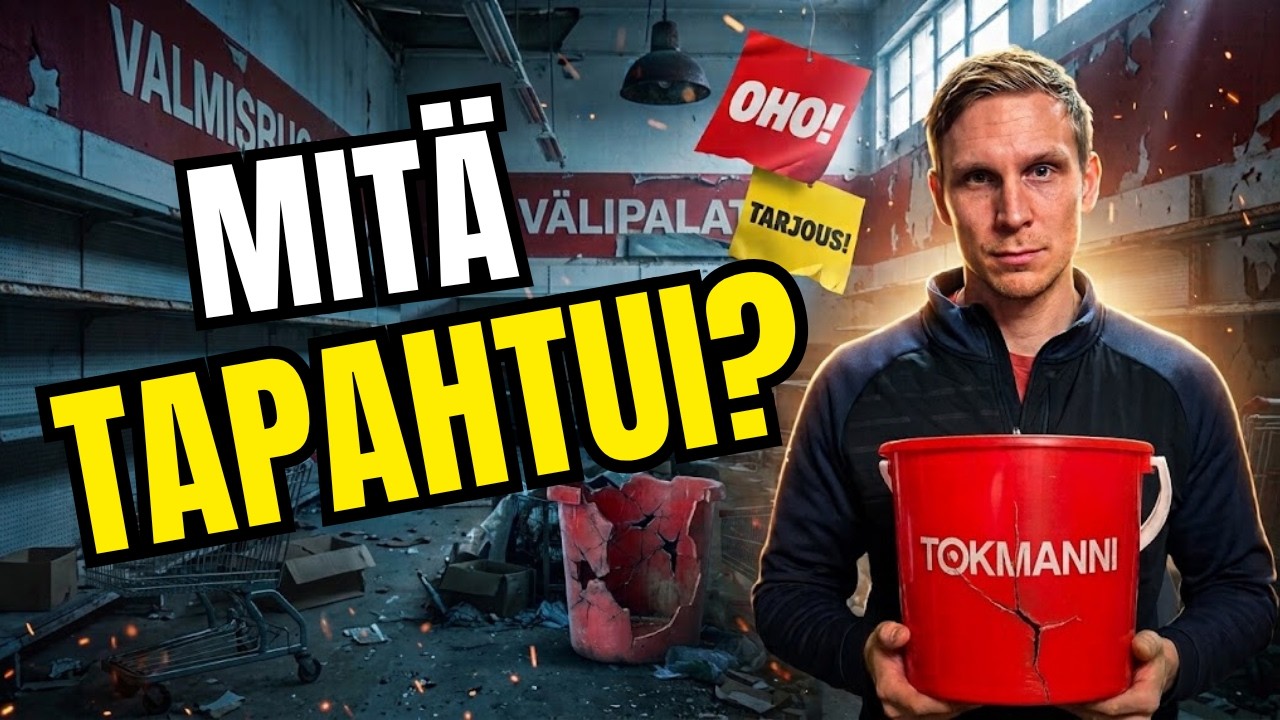
Jussi Halme has made a new video about Tokmanni 
On Thursday, Tokmanni’s stock plummeted 12%, but right on Friday, we saw a mysterious rebound back up—without a single new figure released! Is this the buying opportunity of a lifetime, or are you catching a falling knife?
In this video, I dissect Tokmanni’s Q3 results and the background behind the recent profit warning. Why is the discount retailer losing market share in Finland while Puuilo is powering ahead? Has Dollarstore become a growth engine for Tokmanni or just an expensive headache? I break down the scenarios: is Tokmanni an 80-million or a 100-million earnings machine—and what does that mean for the stock’s value right now?
8 Likes
There were indeed new figures. Dollarstore’s numbers were not presented in the profit warning. In my opinion, Dollarstore’s figures were a small silver lining, and therefore the drop on the profit warning day was an overreaction.
Was there no interview obtained with Päällysaho?
6 Likes
Doesn’t look like Tokmanni’s communication style changed with the new CEO either; after all, back in the day, an interview was only secured with Rautiainen in connection with the launch of the SPAR partnership. A couple of years ago, I suggested all sorts of things to Tokmanni’s IR, but not a single reform I hoped for has been implemented. My wishlist included, among other things, publishing monthly sales figures between quarterly reports, precisely these CEO earnings interviews, transcripts, and offering the webcast in Finnish—or if they’d at least enable English subtitles for those earnings call recordings. Of course, I understand that management has its hands full trying to engineer a turnaround, but you’d think that a company with nearly 50,000 shareholders would try to serve investors at least a little bit better.
23 Likes
Arttu has written a new company report on Tokmanni following the company’s Q3 results
Tokmanni’s Q3 earnings fell short of our expectations as slowed domestic demand weighed on the Tokmanni segment’s result. Dollarstore’s metrics developed encouragingly, but the turnaround is in its early stages and its sustainability remains difficult to predict. We lowered our earnings forecast for the current year, but changes made to forecasts for the coming years were moderate. In our view, the expected return on the stock remains narrow. We reiterate our Reduce recommendation and EUR 7.0 target price.
5 Likes
Caution among other analysts as well, from Kauppalehti’s flash news:
Tokmanni’s target price lowered to 6.90 euros from 7.10 euros at DNB Carnegie, hold recommendation reiterated
Tokmanni’s target price lowered to 7.40 euros from 7.50 euros at SEB, hold recommendation reiterated
Päällysaho on Kauppalehti’s Economy Morning broadcast starting at 09:30 (the broadcast starts then, our part of interest isn’t necessarily right at the beginning, ed. note): Kuluttajien käytös iski Tokmanniin, Oulusta pusketaan himoittua tavaraa kuumalle sektorille – Katso Talousaamu kello 9.30 | Kauppalehti
6 Likes
Faith in direct imports and private labels was also what eventually brought down the Hong Kong chain back in the day. Even though private labels have better margins than so-called brand-name products, large inventory values eat away at the advantage and increase risk. Puuilo has a smarter approach: they always offer a brand-name product even if they have their own product in that category. After all, the brand-name product can be sourced from the importer’s warehouse in small batches according to demand.
2 Likes
I would see that the Hong Kong chain collapsed because it was way too small of a player. It was in no way able to achieve economies of scale compared to other chains. Tokmanni is in a completely different size class and is thus able to negotiate its private label products with a totally different level of leverage.
6 Likes
Only today did I have time to take a look at the webcast with Päällysaho and Arimo. Right off the bat, I have to admit I chuckled a bit: the new CEO is talking about his “first own quarter,” and barely 1 minute and 50 seconds into the webcast, we get the legendary “this season the weather…”. Consultants know there are always two categories of bosses: the “weather excuse makers” and the “doers.” It’s funny how for some, their own success is behind the good times, while nasty weather always ruins the execution of a good strategy. And funny how others manage to succeed whatever the weather…
In my opinion, Maria Wickström asked a very sharp question right at the beginning of the earnings call: how could the weak October sales in Finland and Sweden—which caused the profit warning—be due to weak consumer confidence, when a competitor is delivering, among other things, +13% organic growth with the exact same consumers? A genuine competitive advantage works in all environments.
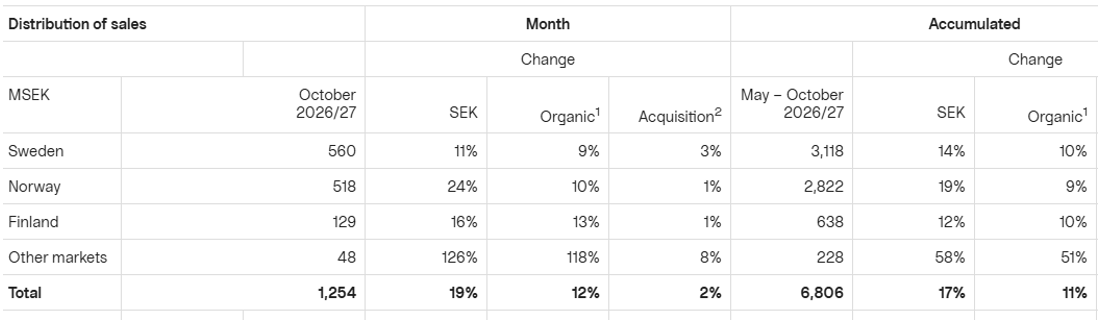
Kudos to Mr. Tokmanni!
There were plenty of good things too, to be fair.
- The margin improved in both segments nonetheless, and at the same time when sales are leaning more heavily toward groceries.
- Dollarstore’s like-for-like sales growth, mentioned here many times, is very important news.
- Sourcing cooperation has progressed. Even though I believe expanding Dollarstore’s assortment is fundamentally risky, doing joint purchasing makes sense regardless. Expanding the assortment always reduces those famous purchasing volumes. That has a surprisingly big impact when, for example, Rusta—which is smaller than Tokmanni—makes purchases from China at an average of €200k/product (€1.2B for ~6,000 SKUs). And when Mr. Tokmanni goes on his famous sourcing trips, the purchasing contracts are only €85k/product (€1.7B for ~20,000 SKUs).
Still Risky
- Customer cost in the Tokmanni segment. Gross margin +2.6% and customer transactions +2%, but operating expenses per transaction +4.6%.
- The asymmetric guidance revision? The midpoint of the revenue guidance dropped -0.8%, but the EBIT guidance dropped -13.2%. The imbalance makes you wonder.
- Validation of BIG strategic choices is still missing? The financial impact of Eurospar remains completely shrouded in mystery. What are the key results of the Eurospar conversions per store? There has been very vague talk (and in my view, very weak growth) of “double-digit growth” after a store is converted into a Eurospar. What is the average investment required? How do store operating expenses change when converting into a grocery store? What about the impact on waste and margin? How does the change affect store-level cash flow, and what is the payback period on the investment? For how many customers does Eurospar become the primary store? What are Eurospar’s most important customer segments and their visit frequency? Who are they competing against—are they stealing customers from S Group, Lidl, or Kesko? Or is Eurospar just an occasional convenience grocery store? → I find it incredible how little verified evidence they had before entering the grocery business. Or have they even genuinely entered it? They’ve been testing this for nearly two years now! Is grocery going to become a sustainable competitive advantage or not? For owners, this half-baked dabbling is the most dangerous thing. Either kill the Eurospar idea or roll it out chain-wide into a genuinely competitive grocery store chain.
- Domestic competition has only just begun to heat up. Competitors will open at least 30 rival stores over the next couple of years. Competitors’ fairly massive investments cannot fail to impact the Tokmanni segment. The most important strategic question is: how will they react to this? Tokmanni - Mahdollisuuksien valintatalo? - #4089 käyttäjältä peruspiensijoittaja
- Risks posed by competition in Denmark and Sweden. The investor role models I respect think much more than average about market shifts and economic moats. In other words, I don’t think Dollarstore’s biggest risk is Rusta, Jula, Ö&B, or even Puuilo expanding into Sweden. It is the transformation of the discount retail market! In fact, Action, which was highlighted in this excellent video by @Arttu_Heikura and Arhi, is that very transformation (and what AI flagged as the biggest risk for Tokmanni for me). https://youtu.be/1hnjSsi-BfU?si=rka1picI3d6lHJth
- Action: So, the AI crunched Tokmanni’s earnings, market, and competitive landscape for an hour and overwhelmingly highlighted Action’s expansion as Tokmanni’s biggest risk. It ran a pretty interesting analysis. There was a lot of analysis and numbers, but here are a few interesting takeaways for a retail investor: Probabilities and timelines for Action’s next 4 new markets. Bulgaria 95% in 2027–2028. United States 90–95% in 2028. Hungary 75–85% in 2028–2029, and Denmark 70–80% in 2029. The analysis reviewed, among other things, local entities established in said markets, announced partnerships, logistics infrastructure of central warehouses, market size, market attractiveness/competition, central/regional organization readiness, etc… There’s already quite a bit of Action data and analytics available from Nielsen, UBS, S&P, Euromonitor, and JP Morgan. So when a brand-new and (wow!!!) “quite” capable AI determined Denmark to be an excellent fit and highly likely for Action’s expansion strategy—it’s probably on Action’s (consultants’) PowerPoints as well. The analysis got particularly fascinating when I saw the bots crunching, based on historical expansion analyses, how and from whom Action would take market share. In the Netherlands: 41% (2020) → 54% (2025), and in the Czech Republic: 2% (2020) → 49% (2025) in the “general merchandising stores” category. In France, for example, Action managed to capture a 7.6% market share in the cleaning, laundry, hygiene, and personal care category within a few years. And can you guess which retail chain the AI ranked among the top 2 victims of Action’s market penetration in Denmark?.. Big Dollar!! In the base scenario, Action’s market potential in Denmark is €520M, and in the extended scenario €780M (by the way, in Sweden, Action’s base scenario is €1,320M). Pretty impressive, well-reasoned analyses, the conclusion of which is that in the base scenario, an established Action would snatch 25–30% of Big Dollar’s sales in Denmark. And in an aggressive scenario, up to 40% is at risk.
Ten years ago, Action was about the size of Tokmanni, by the way. And even though revenue growth has slowed to “only” +16%, with its current €16B revenue and expansion strategy, it is a formidable purchasing competitor for Mr. Tokmanni. While Mr. Tokmanni struts around as a tough negotiator securing those €85k/product purchases (€1.7B for ~20,000 SKUs), these new rival guys are placing €2.7M/product orders…
I had to read that analysis twice, and it got me thinking. Could the most important strategic questions for Tokmanni’s investor story at CMD actually be:
A) Will the SPAR chain be wound down? (Because genuinely taking on Lidl/S Group/Kesko…)
B) Can Big Dollar / Dollarstore be sold to someone before Action’s local entity shows up in Denmark’s CVR? After all, it’s only a 20-minute drive across the Øresund Bridge to Sweden…
7 Likes