A new company is coming to be traded. A positive thing at a quick glance is that no one is selling at this point.
A new company is coming to be traded. A positive thing at a quick glance is that no one is selling at this point.
The company page has also been published, so you can follow the company here!  Toivo Group - osake - Inderes
Could that valuation be accurate, and where are the EPRA figures? Operating profit is large, but apparently it consists of changes in property values. Of course, they develop their own housing stock, but as far as I understand, many others do too, for example, US REIT companies.
Asko will surely have to consider the signaling effect when the time comes to lighten his position. It might have a slightly bigger impact on the share price 
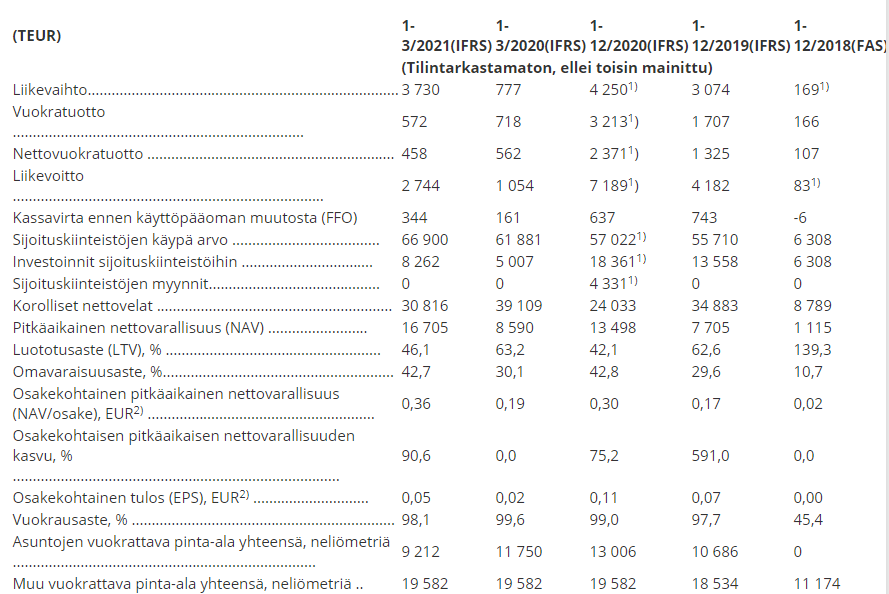
Net asset value per share €0.36 / share
Subscription price per share €2.10 / share

There might be a slight reputational damage; a few key figures were at Lehto building growth, and challenges were left behind. On the other hand, they knew how to disengage at the right time, meaning they still saw the company’s situation.
One learns from mistakes?
Cheat me once, shame on you. Cheat me twice, shame on me?
However, at least in Alexandria’s chain, the company has received all sorts of greater criticism, and that wasn’t a problem in the pursuit of quick profits.
In this case, the 15 MEUR issue, of which anchor investors have committed to subscribe 7 MEUR, is, of course, somewhat large.
Is the CEO the Chairman of the Board’s son?
I wouldn’t put too much weight on this. I hope the founders of Toivo have experience in how to sell shares while the company is gaining momentum.
https://www.is.fi/taloussanomat/porssiuutiset/art-200000523533.html
The share price for the shares sold was 11.60 euros, and the gross proceeds from the sale were approximately 57.7 million euros.
Currently, Lehto’s shares can be bought for 1.65 euros each, although the number of shares has increased with the offering.
Of course, it’s also possible that these founders of Toivo genuinely disagreed with the direction of Lehto’s business and therefore sold their shares and founded a new company. Google finds an article by Henri Elo on the topic from a year and a half ago:
The Myllymäkis and Koivukoski sold most of their ownership in Lehto in early 2018 and gradually withdrew from the company. Asko Myllymäki was one of the founders of the rapidly growing company, along with Lehto’s main owner, Hannu Lehto, but as often happens, they had differences in opinion regarding the company’s development.
Asko Myllymäki wanted to get into the balance sheet business, and now he is in such a business with Toivo, which is good.
Toivo’s concept itself seems sensible. When the entire value chain is controlled by the same operator, the interest would presumably be to build a building that lasts as long as possible.
So, from a quick glance at the announcement:
the subscription price is a maximum of 2.10 euros per share (which corresponds to a market capitalization of approximately 111 million euros after the funds from the IPO)
fair value of investment properties approximately 57 million euros.
IPO gross proceeds approximately 15 million euros,
So, the value of current properties + IPO funds: 57 + 11 = 68M€, but it’s valued at 111M€, meaning over a 60% premium.
I’ll pass. It would truly require quite a magical recipe for properties to be worth paying so much over their valuation. Please correct me if there was something completely wrong in this quick back-of-the-napkin calculation. I haven’t really invested in real estate investment companies because changes in property valuations are such a big element, and that’s accounting voodoo that I don’t understand.
That fair value of 57 million for investment properties was from the end of the year. At the end of Q1/2021, the fair value appears to have been 66.9 million (though that too is well below the IPO price).
At least the CEO was good at storytelling in the Inderes interview  We might get some interesting quarterly interviews…

One could also ask how the value of the properties increased by approximately 17% in one quarter just before the listing announcement…  (and even with those figures, the premium would still be >40%)
(they might have invested more money in new properties, I really don’t know as I didn’t scrutinize it further)
If I looked at the announcement correctly, the fair value of investment properties would have been €61.9 million in Q1 2020, meaning it has decreased by the end of the year. Apparently, properties have been sold in the meantime.
Toivo develops and constructs its properties itself, so when a building is completed, its value is significantly higher than the construction costs.
In addition, when valuing the company, one should consider how the company can invest the IPO funds. The CEO stated in an interview that their current land portfolio allows for the construction of 1400 apartments. So, there is a fairly direct use for the IPO funds already identified.
I haven’t looked at it in much depth myself, but I also noticed that rental income and the total floor area of the apartments have clearly decreased from a year ago (even though apartment sales in 2020 seemed to be only 4 million, so how would the floor areas decrease so much), while fair values have only increased. I guess they’ve somehow manipulated the numbers a bit higher. Well, hopefully, Inderes will start covering it, so we could at least somewhat trust their estimates of the figures.
At least for me, the Toivo table on Inderes’ pages is not displayed correctly. Below are links to the company’s own press release and its own pages.
Indeed, the announced subscription price of EUR 2.10 and the EPRA NAV of EUR 0.36/share are in a different sync compared to many other real estate companies, which often have some kind of (20-30%) EPRA NAV discount, or in Kojamo’s case, it seems to be a small premium. EPRA NAV takes into account assets and liabilities.
I wonder if anyone understands what this EPRA NAV story is in all its distinctiveness? Toivo, however, states that it has received subscription commitments of EUR 7 million from well-known and independent parties.
Aurator Varainhoito Oy, Evli-Rahastoyhtiö Oy, certain funds managed by Sp-Rahastoyhtiö Oy, and certain funds managed by Taaleri Rahastoyhtiö Oy (“Anchor Investors”) have, under certain conditions, committed to participate in the IPO and subscribe for shares totaling 7 million euros at the final subscription price, provided that the subscription price per share is no more than 2.10 euros per share (which corresponds to a market value of approximately 111 million euros after the proceeds from the IPO).
The financial press has created flamboyant headlines for Toivo. At least the company is getting the desired visibility.
Kauppalehti: “The most significant earnings engine is rental cash flow.” Toivo Group eliminates “all intermediaries eating up cash flow.”
KL: The sale of Lehto’s shares gave birth to Toivo.
Arvopaperi’s headline states that the company will revolutionize the entire industry’s value chain 
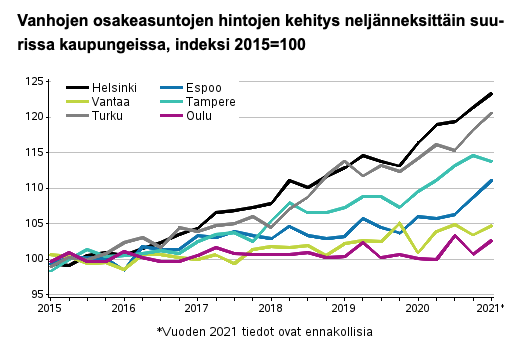
HS highlights “attractive micro-locations.” In practice, 98 percent of Toivo’s apartments are located in the Helsinki, Tampere, and Turku regions.
An article in Rakennuslehti reminds us, among other things, that Markus Myllymäki led Lehto’s residential construction for 7 years.
A Buildertalk episode published a week ago, featuring Toivo Group’s CEO, discussed new-era property development.

In many contexts, the recent sales of Toivo’s (Hope’s) key personnel in Lehto are now brought up as a negative. I myself was on the buying side after these sales in Lehto and made substantial losses, but I still can’t see this as an absolute barrier to investing in this company. In the critics’ opinion, what should have been done? Refuse to sell and stay on as management, even though they disagreed with Lehto’s development direction?
In my opinion, it is entirely justified in such a situation to sell one’s holdings and leave the company. Now, with the money from Lehto, a new company has been founded, where, hopefully, with the lessons learned from Lehto, business can be conducted in a more sensible way. At least in the InderesTV CEO’s interview, it was emphasized that one must identify one’s strengths (housing) and not even try to build Redi or Tripla or similar projects.
I quickly looked at Toivo’s press release. Since the company also engages in real estate development and management, and not just property ownership (rental income), the company’s valuation cannot be based solely on NAV. For example, the profit from real estate development, i.e., the development margin, must also be valued, as it is part of its ongoing operations. So far, it has also been profitable.
A somewhat similar situation once applied to Hoivatilat (Care Facilities), which, in addition to stable rental income from care properties, generated good profits from development margins (and also traded at >1.5 P/EPRA NAV). Hoivatilat was partly responsible for the development of care properties themselves, thus capturing a larger share of the value chain compared to a pure property owner/investor.
Exactly, especially when, according to the company, they already have a portfolio of 1400 apartments in the pipeline, making the current EPRA NAV a rather irrelevant figure. It would be good to know if these pipeline projects are also located in the Helsinki metropolitan area/Turku/Tampere triangle. If so, the company’s housing portfolio will become truly attractive for long-term moderate value appreciation, and rapid value appreciation during construction is also realistic and not just “Excel money” (i.e., houses/apartments can indeed be sold in these areas).
This is a rather interesting company. For me, the strong background in Lehto and the timely exit from there appears as a positive thing, lending credibility to the idea that a rental company would also genuinely know how to build houses sensibly. Regarding Lehto, it’s important to remember that many things were done right in the company until almost all the good was wiped away by excessive growth and risk-taking.
Toivo’s valuation is indeed a bit challenging to estimate precisely because a large portion of the projects are still on the drawing board, so we will wait for the listing prospectus.
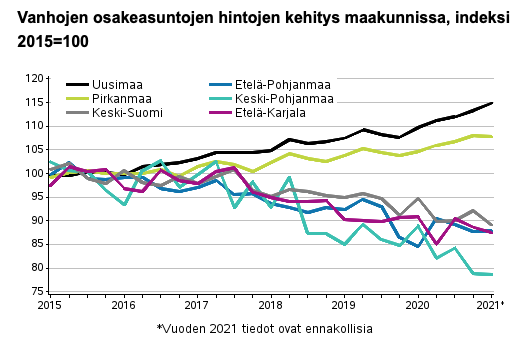
They are sold, but with development looking like this, I for one am positive if we stick to the largest growth centers.
I personally believe that these apartments in small towns, which provide good rental income, are terrible value traps. Good rental income doesn’t help much if the value of the apartment is constantly decreasing (and in part, good rental income is precisely explained by the fact that the apartment’s value is decreasing, so the rental income percentage does indeed increase).