Are you saving for the US stock market? Good – and you should continue to do so

Hi,

Are you saving for the US stock market? Good – and you should continue to do so. I’ve been thinking that investing in the United States has been extremely profitable for virtually the entire last century – and for good reason → https://x.com/JuhaHaanpera/status/1907373982459822441. The USA is the world’s largest, strongest, and most diverse economy. Its companies dominate global markets in a way that no other country can match. But what now that Trump is back in power? Will he ruin this success story?

Trump’s second term – a threat or just background noise? Donald Trump’s politics are characterized by MAGA/America First thinking, which can seem worrying from both an economic and foreign policy perspective. Uncertainty grows, trade wars could escalate, and the USA’s international standing might waver. But no matter what happens in politics, economic fundamentals don’t change overnight. US stock markets have experienced crises before. The financial crisis, the dot-com bubble, the coronavirus pandemic – but they have always recovered and continued to grow. The reason is a simple fact: American companies rule the world.

The USA is still the investor’s best playing field. Imagine your daily life without American companies. No Google, no Apple, no Microsoft, no Netflix or Disney+. No McDonald’s, Coca-Cola, or Starbucks. No social media or cloud services. While some of these things are not purely positive, such as sustainable development, they are here nonetheless – and stronger than ever. In many industries, the world has become a winner-takes-it-all market, where American companies have conquered their sectors one by one. They have no competitors, and they are deeply rooted in the daily lives of both consumers and businesses.

But what about Trump? Can he ruin everything? Yes, Trump is likely the most corrupt president in US history read more → Arvaat varmaan, kuka on Yhdysvaltain historian korruptoitunein presidentti | Kauppalehti, and his America First stance brings uncertainty to the economy. Foreign policy is more entangled than in years, and Republican economic policies could cause short-term turmoil. But in the long run, this has little significance for investors. The largest US companies will continue their success regardless of who sits in the White House. The economic system is built so that political fluctuations do not halt corporate growth.

Market downturns are a poor saver’s friend. The biggest mistake right now would be to stop investing in the USA or to sell off US funds. Stock markets move in cycles, and downturns offer the best opportunity to increase holdings at a lower price. The compound interest effect only works if saving is continued consistently in both bull and bear markets. When US stock indices fall, a monthly investor gets more index units for the same amount of money. This means better long-term returns.

Historically, US stock markets have performed better than others, and their position as a global power is unlikely to change in the coming decades. Therefore, I consider it sensible for the US weighting in a portfolio to be 50–70%, now and in the future. Politics come and go. But the companies that rule the world are here to stay :rocket:

17 Likes

As I am just a young man a little over 20 years old, whose investment horizon is (hopefully) at least 50 years, these Trump-Putin moments don’t faze me at all. On the contrary, they offer a good buying opportunity, and every big dip is a step towards my wealth accumulation. If someone boycotts the United States through index funds/ETFs, so be it; I won’t do that myself. I do, of course, boycott US stocks, but I don’t really make many direct stock picks, so the impact is small.

8 Likes

Maybe, maybe not. History is no guarantee of the future, and market fortunes have varied before.

You only have to go back 15 years, and the US market was considered a relatively dead case. :smiley:

Screenshot 2025-04-02 at 15.18.35

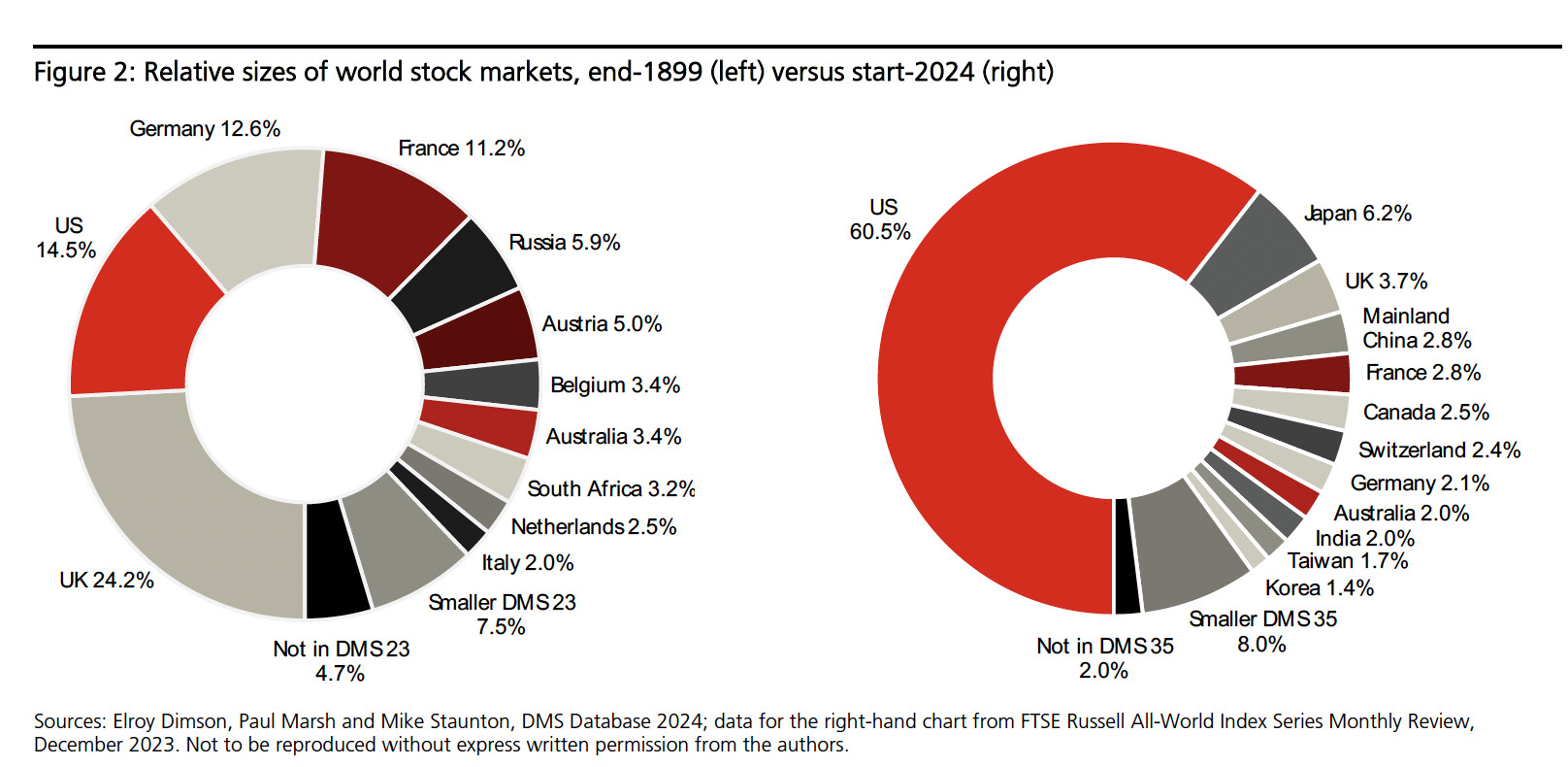
Long-term stock market returns are also skewed by survivorship bias. The United States has had good luck. The Russian stock exchange was also promising in the early 1900s, China in the early 2000s, etc… And it’s not even the best stock exchange. Australia and South Africa seem to have been even better. :smiley:

40 Likes

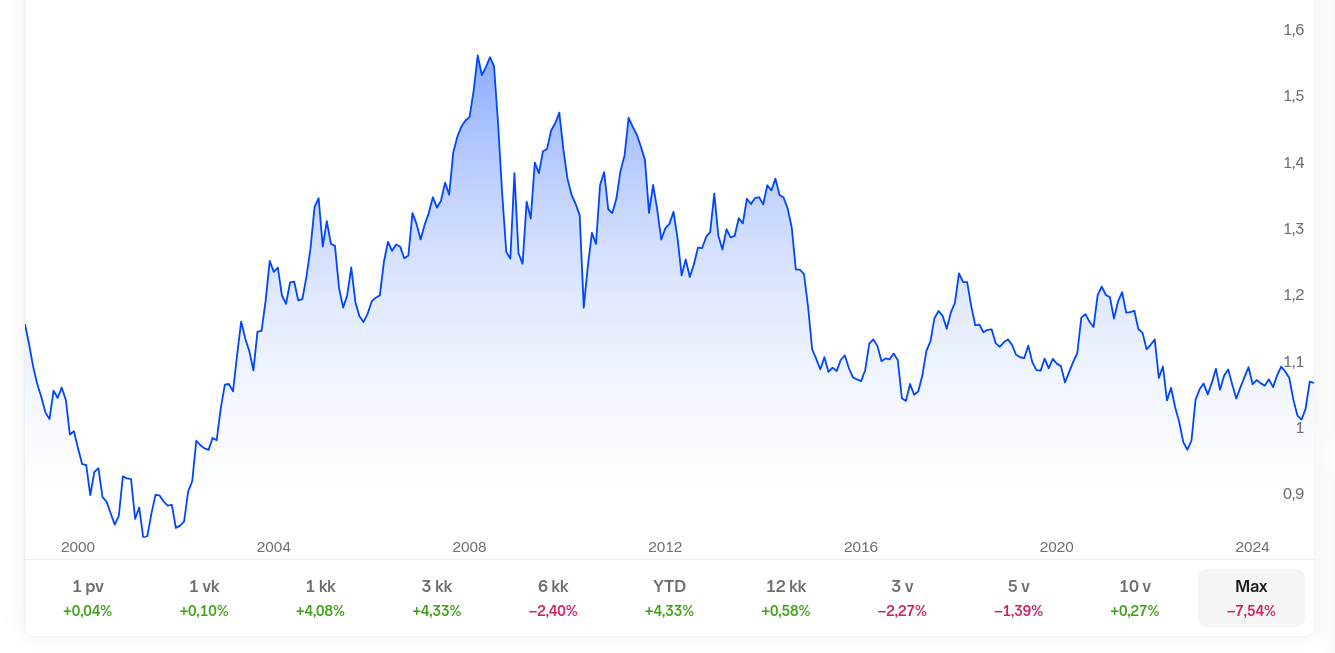
How do you view currency risk? There has been discussion that if the US turns inward, the dollar could lose its position and weaken. And that this would benefit the reduction of massive national debt through inflation. I myself cannot assess how big a risk this is, but at least there is discussion about it. E.g., in the following link https://www.dw.com/en/mar-a-lago-accord-is-donald-trump-deliberately-tryomg-tp-weaken-us-dollar/a-71972325

I still remember the times in 2014 when EUR/USD was ~1.4. Back then, it felt sensible to buy stocks denominated in dollars. Now, the euro and dollar have been quite close to each other.

Currently, the US market does not interest me for a few reasons

  • the current administration is greatly stirring up the old order, and it does not inspire confidence
  • indices are high (this is much more concerning when the administration has become unpredictable)
  • will the dollar’s future be favorable for a euro investor (when we are this close to parity and the administration’s actions could weaken the dollar)

It is true that from a decades-long perspective, everything can change many times over.

EURUSD

image

17 Likes

Quite an optimistic viewpoint. I agree that a long-term (index) investor will survive this storm too. The question of American tech giants remaining relevant probably requires defining a time window for consideration. The next 5-10 years? They will probably still be on top. The situation might be completely different in 20-30 years.

I must say that as a novice investor, the recent stock market fluctuations cause nervousness. I myself plan to stick to my investment strategy and tough it out through these difficult times😁.

5 Likes

President Donald Trump’s decision to impose 20 percent tariffs on EU countries is, in my opinion, an extremely reckless and dangerous move. This measure not only increases tensions in international trade but also threatens to push the global economy into recession.

Why do tariffs lead to trade wars and recession? Imposing tariffs often leads to retaliatory measures. The EU has already announced it is preparing countermeasures to the US tariff decision. This “eye for an eye” mentality can easily escalate into a full-blown trade war, where both parties suffer.

As a result of a trade war:

  • Consumer prices rise: Tariffs increase the cost of imported goods, which is directly passed on to consumer prices. For example, in the United States, it is estimated that tariffs could raise consumer prices by up to 2.5%.

  • Business costs increase: Many companies are dependent on imported components. Tariffs raise the prices of these components, which weakens companies’ competitiveness and can lead to job losses.

  • Reduced investments: Uncertainty in trade policy causes companies to postpone their investments, which slows down economic growth.

Together, these factors can lead to a global recession. According to financial newspapers, Trump’s tariffs add pressure to an already vulnerable global economy.

Impact on stock markets? Stock markets react sensitively to political changes and economic uncertainties. Trump’s tariff decision has already caused stock prices to fall. For example, the Wall Street Journal reported that stock futures plummeted after the tariffs were announced.
In the short term, markets are likely to continue their decline as investors price in the risks of a trade war. In the long term, a prolonged trade war can weaken corporate earnings, reduce dividends, and lead to a broader market downturn.

Short-term and long-term effects? Consumer price increases, rising business costs, and increased market volatility will occur. This can lead to reduced consumption and postponed investments.

In the long term? A prolonged trade war can weaken global trade relations, reduce economic growth, and increase unemployment. Furthermore, it can lead to permanent changes in international production chains as companies seek alternatives to tariffs.

Conclusion? Trump’s decision to impose tariffs on EU countries is short-sighted and dangerous. It not only increases tensions in international trade but also threatens global economic growth and stability. Hopefully, diplomacy and negotiations can still prevent the outbreak of a full-blown trade war.

I am already looking forward to the next Vernerin Vartti, where we will surely get a better analysis and understanding of the tariffs and trade war initiated by the unstable and unpredictable Trump :slightly_smiling_face: The episodes can be conveniently found here → https://www.youtube.com/playlist?list=PLyaj31tIl1ot-8vERIeGBwDhmiIcLJzUt

Trumpin tullipäätös: 20 prosentin tulli EU:lle | Kauppalehti & Trump määräsi EU-maille 20 prosentin tullit – Asiantuntija: ”Merkittävä isku viennille” | HS.fi

9 Likes

It just came to mind while following the stock market crash that Warren Buffett had a whopping 334 billion dollars in cash at Berkshire Hathaway at the turn of the year. In February, he was even criticized for not making bigger moves. Now the situation looks like he no longer has to defend anything. The old pro seems to have succeeded once again.

10 Likes

To be precise, in the US, stock prices collapsed in late summer and autumn of 1929 so drastically that 7/8 of their value melted away by 1932, and the index only returned to its starting level in 1954.

1 Like