Raspberry Pi - The Little Giant of Computers

The favorite product of many home coders and electronics enthusiasts has found its way to the London Stock Exchange this summer. I thought I’d create a dedicated thread for Raspberry Pi in case there are other eager followers of the company here. Inspired by the pitching thread, I’ll boldly start by explaining what the company is all about!

Over the past ten years, Raspberry Pi has become known as a manufacturer of single-board computers, whose original and still largely valid mission is to teach new generations to program by providing very affordable computers for anyone who wants them. For this noble purpose, the company, which grew out of a Cambridge computer lab, has designed an ever-improving range of these small machines (Single Board Computer, SBC) that, on the one hand, function as full-fledged Linux-based programming platforms while being easy enough to use for learning purposes – all for just a few tens. The idea is for children to learn to code with adult toys, and best of all, they would have some kind of similar “DIY magic” as the ZX Spectrums of ancient times. Something clearly caught fire, as demand skyrocketed, and since then, enthusiastic hobbyists around the world have applied Raspberry Pi machines to their own purposes, from homemade video or data servers to retro gaming machines, firewalls, and robot projects, and the trend shows no signs of slowing down. Subsequently, the low price, modular and open design, and flexible software options have attracted more users in industrial automation as well. When a job needs to be done cheaply and quickly, it seems surprisingly easy to pick up a Raspberry Pi for under a hundred from a store and code the little device to record, measure, or listen, and then quickly calculate, adjust, display, or report. These ‘raspberry pies’ don’t consume much electricity either, so in addition to the incredible MacGyver-esque feeling, there are also some rational reasons for using these chips.

Now, however, to the horror of purists, the company has listed on the capitalist-owned stock exchange and intends to continue its growing business with investors’ money. The main owners will remain the charitable foundation Raspberry Pi Foundation (with a 49% stake after the IPO) and Sony Semiconductor Solutions Corporation, from whose factory in Wales most of the ‘raspberry pies’ still seem to emerge, as far as I understand.

But surely these aren’t just made for geeks tinkering in their basements? No, they’re also made for geeks tinkering in the basements of workplaces. The company’s future visions are haunted by the cyberpunk-esque idea of edge computing and the often-associated hazy visions of an interconnected space of IoT devices constantly chatting with each other. Such hallucinations are easy to achieve, for example, if one considers heavy computing concentrated in large data centers (or “the cloud”), where some kind of AI application might be running and growling. However, because the application is a bit slow, clunky, and distant, to be responsive, it needs small machine companions placed here with us, ready to respond as soon as you think of something to ask. Ones that know exactly how many carrots are in your fridge and how many you need to get through the night (optimizing the carrot distribution network, on the other hand, could still belong to the cloud monster). The edge computing shaman sees such devices in their dreams everywhere in society: they fill your home, drive your car, balance your electricity consumption, monitor your factories, and chirp on your workplace walls, keeping coffee-making robots in check and under the Lord’s rebuke. According to all sorts of estimates, the market is growing so fast that galaxies are just exploding, and Earth will soon not be enough. Couldn’t some of these gadgets have “Raspberry Pi” written on their sides, since it sounds so cute?

Raspberry Pi Holdings thus actually has two businesses: one, more mature, aimed at students, hobbyists, and DIY enthusiasts, and another, faster-growing one, targeted at industrial solutions. RasPi can also offer its familiar circuit board for direct use as part of other consumer products where durability requirements are lower than in industry. In the latter, it is potentially helped by a lower price than competitors, a familiar brand, good software and accessory offerings, and a large and enthusiastic user community.

But does this outfit even make a profit? Well, it does. The company’s market capitalization is approximately $970 million, and last year’s profit was about $32 million, so the P/E ratio is roughly 31 and P/B is 6. Revenue has grown rapidly in recent years (2021: $140M, 2022: $187M, 2023: $265M), with gross margin fluctuating between 23-30%. The company has no debt, and there is $42M in cash on hand. So, this is no longer quite a startup-level company, but the current price still relies heavily on growth, among the options for which a more lucrative business would certainly be to get Raspberry Pis into professional use. The company is interesting in that it already has a strong consumer brand, whose mere name brings to mind great evenings in a dark basement for DIY geeks, and in addition, its expansion from classrooms to startups and mass production is already well underway.

A large part of Raspberry Pi’s appeal has always come from a very simple idea: regardless of age and skill, a coder only needs a general-purpose computer, a pinch of determination, and a good heap of imagination. Raspberry Pi provides the first for a few tens, and the rest is entirely up to you. Even up to mass production.

50 Likes

Yes, these Raspberries have been used for real work for quite a while now; at my previous job, all the testers (and a few other things) were built around the device. It’s an affordable and good piece of kit, and the sky’s the limit for what they can be used for. I’ll have to put this on my watchlist to see if I should put a few pennies into it.. :+1:

2 Likes

I’ll continue providing some background on this case and reflect on what factors lie behind Raspberry Pi’s success. Feel free to counter! These visions are otherwise turning out quite positive.

Raspberry Pi’s core mission is to bring a general-purpose computer within reach of absolutely everyone. In the smartphone era, people have almost forgotten why the computer revolutionized the world: each of us already lives in a technology bubble where someone else has programmed, packaged, and defined what you are allowed to do with your device. A few years ago, it was imagined that children would become “digital natives” by using social media, but the opposite happened, and some now struggle even with using Windows File Explorer. Even computer games moved to consoles, and the PC and Mac have remained the last of the Mohicans, where it is even possible to utilize the free computing resources a computer enables. In reality, modern humans hardly use this greatest creation of mankind at all; instead, they walk in a narrow track guided by recommendation algorithms from one purchase to the next. On an emotional level, Raspberry Pi is a counterculture product: a return to basics, rejecting all the fluff, and rediscovering immense freedom and possibilities. What if you could do exactly what you wanted? Why would you want the same depressing “app” as everyone else? It’s your home and your home network. Your multimedia server, your shower lights, and your baby monitor. Why would you want the dysfunctional apps of thirteen different corporations to use your gear and film you while you’re taking a dump? And your smart home doesn’t even need to work in someone else’s house.

But a middle-aged programmer’s existential angst isn’t the only reason for RasPi’s popularity. It is undeniable that Raspberry Pi has succeeded in pushing the price of a computer to a fraction of what has been seen in the traditional PC and Mac markets. This, combined with the abandonment of traditional protective cases, has fascinating consequences: now that same general-purpose computing device can be placed practically anywhere—in a kitchen cupboard, under the bed, or on the floor just for the sake of it. In my opinion, this is a tantalizing historical intersection: on one hand, the device itself is by definition completely generic, but because of its price and small size, it can be used for very specialized purposes. It’s not worth buying a laptop or a traditional server for just one task, but if the machine fits in your pocket and costs 20 euros, then why not? A massive amount of potential is unlocked to be realized in very “niche” situations.

This creates ideal conditions for a completely different animal, which is likely familiar to all of us: capitalism. For nothing excites the brain of a hero fantasizing about entrepreneurship as much as the potential to solve an endless number of problems with pocket change and their own raw labor. That’s why it’s so much fun to tuck these little gadgets into every cupboard and drawer, even if the “DIY king” can no longer think of a single problem to solve in their near-perfect life. What people like is discovered through experimentation, and if Raspberry Pi has created anything, it’s an army of experimenters of all kinds.

Another stroke of genius by the company is understanding that the device a schoolchild uses to code their homework can just as well be the same device an engineer uses to prototype a wood-chopping drone, or that is used to adjust a factory line, or that is placed inside every Moomin alarm clock. Why couldn’t it be? These have traditionally been thought of as their own specialized niches, requiring specialized hardware built for the purpose and a creator with a six-year degree in Moomin alarm clock coding. But you don’t actually need that: you need a range of well-designed, familiar, long-lasting generic devices that can be combined with high-quality peripherals as needed, and you also need an operating system/development environment that works like a charm. Debian, which sits behind Raspberry Pi OS, fits this very well. Its open-source software library is likely the most extensive in the world and available to you with a single press of the enter key. Decades of development have honed it to be quite familiar and safe for several generations of programmers. Even grandpa can code with a Raspberry Pi, at least if he happened to study computer science in Otaniemi in the 80s.

A chapter of its own is, of course, the Raspberry Pi Foundation working in the background, which currently owns 49% of the company. If the RasPi success story continues, the charitable foundation is unlikely to run out of money, and the mission to teach London’s children to code has already shifted to the more ambitious goal of teaching the children of the whole world to code. It’s a pretty interesting thing in developing countries if school has taught you to code on a twenty-euro RasPi, and that exact same gadget is more than enough to solve most real-world (computational) problems. There, you can remind yourself why the computer was such a revolutionary invention in the first place. The last time someone thought to sell cheap computers to consumers in the 80s, quite a few things changed.

9 Likes

Interesting thread and it’s nice that you created it.
I didn’t even know they had gone public.
It’s really easy to build things and learn to do all sorts of stuff with those. I’ve mostly dabbled in computer vision myself, and it’s great how you can add components to them. What I always wondered back in the day when I started tinkering with RPI+Arduino stuff as an industrial engineering student was whether these are good enough for real use or if they are “toys” compared to the real deal. Or I imagined that proper embedded coders still operate at a lower level and these would be too expensive for real use, but since then, versions suitable for industrial use with appropriate price points have apparently been built on top of this and have found their market. Good user community and expandability with different components (I’ve mainly tested things like Intel Movidius/Google Coral USB “AI accelerators” and LoraWAN expansion units).

I’ll be following with interest to see where this develops, and maybe I’ll buy a small stake since the valuation isn’t exactly sky-high right now.

1 Like

This is an interesting question, and since I’m not in the industry myself, I can’t say for sure if industrial settings use expensive and specialized equipment from the big boys and whether there are specific reasons to use them. NVIDIA seems to have an SBC (Single Board Computer) lineup called Jetson, and ASUS appears to be behind UP Boards. It says something, though, when a product is advertised in the company’s own webstore as being “a bit like Raspberry Pi.” :smiley: I believe Texas Instruments is behind BeagleBoard, but as I understand it, they are intended more for educational use and have fallen badly behind RasPi in the consumer market. All competitors seem to be more expensive than RasPi; apparently, efficient production is quite difficult. Who would have guessed?

Someone cracked a joke about durability in an interview, saying something like: where does a computer need to withstand more physical abuse—on a factory floor or in a child’s bedroom? Sure, components certainly need to withstand various temperatures and long-term use, but if the RasPi costs a fraction and has even been to space, I’d believe there are plenty of places where it’s the more cost-effective solution. I don’t know how those decisions are actually made in the industry, but I can imagine that if the big shots, while eating their meeting pastries, have drawn up a budget where getting equipment cheaper is an option, that smaller number in the Excel sheet easily looks better. Then, if you ask the coders whether they want to use a RasPi or learn some new platform whose issues can’t even be Googled, I suspect a seasoned expert might reach for the more familiar option. They might even feel a spark of pride and do their job twice as well, raising the GDP by at least 0.0001% through the sheer force of professional pride.

I don’t know how much software solutions are generally tailored on a factory-by-factory basis in the industry, but probably at a micro-level, even different production lines differ a lot since they produce different stuff. And that’s presumably where these SBCs and microcontrollers belong. Knowing nothing about anything, I’d guess that all sorts of little gizmos need to be integrated into some larger software entity, in which case it would probably be very convenient if there were a slightly smaller machine, like an SBC, between the microcontroller adjusting one specific thing and the Factory Management System™ (Tehdas Management System™), which could talk to both the microcontroller and presumably some million-dollar software cooked up by a software giant. Microcontrollers have been around for ages, but their use cases are more limited; you have to program them yourself in all sorts of archaic languages, and you can’t, for example, run a server on them. Plus, RasPi has its own series of microcontrollers (Raspberry Pi Pico), and the smallest “real” RasPi costs 15 dollars, so there’s no need to buy those from competitors either. :sunglasses: If anyone has actual information about this industrial SBC market, it would be great to hear about it!
5 Likes

Raspi’s very first half-year report is out! I’m not an analyst, but I can take a look.

https://investors.raspberrypi.com/reports/3/document

Operating profit grew 61% year-on-year ($144m), adjusted earnings 27% (5.84c/share). Cash flow also strengthened 9% to $40.4 million. So this is growth on top of the previous record year. However, the company apparently expects that some of the demand has shifted to the beginning of the year, and the rest of the year won’t be quite as strong. :sunglasses: Still, you can’t help but call this a nice start to Raspi’s stock market journey!

1 Like

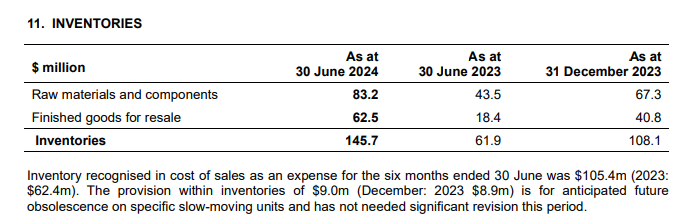
Approximately half of the balance sheet is inventory, which has grown significantly. It would be quite unusual if inventories had been allowed to grow that much without demand. Both finished goods and raw materials and components are on the rise, so it doesn’t look like things are slowing down.

image

1 Like

This was explained as preparedness and apparently slightly weaker sales in Q2, as customers have also been stockpiling products. Could it be intentional inventory accumulation regarding components, given that in previous years they had to turn customers away due to the chip shortage, which caused some consumers to be resentful of the preference shown to industrial customers? If I recall correctly, the company even acquired more warehouse space at the end of 2023 and planned to use the proceeds from the share issue to strengthen the supply chain, which might include some form of balancing price and demand fluctuations by maintaining inventories.

The Outlook section does state that the first half of the year was a positive surprise, yet expectations (which are not specified) are being kept unchanged for the full year. So, reading between the lines, it seems that there probably won’t be any new “ketchup bottle” surges in the coming months. But demand has certainly grown steadily for a decade now and shows no signs of slowing down, so I expect we’ll see quite good results regardless.

1 Like

Raspi has decided to enter into a strategic partnership with the Italian IoT device manufacturer SECO.

Link to the press release: https://polaris.brighterir.com/public/raspberry_pi/news/rns/story/rd8g64w

SECO will leverage its hardware design expertise to bring a 10.1-inch Human-Machine Interface (HMI) solution to market targeting a wide range of industrial and IoT applications. The product is based on Raspberry Pi’s CM5 and supports Raspberry Pi OS to simplify integration. In addition, Raspberry Pi Connect will be incorporated into SECO’s software stack, Clea, making Raspberry Pi Connect part of Clea’s commercial offering on Raspberry Pi devices.

The partnership will explore medium-term opportunities in other industrial areas, including image recognition, edge AI, leveraging SECO’s long history and know-how in sectors including energy management, smart building, healthcare, coffee and vending and industrial automation. Both SECO and Raspberry Pi are committed to working together to drive growth, efficiency, and innovation in the embedded and industrial markets.

Hard to say what kind of product this actually is, but it’s good that the upcoming Compute Module 5 is generating interest.

Now that Edge AI is on everyone’s lips, Raspi has also recently released various consumer-side peripherals for Raspis in collaboration with different parties, such as a camera equipped with an “AI accelerator” and a new “AI HAT,” which is a kind of add-on board that plugs onto the Raspberry Pi 5.

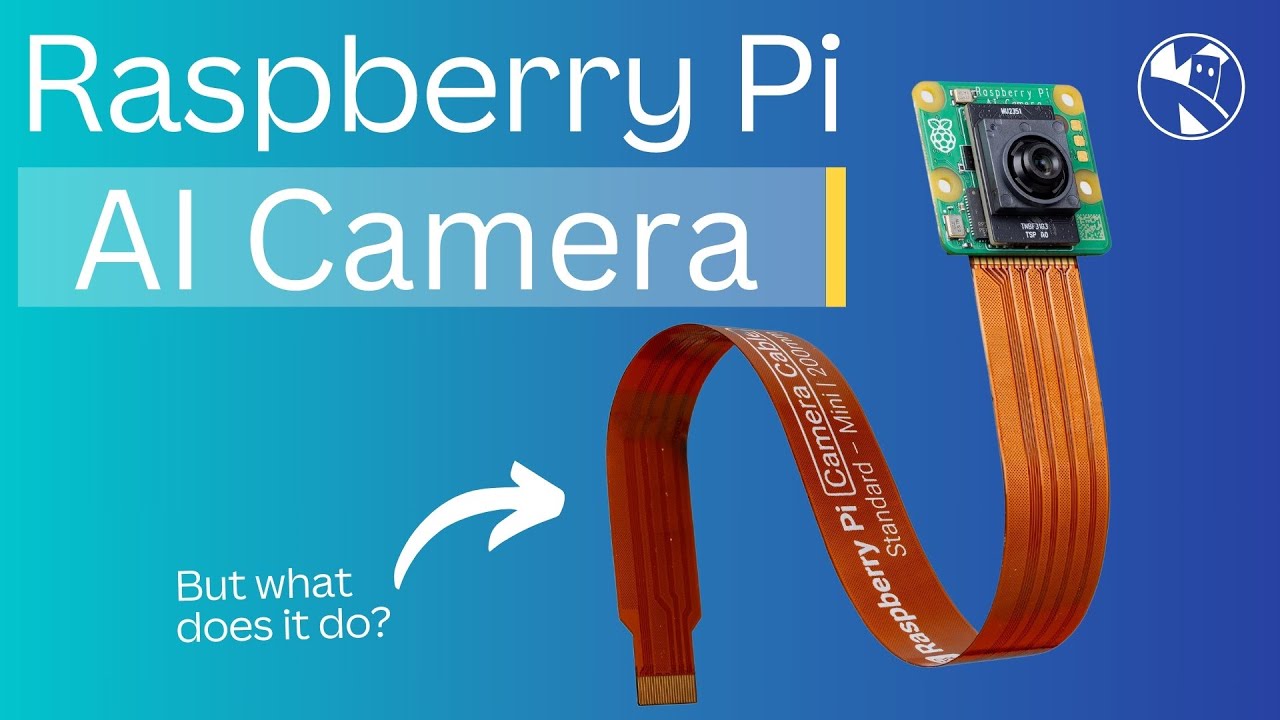
In my opinion, that AI Camera is quite a fun idea; it contains an “intelligent vision sensor” developed by Sony, which I understand to be a sort of combined 12-megapixel CMOS sensor and a signal processing processor designed for running certain types of neural networks. The sensor is connected to Raspi’s own microcontroller, and the list price for the gadget is 70 dollars. I haven’t tried it. It can also be connected to the tiny Raspberry Pi Zero, allowing you to make, for example, a “smart” security camera which, when connected to a home automation system, could for instance turn the lights on and off when someone walks in or out of a room (or the other way around for Halloween). :smiley:

3 Likes

Raspberry has had quite a two weeks – two new product releases out and the stock has rocketed by almost +45% during that time.

So, there’s a certain feeling of euphoria in the air.

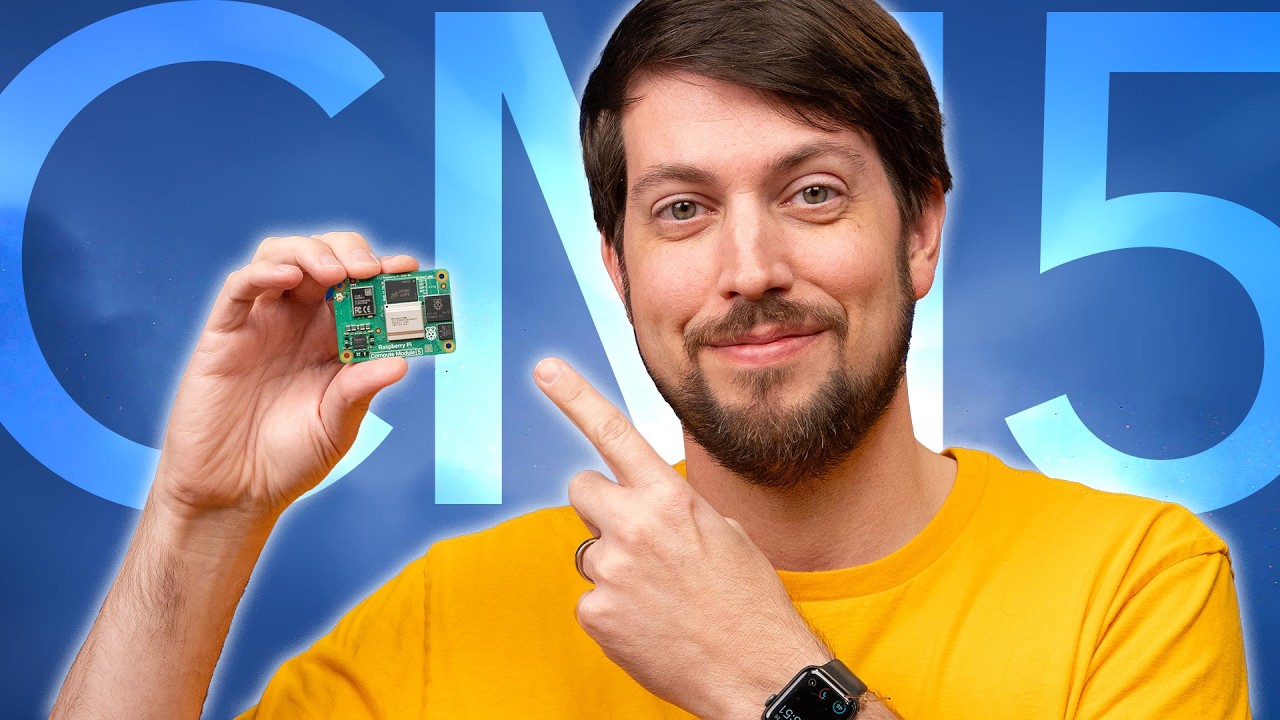
The first of the releases is the Compute Module 5, a half-credit-card-sized version of the Raspberry Pi 5, stripped of all extras. This is a kind of “production version” of Raspi’s flagship model, as the board must be seated on some kind of carrier board with inputs and outputs. At the same time, it makes the device extremely flexible, and the Compute Module can be integrated into all sorts of gadgets. The newly released model is several times faster than the previous Compute Module 4 at its best, and its efficiency is starting to match that of a traditional laptop or desktop computer. A GPU is, of course, missing, but with PCIe support, one can be attached to the machine if desired. List prices start at $45. The previous version proved to be a hit, and the new model has already received good reviews. Last time, the release happened during a chip shortage, and availability issues and price scalpers dampened enthusiasm. Now, such problems should not exist.

Raspi does not publish sales figures for individual devices but stated in its 2023 report that the industrial/embedded segment accounted for 72% of its revenue. It is, in my opinion, quite reasonable to assume that Compute Modules play a significant role in that.

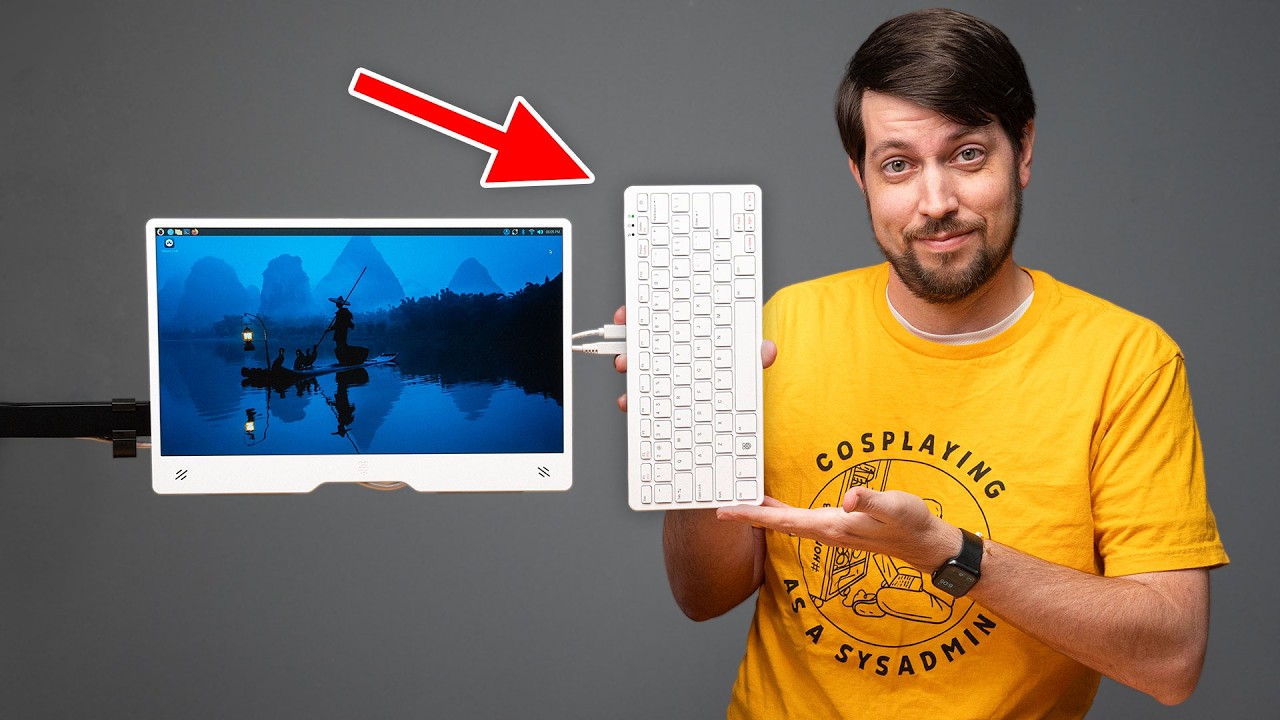
The second product launch represents the other end of the portfolio: the Raspberry Pi 500 is the company’s flagship model integrated into a keyboard. “The keyboard is the computer,” as the slogan goes. This retro-inspired machine is a great device for children, hipsters, and hipster children alike, and I intend to buy one for my living room as soon as a version with a Nordic keyboard is available. :sunglasses: The previous 400 model already received a promising reception, and since this product is intended to be a PC replacement, its increased power makes it much better suited for its purpose than its predecessor. This too has already gained excellent visibility in technology media and on YouTube, and the reception has been enthusiastic. Criticism has been leveled at the lack of an M.2 connection, but there is a place for it, so variants of the basic model are likely to follow. At the same time, the portfolio also expanded with a hundred-dollar display, so a street-credible combo can be had for just over $200 in total.

So, shareholders have some reason for euphoria! I myself still consider the stock to be quite reasonably valued relative to its potential (P/E ~35 with 2023 figures), so I intend to happily sit on my shares despite the rocketing.

6 Likes

Today’s news is the RPI purchase by American Stephen White’s hedge fund (SW Investment Management LLC), which resulted in 3.59% of the share capital changing hands. So, one more hedge fund will be added to Raspberry Pi’s ownership list, which is probably a good thing. Apparently, there is confidence in the company, although someone more familiar with the matter can tell me better what an ownership structure dominated by big players truly communicates about the firm.

https://polaris.brighterir.com/public/raspberry_pi/news/rns/story/xpvdomx

RP always has to cripple the hardware with some stupid limitations (like the absence of M.2 from this modern device), and it hasn’t been particularly cheap for a long time either. The colors and branding are quite nice though.

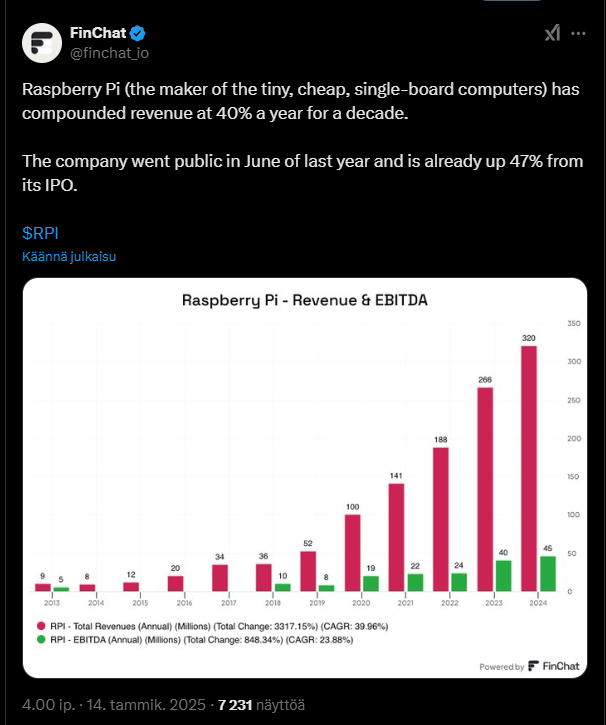
Raspberry has been on a good trajectory; revenue has also increased by 40 percent per year over the decade (it was left unspecified, fortunately the tweet stated it clearly). :slight_smile:

https://x.com/finchat_io/status/1879166637435469933
image

2 Likes

It has probably risen by an average of 40% per year over the decade.

2 Likes

Raspberry (Pi) released a concise business review for 2024 before the actual annual report. It states that sales totaled 7 million units (incl. compute modules and SBCs) and the operating profit (EBITDA) was 36 million dollars, the latter of which seems to be slightly below the lower end of analyst estimates. Now that the new product releases are behind us, there should be no inventory problems, and the company can apparently push out as much product as it sells, which promises a very strong year 2025.

I can’t help but wonder why such strange key figures are always reported; couldn’t they have at least stated the revenue? Is this some British or Raspberry (Pi) thing?

Outlook:

Looking ahead, Raspberry Pi expects demand to build gradually through the year, despite a
challenging macroeconomic backdrop and market conditions reported by the wider industrial
sector. Medium-term fundamentals remain extremely positive. The Company has a sufficient
supply of memory to meet expected demand into Q3 of this year, giving it confidence in its unit economics for FY 2025. In addition, the Company is encouraged by an increasing number of direct discussions with major prospective OEM customers.

The announcement can be found here:

https://polaris.brighterir.com/public/raspberry_pi/news/rns/story/rme16vw/export

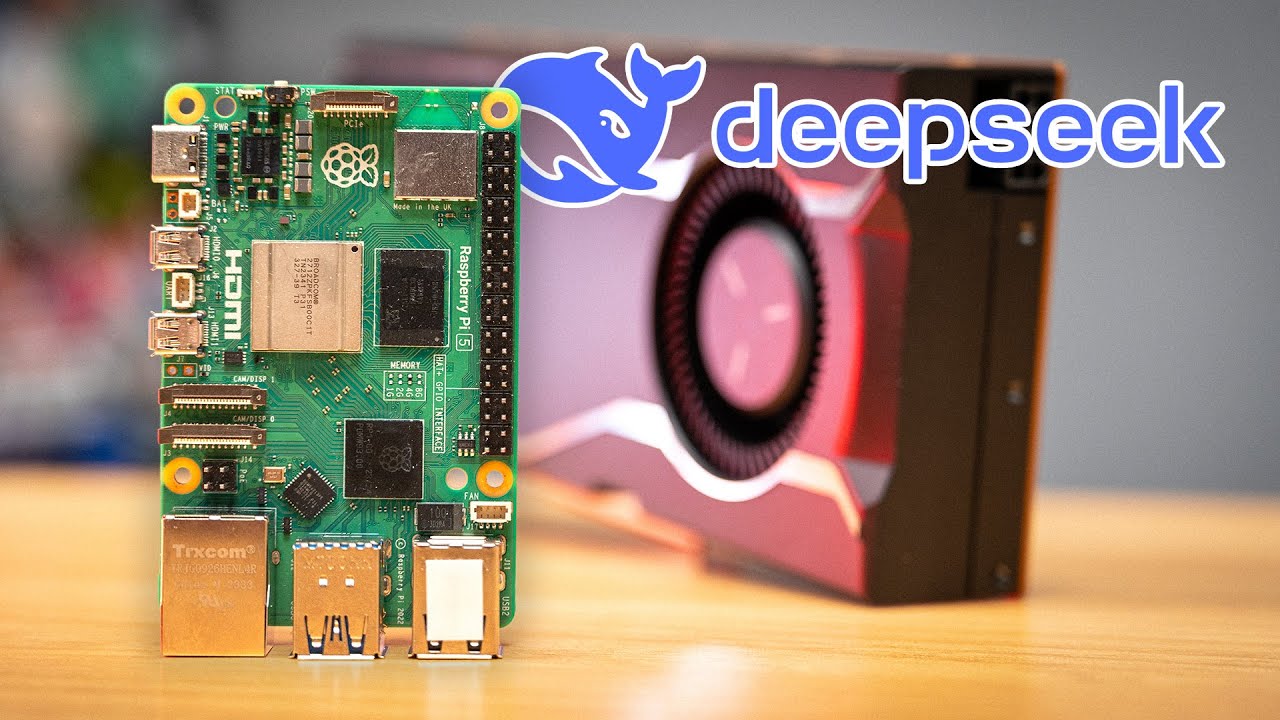
In addition, someone else has also noticed, with the recent controversies, that hey, what if LLMs don’t actually need that much computing power, could they be run… locally? :smiley:

1 Like

Raspi published its results today. In short, revenue and gross profit remained at the previous year’s level, and profit plummeted to $11.7 million (-63%).

https://polaris.brighterir.com/public/raspberry_pi/news/rns/story/r78o0zw/export

As for the stagnation in revenue, despite product launches and a strong year-end, the company cited a quiet Q2 and Q3, which was due to buyers’ inventory overload, which in turn was still a product of hoarding after the chip shortage. However, several reasons were found for the sharp drop in profit: IPO costs and R&D costs for the RP5 and RP3250 microcontrollers (or depreciation resulting from them), an increase in headcount and wage inflation, and to top it all off, the tightening of the UK corporate tax to 25 percent. Apparently, the margin from the RP5 is also not quite at the level of previous models.

What should one make of this now? Personally, I feel that perhaps not much in the short term. However, one might need to start considering whether Raspi will have the ability or desire to raise its prices in the future to improve profitability, or if its traditionally good profitability is threatened in the longer term. One could paint a picture that the company’s idealistic management and largest owner (now a financially independent charity foundation) may not necessarily care about maintaining strict cost discipline. Until now, I have considered the company’s idealism quite positive, as the growth rate has been high and the recipe has worked well, but if the innovation engine stops turning and the brand does not bring added value, one must paint somewhat different futures…

Well, despite the results, the market reaction seems to be positive, so screw it, here we go again. It almost reached buying prices again. :smiley:

2 Likes