PoLight ASA - to the global top with piezolenses

And that’s exactly what happened. The share issue was oversubscribed, albeit by only 7%, so I received pretty much exactly what I applied for in the issue. From poLight’s perspective, completing the share issue without having to resort to the guarantors’ funds is a good performance in the current climate, even if the per-share price (as expected) scalped a significant chunk of value from the existing owners’ holdings.

The company received 140 MNOK (gross, before expenses) into its cash reserves, so a substantial portion of the company’s market value is now cash. Yes, cash is burned every quarter, but whoever those potential customers demanding a stronger balance sheet might be, they will now dare to come forward with orders. This is just my own reasoning, but it is based on more than just a broad interpretation of a single sentence in the rights issue prospectus.

Indeed, the date for the Capital Markets Day (CMD) to be held on June 5th was announced yesterday. If there hadn’t been a compelling reason to rush the share issue (a customer requirement, I’m guessing), it would have been smarter to hold the CMD before the issue rather than after. The cash (before the issue) would have lasted for another 2-3 months of waiting until late summer or early autumn.

So, let’s wait and see if my intuition is correct and if poLight announces a larger order in early autumn.
https://www.polight.com/investors/news-and-events/News/news-details/2024/poLight-ASA---Invitation-to-Capital-Markets-Day-2024/default.aspx

Polight announced its Q1 results, and in terms of revenue, this year appears to be a transition year and an exception to the strong revenue growth of recent years. (I will not cite year-over-year figures here.)

Weakness in volume sectors (read: consumer market) favors sticking with the old and tested, and manufacturers’ enthusiasm for making new openings is low. Last year’s mobile camera delivery, along with its project income, makes matching last year’s quarterly results difficult.

In the words of the CEO, camera module manufacturers state that Polight has a better solution, but costs favor traditional camera (focusing) solutions. Therefore, the ongoing project to reduce camera module level costs (design, manufacturing process) is critical for securing new design wins in cameras that are more affordable than the high-end category.

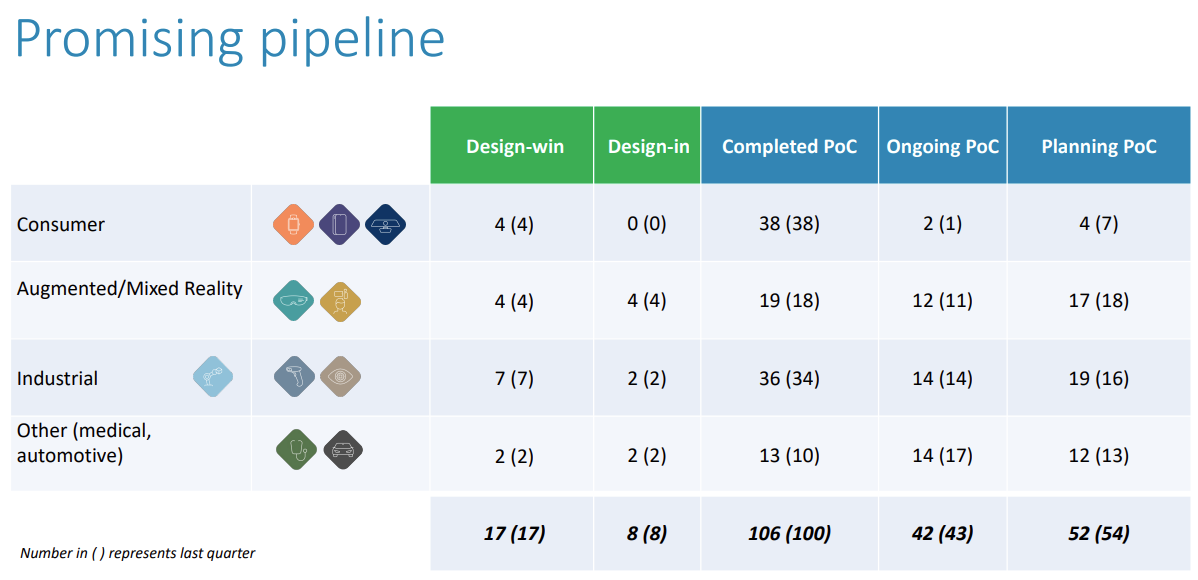
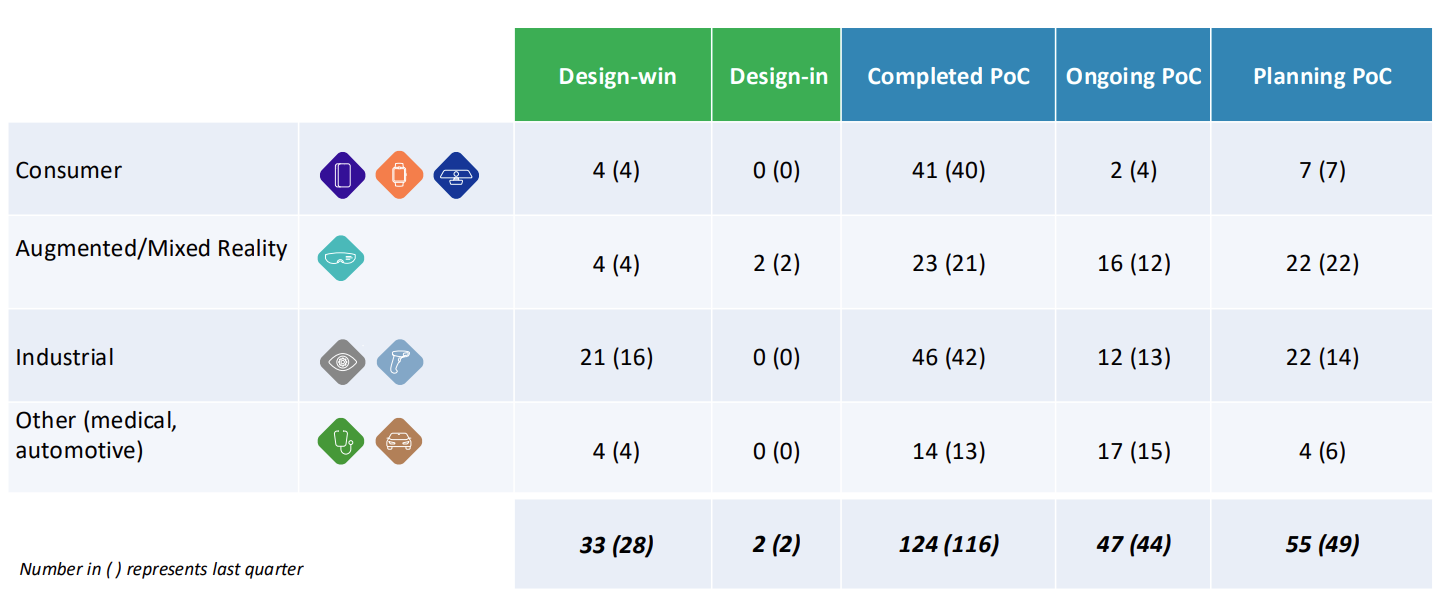
As seen in the traditional pipeline image below, there is only 1 ongoing project in the “ongoing poc” column. In all other columns, the figures are either above the previous quarter’s levels or at the same level.

image

In my view, in the short term (1 year), the only sector capable of driving the share price up relates to AR/MR devices, which are at the beginning of their innovation curve, and the industry’s de facto standards in terms of design and structure are still taking shape.

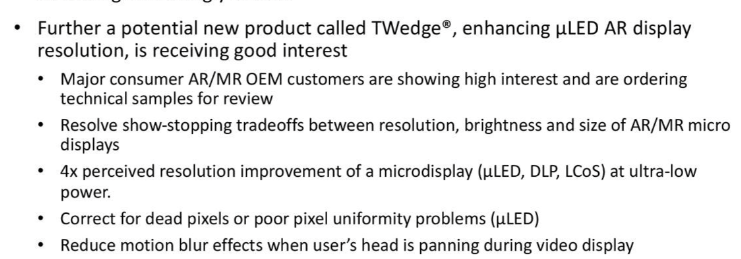
In the medium term, TWedge for AR/VR glasses is an important element for increasing display resolution, while making the display look more natural due to its pixel-“smoothing” operation. In terms of margin, TWedge could be even more lucrative than the Tlens lens, as its potential to address display cost (high pixel resolution) and, consequently, battery life is significant.

image

Unfortunately, I didn’t have time to listen to the CMD day presentation due to work, but I will dig through the material later. Still, in the long term, I see Polight as a winning ticket, but accumulating and realizing returns on the position requires something other than a buy&hold strategy.

https://www.polight.com/investors/news-and-events/News/news-details/2024/poLight-ASA--continues-to-build-confidence-in-future-positive-development/default.aspx

CMD presentation published. With several years of experience, there was no significant new information for me, but it’s a very good package for those who want to get a quick overview of what the company does and on what schedule.

No revenue targets or other metrics typical of an established company. The presentation is product-led. A foothold in scanners and AR/VR sets, among others, has been established, and it’s a good place to move forward from.

An investor, of course, asks how long this will take and if the burn rate will still require further capital raises?

A new order from a Chinese company that was already a customer. The name was not disclosed, but it is for barcode/scanner products. A small deal, and the order will be completed in less than a month.

https://www.polight.com/investors/news-and-events/News/news-details/2024/poLight-ASA--New-purchase-order-received-supporting-barcode-scanning-market/default.aspx

Looking ahead, XR/AR glasses are known to be poLight’s biggest growth opportunity in the 1-3 year timeframe. AI buzz is probably coming out of everyone’s ears by now, but there is some truth to what the interviewed Chinese operator’s CEO says. Smart glasses and AI would be the “killer app” the sector has been looking for for a long time.

“Personally, if I could tell who the person in front of me is with the camera of the AR glasses, I would buy the AR glasses right away,” and expected, “If AI and AR glasses are combined, the AR glasses market will grow explosively.”

To put it laconically, all that’s left is to tackle problems related to user experience, display brightness and resolution, processor power, and power consumption. In the style of a TV shop infomercial, I’ll state that poLight’s products affect all of these – TLens helps with power consumption and user experience (fast focus), and TWedge improves display technology resolution and cuts power consumption (noting, once the product is ready for sale).

Money will be poured into this sector because there’s a potential Klondike at hand, where claims will be staked over the next 1-5 years. It’s not set in stone whether poLight will be one of the beneficiaries of the gold rush, but the potential is there.

How that potential translates into revenue depends, of course, on the company’s overall performance from R&D to sales and management, not just the technical capabilities of the products—something Finnish tech firms have experienced embarrassingly well.

https://www.patentlyapple.com/2024/06/the-ceo-of-sapien-semiconductor-predicts-that-when-ai-is-fused-with-ar-smartglasses-the-market-for-these-devices-will-explod.html

An order of one million Norwegian kroner. Small in terms of euros, but a larger-than-average order on poLight’s scale. A new order from an OEM customer as a follow-on to a previous one, which is of course pleasing to see. One can assume that the customer and end-users are satisfied with the features.

https://www.polight.com/investors/news-and-events/News/news-details/2024/poLight-ASA--poLight-received-follow-on-purchase-order-for-a-barcode-product/default.aspx

Second quarter reporting. The stock price charged uphill by 20% in a couple of days after the report. Slightly surprising, as the quarter didn’t offer anything unexpected to my eye. A quiet quarter.

Headcount has grown rapidly, from approx. 30 people to 48. As the surprising large share issue published in late winter and its justifications suggested, it has been noted that the market phase requires strong front-loaded investment.

Apple’s entry into the smart glasses market is moving the field and igniting new buzz in a sector that had already started to sag a bit. MR/AR glasses are finally starting to move toward the consumer market (12-24 months) and the market’s baseline technology solutions are being locked in, at least for this generation of devices. Polight’s position is good; in the CEO’s words, “many big players say Tlens is the best (solution)”.

Traditional pipeline image - leveling off, but 46 ongoing testing projects is a respectable tally for a company of this size. The AR/MR sector and industrial devices (scanners, machine vision, etc.) are pulling the strongest.

Quoting the CEO, “hands are full,” but the increased headcount helps to serve PoC projects and sales work better.

image

Regarding revenue, we are clearly behind last year, but a significant part is explained by the difference in booking times on both sides of the turn of the year.

image

The company is investing in reducing the unit price of the product, but also the assembly price. This was discussed in an eye-opening way during the investor call - in addition to the importance of the product’s price itself, the time spent on assembly and testing must be considered. One must therefore delve quite deep into the manufacturing technology of the end-user device assembly and package the product in a way that brings down the total cost of the solution.

Investor calls for quarterly releases are gold mines of information. This time, the CEO spent an hour answering good questions sent by investors, allowing the market positioning of products and the challenges to unfold better than concise reports and presentations.

From the perspective of the company’s cash flow, the most important question is, of course, when the consumer market for AR/MR glasses will truly open up. As the CEO also said, the timeline has continuously shifted forward, due to, among other things, the slower development of key technology and, on the other hand, the lack of a compelling sales driver.

Will Polight’s Eldorado finally open up in the next 12 months, who knows?

Q2 presentation:
https://mb.cision.com/Public/14821/4024428/92388f1b36020e61.pdf

2 Likes

Next week’s treat for Polight shareholders—or a total flop—is Meta’s upcoming Connect 2024 event. Meta is expected to trump Apple’s Vision Pro headset with its own device, codenamed Orion. Zuckerberg couldn’t resist taking a jab at Apple:

We’re almost ready to start showing the prototype version of the full holographic glasses. We’re not going to be selling it broadly; we’re focused on building the full consumer version rather than selling the prototype.

Meta seems to be heading in a different direction compared to Apple, placing its bets on a continuation of the Ray-Ban glasses’ “light concept,” which is intended not to look like AR/XR glasses from the outside. Understandably, the use cases are slightly different, as holographic rendering cannot (at least for now) display graphics as versatile as those the display components of Apple’s glasses are capable of.

Polight’s opportunity would be in eye tracking and as a component for the cameras in the temples. If TLens is found in any product presented by Meta, it would be a strong signal of future revenue streams. They are unlikely to deviate from this chosen path immediately, and the smart sunglasses concept, if executed cleverly, is likely the least off-putting from a consumer perspective.

At Meta Connect, glasses with the code name Orion were indeed announced. For now, it is a demo device and developer version, but admittedly an impressive one.

I cannot be sure about PoLight’s involvement, but the information shared by Zuckerberg regarding eye tracking with waveguide technology would point in PoLight’s direction. The Orion glasses are so thin that a very low-power technology is needed to implement the waveguide. PoLight has such a thing to offer:

PoLight announced a design win for Vuzix glasses in the spring, stating:

Besides being the world’s first binocular waveguide smart glasses implemented for industrial use, Vuzix Shield also uses TLens® in its two front-facing stereo RGB autofocus cameras

According to The Verge, Meta’s device has seven cameras. From the announced information, it cannot be concluded whether they utilize features familiar from TLens, but the lightness, low power consumption, and lightning-fast focus in the direction of gaze would support the idea that at least some part was made using something other than VCM technology.

I will wait for more detailed information. In any case, Meta’s idea of AI features integrated into glasses with hologram surfaces feels like a winning bet. IF the price for the consumer version can be brought down to around 2,000 US dollars.

1 Like

poLight investors have been witnessing a flurry of design wins: a total of three in a single week. Two imaging systems based on the Mini2P microscope and a couple of new handheld scanner models from an existing customer.

They are still not high-volume products, but especially the TLens lens stack for the Mini2P microscope is a very high-margin business. A year ago, the CEO stated the following on the subject:

Now we see commercial players preparing to supply such solutions. We have mainly seen this activity as important brand building for us, but in sum this activity has so far represented an accumulated value of approximately 5.5 million NOK, and hence starting to be an important financial contributor.

The Mini2P imaging system from the Chinese company Transcend Vivoscope is the most interesting of these three. The design win announced in the press release concerns the individual Supernova-600 flagship product, but the phrasing suggests more is on the way:

The SUPERNOVA-600 incorporates TLens® tunable optics for real-time optimal microscopic in vivo imaging of neuronal and cellular activities in the brain, advancing research in cognition, drug development, and diseases including Alzheimer’s, Parkinson’s, epilepsy, and others.

“We look forward to leveraging TLens® in our full SUPERNOVA product portfolio” (said Dr. Wu Runlong, Director of R&D at Transcend Vivoscope)

According to their website, Transcend Vivoscope’s partners include the Max Planck Institute, New York University, and a bunch of Chinese universities.

For a company founded in 2016, the list is remarkable, as gaining a foothold as an instrument supplier in a conservative industry is not easy. It is, of course, a separate question how well the devices sell…

Vivoscope’s press release:
https://www.polight.com/investors/news-and-events/News/news-details/2024/Transcend-Vivoscope-to-Offer-Turnkey-Miniature-Two-photon-Imaging-Systems-with-poLight-ASA-Tunable-Optics

Second Mini2P-based announcement:
https://www.polight.com/investors/news-and-events/News/news-details/2024/Thorlabs-Mini2P-Imaging-System-Leverages-poLight-ASA-TLens-for-Optimal-Neurological-Imaging/default.aspx

Scanners:
https://www.polight.com/investors/news-and-events/News/news-details/2024/poLight-ASA--poLight-TLens-confirmed-to-be-used-in-two-new-handheld-barcode-products/default.aspx

Q3 report is behind us, and although the earnings update is late, this year’s quarterly presentations have followed the same tracks. Let’s recap a few orders received and try to estimate when the surge of revenue-boosting AR/MR product releases will truly begin.

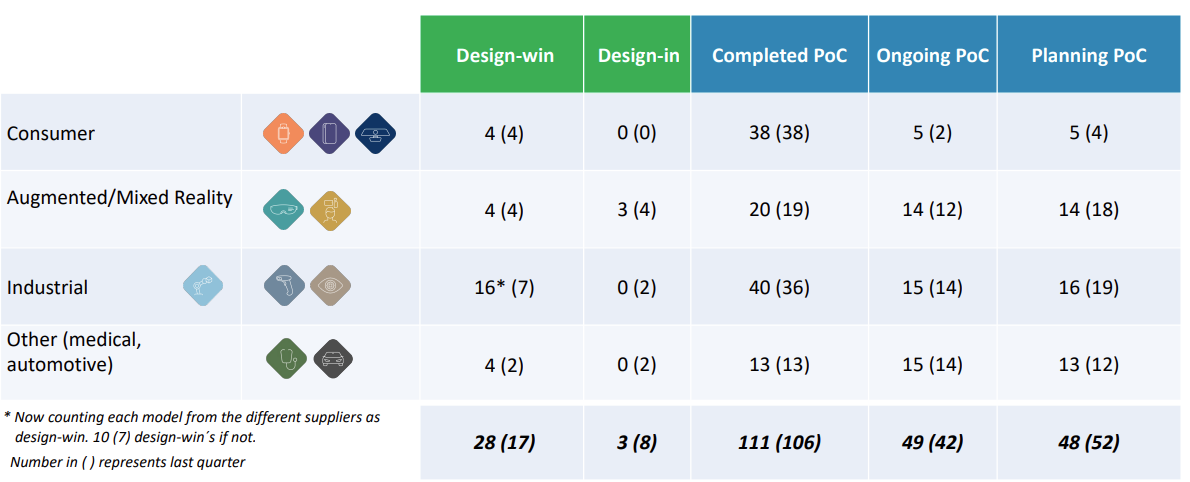
In the consumer sector, the most surprising news was that mobile phone projects have started again. Similarly, there is activity on the laptop and smartwatch front, but it will likely take a long time to move from the PoC (Proof of Concept) phase to orders. In the AR/MR sector, there are familiar delays in announcements.

Industrial sector design wins are scanner-driven, so nothing significantly new here. In the health sector, Mini2P microscopes are also bringing in the crowns as usual. Endoscope-related projects are under development, but maybe more on those in 2026?

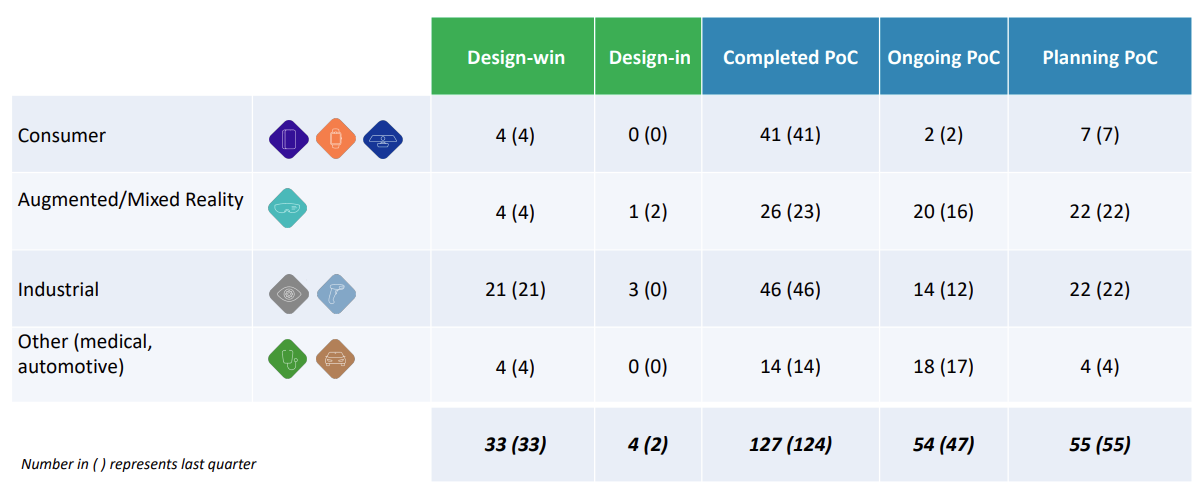
The familiar project pipeline is on display again; the rapid increase in the number of design wins is due to a change in the calculation method—meaning each product is counted individually rather than as a customer win, as it should be. Stabilization in the numbers.

image

Earnings presentation:
https://mb.cision.com/Public/14821/4058849/b5b99350553c764e.pdf

Perhaps the most interesting info comes from rumors related to Samsung. Sunglasses as a frame for smart glasses interest others besides Meta, and Samsung is said to be developing its own glasses with Qualcomm and Google.

Mentioned use cases include AI searches, QR codes, gesture, and human recognition. This clearly looks like a use case for Tlens. According to the news, the release is expected in Q1, and it will hit the market in Q3/2025. Big if true.

https://www.mk.co.kr/en/business/11169803

1 Like

[quote=“In_Der_Esche, post:64, topic:8147”]In the medium term, TWedge for AR/VR glasses is an important element in increasing display resolution, while making the display more natural due to its pixel ‘blurring’ function. From a margin perspective, TWedge could be even more profitable than the Tlens lens, as its potential to address the cost of the display (high pixel resolution) and further battery life is significant.
[/quote]
The first customer has ordered technical TWedge samples worth 500,000 NOK. A bigger “milestone” than the money is the OEM’s significant early-stage investment in new technology. Whoever the customer is, the quantity purchased indicates a front-loaded investment. TWedge is not yet properly productized and is still at a demo level as a concept.

CEO of poLight ASA. “TWedge® wobulator is based on the same tunable optics technology platform as our TLens® product used in numerous auto focus imaging systems. < > this milestone is an important step for our TWedge® wobulator technology and we are encouraged by the continued interests from many of our customers

https://www.polight.com/investors/news-and-events/News/news-details/2024/poLight-ASA-receives-purchase-order-for-TWedge-wobulator-technical-samples-from-a-top-tier-consumer-OEM-customer/default.aspx

1 Like

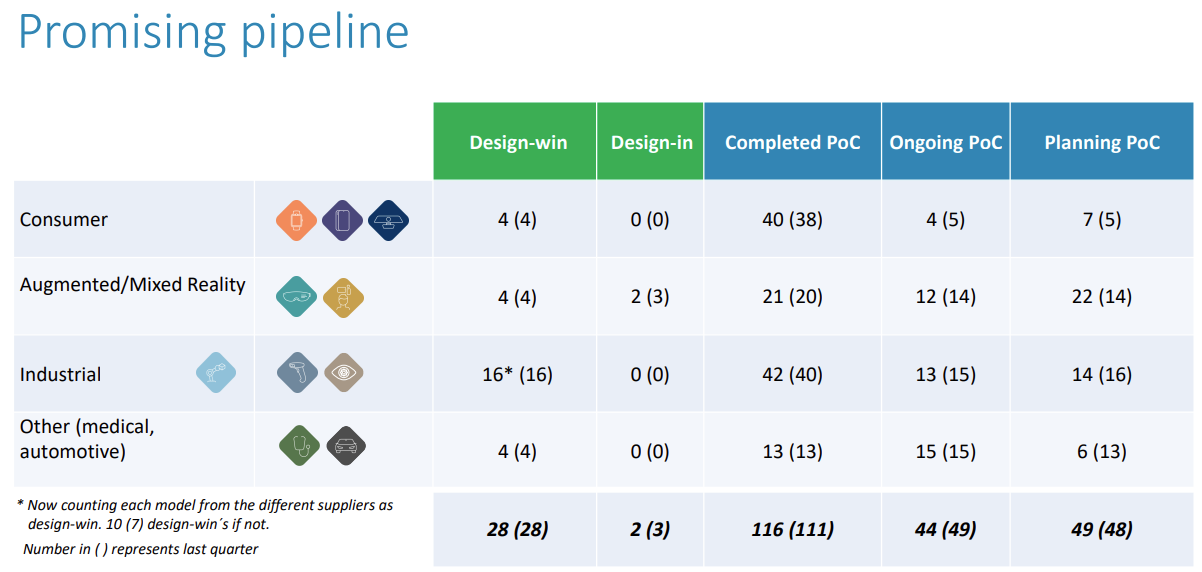
The Q4 report was published on Tuesday, and the tone did not change significantly from the Q3 report, except for the surge in the Planning PoC section within the AR/MR sector. I have been looking at the pipeline figures for several years, and I don’t recall the column ever exceeding 20 units.

In the conference call, the CEO stated promisingly how practically all significant consumer electronics market players now have an AR/MR project underway or starting.

image

Furthermore, in the CEO’s words, the AR/MR segment is “definitely maturing”. Consumer electronics needs a new driver due to the maturation of the mobile phone market.

For 2025, Polight’s most significant actions relate to improving Tlens’ cost competitiveness and to design models taken further along the value chain. Thus, they are not just a component supplier relying solely on the superiority of their own product, but rather offering reference models and design services to lower the purchasing threshold.

As stated at last summer’s investor event, AR/MR consumer products are entering the market more broadly starting from 2026. I personally do not doubt Polight will achieve its goals, but the rapidly increased number of personnel also means a faster cash burn rate.

From a shareholder’s perspective, a new share issue before 2026 seems likely, and unless significant new design wins or other service agreements/revenue sources emerge during the spring, it might be better to risk missing out on a price increase than to hold onto the shares and watch the price being manipulated downwards on the Norwegian stock exchange.

Q4 presentation:
https://mb.cision.com/Public/14821/4106864/8e6106ca07ba6d39.pdf

2 Likes

A strategic investment came, and with it, a typical Norwegian mini-issue for existing owners.

Company has entered into a strategic investment agreement (the “Investment Agreement”) with Q Technology (Group) Company Limited (“Q Tech”), a leading manufacturer of camera modules for global
companies. Pursuant to the Investment Agreement, the Company will issue 63,743,112 new shares to Q Tech at a subscription price of NOK 2.69 per share, raising total gross proceeds of NOK 171,468,971.28 (the “Private Placement”).

With the proceeds from the share issue, Polight’s cash balance will rise to MNOK 350, if the uncertain amount of money from the mini-issue is disregarded.

As a part of the strategic investment, Q Tech is working to establish a dedicated TLens® assembly and test line (“Strategic Partnership Agreement”), in addition to poLight’s existing manufacturing capabilities.

Apparently, the expected demand peak is strong, as Polight’s current testing and assembly capacity is insufficient. In addition, the end customer wants to ensure deliveries, should something happen at one factory that hinders production.

“We strongly believe that poLight’s unique technology will be important for several applications,” said Q Tech Chairman Roy Ho. “With backing from a top tier U.S. consumer electronics customer, we are confident this alliance will bring cutting-edge solutions to the market, addressing key industry challenges.”

Speculating about this large American customer is pointless in itself, but such extensive upfront investments narrow them down to the fingers of one hand. The long-awaited consumer market for AR glasses is therefore a concrete reality in the near future.

This investment and share issue remove the uncertainty surrounding the price and timing of new money that has been weighing on Polight’s stock. A large investment would not be made for nothing, so the breakthrough of Tlens and TWedge products into the mass market now seems more likely than before.

Despite the issue price being based on yesterday’s share price, the stock appears to have been quoted the same, and is trading 30-40% higher than the issue price.

https://www.polight.com/investors/news-and-events/News/news-details/2025/poLight-ASA---Enters-Into-Strategic-Investment-Agreement-with-Q-Technology-Group-Backed-by-U-S--Top-Tier-Consumer-Electronics-OEM/default.aspx

2 Likes

Polight held an investor call and, judging by the reaction (+30%), the content nicely complemented last week’s announcement.

As is appropriate at this stage, the strategic investment was praised and how it provides

  • two suppliers, reducing the OEM’s supplier risk
  • financial support from the investment, industry expertise on the board
  • accelerates OEM decision-making

Whether it’s an American consumer electronics company like Apple, Meta, or something else, the validation offered by Q Tech, a camera module manufacturer, is a big help in itself. The company is the market leader after Sunny Optical.

The CEO emphasized that the investment itself does not change Polight’s direction, but it speeds things up and increases the likelihood of a bigger breakthrough.

The “big bang” of the AR glasses consumer market is still 18-24 months away, but device specs and suppliers are locked in earlier. Perhaps that partly explains the timing and size of the deal.

I have never before participated in an issue where the issue price is (currently) 40-50% lower than the share price. Art of the deal, I’d say.

1 Like

The Q1/2025 report brought no surprises. The biggest news was already delivered earlier, and the traditionally informative Q&A session did not add significantly new color to the previously painted picture.

AR/MR is at the core of the whole, and the long-simmering, sometimes cooled-down, stew now shows signs of ripening. The CEO still emphasized that, due to technological reasons, the opening of the AR/MR consumer market in earnest is still 18-24 months away. Meta’s Ray-Ban glasses were mentioned in the same breath as an example of an “intermediate” device that provides a foretaste of what’s to come.

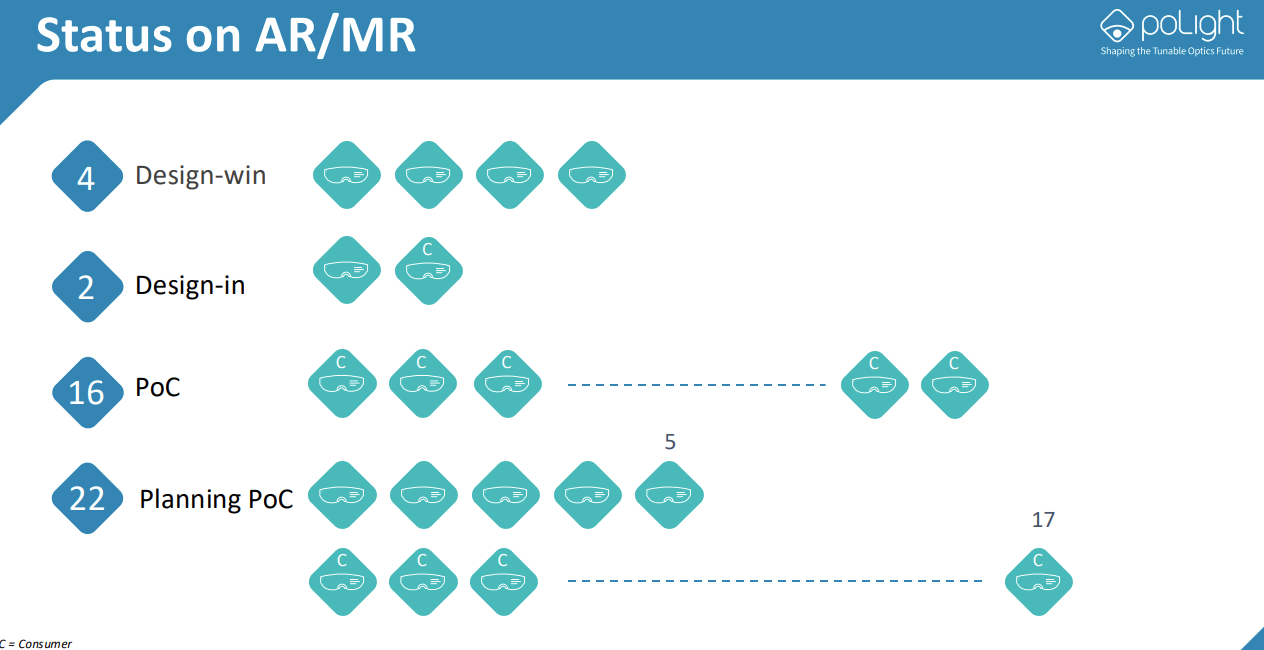
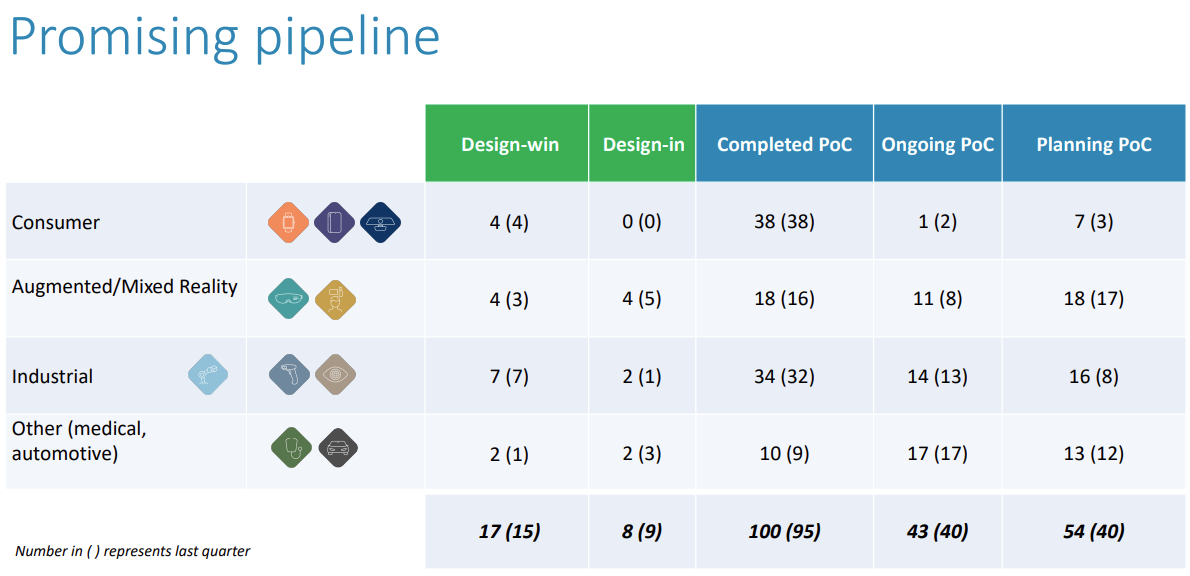
The “C” letters in the image below are not clearly distinguishable, but this is how “back-heavy” the AR/MR pipeline is currently, as the AR/MR device base for consumer markets is being built right now:

  • Design-in: 1 pc
  • PoC: 16 pcs
  • Planning PoC: 17

(Correspondingly, no separate figures are available from the “Completed” column.)

image

The entire “pipeline” still looks upward-trending. The consumer segment (excluding AR/MR devices) is thin in terms of the PoC pipeline, so high-volume deliveries do not seem likely in the near future.

image

Other significant matters to highlight:

  • a “standard block” developed in cooperation with an optics supplier for the scanner markets is expected to speed up Tlens’ adaptation work for new product concepts
  • a lead-free version of Tlens’ actuator is being developed to meet OEM requirements
  • the second production line to be built at the premises of Q Tech, which made a strategic investment, will be completed by the end of the year
  • new supply agreements for laptop/projector cameras appear to be close, and with Q Tech’s investment, new activity has been observed regarding old “cases,” including phones
  • Polight’s credibility as an operator and contract partner has increased due to Q Tech’s investment

In summary: The CEO seemed very positive in demeanor, and the main message had an older ring to it than before.

Still, because of Trump and China and whatever other black swan events the world may yet throw our way, Polight’s path to riches is not a ready-made package to be picked up without a mere stroll in the park.

1 Like

The offering closed, and my understanding of efficient markets took a hit. As I write this, the share price is 3.7x NOK and the offering price is 2.69 NOK. Even without a calculator, one can see that the shares would be significantly cheaper than the market price.

According to the company’s announcement, only 1500 different owners participated in the offering (the offering was 80% oversubscribed).

By the end of the subscription period, the Company had received valid subscriptions for 35,423,252 Offer Shares in the Subsequent Offering from 1,500 subscribers. Thus, the Subsequent Offering was oversubscribed.

In Nordnet alone, Polight has 5652 owners, so thousands left their offering shares for others to snap up. Like me. I probably won’t get 3x over my quota of booked shares, but something nonetheless. The downside and thus profit are secured by previous sales.

Profit is always profit, but the situation is still frustrating. Many investors have overlooked this situation. Perhaps some have already mentally buried the shares behind the sauna (I understand), it’s summertime, or the number of shares offered in the offering is insignificant for a small investor?

The most significant reason, I believe, is lack of knowledge. In the big picture, share offerings with subscription rights, offer periods, and other details seem to be a mechanism that disadvantages owners. My gain is a loss for popular capitalism.

1 Like

The letter I received was dated to the start time of the offering. When I arrived and opened the letter, the offering was already over.

2 Likes

Sounds like Nordea? I had a similar situation with Andfjord’s spring mini-offering - I had to call customer service myself and inquire about subscription rights. The letter only arrived after the offering was already over…

2 Likes

Oh boys, girls, and non-binary people! Is the AR/MR glasses jackpot finally hitting the mark?

A mysterious “Top tier consumer OEM” has reportedly ordered lenses and accessories worth 1.7 MNOK for the product testing phase. In previous announcements (April), the entity was described as “North American”. So, the mysterious “someone” is likely among Meta, Alphabet, Apple, or Microsoft, listed according to my own off-the-cuff guess.

The device type is not mentioned either, but I believe it concerns next-generation AR/MR glasses. Depending on the test results, the product will move to further testing (a new order) and eventually to an order leading to the start of production, if traditional steps are followed.

Of course, I don’t know the device’s release schedule, but the latter half of 2026 would be a good guess. Consequently, the next, significantly larger lens orders would come in the first half of 2026.

Let’s keep our fingers crossed and wait for other OEMs to follow suit.

4 Likes

The most essential aspects of Q2 have been covered in separate posts, so no more on that.

QTech’s acquired stake in the company has elevated Polight’s status from a niche player to the league of slightly bigger players, making it easier to get in touch with the product managers of those really big players. Still not easy, though.

In the traditional pipeline view, nothing particularly special. AR/MR glasses and scanners/industrial optics are driving progress. Other consumer product business and health technology are contributing less.

image

So, nothing new from Norway; the boom of the AR/MR glasses consumer market is approaching, but in the eyes of a quarterly capitalist, very slowly. In the short term, the ambition to move up the value chain from tailor-made products to standard components (such as the M12 format product prototype for scanners) is an important milestone, but it will only show up in order books next year.

The stock price’s negative reaction to the earnings report is thus expected. The recent rise in the share price leaves room for corrective movements. This is often the story of Polight’s stock price – climbing towards the earnings report and then falling significantly on earnings day due to excessive expectations. A true momentum stock.

1 Like