Prolight Diagnostics (PRLD) - Central Lab Diagnostics at Your Fingertips

Lupasitko itsellesi “Ei koskaan enää biotechiä”? :sweat_smile:

Prolight Diagnostics (PRLD)
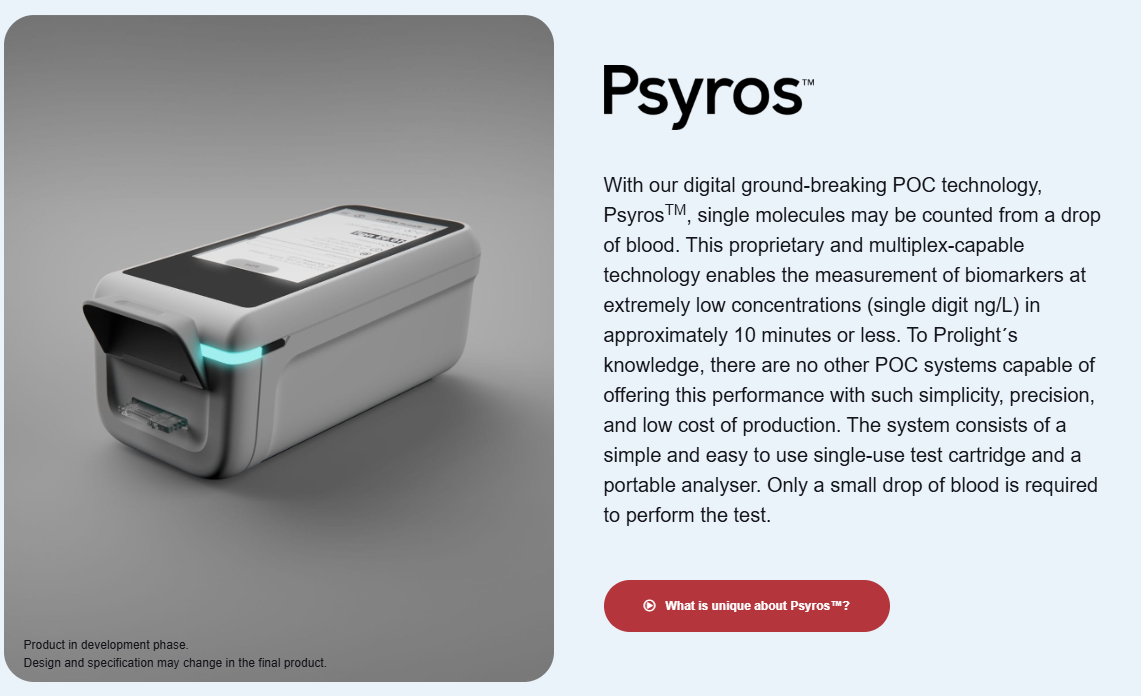
Prolight Diagnostics on vuonna 1999 perustettu biotech-yhtiö, joka listautui 2017. Osake löytyy tällä hetkellä First North Sweden-markkinalta. Yhtiö kehittää pienikokoista, valoon perustuvaa POC-diagnostiikkaa, jolla voidaan mitata verestä lähes mitä tahansa molekyylejä erittäin pienillä pitoisuuksilla kannettavalla ja edullisella laitteella. Yhtiön omien väitteiden mukaan teknologia tuo keskuslaboratorion tasoisen mittausalueen ja tarkkuuden pieneen kannettavaan ja kustannuskilpailukykyiseen pakettiin, joka kulkee mukana vaikka ambulanssissa. Yhtiön päätuote kulkee nimellä Psyros.
Screenshot 2025-01-22 123932

Psyros:
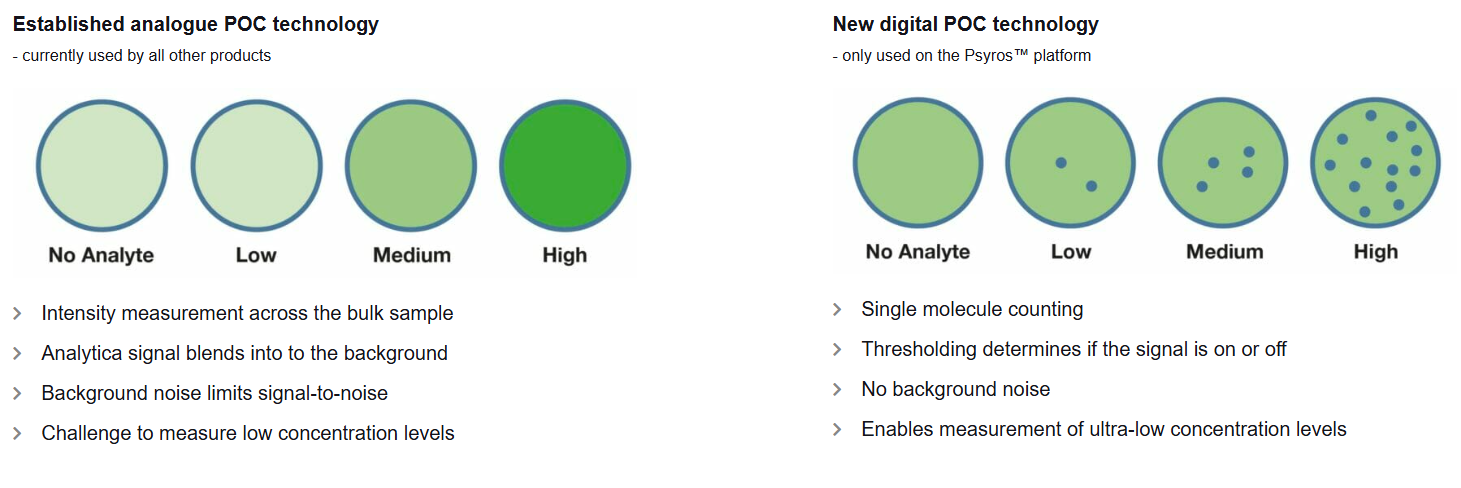
Prolightin Psyros-teknologia mahdollistaa “yksittäisten molekyylien laskemisen” veripisarasta. Käytännöstä biomarkkereita voidaan mitata hyvin pieninä pitoisuuksina (x ng/L) muutamassa minuutissa ja helposti. Teknologia perustuu kertakäyttöiseen testikasettiin ja kannettavaan analysaattoriin, ja se vaatii vain pienen veripisaran. Toisin kuin monella muulla POC-järjestelmällä, veriplasmaa ei tarvitse erottaa sentrifuugilla. Prolightin itsensä mukaan vastaavaa suorituskykyä, yksinkertaisuutta, tarkkuutta ja edullista tuotantokustannusta ei ole muilla POC-järjestelmillä (Note to self: olemme kuulleet tämän ennenkin)

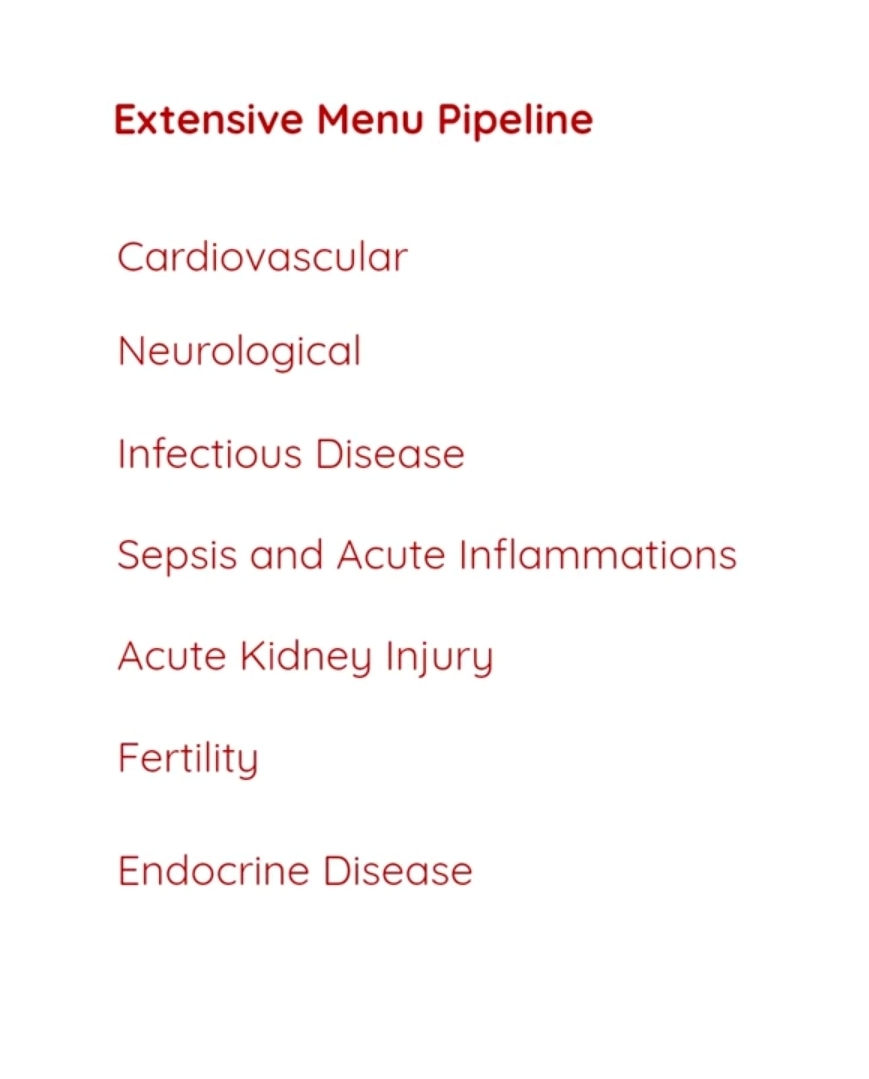
Yhtiö aikoo hakea markkinalupaa ensimmäisenä troponiinin mittaukseen, mahdollistaen sydänkohtauksien diagnosoinnin paikan päällä, kuten ambulanssissa tai vanhainkodissa. Käytännössä troponiinin mittaus nykyistä herkemmin mahdollistaa oikean hoitoon ohjauksen useita tunteja aikaisemmin ja huomattavasti ketterämmin. Alusta on kuitenkin suunnitelty ns multiplexaavaksi, eliteknologialla voidaan kuitenkin mitata myös muita merkkiaineita samanaikaisesti. Yhtiö siis aikoo laajentaa samalla laitteella myös muihin merkkiaineisiin.
Screenshot 2025-01-22 141117

POC - eli Point Of Care
POCilla kuvataan hoitoyksikössä suoraan toteutettavaa diagnostiikkaa. Markkina on voimakkaasti kasvava. Selväähän se on, ettei näytteitä kannata kuskata ampulleittain keskuslaboratorioon kalliisti, hitaasti ja kankeasti, jos teknologia mahdollistaa tarkan ja luotettavan mittauksen nopeasti, edullisesti ja välittömästi vaikka ambulanssissa tai vanhainkodissa ilman veriplasman erotusta tai muuta käsittelyä. Kysymys on siinä, kuka vie markkinat, sillä erilaisia POC-teknologioita kehitetään lukuisen firman toimesta.

Patentit:
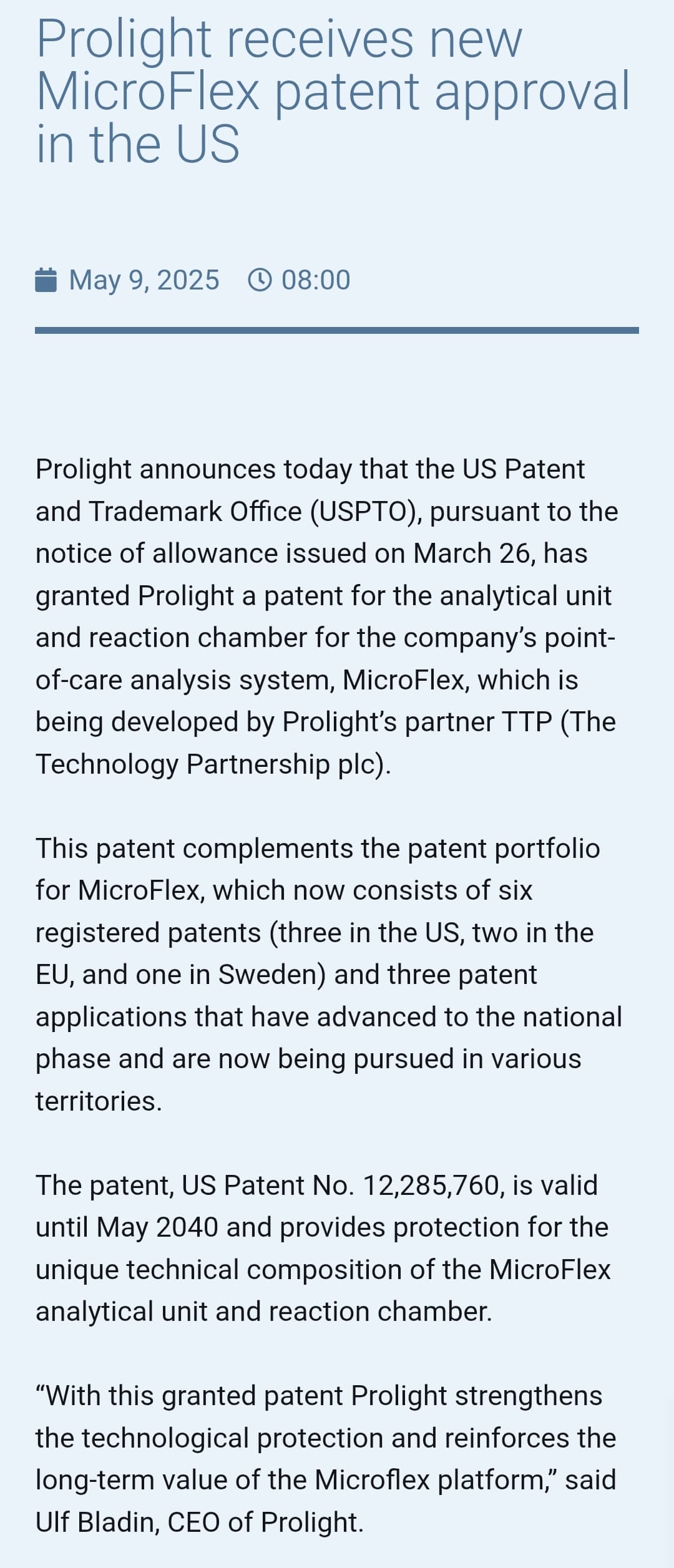
Prolightilla on tällä hetkellä viisi patenttihakemusta, jotka liittyvät Psyros™-teknologiaan. Kolme näistä on siirtynyt kansalliseen / alueelliseen vaiheeseen ja niitä käsitellään useissa eri alueilla, mukaan lukien Eurooppa, Yhdysvallat, Kanada, Kiina, Japani ja muut. Jäljellä olevat kaksi ovat kansainvälisessä PCT (Patent Cooperation Treaty) -vaiheessa ja siirtyvät kansalliseen / alueelliseen vaiheeseen vuonna 2025. Lisäksi Microflex-tuotteella on viisi patenttia, joista kolme hakemusvaiheessa. Hiljattain yhtiö viesti uusista bisnesmahdollisuuksista uuden MicroFlex-tuotteeseen liittyvän patentin myötä. [Lähde]

Osakkeen kehitys
Yhtiö on ollut ensimmäisille sijoittajille biotechien tapaan ollut karmea sijoitus. Oman tuntuman perusteella sijoittajat eivät ymmärrä kuinka pitkistä ja kalliista prosesseista on kyse, puhuttiin sitten lääkinnällisistä laitteista tai lääkkeistä. Osaketta on dilutoitu useamman kerran kun kehitykseen tarvitaan rahaa.
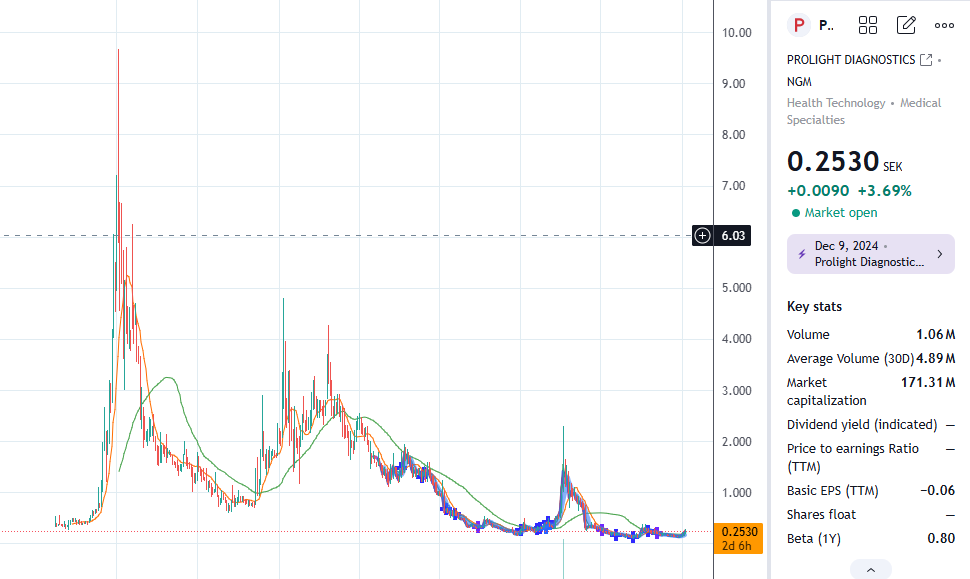
Screenshot 2025-01-22 124333

Nyt yhtiö on kuitenkin “loppusuoralla”:

  • Lopulliset tuotantoprototyypit laitteesta ovat valmiina [Lähde]
  • Kertakäyttöiset näyteyksiköt ovat viimeistelty [Lähde]
  • Pilottilinja näyteyksiköiden tuottamiseksi on valmis tai melkein valmis, ja se tuottaa tarvittavat näyteyksiköt pre-validointiin ja lopulliseen validaatiotutkimukseen [Lähde]
  • Täysin automatisoitu massatuotantolinja miljoonien näyteyksiköiden valmistamiseksi on suunnittelussa yhteistyössä FlexMedical-yhtiön kanssa [Lähde]
  • Markkinahyväksynnän edellyttämä pre-validaatiotutkimus on meneillään ja sen raportin tulisi tulla julki Q1 2025 aikana.
  • Pre-validation pohjalta toteutetaan varsinainen validointi 2025 aikana.
  • Markkinoille pääsy voi tapahtua vuoden 2026 alussa.

Markkinoille tulon lähestyessä osakkeen kiinnostus näyttääkin kohottaneen osakkeen lyhyen aikavälin nousutrendiin:
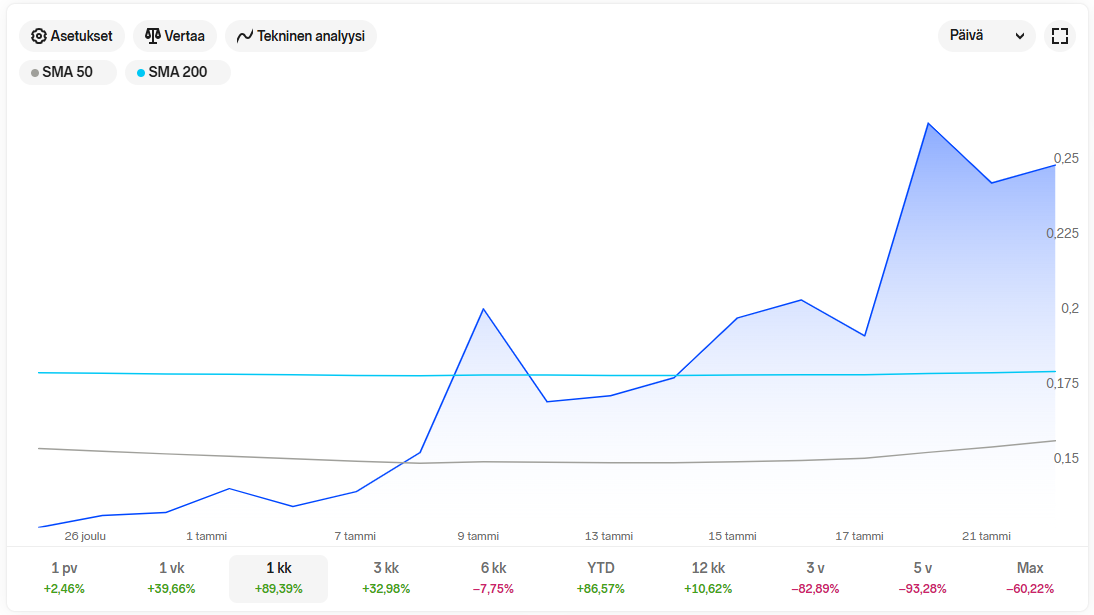
Screenshot 2025-01-22 140327

Pre-Validation:
Q1 2025 aikana tullaan julkaisemaan alustava raportti joka linjaa markkinahyväksynnän edellyttämän validointitutkimuksen yksityiskohdat.
\u003eThe pre-validation study that includes fresh blood samples from approximately 120 cardiac patients at St. Thomas’ Hospital in London and approximately 1,200 frozen plasma samples from biobanks. First results from the study, expected in Q1 2025, will fine-tune the system, minimising risks and ensuring the robustness of the final design. This progress aligns with the clear path to IVDR certification and commercialisation in 2026.

Nostoja tiiviisti:

  • Kassavirtaa ei käytännössä vielä ole, grantin maksuja lukuunottamatta. Yhtiöllä on vielä noin 17M SEK maksamattomia avustuksia.
  • Rahoituksen riittävyys on kysymysmerkki.
  • Emergers antoi osakkeelle käyvän arvion 0.9-1.0 SEK tai yrityskauppatilanteessa 2.1 SEK, mutta osake on pyörinyt pääosin 0.15-0.25 välillä. Merkittävää piristymistä on kuitenkin ilmassa.
  • Yhtiöllä on 17 M SEK avustus briteistä, joka kattaa ilmeisesti suuren osan validoinnin kuluista
  • Yhtiö on kerännyt rahoitusta warranteilla. Viimeisin TO7 warranttikierros merkattiin käytännössä täysin viime lokakuussa. Samalla johto merkkasi kaikki warrantit omalla rahallaan, mikä lienee positiivinen merkki: October, the TO7 warrant
    program was exercised at a 96.4% rate, raising SEK 12.6m before costs.
    Management and board members fully exercised their warrants, increasing
    their ownership to 22.8% of total shares—a strong signal of insider confidence
    in Prolight’s progress and potential.
  • Yhtiöllä on myös toinen tuote tuote Medflex jota kehitettiin ensimmäisenä. Sen suorituskyvyn erityisesti pienillä biomarkkereiden pitoisuuksilla koettiin heikommaksi kuin myöhemmin yrityskaupalla saadun Psyroksen. Medflexin kehitys kuitenkin jatkuu, ulkoistettuna kolmannelle.

Yhtiön osakesivu Nordnetissä: Prolight Diagnostics (PRLD) osake | Nordnet

Viimeisin Emergersin valuaatio-arvio 20.1.2025

Viimeisin kvartaaliraportti Q3 2024

Yhtiö on kiinnostanut itseäni jo pitkän aikaa, ja viime aikoina osake on myös osoittanut voimakkaita elpymisen merkkejä. Päätinkin aloittaa tästä ensimmäisen Inderes-ketjun, etten sokaistu “fomoon”. Päivittelen aloitusta ajan myötä.

Keskustelun virikkeeksi:

  1. Voiko yrityksen kassa riittää markkinoille asti, vai tarvitaanko lisää rahoitusta?
  2. Onko Psyroksella oikeita kilpailuetuja, ja mikä on myyntipuhetta?
  3. Mikä on POC-markkinan tulevaisuus?
7 Likes

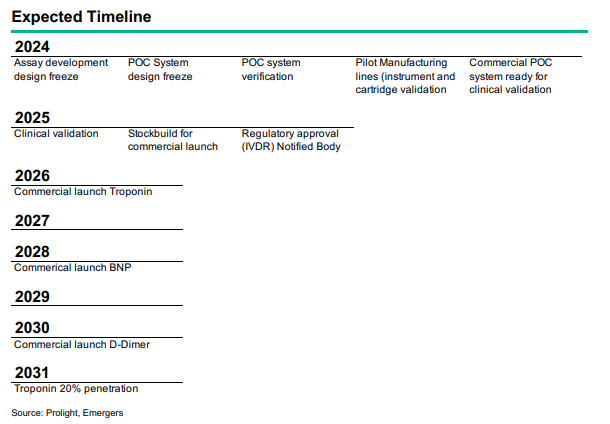
Market entry timeline.

Screenshot 2025-01-22 133525

From this, one could conclude that Prolight is slightly behind its competitors. For example, Norwegian SpinChip already has market authorization. In my interpretation, SpinChip is the toughest competitor because it also achieves better accuracy than other POC (Point-of-Care) systems, comparable to Prolight, and it also does not require blood plasma separation. SpinChip is currently seeking CE approval to comply with the EU’s IVDR (In Vitro Diagnostic Regulation) and the expected approval is by the end of 2025.

Fun fact: SpinChip was recently acquired for a hefty sum of 138M.
equity-research-prolight-spinchip-deal-highlights-the-strategic-importance-and-valuation-potential-of-prolights-solution.pdf

For comparison, Prolight’s market capitalization is only a tenth of that. If the technologies and companies are even somewhat similar, the stock might appear significantly undervalued to some.

Let me also add my thoughts on the initial question 1: The company will likely need additional funding during 2025. Development will probably still consume a few million, and the cash reserves cannot completely dry up. There are two options I consider likely for this implementation:
a) A new warrant issue, similar to previous ones.
b) A marketing and distribution agreement with a large partner, which would provide an advance payment.

3 Likes

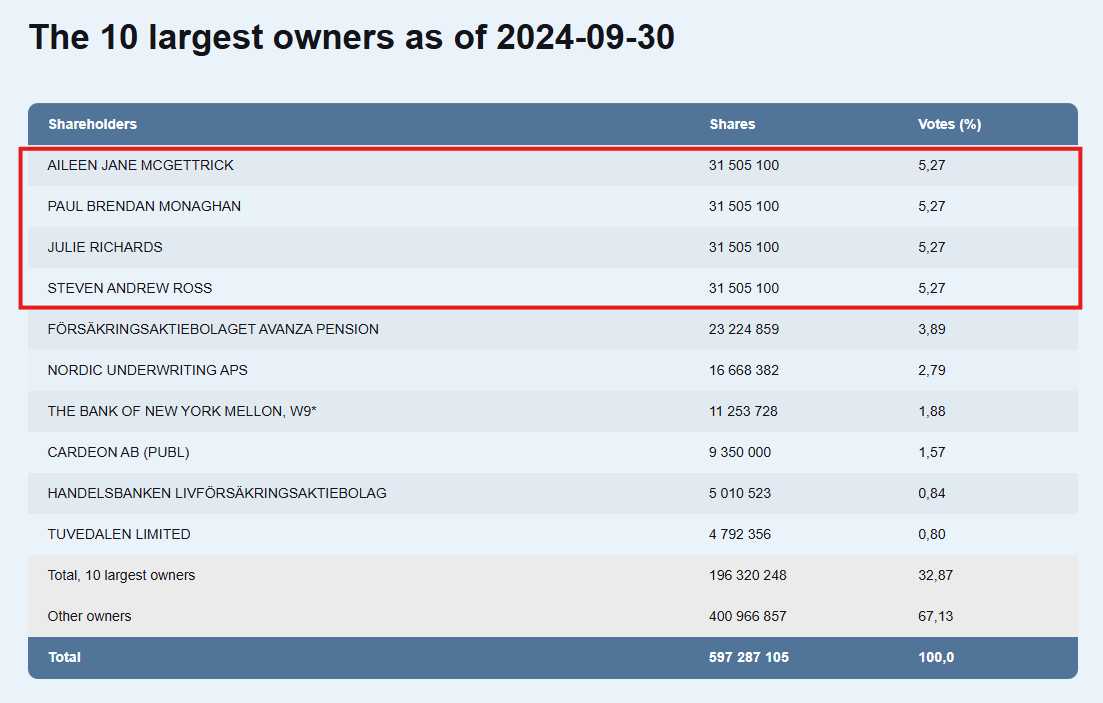
As a random highlight: A positive new piece of information for me was that the founders of Psyros, who are now in Prolight’s operational management and are four of the largest owners, each with approximately 5.5% ownership, previously made an exit for 90 million by selling Vivartis, a company that developed POC (Point-of-Care) testing, to pharmaceutical giant Novartis already in 2012. So, previous experience seems to exist.

Novartis Acquires Vivacta | Mergr M&A Deal Summary

Screenshot 2025-01-22 165325

The ownership structure and the stakes of the Psyros founders in September 2024 are presented below. However, the management subscribed to all their warrants in the offering carried out in autumn 2024, and their ownership stakes increased to 5.7% per person.
Screenshot 2025-01-22 170610

2 Likes

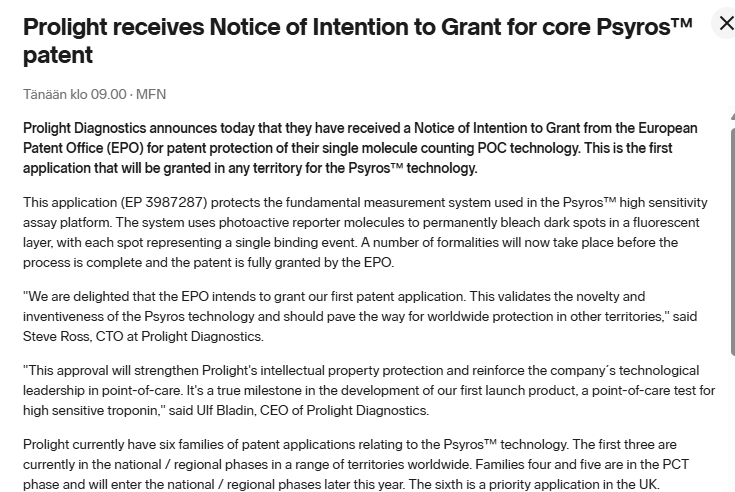
The stock opened today with a nice 25% increase following patent news. At the time of writing, it is still up 10%.
Screenshot 2025-02-18 132846

4 Likes

Screenshot 2025-02-19 122130

Today, there was another patent update. However, this is not particularly significant; in practice, it is a small addition to the patent from yesterday’s news.

1 Like

This thread has unfortunately become a monologue.

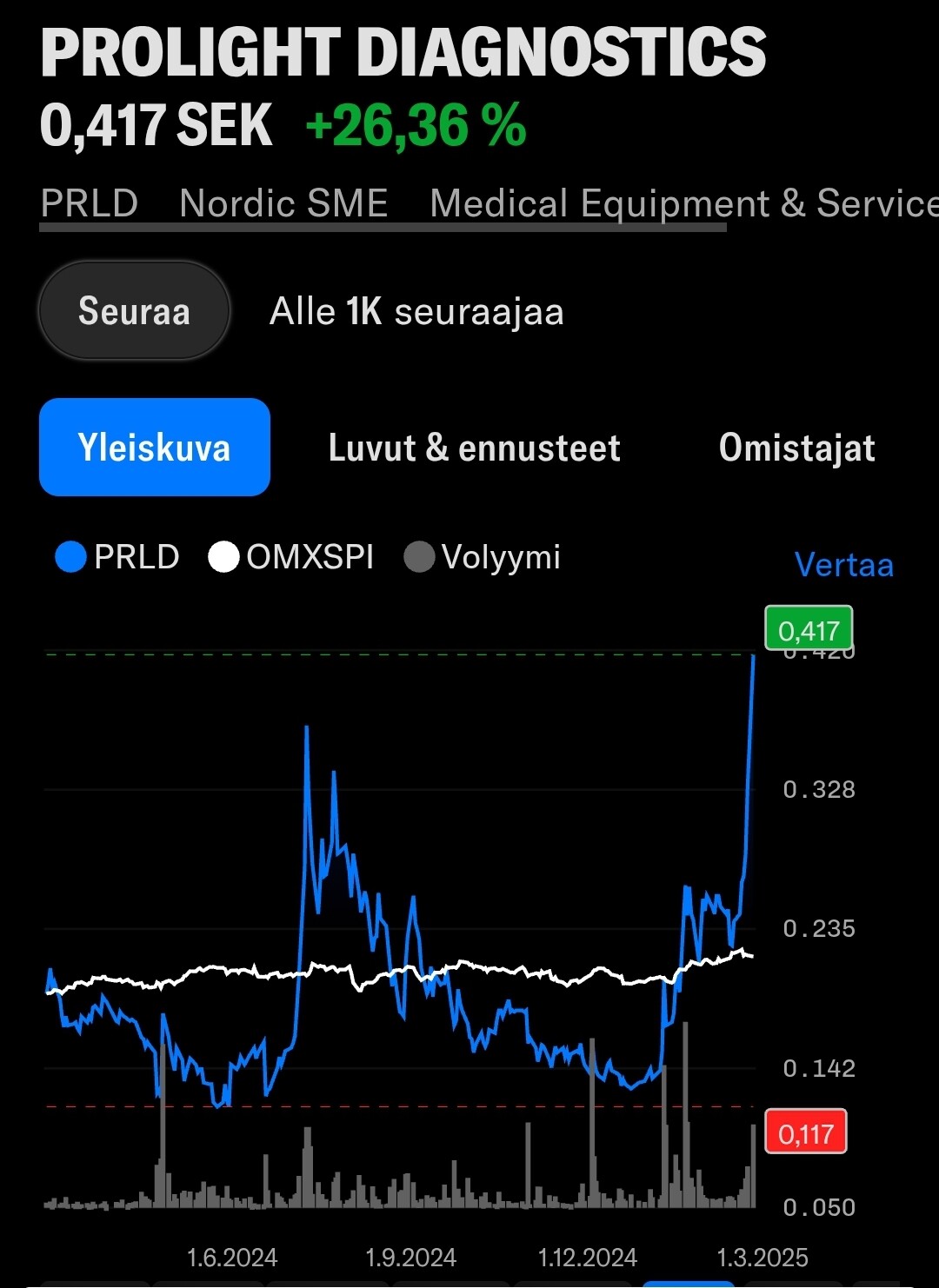
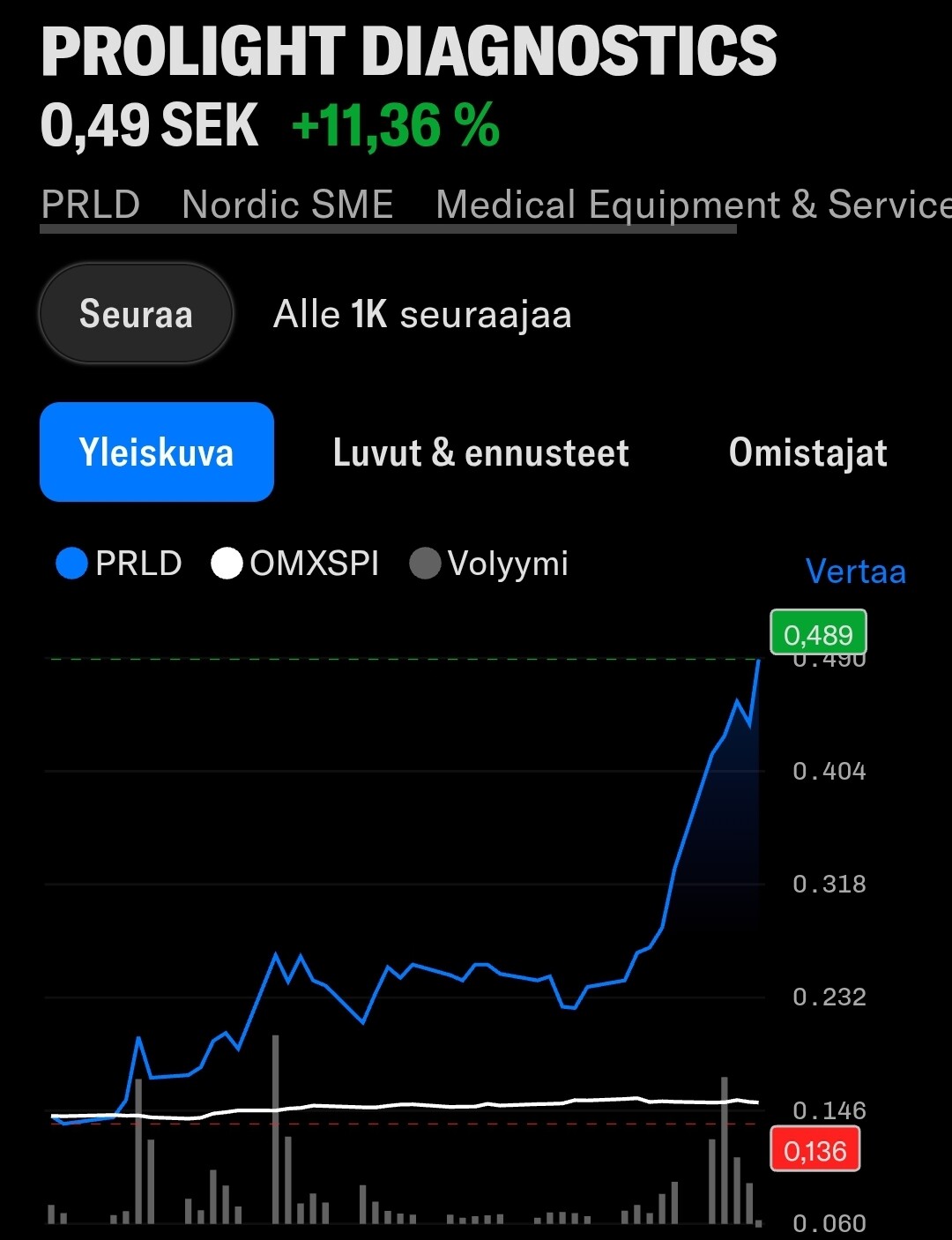
However, let’s bump the thread by noting that today, around 2 PM, it suddenly jumped by about 15%. No new news has emerged, though. Since the thread started, it has risen by 26%.

As a small disclosure, I originally joined in around the 0.10 SEK range and am currently in at an average price of 0.15 SEK, which is why my 3-month average returns already exceeded 100% today.

Similar competitors have been valued in the hundreds of millions in M&A situations, so for now, the stock will remain in the portfolio for the foreseeable future.

2 Likes

For some reason, the company doesn’t seem to be generating interest, so I’ll have to continue with a monologue.

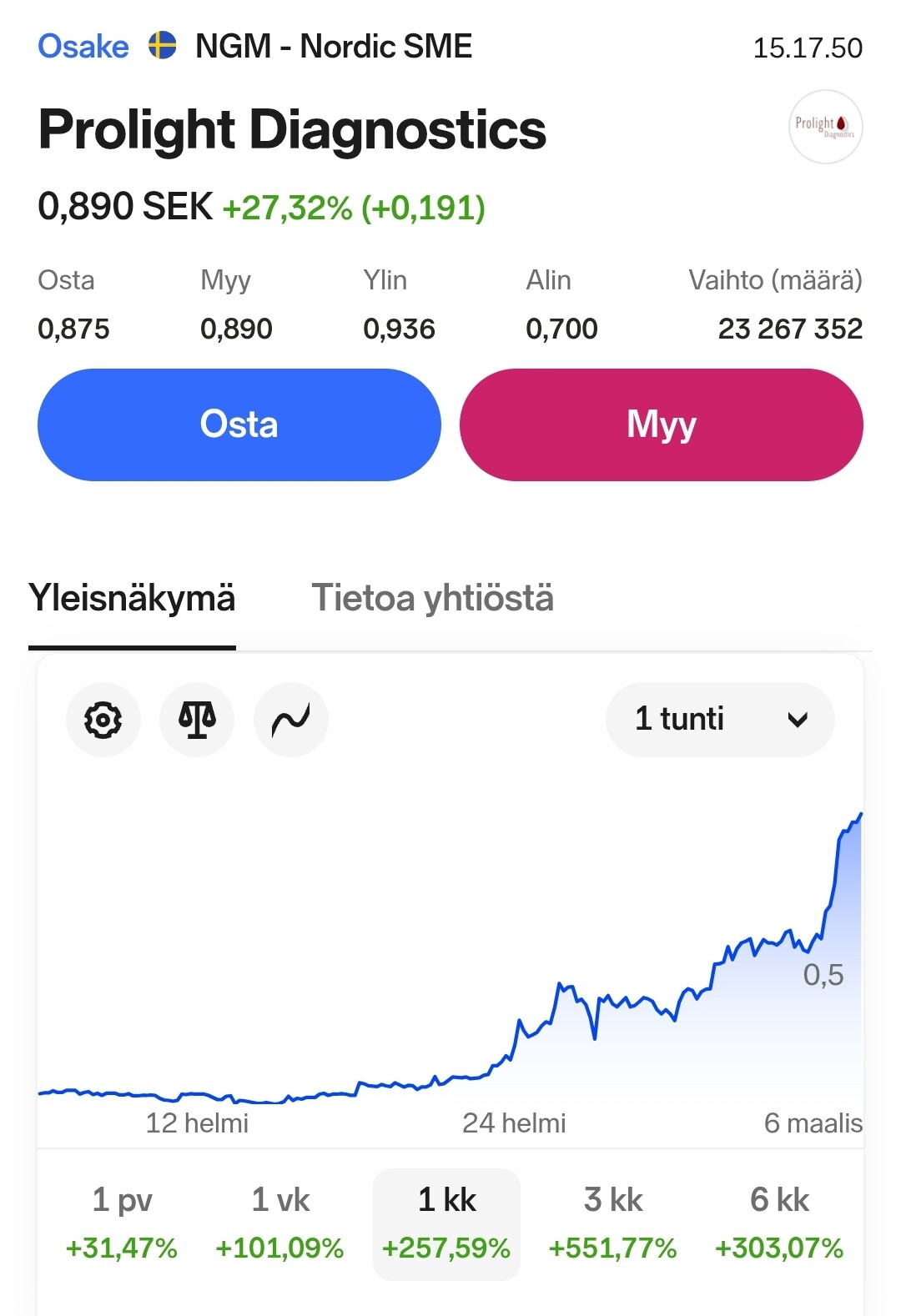
Yesterday, more unusual market movements were observed. No news came out, but the stock rose by as much as 40% and closed at the figures shown in the picture.
Screenshot_20250225_080823_Chrome

This morning opened with an additional 10% rise.
Edit: now we are already in the second day of 26% gains.

Possible reasons for the rise:

  1. The stock is simply very illiquid, and there are high expectations for this week’s Q1 report, as the pre-validation preceding market acceptance testing of the equipment is scheduled to be released during Q1.
  2. Could the company be entering into a marketing agreement and the information is leaking? It’s hard to say if it’s even appropriate to speculate on something like this, but it has been noticed that with small companies, the stock price tends to rise significantly in advance of major news.

I can’t think of any others. The week’s gains are already 100%. Of course, the market cap is also small. There must be something behind this. Perhaps it will become clear in the earnings report to be published on Friday.

4 Likes

Today, the year-end report was released. The report turned out to be positive, but we haven’t yet received new news that would explain the recent sharp rise.

Costs are under control and the operational result is even moderately positive, even though sales haven’t started yet. The funds should last a while longer, considering the outstanding research grants.

Screenshot_20250228_134058_Chrome

Pre-validation results are still awaited during Q1. From the CEO’s comments, one could infer that the device is being tested by potential large partners.

The share price is currently +12%, correcting yesterday’s decline.

No news related to the company. However, I returned to bump the thread with a price update.

Since the thread started, we’ve risen about 300%. I can’t name any clear drivers.
Screenshot_20250306_163630_Chrome

1 Like

I’m bumping the thread with the update that an interesting week is starting now. The first validation results for the Psyros device are scheduled to come during Q1, i.e., this week. There has been a lot of talk, for example, about interested partners. A successful pre-validation would be an opportune time to sign marketing agreements so that preparations for the market in 2026 can begin.

Prolight Diagnostics publishes year-end report 2024 – Prolight Diagnostics

2 Likes

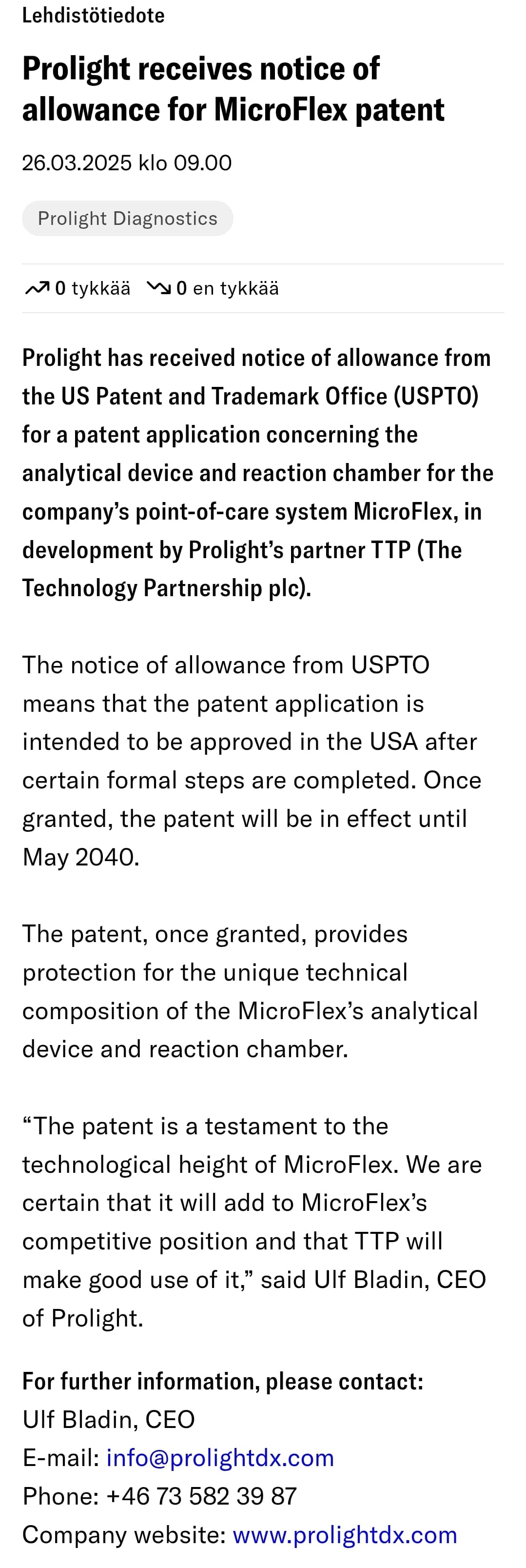
Screenshot_20250326_101542_Chrome

Patent news. Is even old microflex technology apparently still relevant? Or perhaps an old patent application was only just approved now. In any case, the cutting edge of development is in Psyrox.

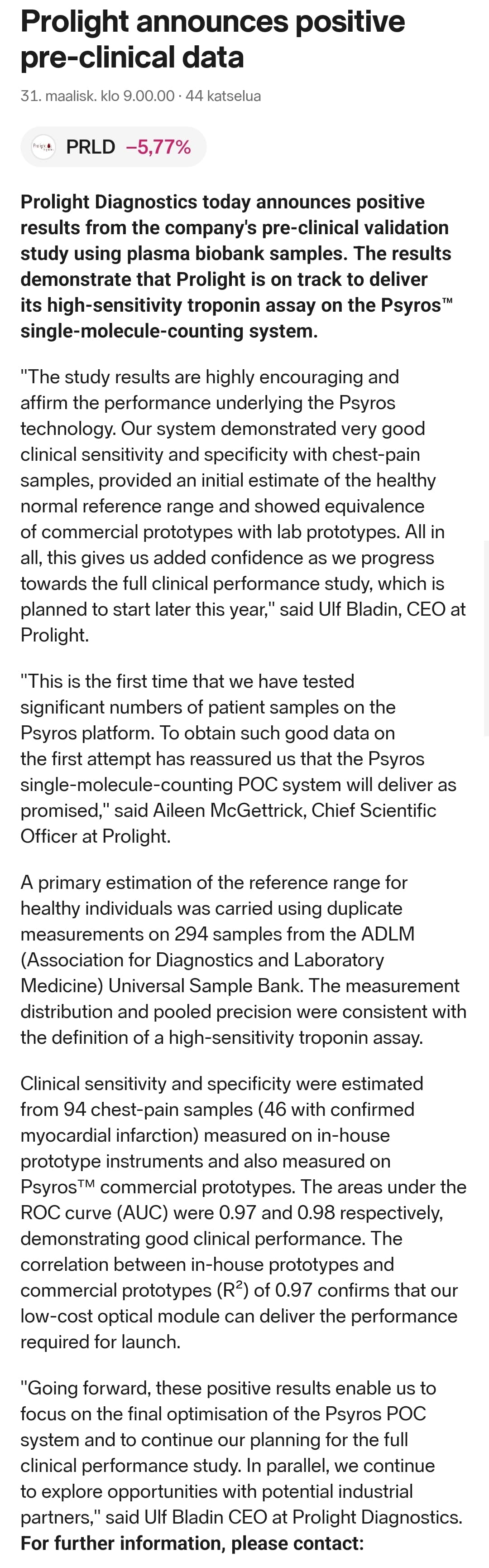
Today, the long-awaited news of successful pre-validation arrived. The commercial prototypes successfully replicated the in-house prototype’s results beautifully.

However, the disclosure was disappointingly brief. We didn’t get a comprehensive report, just a few figures in a stock exchange release. The release did, however, mention the device’s discriminative ability for myocardial infarction: if the data is otherwise comparable, and the mentioned AUC 0.97-0.98 can be replicated in clinical conditions, that makes it an incredibly good PoC device. Even with central laboratory devices, the figures are not that high.

Spinchip’s hs-cTnI AUC was 0.94.
Abbott Architect hs-cTnI AUC = 0.94,
Roche Elecsys hs-cTnT AUC = 0.93.

However, Spinchip’s device is not even a portable model. The latter two are devices used in central laboratories.

Nevertheless, one should not draw too many conclusions based solely on AUC. Not enough is known about the sample, and other statistical figures are needed. However, it gradually seems that the title of this thread is quite justified.

Screenshot_20250331_111459_Nordnet

2 Likes

I will finally interrupt Mauski’s quality monologue. Hopefully, this company will generate discussion.

This week’s news about good AUC results did not cause a share price reaction. I’ve been wondering why.

Perhaps the results had already leaked earlier. Maybe the leak of the results was the reason for the share price increase in March to almost 0.90 SEK?

Another option is that investors simply overlooked the matter in the press release, or its significance is not understood in this case.

Thirdly, I wonder if the AUC results are considered good but uncertain at this point, and therefore insignificant. The study’s data is very limited, and a broader study is underway. Only the upcoming study will be comparable in scope to the results of those other devices.

I have only been familiar with the company for a few hours, so all my speculation is just speculation and guesswork with very little information.

This is indeed an interesting company from the health sector. Instead of inventing something strange and unique, this is about technology that improves existing ways of diagnosing patients. Similar products already exist, but this one is smaller, better, and even more affordable. Certainly not as revolutionary a product as Revenio’s highly successful iCare tonometer, but I see similar features in them. Overall, however, I personally like that the company’s main product is being developed for an existing market, and the company’s product can also grow that total market due to its features. Since there is no similar small-sized device, new applications, for example in ambulances, can be found for this diagnostic tool compared to other similar diagnostic devices.

It is always important to me that a company produces genuine and visible added value for its customers or users of its products. In the case of this product, added value arises from the fact that suspected heart attack patients do not need to be transported for hospital care, expensive laboratory tests do not need to be performed, and the diagnosis is faster and more reliable. I saw a figure somewhere that approximately 90% of suspected heart attacks are unfounded. If these can be quickly and reliably ruled out already in the arriving ambulance, several costly stages can be avoided. On the other hand, whether these unnecessary suspicions can already be deemed unnecessary by other means, for example by interviewing the patient, etc., I do not know.

This morning I opened my first position by buying about 20,000 shares. I will wait to see if the CEO will issue a separate enthusiastic press release about the stock exchange announcement, which the media would pick up. I am still waiting for a reaction to that, although I don’t know why it would happen so late now.

Hi, Thanks for interrupting the monologue.

I did enough detective work to conclude that the rise stalled partly because Nordic Underwriting, which underwrote the 2023 warrant issue and received a significant number of shares from the unsuccessful issue, likely sold about 5 million shares into the market over 3 days, draining the power from the rise in an illiquid market. The sales began immediately after the announcement was published and continued in batches of 5,000-20,000 shares for about three days.

In total, 4.6 million shares were sold through the Swedish SEB bank, and almost zero were bought. This means that a single institution, likely on the top 10 list, probably sold the shares. I examined changes in the top 10 over previous years and found that Nordic Underwriting also sold the same 4.6 million shares in a short period last year. So I would consider it likely that it’s the same institution.

The latest list of top 10 shareholders on Prolight’s website is from the end of the year. Is a more real-time list available somewhere? I understood that in Sweden, the list should be updated quarterly.

2 Likes

Screenshot_20250509_130714_Chrome

More Microflex patent news. We’ll see if Microflex also has potential. I still consider it a completely secondary product for which I have very few expectations.

Have you been following Prolight’s story yet?

Now there’s a rights issue coming, which will practically double the number of shares. Money coming in is 20-115 MSEK, and the market value is around 380 MSEK with full subscription, of which over 100 MSEK is cash.

The share issue was announced quite late. At the end of Q1, the cash balance was only 3.17 MSEK, to which 9 MSEK in subsidies and 8 MSEK in bridge financing were added during Q2. Money is burned at least 10 MSEK per quarter, so the cash situation was allowed to become very tight.

Could there have been a partner deal on the table that was thought to bring in money but ultimately fell through early in the year? Or why else was capital raising delayed like this?

Additionally, results from an important study have been promised by the end of Q2, meaning they could be coming any moment. The subscription period lasts until the end of June, so results can be expected before committing to subscribe. Rights will likely not be needed, as there is also an option for an additional 15% issue if necessary.

In any case, the funds should be sufficient at least beyond 2026. After the Q2 study, apparently one more extensive study is needed before CE marking can be applied for, but the timeline for commercialization to begin in H1 2026 still holds.

2 Likes

Still under observation and in the portfolio. I was thinking of subscribing for my own shares and perhaps slightly increasing the portfolio. Currently, it’s under serious consideration whether to sell the shares now that we are clearly above the subscription price. With the company this far along, the subscription could go very well if they advertise it. However, the 2023 subscription went quite terribly, and the 2025 offering does not include warrants as a bonus. On the other hand, the lack of warrants perhaps signals that the company does not foresee needing money in the near future.

Including these new subscription commitments, the Rights Issue is now covered by subscription commitments amounting to approximately 16.2 MSEK, corresponding to approximately 16.1 percent of the Rights Issue, of which 9.9 MSEK is represented by a subscription commitment from the Company’s UK-based instrument contract manufacturer ITL, corresponding to approximately 9.8 percent of the Rights Issue. In addition to its subscription commitment, ITL has undertaken not to sell or transfer any shares before September 30, 2026, under a lock-up agreement.

However, it is a very positive sign that the contract manufacturer ITL is willing to take a risk by taking shares as an advance payment, and the shares are vested. ITL’s CEO has also quite visibly praised the Prolight collaboration, for example, in annual reports.

The primary purpose of the Rights Issue is to strengthen the Company’s financial position in ongoing partnership discussions and to finalise the development of the Point of Care (“POC”) system Psyros™ (“Psyros”)..

“Ongoing partnership discussions” is again a tremendously good signal, although it could also be sales talk that practically means nothing significant. However, advance commitments are very low (16%), and the management’s own subscribed shares are small. The 4 founders of Psyros each own 4.5% of the shares, and CEO Ulf owns one percent. The founders of Psyros previously made a huge profit from their previous company, so one would think they’d have funds for this too? I wonder if they have a large number of incentive options open?

By the way, do you ever recall seeing a situation where management ends up subscribing for significantly more options than they publicly committed to beforehand? A shrewd player would do this if they wanted to snatch a larger share of the company before significant results. Not necessarily entirely according to regulations, but it’s probably impossible to monitor.

The share issue was announced quite late. At the end of Q1, there was only 3.17 MSEK in cash, to which 9 MSEK in subsidies and 8 SEK in bridge financing were added during Q2. At least 10 MSEK is burned per quarter, so the cash situation was allowed to become very tight.

That’s how it looks. Right now I can’t check the figures, but according to my recollection, some more previously decided subsidies were expected during the summer.

Previously, I looked into grants distributed by the British and noted that it might be possible to apply for a separate NIHR grant for final validation as well. The programs seemed quite extensive. This is certainly more difficult.

I have previously wondered that the resources and time used for this pre-validation seem quite heavy, considering that pre-validation is not actually a mandatory procedure. This could be justified by a couple of factors:

  • Money and partners: In an ideal situation, they want to get solid proof from pre-validation so that they have good leverage to get a large partner to finance the final validation and simultaneously prepare for commercialization. In principle, conditional offers might have already been made for this, because, according to Prolight at least, there are enough interested partners. Pure speculation.
  • Approval and risk management: Based on preliminary information, the device’s accuracy is top-notch, at least competing with central lab devices, if not even better. At that level, the choice of sensitivity and specificity, reagent ratios, and perhaps even the physical properties of the device, such as the distance of the light sensor, may be extremely sensitive to changes. All these factors must be precisely optimized before actual validation, and to obtain a comprehensive dataset for optimization, extensive studies must be conducted, and differences between whole blood vs. plasma must be considered. Potential errors and problems that would only emerge during validation would become very expensive, and possibly the entire validation would have to be started from scratch.
  • Regulatory risk: The EU’s new IDVR came into force in summer 2022, and it made the approval of medical devices much stricter. The previous directive was 25 years old and completely outdated, and otherwise, the requirements were almost a joke compared to before. Almost all devices were approved without third-party validation, relying on the manufacturer’s own word, and no actual scientific process for verifying performance was required. Manufacturers could even justify performance with “equivalent” devices (“predicate devices”). Now the new regulation is very strict and the rejection threshold is high.
  • Regulation + approval: The new IDVR is very strict about the fact that if significant changes are made to the device, validation and approval must fundamentally be carried out again. Even a small adjustment of reagents would thus change the device’s properties, making it an expensive operation. Therefore, optimization must be done comprehensively before actual validation.
1 Like

The valuation is now practically the same as it was a couple of years ago, even though the company has advanced a lot. And this time, there’s potential for this to be the last offering. I believe at least 100MSEK will be raised.

There might be more of those, but absolutely the offering is really small, so one would think it would fill up quickly even from small streams.

This is an interesting point, because now the management and others have given their commitments even before the research results have been published. I don’t know if the results are even known to the management yet, but I certainly wouldn’t commit to subscribing before they are published.

So, is the actual validation about the study that will be conducted after the Q2 study is published, and based on which permits can be applied for in Europe?

By all means, sell; after the results, you can buy them back cheaper and won’t have to bear the risk. It’s unlikely that new shares will be snatched up quickly anyway.

Could another reason for this have been the desire to stretch the offering until after the research results?

So, is the actual validation about the study that will be conducted after this Q2 study is published, and based on which permits can be applied for in Europe?

Yes, so now we optimize and ensure flawlessness, and then the actual validation is performed, which fulfills the IVDR “performance evaluation” criterion. During and after the latter, the device and specifications are intended to be kept unchanged.

1 Like

New presentation video for the Psyros device

https://youtu.be/WVNC8vKRdWA?si=-ZSWBgD2FU2Hsmzs

The video hinted at what markers might be in the development pipeline.

Screenshot_20250609_212100_YouTube

1 Like