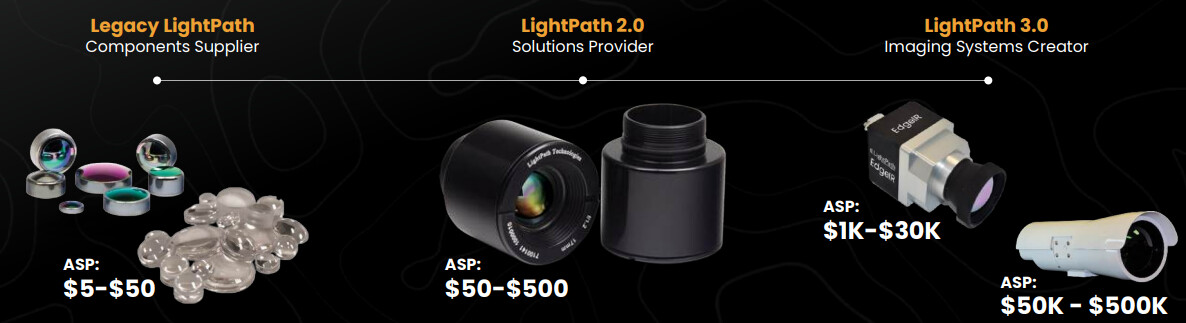
LightPath Technologies designs and manufactures optical and infrared imaging solutions for the needs of industry, defense, telecommunications, testing/measurement, and the medical industry. Their offering ranges from individual optical components (e.g., precision-molded glass aspheric lenses) to finished infrared cameras and customized optical assemblies.
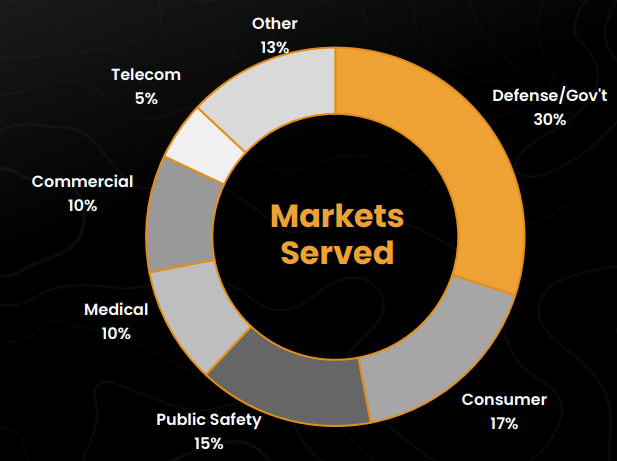
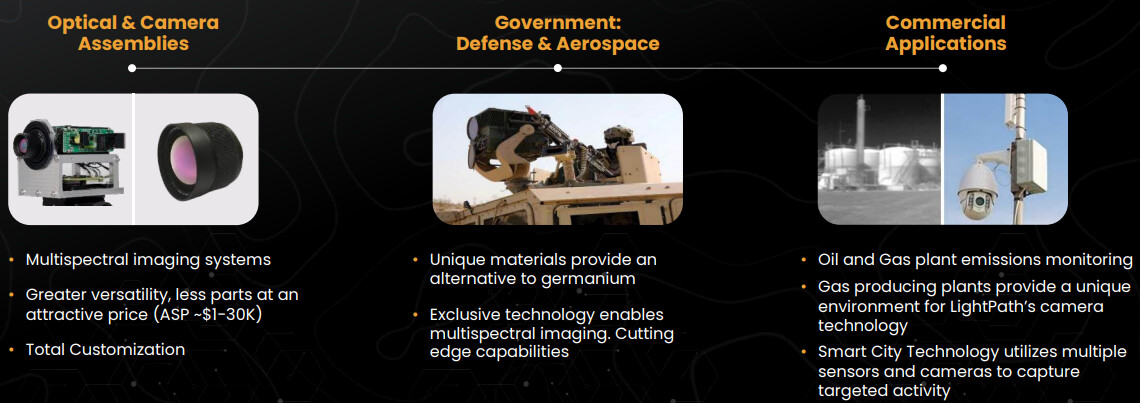
The company is known for its proprietary, patented BlackDiamond chalcogenide glass, which replaces germanium and enables lighter, multi-spectral camera systems. BlackDiamond is a significant competitive advantage for the company because it is not dependent on germanium, which is primarily controlled by China and whose exports China has restricted/banned as a result of the trade war. The company sees government entities (militaries) as its largest customer segment.
In its latest investor presentation, the company highlighted three growth pathways. The strategic investment of 8 million USD (price 5.0 USD per share and ownership stake ~3.0%) made by Ondas Holdings and Unusual Machines in September 2025 likely points to drone-related applications.
At the time of writing, the company’s market capitalization is ~613 million USD. The company has recently (December 2025) conducted a 60 million USD share offering at a price of 7.75 USD per share.
Below is a summary of the press release. I think it’s a good deal for the company.
LightPath is paying $7.0 million in cash for the acquisition. Additionally, a potential option of up to $3 million has been agreed upon, tied to achieving certain targets.
The acquisition is estimated to bring approximately $3.0 million in additional annual revenue to the company. Most of AMI’s revenue comes from long-term defense programs. So, the purchase price is 3.3x revenue, which I don’t think is bad at all.
The deal expands LightPath’s capability to manufacture large infrared lenses and grows the company’s range of chalcogenide-based products.
In the future, the company will be able to manufacture its own BlackDiamond™ glass in diameters of up to 17 inches (instead of the previous 5 inches). This enables access to high-value long-range imaging markets (e.g., space technology).
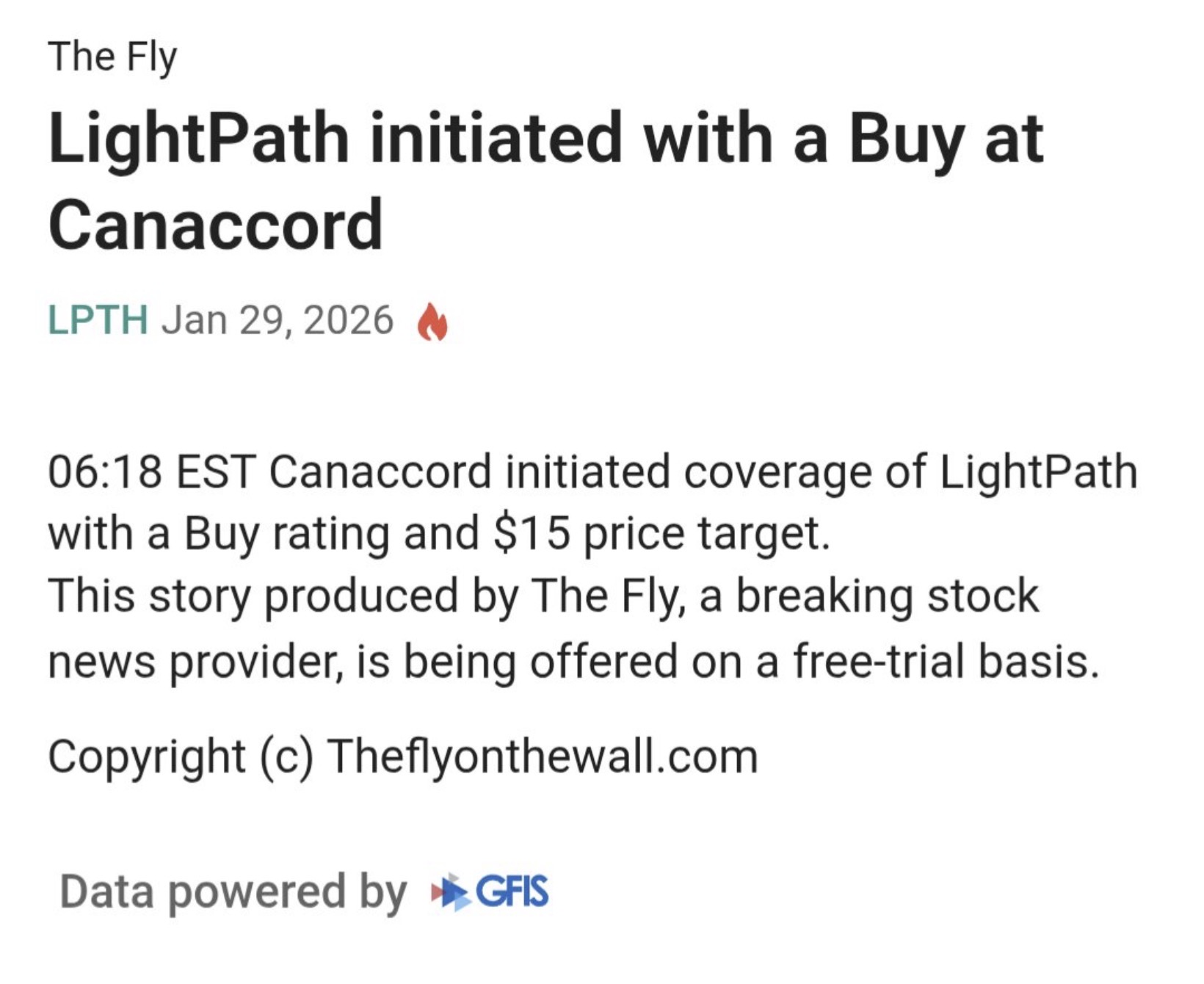
Canaccord initiates coverage of LightPath with a Buy rating and a $15 price target. Comment from the report: ”Canaccord initiated coverage of LightPath with a Buy rating and $15 price target. Global manufacturers are actively seeking a high-performance Germanium alternative, which has generated substantial tailwinds for LightPath, which is actively replacing its Ge infrared optics with its new BlackDiamond chalcogenide glass material, the analyst tells investors. Amid U.S. strategic and regulatory disruption for existing drone production, LightPath has made extensive inroads into the U.S. drone supply chain.”
LightPath has received a new $9.6 million order from an existing defense customer. The order is for cooled infrared cameras. The company will release its second-quarter results this Wednesday (Feb 11) after the market close.
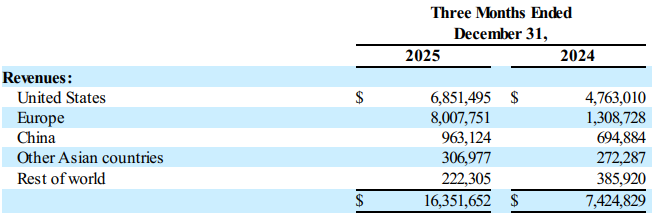
Q2 report is out. Revenue grew 120% y/y ($7.4M → $16.4M). Gross margin 37% (vs. 26% a year ago). Net result (loss) was -$9.4 million, but this includes a “7.6 millionUSD non-cash charge related to the fair value adjustment of the G5 acquisition earnout liability.” Adjusted EBITDA was positive at $0.6M (last year -$1.3M).
The backlog was $97.8M, the majority of which came through the G5 acquisition.
In summary: rapid growth continues while margins improve. The backlog is in very good shape. It is noteworthy that the company’s growth came primarily from Europe (+515% vs. +43% in the US), making Europe the company’s largest market in the past quarter (image below). The company does not provide guidance.
On the call, management spoke about the potential related to satellites:
“The space development agency (SDA) awarded in December $3.5 billion to build 72 tracking layer satellites. Those are all based on infrared cameras. Public information, which one can easily look up. That is $48 million per satellite…the infrared camera system typically is about a third of the overall cost of the satellite. So that is $16 million per satellite…So until now, Black Diamond was not even considered for use in those applications. And even though it has incredible properties suited just for that use case in terms of thermal behavior and such. So we had a couple of space-related programs in our category of potential $10-plus million programs. But those were small, definitely small compared to what we’re facing now. So now we get to play a major role in this… So couple that with SDA’s very recent announcement, I think last week, for a constellation of 300 to 500 satellites in low Earth orbit. And satellites in low Earth orbit have a fairly short lifespan. And this is, as they say, a whole new ballgame for us…However, a word of caution: satellite development takes time. The government works in two-year tranches, which means the next designs, the ones we plan to be part of, are not going to go out for at least another two years. So this is a huge potential for us, but it’s not immediate.”
In practice, this U.S. order tightens supply chain requirements for the defense industry, meaning that critical materials and components used in defense projects must henceforth come from the United States or allied countries (and not from China, which controls the vast majority of the supply of germanium used in lenses and sensors), and obtaining exemptions for foreign sources will become significantly more difficult starting in 2027. Furthermore, contractors must be able to trace components all the way back to their raw materials.
This plays directly into LPTH’s hands, as the company manufactures infrared optics, cameras, and its own BlackDiamond material in the United States, which is marketed as an alternative to germanium that is dependent on foreign sources. The company has previously emphasized its NDAA compliance and domestic supply chain, so the pressure on defense clients to shift to domestic suppliers should increase both demand and market share.