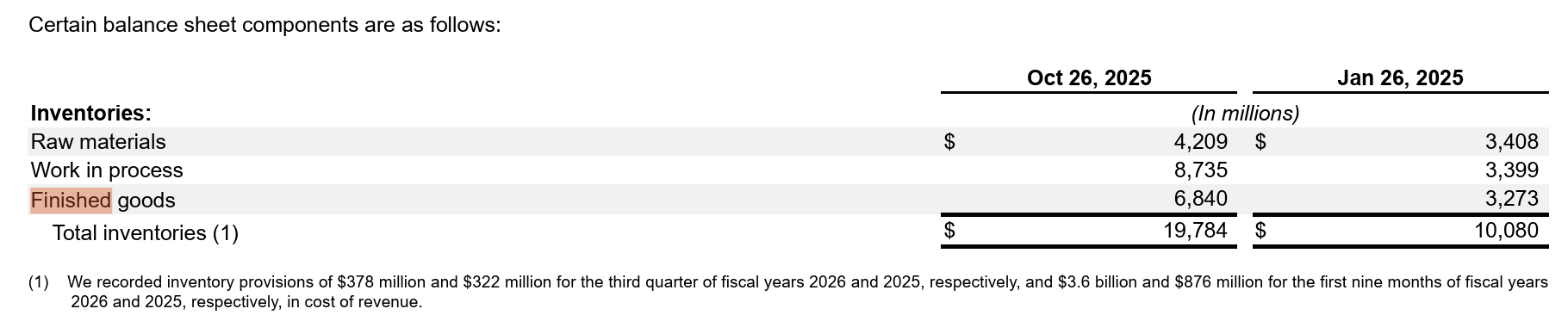
Inventories include goods in the pipeline (i.e., wafers paid to TSMC that are in production, wafers received from TSMC that are somewhere on their way to being cut from wafers, packaged, then soldered onto a GPU PCB, and assembled into a server rack), and this logically causes a situation where increasing sales and increasing production volumes create an effect where there are more goods “in inventory” this quarter than last quarter. As long as production volumes per quarter continue to grow, “inventory” would also do so, because the chain from an exposed silicon wafer to a finished server rack heading towards the customer’s data center is quite long.
An AI bot sniffed out this set of information on the topic, comparing the previous and most recent quarters (Q2 2026 vs Q3 2026), which would confirm this assessment. I didn’t bother to manually dig through the reports, so let me know if the AI produced nonsense this time:
NVIDIA Inventory Breakdown: Fiscal Q2 2026 vs. Q3 2026
NVIDIA’s fiscal year 2026 Q2 ended on July 27, 2025, and Q3 ended on October 26, 2025.
Inventory figures are reported in millions of USD on the consolidated balance sheets in their respective 10-Q filings. NVIDIA provides a breakdown into raw materials, work in process (WIP), and finished goods in Note 8 (Balance Sheet Components) of the financial statements.
Key Observations
Total inventory increased by 32% from Q2 to Q3, driven primarily by higher raw materials (+128%) and WIP (+98%), partially offset by a decline in finished goods (-21%).
This buildup reflects ongoing demand for AI and data center products, with provisions for excess inventory totaling $378 million in Q3 (vs. $886 million in Q2).
Inventory Breakdown Table
| Category |
Q2 FY2026 (Jul 27, 2025) |
Q3 FY2026 (Oct 26, 2025) |
Change (Q3 vs. Q2) |
| Raw Materials |
$1,843 |
$4,209 |
+$2,366 (+128%) |
| Work in Process |
$4,411 |
$8,735 |
+$4,324 (+98%) |
| Finished Goods |
$8,708 |
$6,840 |
-$1,868 (-21%) |
| Total Inventory |
$14,962 |
$19,784 |
+$4,822 (+32%) |
Based on this data, inventory is indeed swelling because there are always more goods in transit that are not yet ready for sale, and in fact, the pile of finished goods decreased compared to the previous quarter.