Nokian Tyres Plc

You’d think it’s a good sign when you start hearing this kind of speculation in public. In yesterday’s Kauppalehti market panel, Sari Lounasmeri, CEO of the Finnish Foundation for Share Promotion (Pörssisäätiö), highlighted Nokian Tyres as a potential turnaround company.

I don’t know how well-versed Lounasmeri is with this particular company, but I’ve believed in it ever since I bought my first Tyres shares a couple of years ago. After the recent rise in the share price, hope is starting to grow that the upward trend will continue. Should I top up more before it really takes off? This is a good place to continue from.

The article is behind a paywall, but it didn’t provide any further details regarding Lounasmeri’s thoughts.

20 Likes

In my opinion:
If you see this as a turnaround case, you’re already (a couple of) years late. When the Russian operations were scrapped and volumes along with them, I think we hit rock bottom, and since then the turnaround has been underway. This turnaround kicked off at the latest when the Romanian factory was completed, and now that turnaround is being worked on.

Looking at recommendations and forecasts, I think the share price has also run away, but I’m not complaining. Let it ride.
In my view, the valuation risk here is quite significant.

30 Likes

I’d venture to say that the real turnaround is still ahead of us and hasn’t been seen yet. Why would the turnaround have happened already, when the company’s operations are only just now properly getting underway? Evidence is needed for this.

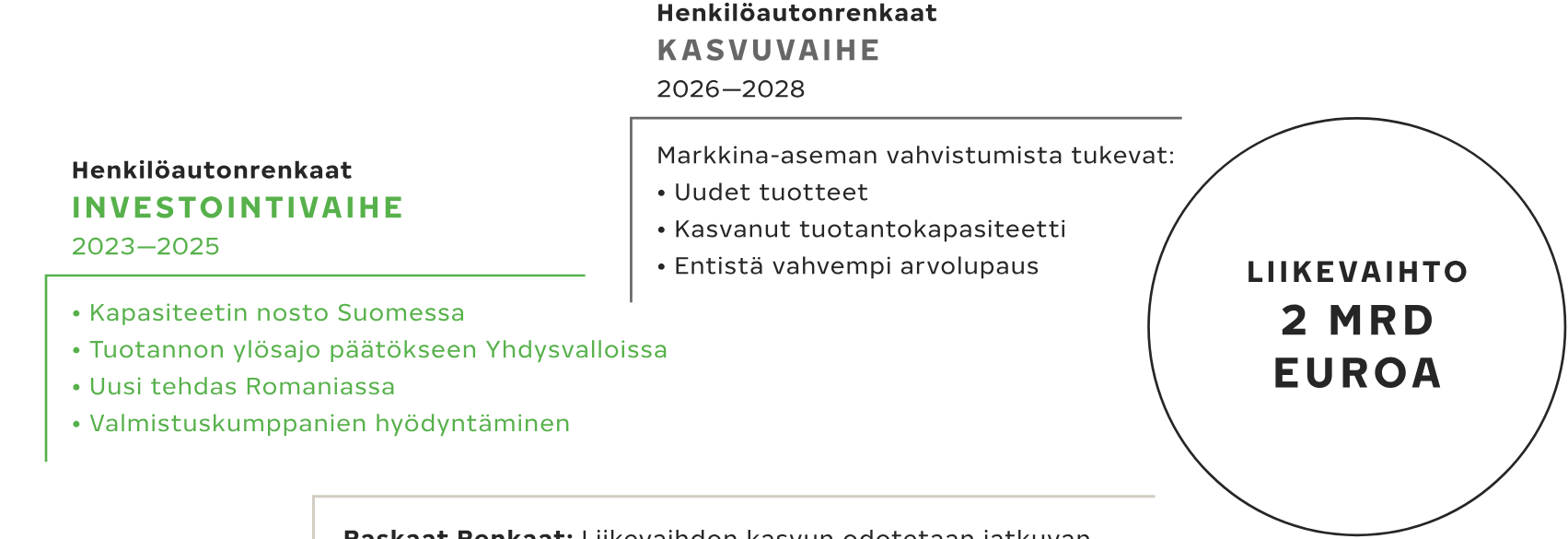
The turnaround happens when the market finally trusts the future and dares to price the company according to its true potential—assuming, of course, that the company has made it out of the slump. Regarding Tyres, it seems they have survived the exit, and the key metrics now mostly suggest that the company is very moderately valued, provided it can eventually return to the same sales figures and profit margins as before the war in Ukraine. The market doesn’t want to believe this until it becomes a reality. And that is what is being waited for now. The company must prove that it can deliver and that it has maintained its market position and reputation. That a €2 billion revenue is still achievable. At least I have strong faith in this.

21 Likes

Great innovation :blush: :+1:

“Nokian Tyres is launching the Nokian Tyres Betula concept tire, which incorporates a new type of raw material made from birch bark. The renewable material, produced by the Swedish company Reselo, utilizes birch bark waste from the global pulp, paper, and plywood industries.”

“From the beginning of the collaboration, the potential of the raw material as a tire material has been obvious. The Nokian Tyres Betula concept tire confirms the raw material’s suitability for tire manufacturing and highlights its potential for commercial use in the future. The raw material is not only sustainable, but according to our tests, it also seems to have the capability to improve tire performance,” says Nokian Tyres’ Innovation and Development Director Teemu Soini.

37 Likes

Good stuff. Sounds like the tire of the future.
However, I won’t start celebrating because of this; unfortunately, even this is business as usual. You have to develop your own product to avoid falling behind the competition.

“Green tires,” where recycled materials or biomaterials are used as raw materials, are not a competitive advantage now or in the future, but rather a market/regulator requirement.

”The reality is, we’re already more than halfway there. A whopping 65%* of the UltraContact NXT are crafted from these eco-friendly materials, and we’re committed to pushing that figure higher. We’re innovating, progressing, and relentlessly pursuing a future where 100% sustainable tyres are the norm, not the exception. This isn’t just the future of tyre manufacturing, it’s the future of our planet.”

In Continental’s words: the green tire will be the norm, not the exception.

Michelin’s goals give them some time, but they too are heading towards “green tires”
”Group is committed to using 40% renewable or recycled materials in its tires by 2030, and 100% by 2050.”

Pirelli has tires in production made from over 70% recycled or plant-based raw materials:

19 Likes

It’s good to remember the long game, i.e., what Nokian Tyres is preparing to compete against.

I mean against its former factory in St. Petersburg.

One day, peace will be achieved in Ukraine.

One day, Russian products will return to the market.

At that point, the highly profitable St. Petersburg factory will enter the EU market.

When Europe regulates environmental targets for its products and the requirement for recycled raw materials takes effect one day, the St. Petersburg factory’s advantage over local EU peers will level out.

Because ultimately, customers buy the cheapest tires that they consider safe.

5 Likes

Those Ikon tyres they’re now making in St. Petersburg are surely just as “hot” in the automotive world as Abibas sneakers are among sports enthusiasts.

25 Likes

Looking at it quickly, all sorts of Yartus, Westlakes, and Tigars are already being sold, so I don’t doubt for a second that there wouldn’t be a market for Ikon tires in Finland. How many 15” summer tire buyers look at the brand or handling versus the price?

3 Likes

Could the Russian origin of the tyres be one reason why not everyone is buying?

Personally, I will never buy Russian products as long as I live. Plus, that factory was stolen.

28 Likes

The human mind is a very forgetful sort, by the way.

The 2014 invasion of Crimea, ‘Putin cheese’, and even Valio’s plight were forgotten by companies quite quickly as they chased savings.

Consumers are no different.

10 Likes

I’m not actually all that worried about the competition Russians will bring to the consumer markets in the future. The return of Russian tires—and other products—to Western markets will surely happen at some point, but when? At the point when tires from the St. Petersburg factory return to the European market (in years or decades?), it’s worth considering the following:

  • Has the infrastructure of the St. Petersburg factory been maintained? I mean, production is likely being sucked in by the state at cost price to maintain the war machine today, and maintenance might be hit-or-miss → How long will the current equipment even function? Maintenance might be hard to get even with money.

  • Has there been investment in R&D? Are there committed people innovating? In today’s Russia?

  • Availability of raw materials, quality, and manufacturing equipment. Several sanctions apply to chemicals and equipment used in tires. Will high-quality raw materials be patched over with whatever is available, no matter what it is? Is there any other choice? Can they get new machines if the old ones break?

I am reasonably certain that potentially even today—let alone in perhaps a decade(?)—tires manufactured in St. Petersburg will not emerge as winners in a single impartial tire test, even against the cheapest Chinese tires. In tire development, a generation passes probably every couple of years, and that’s not easily caught up if there hasn’t been genuine investment in R&D. In Russia, this is not currently a very central focus for companies when they are mainly trying to stay alive in a war economy.

Even if they were to get a sales permit for Europe, since Western markets offer choice and tires are literally a matter of the buyer’s life, buyers will (hopefully) look through at least one test before making a purchase decision. At the current rate, watching the suicide of Russian industry from the sidelines, the tires they produce will probably be death donuts under any vehicle in a few years.

This is how I’ve thought about the matter of this Russian factory. It likely won’t threaten the markets of Western manufacturers for several years after the war ends and sanctions are lifted, if ever. In fact, Russia’s first sanctions came in 2014 after the annexation of Crimea. Before that, it was perfectly possible for them to develop anything to compete in Western markets, but what have they managed to sell here? Aside from vodka, I don’t know a single Russian product that sells in Western markets, if we exclude weapons. And even regarding those, I’ve heard dissatisfied feedback from customers. Performance does not match what was advertised.

Russian technology has never been able to compete in Western consumer markets. Only low value-added products like fertilizers, metals, oil, natural gas, and vodka sell. Competition for Nokian Tyres (Nokian renkaat) now comes from the West and, in a few years, perhaps also from China, as the quality of their products improves while prices remain affordable.

22 Likes

This is just one of those basic narratives about Russia that we are always sold. I haven’t been to Russia myself, and the stories about old Soviet-era factories visited by Finns are generally…

Let’s just say, quite exotic.

It’s worth remembering that there is a difference between a factory built in a peripheral area and one built in a city like St. Petersburg.

It’s the same in many countries.

I’m not quite sure if, when pondering maintenance issues, we are clinging too much to the memory of the Soviet Union. Vietnam once fell behind due to strict trade sanctions, but will the same happen to Russia in today’s world?

I wouldn’t be too sure about that.

Nowadays, many industrial products have a Chinese equivalent, and China hasn’t been interested in the situation regarding the war in Ukraine.

As for how advanced Russia is. Some also say that after traveling to St. Petersburg and Moscow, they were surprised by how every service has an app, how clean and advanced the city centers are, etc.

I’m only saying this because it’s not worth lulling ourselves into thinking that Russians wouldn’t know how to develop their own factories. Even though, of course, that’s the propaganda we’re being fed.

11 Likes

It wasn’t that long ago that there was an article somewhere saying that the factory stolen from NR hasn’t really taken off. And I don’t believe that tires from there would even be coming for sale in the EU area anytime soon.

1 Like

I read something a while back about how they spent months tinkering to get the Ikon sidewall molds, and that the winter tire studs aren’t the same as the ones Nokian uses. It’s just one of those things—buy Makita tools and anyone can become a house builder, and steal a tire factory from Nokian and you automatically know how to make car tires.

8 Likes

I have personally spent time at the factory in question on various projects. The factory’s degree of automation is high, and running it requires significant expertise.

They certainly had a competent organization back when NR still owned the plant, and at that time, the factory operated quite independently.

Production development was largely done in Nokia and often only transferred to Russia afterward. In other words, the locals didn’t really develop anything new themselves.

Personally, I believe that even in the medium term, the products and production methods will inevitably fall behind those of competitors—though this likely comes as no surprise.

65 Likes

Good points. I agree. Right now, we are living with the mindset that nothing is being done with Russia, and that nothing can be done there either. But it is indeed true that sentiments change. In a couple of years, there will already be young people who don’t even remember the whole war in Ukraine. It’s the same with Covid. Now people shake hands and cough just like before.

However, I still believe in Nokian Tyres (Nokian Renkaat) even in this new situation. Product development and competitiveness seem to be in the company’s DNA, so I hold.

6 Likes

My message below goes off-topic regarding Nokian Tyres and focuses on Russian society. However, I am posting it here based on the premise that the St. Petersburg tire factory will not be a threat to Nokian Tyres or other tire manufacturers, now or in the future.

Russian individuals are no less intelligent than any of us Finns. My central argument in this message rests on the Russian social order and their mutual trust. Over the last few years, I have read dozens, if not hundreds, of different stories about how things work there. Usually written by someone who has lived there themselves and knows the customs of their society. They all paint a similar picture of Russian society. Only Russia’s own propaganda tells how they can do everything and do it well. Individuals tell a different story.

Russia is a command economy. Everything flows from the top down. Success in life depends on connections and whom you can do favors for in your position. Success depends much less on how good you are at your job. And in a society where success means a job where state money is being distributed, for you to succeed, someone else must lose. It’s a zero-sum game more often than not.

This kind of society favors using time and talent to cultivate relationships instead of developing into a top specialist in your field. While top specialists can certainly be found there in every field, the incentives provided by society for succeeding in life are different. There is no academic freedom; if you say something in someone’s hearing that some bigwig above you doesn’t want to hear, then too bad for you.

Below is a good video by Elvira Bary, in which she describes the current technological state of Russia and begins her story from the Soviet era. She goes through, based on facts, where the money goes in Russia and what kind of impact it has on the development of things. She goes through how the funding of education and science, academic freedom, obtaining degrees, and challenging the prevailing view with new ideas works and what is achieved by it.

Conclusion: The St. Petersburg tire factory can be a significant player in Western markets if and only if a Western entity invests millions (or tens to hundreds of millions?) of money into it, updates the technology, production methods, and brings in the latest recipes and raw materials. How likely is this? Not in the timeframe that I see. But of course, I could be wrong. I will not write more about this topic in this thread.

35 Likes

Nokian Tyres will hold its CMD in February.

Apparently, the CMD is being held in Helsinki, rather than attempting to attract big money from London, New York, or Central Europe. As I understand it, the strategy, financial targets, etc., remain unchanged and will just be elaborated on further.

kuva

Investments have been made and capacity increased in every geographical region. Significant debt has also had to be taken on; now production just needs to keep running and products sold to end customers.
So, it’s all down to execution now. In Inderes’ forecasts, revenue does grow reasonably every year, but there’s room for more, and profitability & return on capital are creeping upward frustratingly slowly; ROE > 10% only in 2028 according to Inderes’ forecasts (and ROI is still only 8.6% in 2028).
An optimist can always hope that the US investments have created a solid foundation where sales exceed forecasts with at least reasonable margins, and that the consumer gloom in the Nordics finally eases a bit and things start looking up.

The insiders have some of their own skin in the game, though there could be more. (PS: that table shows the situation at the end of 2024! :man_facepalming: )

18 Likes

Here are Rauli’s comments on European new car sales in December. :slight_smile:

According to ACEA (European Automobile Manufacturers’ Association), new car sales in the European Economic Area were 8% higher than the comparison period in December, totaling 1.2 million units. The market has been on a slight upward trend throughout the second half of 2025. In ACEA’s statistics, the figures include the United Kingdom in addition to European Union and EFTA member countries. In the Nordic countries, development in December was mixed, with Sweden declining 9%, Norway rising a staggering 160%, and Finland declining 12%. We previously commented on Finland’s figures in this comment.

10 Likes

Rauli’s preview as Nokian Tyres reports its results on Tuesday, Feb 10 :slight_smile:

We expect the company’s revenue to grow and adjusted operating profit to improve significantly from an exceptionally weak comparison period. The fourth quarter is critical for the company, as it accounts for more than half of the full-year adjusted operating profit in our forecasts. Along with the results, attention will be focused on the capital markets day held the following day, where we expect

13 Likes