2018 wrapped up, and new things coming

A year is a short observation period, but I’ll still make a brief diary entry for the past “fiscal year.” This way, it’s saved in case I ever feel like looking back at the past. Of course, others are welcome to use this thread too, if you want to summarize your own year, celebrate good performances, or curse bad ones. :smiley:

First, a few individual stock picks, both good and bad. Entering the year, I clearly overweighted Nokia (30% of the portfolio), and that turned out to be a quite good move when the market’s pessimism began to unwind in February. Later on, Nokia’s weight in the portfolio dropped to a normal level, and shortly after the Q3 report, they left the portfolio entirely. If a profit warning (negar) occurs, I might potentially move back to the buy side.
Another overweight was Danske Bank, while the controversy surrounding the bank was swirling. Here, I clearly underestimated the braking effect of fundamentals and the importance of momentum, while overestimating myself in the short term, and I ended up taking some hefty losses as the share price plunged even deeper. Fortunately, I made the purchases in several installments rather than all at once at the first purchase price (170 DKK). Danske was let go during the portfolio’s annual cleanup.
The third and final overweight of the year was Harvia, which I bought in two installments during October. I lightened these positions at the end of November after the price corrected, but some are still in the portfolio, and at current price levels, I am definitely more on the buying than the selling side.

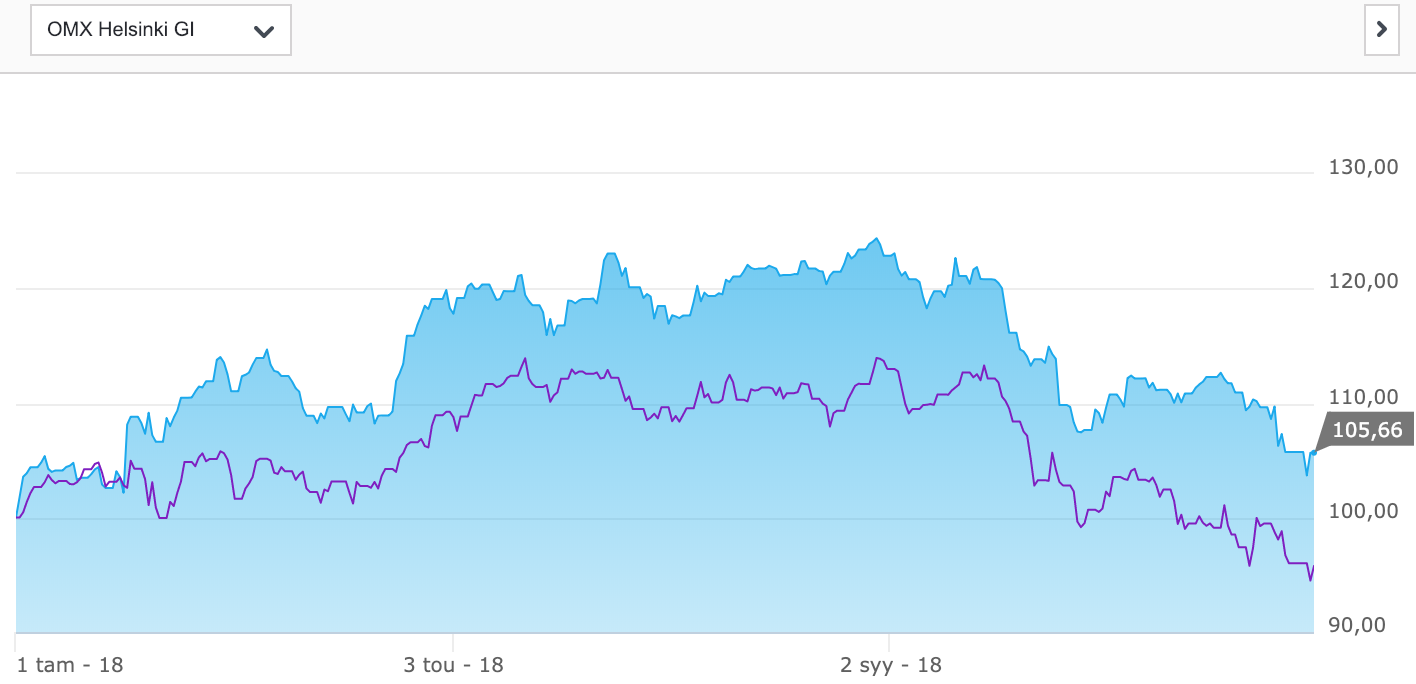
The portfolio’s return since the beginning of the year was 5.66%, which in itself is an okay figure, but especially compared to the index, the return was even excellent.

Tuottoka%CC%88yra%CC%88%202018

Looking ahead to 2019

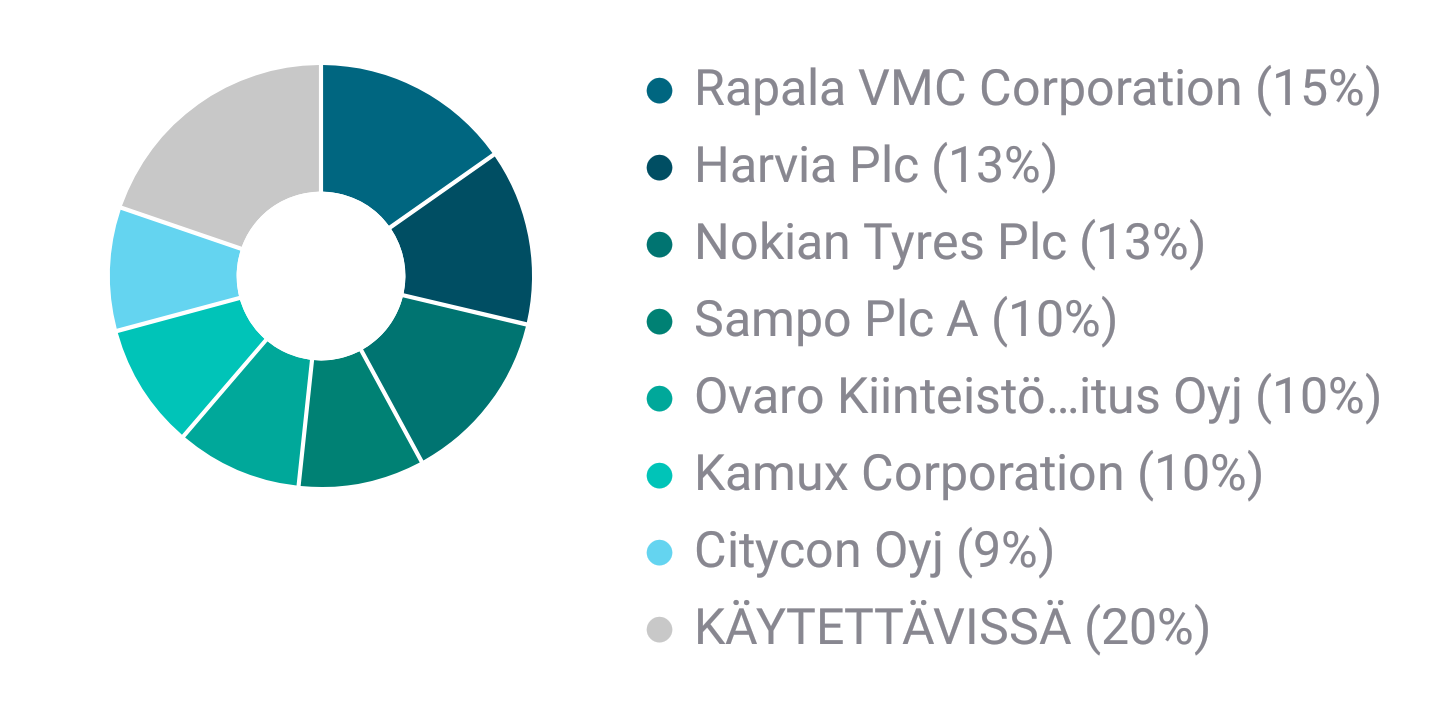
I will continue into next year with the same theses I started this one with. There is no rush to scoop basic industry and other more cyclical stocks into the portfolio, although admittedly, valuations look significantly more reasonable for many companies than they did a year ago. Of these, forest companies are perhaps the most interesting, but not quite at these levels yet. So, in a way, the portfolio is tuned to a slightly defensive stance by mainly acquiring companies whose own development is not so strongly linked to the development of the world economy but rather to the company’s internal matters. Not all choices are like this, however; for example, Nokian Tyres is more susceptible to the development of the general economic situation. However, the price has been such that I believe one can own such a high-quality business. Citycon, the last purchase of the year, feels cheap, and everyone knows the distressed state of brick-and-mortar retail—it has likely been priced in quite effectively. There is also the option of Katzman’s takeover bid, which I would likely accept if it were made from those +€1.80 levels. Here is the full content of the portfolio heading into the year:

Salkun%20sisa%CC%88lto%CC%88%202018%20lopussa

Outside the portfolio, I’m watching forest companies, Nokia, Tokmanni, and Rovio, among others. I am also ready to add to all the companies I own if prices continue to drop.

A very happy and profitable New Year 2019 to all forum members and the Inderes office.

9 Likes

Congratulations! So smart picking can still pay off. This old man went with Mr. Index and ended up pretty much +/- zero, so there’s no cheering in this old man’s camp. Of course, this old man is probably not alone in this pile of losses.

2 Likes

Happy New Year to all forum members!

P.S. It’s nice to see that the thread starter’s choices include the same stocks in their portfolio as mine, except for Citycon and Renkaat (Tires). :+1:

3 Likes

The year 2018 was personally the best ever. For the first time, the returns generated by the portfolio clearly exceeded earned income on an annual basis. Yeehaw!

A big thank you goes to Mikael, whose understandable and clear reports and videos made me realize a year ago that it’s worth investing in Nokia with a price tag of less than four euros. Nokia became the backbone of the portfolio a year ago - and also its only content.

Nokia was also the only company that remained in the portfolio. And will remain for years to come.
Other companies that have visited there include Norwegian Shuttle, Volkswagen, Realty Income Corporation, Bittium, Verkkokauppa, etc., from whose temporary dips I have tried to benefit speculatively.
However, the biggest jumps have been brought by Nokia’s long derivatives, with which I have taken swings on Nokia’s upward legs using technical analysis.

Now, with the market decline, I have begun to consider a more sustainable diversification alongside Nokia.
I already acquired some Qt (3 percent of the portfolio’s value), but with the index’s fall at the end of the year, I will now also start saving in Nordnet’s commission-free Super, which replicates the OMXH25 index. There are numerous Finnish stocks, in addition to Nokia, that have fallen to an attractive price.
As an initial investment, I put 4% of the portfolio’s value into the Finnish Super on the last trading day of the year, and in the future, an investment corresponding to approximately 0.2% of the portfolio share will go there monthly.

I don’t want to sell my Nokia shares at these prices and with the outlook for the coming years, so diversification will be frustratingly slow. By the end of 2019, diversification will probably be around 6% Finnish index / 3% Qt / 91% Nokia :smiley:

But this is how it goes for now. I am ready to sell my Nokia shares only if I identify a better and more reliably profitable target for the coming years.
Perhaps I am more at home as a concentrator than a diversifier.

I’ve had to put in a pretty shocking amount of work for this, but when the goal is to beat the market’s average return / beat the index, it’s much more certain with appropriate activity than by sitting on your portfolio.

5 Likes

Here are some interesting picks for the beginning of the year; feel free to disagree. I’ll try to justify them from a “value investor’s” perspective, even if they aren’t classic Grahamian value investments… they’re more like Munger-style “modern value investments”:

  • Verkkokauppa.com is hovering between €4-€4.5. Presumably, the most important quarter of the year, Q4 (including Black Friday and December sales), has gone reasonably well in the consumer electronics market, which is why Verkkis is expected to return to its anticipated and forecasted growth. That is, a “clean quarter” is expected. In December, Gigantti’s online store sales grew by 20%, and Power’s by 3%. Black Friday sales for Gigantti and Power grew by approximately 25-30% from the previous year (How much of this can be explained by Black Friday transforming into a week-long event this year?) → As @Sauli_Vilen explained in his recent report and various videos, “you get future growth for free”. That is, the current valuation is justifiable by the current business alone. → This creates a Munger-esque margin of safety and is definitely a case worth trying for a long-term portfolio → I would definitely buy at €4.5 or below. (My average cost is now €5.1, it’s the largest investment in my portfolio along with Remedy).

  • Fellow Finance took a significant dive at the end of the year. Apparently, with relatively low trading volume, largely due to small investors’ tax-loss selling (the “IPO boom” didn’t materialize, so they exited in a panic). On the last trading day(s) of the year, someone took a position of about 60-70k units at the €6.5 level. → Based on Inderes’ analysis, in a bear scenario (€6.5), an acceptable valuation level is justifiable by the Finnish business and Lataamo’s business. The Finnish business is reportedly developing as expected in Q3/Q4. → Munger-esque margin of safety is included in buying at <€6.5, meaning “internationalization is largely thrown in for free”. → Currently, it has been offered at the €5.9 level, which is about 10% below the Bear scenario. The development of the business in a potential economic downturn is still unclear, so there’s still plenty of risk. I have a small trial batch of this in my portfolio at €6.3.

  • The progress of Rapala’s strategy is a question mark, although the first positive signs were seen during H1/2018. Additionally, an improvement in the financial situation is expected in H1/2019. → According to Inderes’ analysis, the fair value with the current poor operating profit margin (8-9%) is already in the range of €3.3 - €4.6, however, a 10-11% operating profit margin is realistic if the strategy implementation succeeds. A plus for defensive business, driven by strong consumer demand and a known brand. → In my opinion, a Munger-esque margin of safety is obtained by buying at <€3.3, in which case “the potential fruits of the strategy change are obtained for free”. Currently, the stock has been offered at around €2.85 - €2.9, which is about 10% below the lower end of the fair value range of €3.3… in this case, the market strongly assumes that the strategy change will not progress. It has a 10% weighting in my portfolio, average cost €3.5.

  • Remedy, a favorite case, is still priced at <€7. Inderes’ @Mikael_Rautanen, together with @Atte_Riikola, has explained very well where the margin of safety in this case comes from (=development costs come through before game revenues, and even in the current situation, it gets close to zero profit). In addition, there is significant upside potential in the valuation multiples if even moderate success is achieved. In December, we received a good update on the progress of the new strategy: the single-player mode of the CF game (most likely CF HD) has been completed on schedule or even ahead of schedule, and the continuation with Smilegate is for at least two more years (CF2 project). In addition, “Control will be a high-quality game and will be completed on schedule in 2019,” in the CEO’s words. → The current €6.6 valuation requires sales of just over 1 million copies (about 1.1-1.2 million units?). Compared to the previous performance which received poor ratings (QB sold about 0.7 million units), a new addition is the Sony Playstation platform, which has the largest user base of all. 1 million game copies sold for a game that received poor reviews could be distributed, for example, PS4: 0.5 million / XBOX: 0.3 million / PC: 0.3 million, which I personally consider quite easily achievable. → Thus, a kind of Munger-esque margin of safety is formed between the game sales assumption (1 million units) embedded in the current share price and the clearly expanded target audience (now including PS4). It is the largest investment in my portfolio along with Verkkis, with about a 20% weighting. Average cost €6.65.

Here are my thoughts for the beginning of the year.

2 Likes

From those, I’ve considered Verkkis and Remedy for my portfolio.
I don’t understand anything about Fellow (and I don’t intend to find out), and Rapala, as an ancient lure manufacturer, is a bit outside my interests.

It hasn’t been that long since Verkkis’s target price at Inderes was ten euros.
I suppose that was based on something too.
Why is Mr. Market so massively in disagreement about the current price?
Mr. Market isn’t stupid, however. It’s usually wiser than an individual investor.

Have you chewed on that? Why is Verkkis’s fair value in the market 4 euros, and not ten?

1 Like

Good question. My opinion is that Mr. Market is such a hysterical guy that in the midst of general pessimism he completely forgets the view produced by careful analytical work, especially with small companies. Mr. Market acts on emotion, not reason.

Regarding Verkkis, there’s also an overemphasized fear of Amazon. I hope this coming year will alleviate some of that Amazon fear.

On the other hand, one could get a winning ticket with Verkkis by always buying after any Amazon news and waiting to sell at the next earnings report… :joy:

Edit: Inderes’ targets were also overly optimistic before

1 Like

Again, a quote from some well-known investment guide that Uncle hasn’t read: “We have fundamentals and sentiments, the former being reason and the latter emotions. If the fundamental basis is strong, the stock won’t hit rock bottom and will eventually rise. But: sentiment creates annoying, sometimes big, turbulence along the way, and that’s where a common man’s patience is tested - both in selling panic and buying frenzy.”

Making money is easy once you truly grasp it::slight_smile:

1 Like

I thought I’d open up a bit in this thread. Now that the Q4 earnings season is coming to an end and many investors are once again happy about the upcoming annual spring transfers, how did the 2018 financial statements go for people’s portfolios?

For me, it went relatively well. Six out of eight* companies in my portfolio had what could be called an excellent year. Admicom and Talenom probably drew the best straw. Titanium’s year was also excellent. Then the remaining two companies; Vincit published a slightly softer Q4 report and last year was in a certain transitional phase in all respects. The other company, Efecte, had a weaker year overall than expected. However, both are comfortably in the portfolio and this year will be interesting for both of them.

Now I have a feeling that it’s difficult to find anything to buy on the market again. I’ve been digging through my portfolio a bit and haven’t found anything to sell either. I think the coming weeks will be a bit quieter again after a brisk earnings season. There isn’t any good case in my sights right now. So, just take it easy, sometimes things are quieter and then it can be a good opportunity to focus on something else.

*Currently 9 companies in the portfolio after buying Wärtsilä. I bought a small slice of it after the earnings release.

Ps. There were indeed losses in 2018, but I focused more on the companies that were in the portfolio at the time of the earnings release.

2 Likes

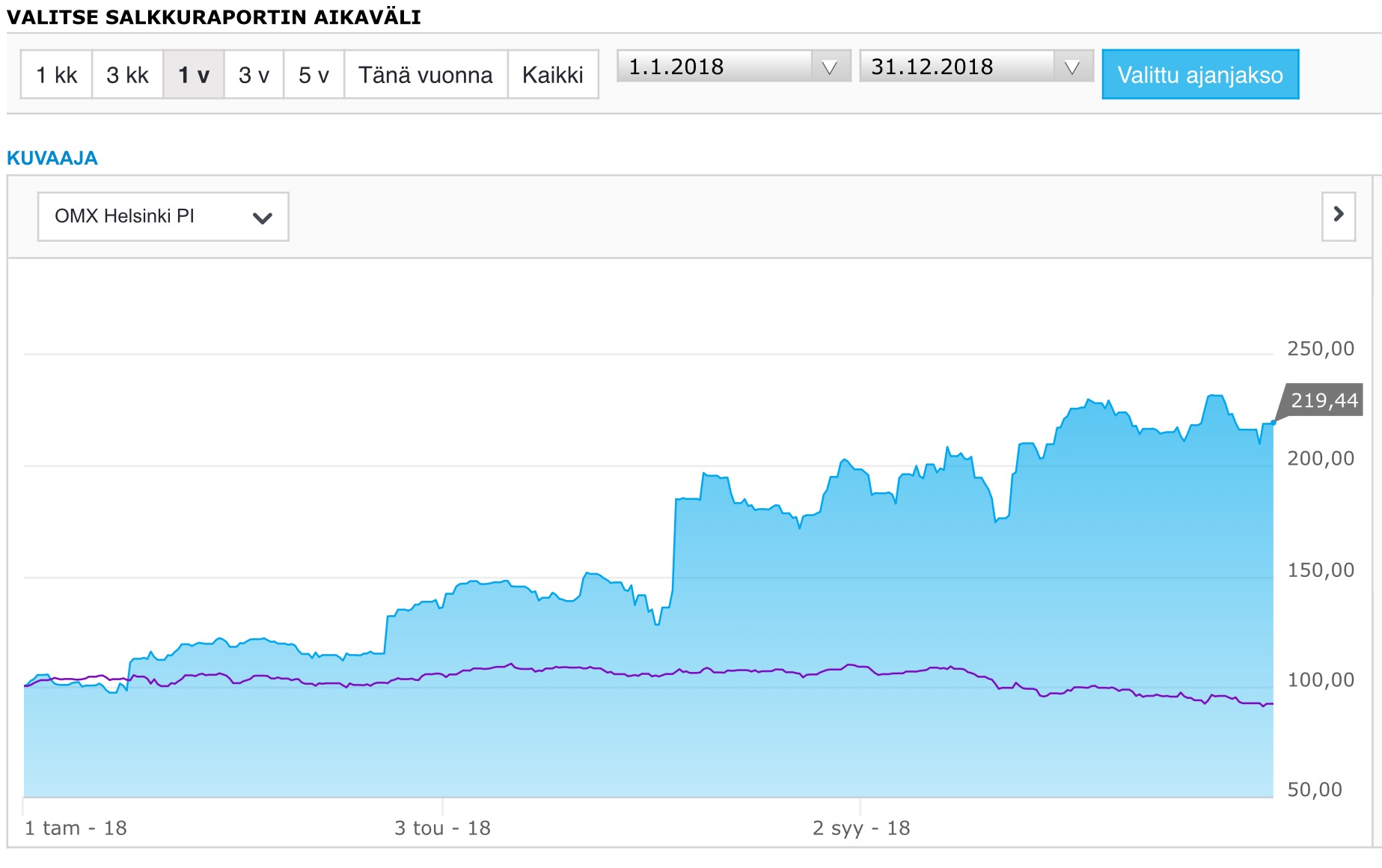
It seems I’ve posted my portfolio’s performance from 1/1/2018 - 31/12/2018 in this discussion.

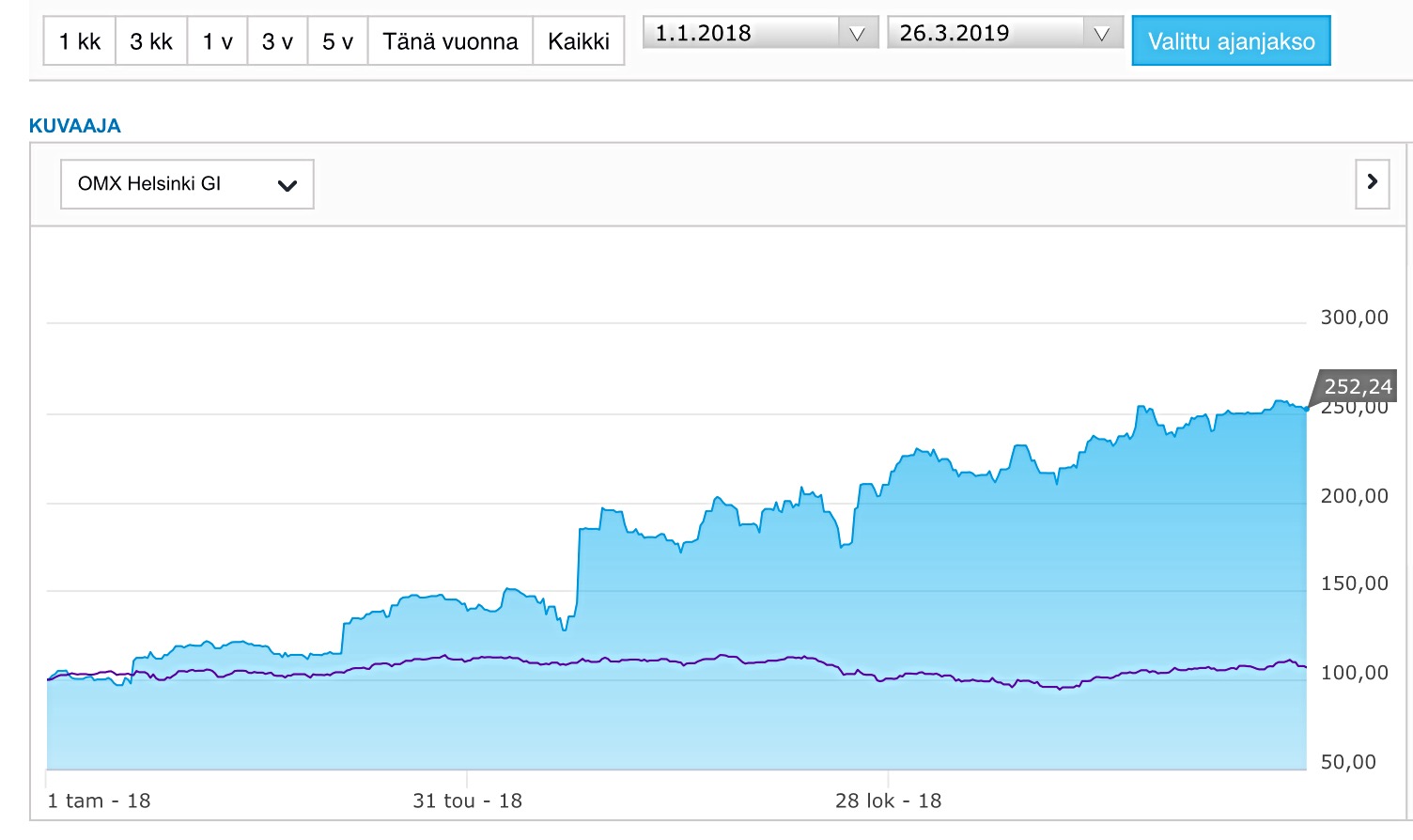
We’ve now leaped forward by about a quarter. The portfolio’s value growth has continued, from +119% to +152%, using the same starting point from last year as an anchor.

The last couple of months have been quite uneventful compared to the portfolio’s history. Calm before the storm?

4 Likes

Hey, do you happen to have that portfolio published on Shareville?

Out of curiosity, I’m asking what all you include in the return? I mean, do you include paid dividends in the returns, and on the other hand, when you have bought and sold, are trading costs and the taxman’s effect baked into the returns?

1 Like

These issues will be resolved when the “stock savings account” competition opens on January 1, 2020. Everyone puts in their €50,000 and takes nothing out (i.e., capital gains and dividends are left in the account), and we’ll see the % growth at the end of the year. Some unfortunate souls will have to put that famous minus sign in front of their % growth ::slight_smile:

Masse, FA, obvious holder of the winning ticket on December 31, 2020, +60%?

1 Like

I haven’t started using Shareville. The screenshot is directly from the portfolio report.
Currently, the portfolio holds about ~35% cash, Nokia (~55%), Qt (~3%), Kamux (~3%), and Suomi superia (~3%). All were picked up during dips.

The journey has sometimes been rattled by leveraged products, which occasionally find their way into the portfolio when a “playing opportunity” arises.

I had a small profit with Nokia, Talenom, and QT, among others, by raising (my holdings), but the financial sector did bring some losses. I actually grew my portfolio (started investing company funds) throughout last year and was a clear net buyer in December when we dipped. Siltronic also took its toll. Early in the year, I managed to make a few good trades, but now prices have been falling again. Nearly 50% of all funds are in cash.