Nilörngruppen AB, clothing label manufacturer

Business

Nilörngruppen is a label manufacturer whose shares are listed on the Stockholm Stock Exchange. The company designs and manufactures garment labels in collaboration with fashion houses. Through labels, manufacturers can enhance the branding of their clothing. Labels represent a small luxury that elevates the perceived value of a garment purchase in the eyes of the consumer. Today, labels include identifiers through which manufacturers can send greetings to the consumer or provide, for example, washing instructions. These identifiers also facilitate e-commerce inventory management, as scanning a code reveals which product is in question.

The company was founded in 1977. Since 2009, the company has undergone a transformation process from a manufacturing-oriented company toward a service-focused group. The company has distribution units in Europe and the Far East, from which products are delivered to factories serving brand houses. The company has over 1,000 customers, of which the 10 largest cover 30% of revenue and the 20 largest cover 44% of revenue (in 2022).

The company’s main owner, with a 58.1% voting share, is the Swedish listed investment company Traction AB.

Profitability

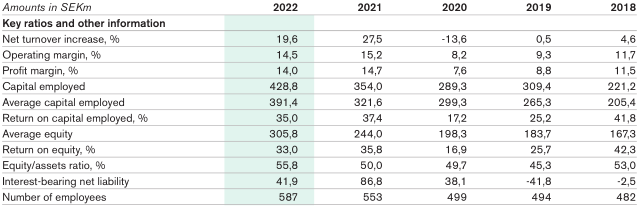
Nilörngruppen is a highly efficient and profitable group. The operating margin has averaged 11.6% over the last 10 years, and revenue has grown by 146% during the same period. Growth has been achieved through internal financing, and the share base has not been diluted. The company’s balance sheet is also net debt-free (as of 2023 Q1). The company’s Return on Assets (ROA) was 17.2% last year.
Risks

When considering the company’s risk profile, it is worth paying attention to the pandemic year 2020 in the accompanying table. Revenue decreased by -13.6%, but the operating margin fell only slightly to 8.2%. Thus, the company was able to adjust its costs and keep cash flow positive. However, the stock crashed severely on the market, losing about two-thirds of its market valuation.

I believe the company’s real risks relate to the necessity of the product if consumer buying behavior shifts toward recycling clothes at the expense of buying new garments. The company is cyclical, and purchasing clothes is something consumers can easily cut back on when the economic situation is tight. Furthermore, in the Business-to-Business sector, the company is dependent on the fashion houses’ own cost-saving measures and competitiveness. Recently, the decline in consumer confidence and the high inventory levels of garment manufacturers have led to a weakening of the company’s earnings development and a decline in the share price.

Valuation

The company has 11,401,998 shares outstanding. At a share price of 70 kronor, the market capitalization of the shares is 798 million kronor. Based on the latest quarterly report, the P/B ratio is 2.31. Net cash is 25.4 million kronor. The board has proposed a dividend of 5 kronor per share to the Annual General Meeting to be held in May.

Disclaimer:
Nilörngruppen shares currently account for approximately 5.8% of my stock portfolio’s value. This thread opening is not an investment recommendation; the information may be incorrect, and I encourage readers to conduct their own research on the company. The 2022 annual report can be read at this link.

13 Likes

This valuation section was a bit brief, so let’s supplement it.

My favorite method for evaluating stocks is combining the P/B ratio with the return on equity (ROE). Nilörn had 344.725 million in equity at the end of Q1. If we subtract the dividend likely to be paid soon from this, 344.725 - 5*11.402 = 287.715 million remains. Nilörn’s average ROE over the last five years was 30.74%, so based on this, the expected return could be 287.715 * 0.3074 = 88.444 million. This would result in an earnings yield of 88.444 / 798 = 11% without growth.

Another way to evaluate is through business margins. Nilörn’s revenue was 921.7 million crowns over the last 12 months. If we apply that 11.6% average operating profit margin, the expectation could be 921.7 * 0.116 = 107 million crowns in operating profit. Estimated financial costs are -5.5 million based on actual costs. With a tax rate of 23.2%, the expected net profit would be (107-5.5)*(1-0.232) = 78 million, or a 9.8% earnings yield without growth.

Both methods are, however, very rough generalizations, and especially the operating margin estimate is sensitive to the assumptions used. However, the revenue level is supported by the investments made and the growth of the balance sheet size over the years.

2 Likes

First of all, great opening! It’s awesome that you explained the situation in plain language instead of just slapping down charts from a corporate presentation without any explanatory context. I was inspired to read through the annual report because the subject area (=garment industry) is one I can’t say I understand much about. I learned a bit more today :slight_smile:

This reminded me of the situation with the domestic company Duell, which is at the next step of the food chain as a wholesaler distributing clothes, among other things. The demand generated by COVID didn’t continue, and in the current economic environment, it’s easy to cut back on clothing purchases. On the other hand, the situation is the same for all of the company’s competitors, and the cash position could withstand even a larger acquisition.

As I understand it, the company’s role in utilizing technology on the B2C side is small, but growth could be sought from there. A product information register maintained by a third party could facilitate clothing recycling if an RFID or other chip indicates what raw materials have been used in the garment.

At the same time, the register would provide certainty that a specific bag or garment is authentic, which is valuable information for the secondary market and protecting brand value.

In light of the numbers, the company looks high-quality, but in my opinion, the current price level can’t be called cheap yet? (Apparently, the company doesn’t buy back its own shares but prefers dividends for rewarding shareholders.)

1 Like

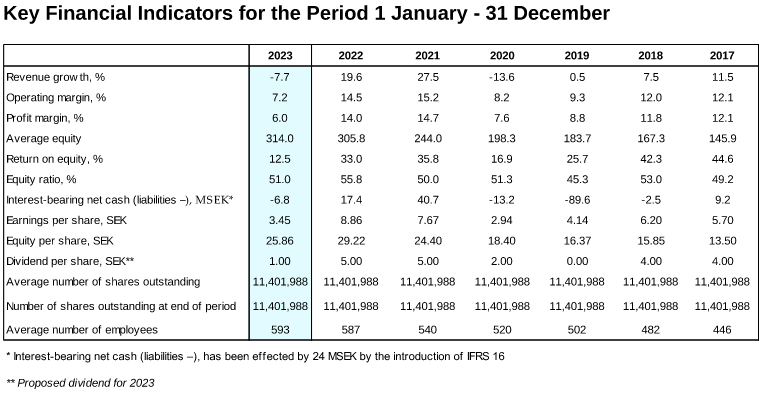
2023 was a subdued year for Nilörn, as shown in the Q4 report.

The results were driven by an oversupply of clothing, as purchasing managers ordered excessive inventory due to the COVID-19 era and supply chain difficulties. This meant that Nilörn, which is further upstream in the value chain, did not accumulate orders as it had in previous years. However, things are moving in a better direction. Free cash flow was strong at 71 million SEK, as inventories were successfully reduced (orders were fulfilled from stock).

In previous analyst calls, the CEO has spoken of 2019 as a benchmark for the company’s business, as according to him, 2021 and 2022 were better than usual. Companies can have certain “sweet spots” where the scale of business is at an optimal level from an organizational structure perspective. This has also been highlighted in the company’s annual report. However, the surprise in the latest report was that the board has given the green light for capacity investments in growth markets: Bangladesh, Portugal, and Vietnam. For this reason, the dividend was also cut to one SEK per share. Nilörn does not finance its operations through share issues.

2 Likes