Good vibes in the air. The stock ended up 21% yesterday, and today it’s already up +6% on the board.
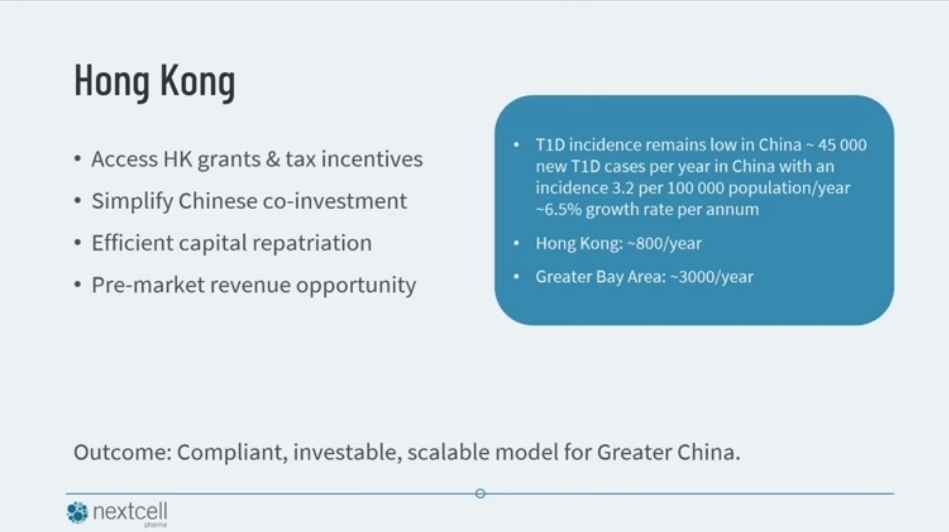
@Clark_kent and other professionals: Could we hear your views on my Hong Kong hypothesis, which I’ll outline as follows:
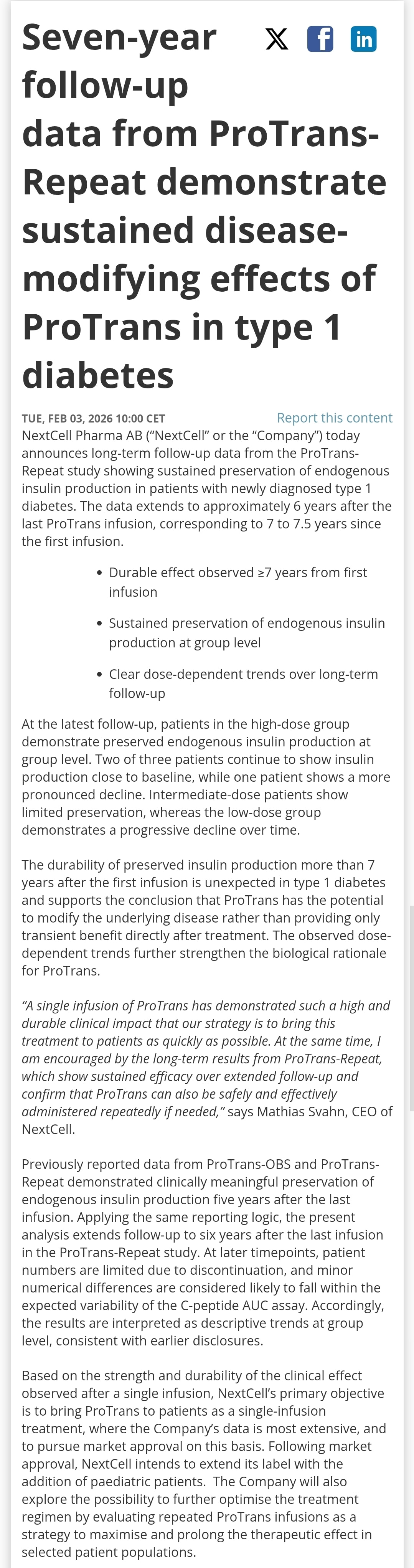
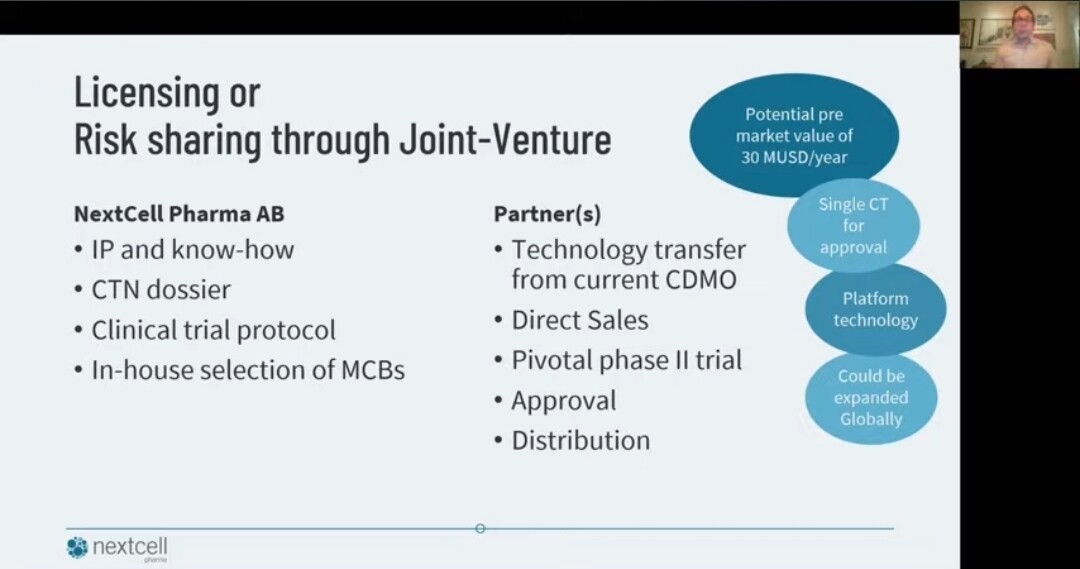
“Hypothesis: Nextcell aims to apply for a first drug approval based on Phase 2 adult data through Hong Kong’s recently launched primary evaluation track. It seeks to leverage the established position of MSC products and applies for approval primarily under a “new indication” interpretation, which would enable a marketing authorization application for the adult population using existing data. In Hong Kong, a partner is certainly needed, for example, to license the local and Chinese markets.”
One stumbling block for this hypothesis is that, as far as we know, there is no actual commercial approval for MSC stem cell therapies in HK yet that Nextcell could reference. Perhaps that’s not necessary, though, because MSC stem cells are otherwise so extensively studied, and it’s not a chemical drug.
Secondary Hypothesis: Nextcell aims to find an Asian partner to establish a local laboratory under a holding company in Hong Kong’s new biotech scene. Locally, they would start Phase 3, which, however, would be significantly lighter, faster, and cheaper than in the West. This would allow them to seek first drug approval through Hong Kong’s recently launched primary evaluation track faster than in Western countries.
The stumbling block for this hypothesis is that it doesn’t explain why they would talk about seeking marketing authorization first for the adult population only, when the results for young people are just six months away. What is so critical that they can’t wait half a year if they’re facing a time-consuming and labor-intensive Phase 3 and approval process requiring financial investment?
One possibility, of course, is that Nextcell perceives its “big brother” Diamyd as a threat to its own business potential, as Diamyd could reach the market soon with Stage 3 treatment. Furthermore, it has a strategic lead in Stage 0–2 treatments. If treatment responses, costs, and prices are on the same level, Diamyd could take the whole game in the West. One could also think that an aggressive focus on Asia using “fast tracks” is the best chance for long-term commercial success.
It is also possible that Nextcell has not succeeded in finding a partner in the West and feels it is necessary to rush a marketing agreement before Diamyd’s results are released and potentially lower Nextcell’s chances, hence the hurry to try for Hong Kong.
Since “Primary Evaluation” is a goal declared at the HK government level, it surely has a far-reaching strategic purpose. I would assume it relates to the Northern Metropolis plan, at the heart of which is specifically a biotechnology and high-tech cluster. For instance, it has invested 10 billion in InnoHK Research clusters, one of which relates specifically to biotech and where it has sought to attract laboratories from MIT and Stanford. Additionally, it is building the massive Hong Kong-Shenzhen Innovation and Technology Park, where a special life sciences and health technology hub will be established, focusing specifically on drug development, genomics, and cell therapies.
It would seem that Hong Kong is trying to attract foreign companies and create an advanced medicine business hub. There is, of course, a high risk that intellectual property and trade secrets might leak “under the table”. To offset that risk, Hong Kong must offer significant benefits to companies. My gut feeling is that it consists of two factors:
- The previously mentioned fast, limited access to the Mainland China market. This has existed before if approval was obtained from another country’s drug authority. It was previously facilitated by the “+1 mechanism”.
- Now, Hong Kong, with 7.5 million inhabitants, is establishing its own drug authority. Why? Because it wants to be the entity that can grant the world’s first approval, thereby attracting companies. How do they achieve this? By offering a shortcut to success—meaning significantly easier first approval for selected firms compared to what Western countries offer. This could mean smaller and shorter sample sizes, higher tolerance for complications, faster processes, and, for example, acceptance of Phase 2 data on a broader scale, if treatment response and safety are tolerable.
Hong Kong does follow, at least on paper, internationally accepted ICH standards regarding clinical data, and at least on paper, it also wants to make its drug authority internationally recognized. So, it’s unlikely to be a total “Wild West” there. But drug authorities do have a lot of their own discretion regarding conditional marketing authorizations. Thus, even while following international standards, it is possible to lower the barrier significantly by interpreting the grounds for conditional marketing authorizations more freely.
Even though things in the US might be easing slightly, Europe and the US emphasize certainty and safety and love bureaucracy more than the East, which forces early-stage companies to the door of Big Pharma, hat in hand, by Phase 3 at the latest, as it easily requires hundreds of millions in investment with uncertain results. At the same time, the majority of future cash flows are given to pharmaceutical giants in return. There would certainly be demand for a light regulatory path.
If the currently uncertain hypotheses above prove to be true, Nextcell could be in an interesting position among the first applicants. Surely, the Hong Kong authorities also have an incentive to show successful success stories from their strategic project.