Mercedes-Benz - Automotive Industry Value Stock

Greetings everyone!

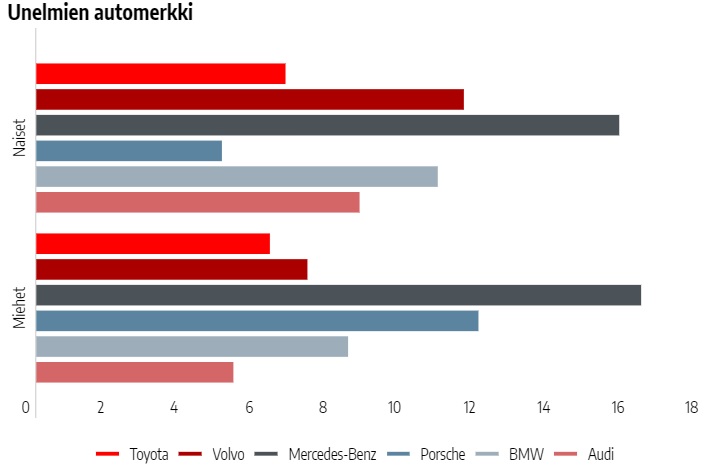
This forum lacks a thread about Mercedes-Benz, and given the company’s interesting situation, I believe there absolutely should be one. Mercedes has been in my portfolio for three years now, and I have regularly increased my holdings. To start, I should state that my interest in Mercedes-Benz is purely on the investment front, and I am not a fan of the car brand in any way. It is therefore highly unlikely that I will ever find a product of the company in my yard, but the shares will probably remain in my portfolio for a very long time. To my taste, Mercedes cars are unnecessarily expensive vehicles, and their design has never truly appealed to me. I realize that my preferences do not represent the majority of the population, and for example, in Finland, Mercedes-Benz is the dream car for both men and women. Below is a relatively recent graph from Iltalehti on the matter:

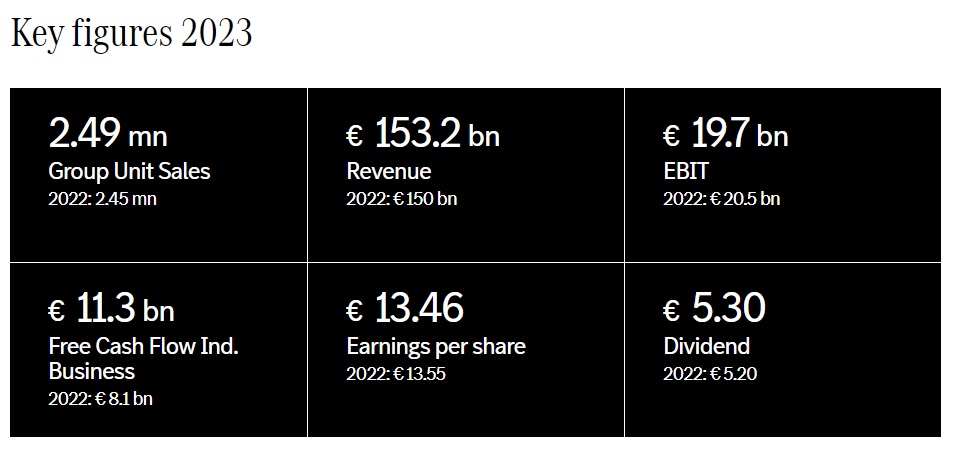
As an investor, I am a value and dividend investor. I try to find companies that grow and are able to continue increasing their dividends. Mercedes-Benz fits this category perfectly, along with a few other car manufacturers (I might open a thread about these manufacturers later). Two aspects are attractive about the company: its financial situation and its strategy. Based on its financial situation, Mercedes is a very undervalued company. The market capitalization at last Friday’s closing price is only 79 billion euros. The company is net debt-free, and its net cash position is 31.7 billion euros. The image below shows the key figures for 2023:

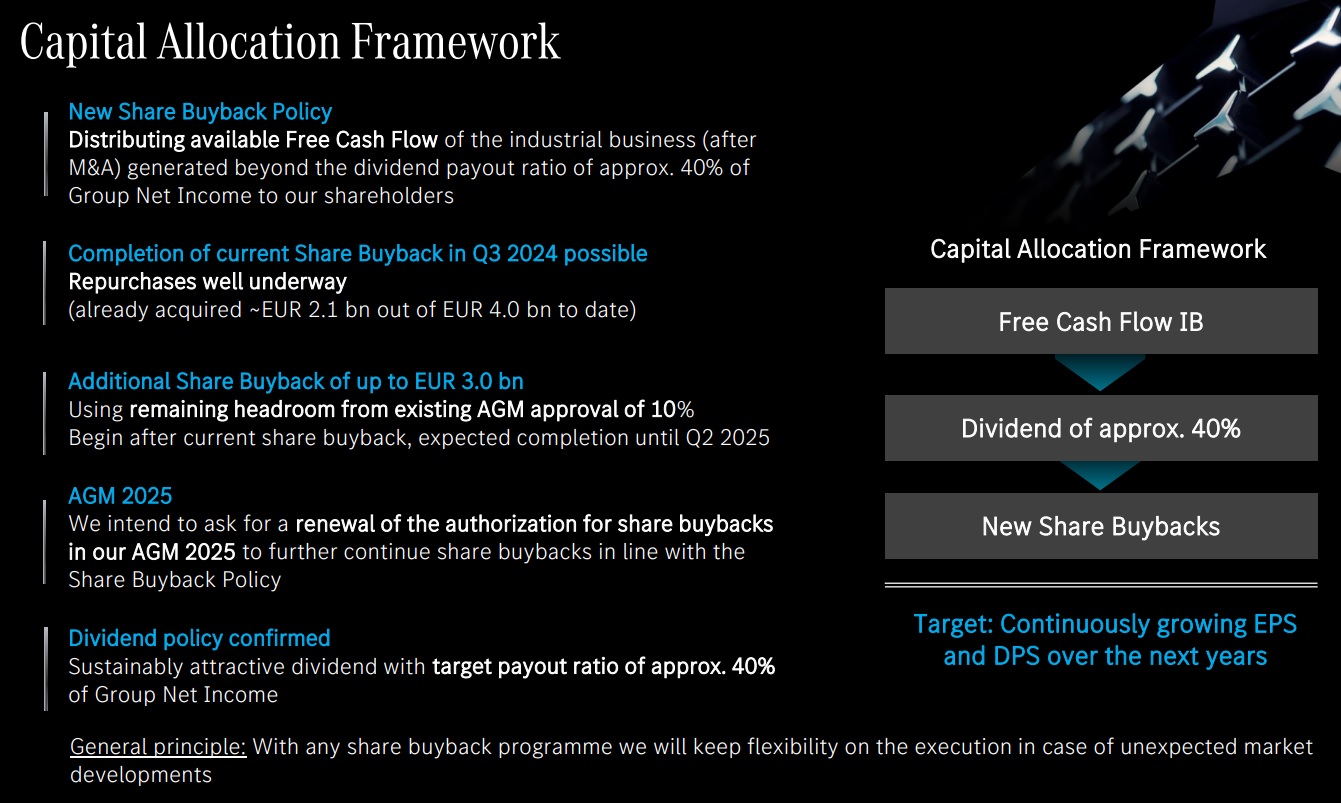
Mercedes-Benz’s P/E ratio is 5.5, and the dividend distributed in spring is 7%. Mercedes invests heavily in product development, but despite that, the net cash flow for 2023 was 11.3 billion euros. For the current year, the cash flow guidance is 8.5-10 billion euros. Since the cash position is very strong and investments are not expected to explode in the next few years, the entire cash flow will be distributed to shareholders through dividends and share buybacks. Mercedes-Benz has guided that the dividend will grow in the coming years. A rather significant amount of money has been allocated to share buybacks. Almost exactly a year ago, a four-billion-euro share buyback program was initiated. Of that program, 1.9 billion euros are still unused, and the assumption is that the program will conclude in the third quarter of this year. After this, a three-billion-euro continuation program will begin, ending in the second half of 2025. It is therefore clear that buybacks are being accelerated, and it is highly probable that buyback programs will continue even after July 2025. In total, the authorization is currently for buying back 10% of the share capital. Here are the points I mentioned, from an investor presentation slide:

Regarding the financial figures, I have also generally considered Mercedes-Benz’s strategy to be smart. A big change is, of course, the electrification of transport, but I have been pessimistic about its speed. Mercedes has a very strong position in the internal combustion engine segment in higher price ranges, and this market is not disappearing anytime soon. The expected dip in electric vehicle demand that has now occurred benefits more conservative car manufacturers. Mercedes-Benz has also reacted to this and announced that electrification milestones will be shifted forward by half a decade: Mercedes siirtää sähköistämistä tuonnemmas – Polttomoottorimallien tuotanto ja kehitys jatkuu | Kauppalehti . Although I am not at all enthusiastic about this, I assume that the upcoming European Parliament and political developments in the United States will not accelerate electric vehicle adoption (or the green transition in general).

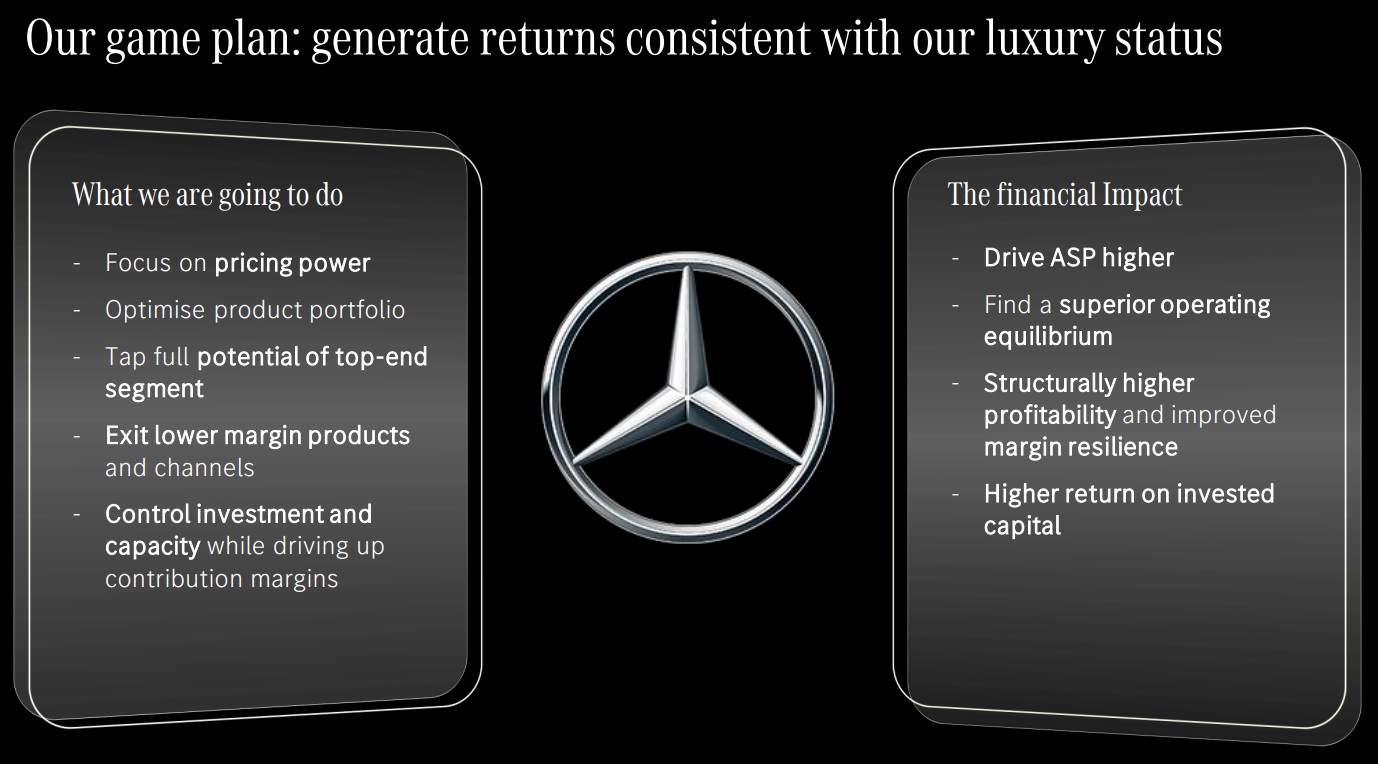
During my ownership of the shares, Mercedes-Benz has made two major strategic moves. When I first bought the shares, the company’s name was Daimler. The truck division was divested into its own company, and the name changed. I quickly sold these shares I received and reinvested them back into Mercedes-Benz. Another major strategic direction is to focus on margins and shift more towards being a luxury manufacturer. This means that the offering at the lower end of the price spectrum will be scaled down. This shift is clearly visible in the average price of cars sold. While it was 51 thousand euros in 2019, it was already 74.2 thousand euros in 2023. The strategy is also illustrated on this slide:

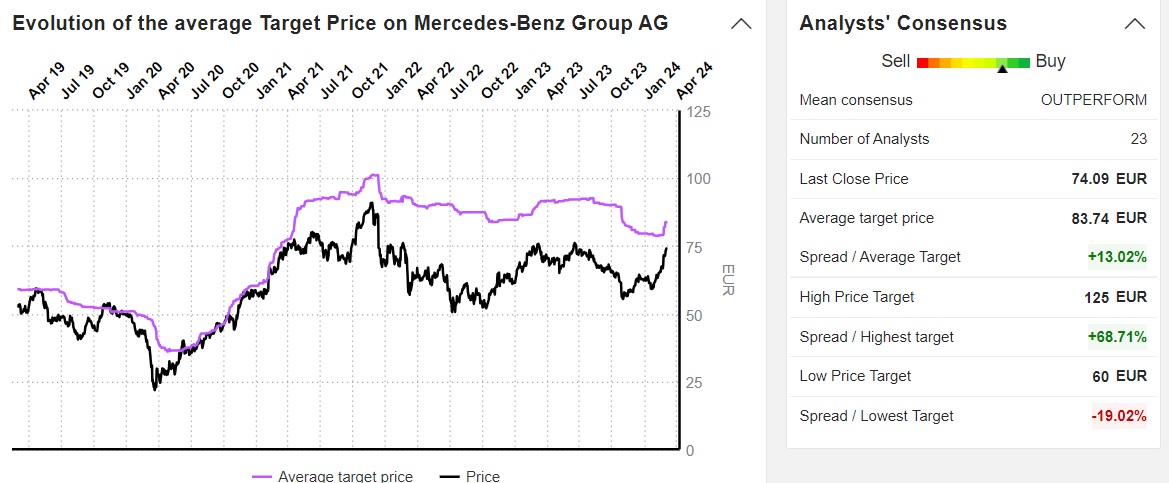
Currently, the analyst consensus estimate, according to Marketscreener, is approximately 83.74 euros. The lowest target price is 60 euros, and the highest is 125 euros. Valuation multiples are low compared to other European car manufacturers, but I would see (or hope) that this aspect will change. It certainly doesn’t look like traditional car manufacturers are shrinking in the coming years. This assumption has already quite nicely taken hold in Toyota’s stock price this year.

62 Likes

It could certainly be interesting. Another quite interesting one is BMW.

The stocks are valued at rock bottom, but the business has performed quite well if you look at the numbers, and in my opinion, the shift to luxury is the right strategy. (P.S. when looking at the manufacturers’ figures, it’s best not to get confused by the debt from the financing segment – you’ll get a clearer picture by looking at the industrial figures.)

The Chinese are coming, and I personally believe that electrification is the future. But Mercedes and BMW have already released some good EV models, at least according to reviews.

And perhaps most importantly – I see significant brand value in them. Mercedes probably has one of the most valuable brands in the automotive industry, perhaps trailing only Ferrari and a few others. This is where it’s difficult for the Chinese to compete – the history required for a luxury brand isn’t created out of thin air. I’m sure wealthy Chinese people will also continue to buy Mercedes and Ferraris. The luxury segment can be a safe haven amidst the industry’s turbulence.

The most important thing, of course, is to be able to continue making great, high-quality cars that are at least on par with the challengers. But as I understand it, Mercedes and BMW have continued to succeed in that regard.

11 Likes

https://www.visualcapitalist.com/most-valuable-brands-in-2024/

Brand values. (Though I don’t know if the data is reliable in any way.)

4 Likes

From a branding perspective, Mercedes is really cheap. From memory, BMW had slightly better manufacturing margins, but I see that Mercedes has more potential for premium pricing. This could also benefit current drivers of the three-pointed star, as it would likely increase the value of used cars as well.

I see Mercedes as being in a similar situation to where Gucci was before Tom Ford. The brand is being diluted by current solutions.

I’ll keep following how the situation develops. Thanks for the thread!

5 Likes

That’s just how it feels to them if they can’t afford it :wink: :smile: :+1:. Coincidentally, we’re visiting the Merc museum tomorrow as we are returning to Finland from Southern Europe, don’t ask why…
We won’t have time for the Porsche museum :cry:.
https://www.mercedes-benz.com/en/art-and-culture/museum/
I don’t have a Merc at the moment, but I think the next one will be, given how much that “Swedish”… Håkan’s sofa is getting on my nerves…

4 Likes

I calculated the pace of share buybacks a bit more closely, and it is clear that the pace must multiply if the targets are to be met. Mercedes has an extremely illustrative website for tracking these buybacks: https://group.mercedes-benz.com/investors/share/share-buyback/ . All other companies conducting buybacks should have something similar.

Last year, the number of shares shrank by 2.7%, costing 1.9 billion euros. Thus, one percent of the share capital cost 700 million euros. From the original buyback program, 2.1 billion remained, and soon the program will be expanded by three billion, bringing the total to 5.1 billion. If the share price stays roughly where it is now, the remaining buyback program could be used to acquire 6.5–7% of the share capital. The total amount could therefore, at best, approach the maximum limit of 10%.

However, it is possible that the share price will rise due to the buyback program itself. Such a large volume of shares must be gathered from the market to reach the targets. Recently, daily purchase volumes have been around five million euros. This pace cannot continue, as these buyback programs must be concluded by July 2, 2025. There are approximately 310 trading days left until that date. This means that from now on, the daily purchase volume must triple to 15 million to exhaust the allocated sum by the middle of next year. If we compare this to the average daily trading volume, it is about 8% of it.

13 Likes

On Tuesday, Mercedes released its first-quarter results, which were lackluster as expected. There were no positive surprises, so the share price retreated a few percent along with other European auto stocks. The most interesting takeaway for me was the update on the timing of the share buybacks:

Kuva6

Starting today, share buybacks should be shifting into a new gear. Over a five-month period, 1.7 billion worth of shares are to be acquired, so daily purchases will likely rise from five to over fifteen million.

4 Likes

Has anyone sold the Truck shares received from the split that occurred a couple of years ago?

I sold the aforementioned shares last year, and now I need to find the acquisition price for those Truck shares for my tax return.

1 Like

28 euros was the opening price. I stated it myself when selling.

1 Like

Last week, Mercedes significantly ramped up its share buybacks. Shares are now being purchased at a daily rate of about a million, with the total daily sum being slightly under 70 million euros. This corresponds to a third of the total daily trading volume.

Kuva7

The tracking of these buyback programs has been improved on Mercedes’ website, and the status of each program can now be viewed separately. https://group.mercedes-benz.com/investors/share/share-buyback/

Even though the buyback program is proceeding at a high pace, the share price has been trending downwards in the wake of the rest of the sector.

1 Like

Teemu Liila and @Heikki_Keskivali discussed Mercedes and BMW as investment opportunities :slight_smile:

In this episode, German automotive legends Mercedes-Benz and BMW are compared as investment opportunities.

Topics:

00:00 Intro 02:40 The story of BMW 03:44 The history of Mercedes-Benz 08:00 Development of the automotive industry 10:16 Differences between the brands 13:52 Business segments of the companies 15:19 Electrification of the auto industry 17:07 Valuations 22:40 Which one will Heikki and Teemu choose for their competition portfolios?

6 Likes

An interesting opening. I’ve been involved myself since 2020, as I’ve worked for the company since 2019, and since 2020 I’ve been able to buy shares at employee pricing, which consists of a lump-sum discount and the use of “pre-tax” money for the purchases. I would buy almost anything under these terms, but Mercedes as a car manufacturer is an interesting target anyway for the reasons mentioned above.

Regarding brand value, I’d comment that it’s not really worth worrying about who in Finland wants or doesn’t want to buy these cars. The biggest market is China, and Mercedes has been the most desirable brand there since the 90s; some might remember how, back in the day, Nokia executives were met at the airport with S-Class (S-Klasse) cars, etc.

The P/E ratio is, of course, ridiculously cheap, but that’s how it often tends to be with cyclical companies. On the other hand, the focus on higher-end cars somewhat mitigates the downsides of cyclicality; the wealthy can afford cars even during bad times.

One nuisance this year has been the delivery difficulties of 48-volt batteries from Bosch, which has led to profit warnings and relegated the supplier in question to the “bottom tier.” This too will be overcome, but minor annoyances like this can pop up at any time in another form.

The dividend is hefty and a big part of the overall investment case. If I lived in Finland, I might skip the stock entirely because Germany withholds the full 25%, and you would have to reclaim that 10% slice through a lot of paperwork over time. Since I live in Germany, this works out correctly for me, but I’ll have to reconsider the situation whenever I eventually move out of the country.

12 Likes

Recovering excess withholding tax is manageable. Nowadays, the application is submitted online. The hardest part is setting up the systems for the BOP portal, which is the German equivalent of “MyTax”.

Also, Nordnet—which is favored by many—cannot be used as a custodian for German dividend stocks; for instance, Nordea and OP are able to provide the dividend tax certificate required by Germany.

1 Like

BMW and Mercedes sales have declined significantly, particularly in the Chinese market.

Deliveries of BMW and Mini brand cars fell by 30 percent, and Mercedes sales dropped by 13 percent, partly due to weak demand for high-end models such as the S-Class and Maybach.

Both companies have issued profit warnings and may also suffer from tightening trade relations, such as potential Chinese tariffs on large-engine imported cars. While electric vehicle growth in Europe has slowed, BMW’s EV deliveries grew slightly, whereas Mercedes’ EV sales plummeted.

This story should not be behind a paywall.

2 Likes

Mercedes-Benz had a couple of hundred million left unused when 10% of the share capital was reached. The low share price probably surprised the company.

"The last share buybacks were carried out on November 29, 2024, and the share buyback programs were thus concluded.

Upon the completion of both programs, a threshold was reached, which is a maximum of 10% of the share capital resolved by the Annual General Meeting in 2020. The total number of shares in both share buyback programs between March 3, 2023, and November 29, 2024, is 106,933,744 shares. A total of own shares were acquired for a price of 6,803,114,858.09 euros (excluding incidental costs). The acquired shares will be held as treasury shares and are intended to be cancelled before the Annual General Meeting in 2025.

Mercedes-Benz Group intends to request at the Annual General Meeting in 2025 to renew the authorization to buy back up to 10 percent of the share capital."

https://group.mercedes-benz.com/investors/share/share-buyback/

7 Likes

This is also a celebration, 100 years since the registration combining Daimler’s three-pointed star and Benz’s laurel wreath.
The actual merger took place in June 1926.

18.2.1925: One of the world’s most famous trademarks was born 100 years ago 18.2.1925: Yksi maailman tunnetuimmista tavaramerkeistä syntyi 100 vuotta sitten | Kauppalehti

6 Likes

Mercedes-Benz announced its 2024 results now.

Things look quite bad. Sales are projected to decrease in 2025, EBIT is projected to decrease significantly, and fixed investments are growing. Additionally, the dividend will decrease to 4.3 euros. A bright spot is the share buyback program of up to 5 billion over the next 24 months. However, this will naturally be done within the limits allowed by cash flow, specifically what remains after dividend payments and acquisitions.

2 Likes

Mercedes-Benz is not doing well; the company is now warning of a significant drop in profits and launching a severe cost-cutting program.

The company fears rising US tariffs, which would weaken its profitability. The decline in demand for luxury cars in China and the weak European market further complicate the situation. The stock price has naturally fallen, and the company plans to reduce production costs and introduce new models, such as the electric CLA.

https://x.com/alojoh/status/1892463662511579627

image
image
image
image

6 Likes

Was any information found on where those significantly growing investments are going? Are they, for example, building new factories in the US or something?