Hmm. I haven’t bought beef-pork for twenty years. Beef has been enough.
Well. Your suggestion came quite quickly. I should probably look around for a while - so I don’t fall for some cheap trick in a moment of impulse.
2 Likes
OP has changed Lehto’s recommendation to “buy”. Was very surprised by Lehto’s “good” Q3 result. So Massen’s layperson recommendation is getting support.
When the difference between the target price and the share price is between +/- 5%, the recommendation is to reduce. Can be found at the end of the reports.
Yeah, it is. I used to always think that an add recommendation would be 0-15% and a reduce recommendation would also be 0-15%. This system is somehow illogical: they believe in an upside and yet give a reduce recommendation.
In a way, yes, but on the other hand, if you see a potential gain of say 1-2% within a year, does it make sense to take on stock risk if the expected compensation is that? It’s another question where exactly that threshold percentage should be set. I think this current limit is perfectly fine.
2 Likes
At these prices, it would be easier for those who are NOT at a loss to come forward  I bought in two tranches when it was “cheap” for the first time, i.e., in spring after insider sales, so the average price for purchases was around 11 euros. However, I didn’t plan to sell, as I still believe in the company’s competitive advantage. Waiting for the next upcycle…
2 Likes
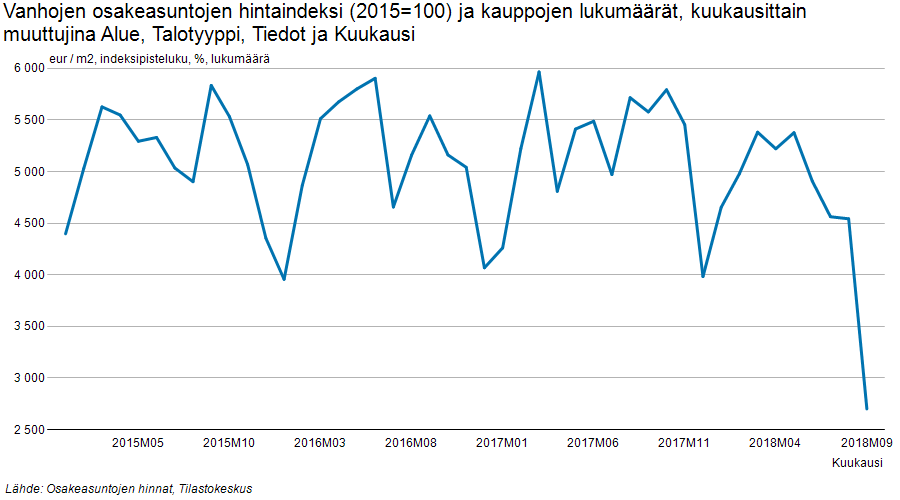
The Finnish housing market has quieted down significantly during the autumn. Now, both new construction starts and the number of existing home sales are simultaneously slowing down. What thoughts does this evoke? (This refers to sales volumes per month, not price, even though the eur/m2 in the image might suggest otherwise.)
4 Likes
I own several investment properties. I’m following. 
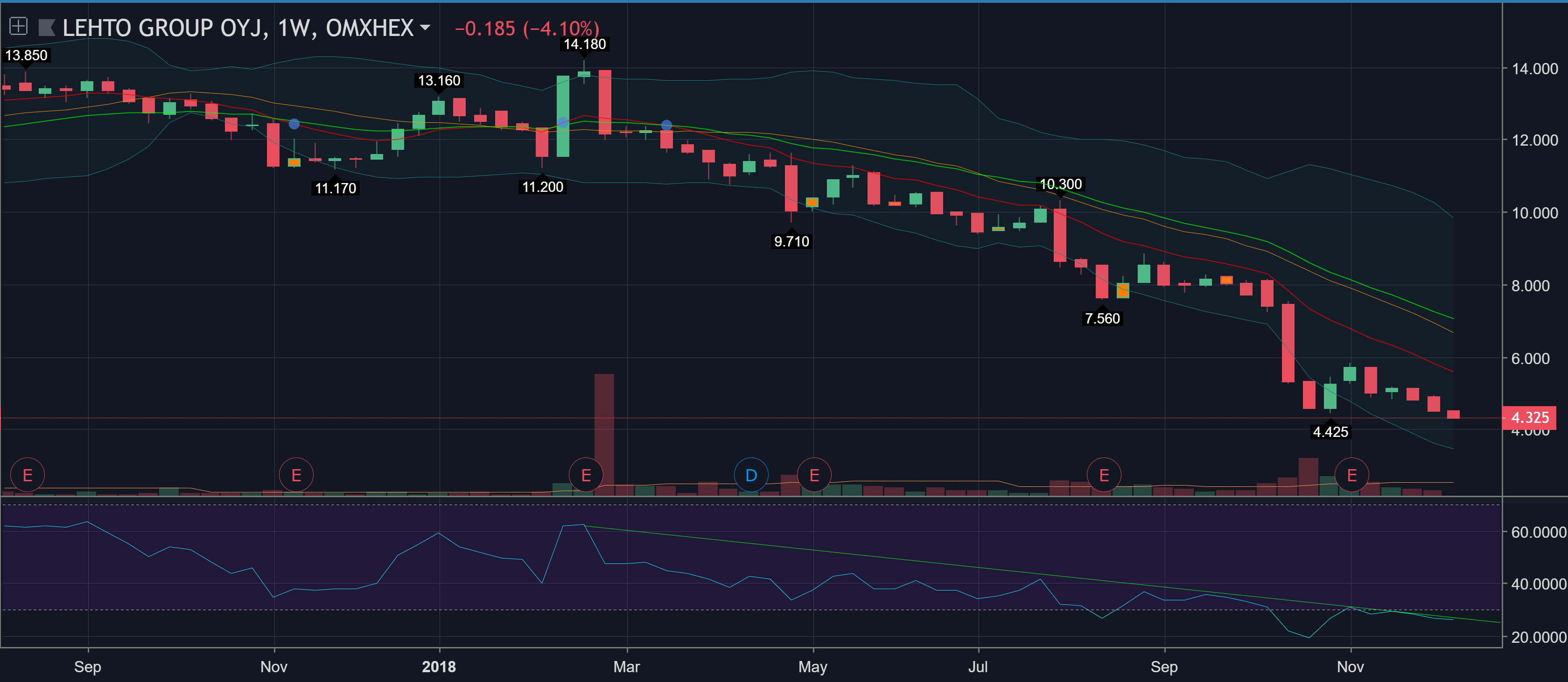
I bought there for 12 eur and then it fell. Then I started to get anxious and gave up at €8.5, bought again at about €8, and sold on the rise at about €8.7. Then I waited for the earnings report, after which I bought at 5.2x and then sold for a gain of a little under 10%. Now it’s back in my portfolio at €5.09… I’m doing quite well at a loss! The lots have been smaller lately…
Luckily, Basware jumped today, even though I didn’t have a big stake in that either.
1 Like
Hannu Lehto seemed to have bought a reasonably sized pile.
I was just speculating a bit, perhaps more apartments are coming by the end of the year?
I’m one of those whose loss was <3%. This stock has been a terrible disaster for many. Last winter, everything still looked so promising… Even in the summer, several smart investors hinted that it was a good target.
Not to mention the drop in the autumn.
This is a complete lottery ticket. It’s possible that things will still turn out well if one can be patient. In my opinion, it’s more likely that it will turn out badly. This is my gut feeling; I’ll leave the analyses to the more competent.
2 Likes
It’s worth remembering, though, that even if the number of new housing starts has decreased, the peak in new housing completions might still be ahead. For this reason, it’s quite natural that as new apartments flood the market, demand for older apartments will dwindle. What’s more crucial is the overall demand, so there’s no need to worry about a temporary drop in demand for older apartments in this kind of environment. Of course, it could also be a signal of worse things to come, but in this situation, it’s quite difficult to assess. The reality, in the bigger picture, is that housing is far too expensive relative to income levels, so that needs to normalize at some point.
1 Like
It is definitely possible that the sales volumes of new + old apartments have not decreased at all. I just don’t know if anyone tracks the sales volumes of new apartments. Now we only see one component of the equation having decreased, so there is a lot of uncertainty in the conclusions.
Certain conclusions can be drawn from the net subscription development of the FIM Housing Yield and Ålandsbanken Housing Yield funds in the fund report. FIM has received 50.8m of new invested capital by the end of October. This is known as the S-housing fund, which is a fund heavily marketed to private investors. Ålandsbanken, on the other hand, sells its fund to private investors and institutional investors in two different series. These, I understand, are bundled together in that fund report, and their invested capital has only grown by 6.5m.
This is a bit speculative, but it would seem that institutional investors are slowing down their fund investments, and private investors are still putting in new money at this stage. However, one cannot be certain about this, so it may also be that the situation is not like this. This market is not very transparent.
Why is this significant for the housing market? A lot of these new apartments have gone to all kinds of investors, big and small. If, and if, at the same time a lot of new apartments are completed that have not yet been sold during the construction phase, and if investor demand wanes, this creates pressure on the sale and prices of new apartments.
Link to the fund report:
https://www.sijoitustutkimus.fi/wp-content/uploads/2018/11/Rahastoraportti_201810.pdf
1 Like
Rental yields have been falling all the time, so it’s natural that demand also decreases through that. In addition, interest rate hikes are getting closer, so financing costs will also increase. Many small investors are starting to face interesting times if interest rates rise to the same levels as in the US, as returns would then approach zero. At the same time, as apartment prices come down, things could really start to rumble.
Lately, there has been quite a boom in apartment purchases by small investors, so the same cannot continue for very long. In the future, buyers will be more apartment funds and those buying for their own use. Overall demand will therefore come down somewhat. I don’t believe there is any alarming phenomenon yet, because demand has only somewhat leveled off. Of course, at the same time as supply increases and construction is expensive, trade will inevitably slow down somewhat if one does not want to sell at a loss. It is also interesting that because new apartments are built at very high costs, it also keeps the price of old apartments high. For this reason, too, the trade in old apartments is slower and the number of transactions decreases. Problems only arise when the economy turns downwards and owners have a compelling need to start selling.
Things will balance out over time, if the surrounding economy doesn’t collapse. If it collapses, then the housing market could really start to rumble. Risks have therefore increased.
Uncle Masse’s theses for the housing market (feel free to copy, it’s free):
-
Finland is full of expensive 60-70s apartment buildings crying out for renovation. Mold, leaky pipes, etc.
-
Renovation is expensive, troublesome, and finding someone to pay for it is difficult.
-
Lehto to mass-produce cheap but sufficiently high-quality modules in their place. The public and/or municipalities buy them, and people move in.
-
Old renovation sites are emptied/cleared and then demolished. Period.
Easy and effective. Uncle Masse didn’t know he was an expert in this construction sector until now  Feel free to correct me if something is badly wrong.
3 Likes
How else would it be if interest rates rise, then the banks’ own funds suffer from it (e.g., some OP fund), how are they financed? So the question is, do banks suffer from rising interest rates (or do they lend our money to themselves at zero interest? Or does OP sell someone else’s products?
Based on the news article, Lehto is really trying to maintain its price level and is no longer (or perhaps never was?) competing solely on price.
2 Likes
{“content”:“I’ve burned my fingers a bit here, unfortunately. I did make a good profit at first, but then I bought back in as an owner at around €8.5, and now I’ve lost probably the same amount.\n\nHowever, I still consider the stock undervalued and will maintain my current position. I’m prepared for a longer hold. I’ve already taken advantage of tax benefits for this year, and I hope the forecasted dividend will materialize.\n\nInsiders, especially the CEO, have been accumulating shares recently: https://www.arvopaperi.fi/sisapiirin_kaupat/ (-> search Lehto Group)\n\nClearly, there’s a focus now on project selection to ensure profitability. Let’s hope the net profit rises to around 10%.\n\nEven with current key figures, it’s not a bad stock, in my opinion.”}
2 Likes