SRV as an Investment

Hi everyone!

I have been following the stock market developments in the construction sector to some extent during 2018.

Almost all companies had the air blown out of their share prices quite thoroughly. For example, SRV and Lehto.

Both performed very poorly last year, even though in principle, you would think there would be free money for everyone at the peak of the cycle.

However, I won’t delve deeper into Lehto, but will focus directly on SRV instead. A few questions came to mind regarding the company and the market’s pricing of it.

The share price indeed dropped to nearly the 1.6 level at its worst.
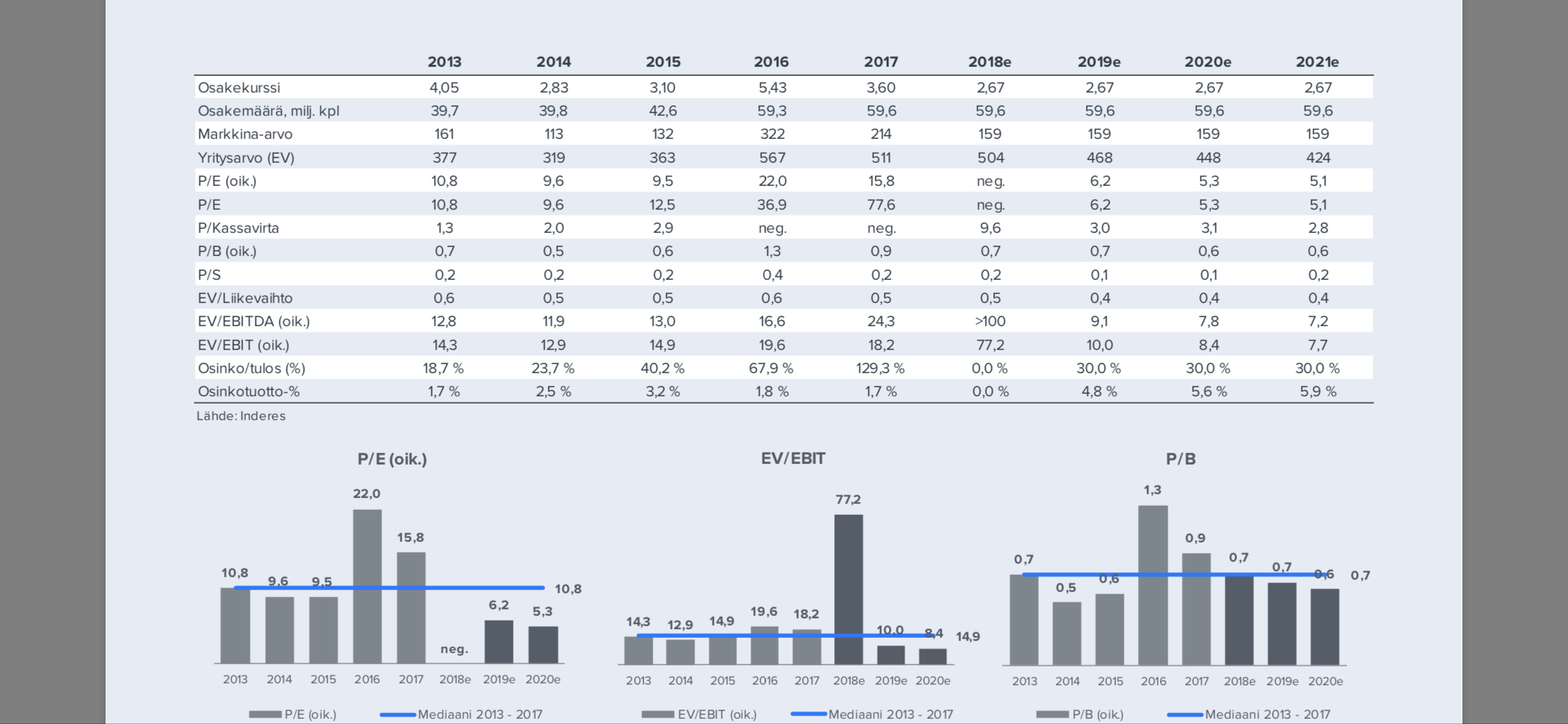
What kind of fear is the market pricing into SRV for the coming years?

The real estate portfolio is significant, and if SRV succeeds in divesting these as planned over the next 3-4 years while simultaneously reducing debt, then the share price simply isn’t pricing in the return potential for the coming years. Are one of the following scenarios perhaps being feared?

A) Shopping centers/commercial premises won’t sell at target prices

B) The construction sector faces a significant downturn for the coming years/decade

C) SRV is unable to exit the centers, making additional access to debt financing impossible?

D) Something else?
kuva

Thanks in advance to everyone who joins me in sharing this state of fear.

If there are errors in the text, it is due to the following reasons:

  1. I am a poor writer.
  2. I don’t know how to analyze the construction sector/stock market well enough (I’ve only been following and studying for about a year).

Best regards, an individual interested in the construction sector from an investment perspective.

2 Likes

Let me add that the +40k housing starts in the construction industry are not at a sustainable level.

According to Inderes’ view, SRV is, however, relatively well positioned for a slowing market.

For the project management organization, decreasing margins in subcontracting due to increased competition also reduce cost pressures on SRV.

Regarding SRV, perhaps the most awkward question is that if they are making a loss at the peak of the cycle, how are they supposed to make a profit in a downturn.

Of the issues you listed from A-D, all are relevant concerns for SRV, and on top of that, if the ruble continues to weaken, they will take further losses from Russian shopping centers.

A lot of bad news has probably already been priced in, but to what extent, one would have to properly go through the numbers and forecasts.

1 Like

However, at Srvl, Redi was clearly the biggest cause of loss in the fixed-price project, which the company has retrospectively stated they will try to avoid in the future.

For example, in the Tampere Arena project, costs are spread across several investors.

Whether these problems exist elsewhere is another good question.

Lehto, on the other hand, showed clear underperformance on several fronts.

Is growth being pursued too greedily, and then this is the result?

This is the explanation that one often hears (from others besides SRV). That is, “we don’t usually, but this was a unique case.” If the management has made foolish decisions before and lost in a rising market, it is difficult to find faith that they would suddenly be enlightened and wise enough that no other mistakes will occur and results will improve in a declining market. Especially if the explanation is that “this was an isolated mistake,” without stating what went wrong in the decision-making process and what has been corrected. If the strategy/decision-making process produces poor results, it doesn’t help to be wise after the event and decide that the same outcome will no longer be allowed if the poor decision model remains.

Now I have to admit that I haven’t followed this particular company, so it’s possible that they have openly explained why they made this mistake, what they have now changed in the whole process, etc., but generally, good/bad decisions tend to accumulate in the same companies if the management is not properly refreshed. (Compare Nokia before and after Siilasmaa’s chairman term)

Edit: This does not mean that SRV could not be a good investment for someone who knows it better. For me, it just seems too vague and “prone to error,” and I would personally wait for evidence of a turnaround.

2 Likes

You are right. I looked at SRV’s Q3 review myself, where the matter was questioned. It was stated directly that a mistake has been made and that such fixed-price projects, where risks accumulate solely on SRV, will be avoided in the future.

SRV is, in my opinion, an interesting case, and I believe the market is pricing in almost every possible negative risk imaginable. However, the stock price has recently corrected to Inderes’ target price. Still, if the shopping centers that may generate revenue within the long term (2-3 years) succeed, they will give the stock price a lot of room for growth. I’ll wait with anticipation. Apparently, the construction sector isn’t the most interesting to follow even in this forum :smiley: Let’s see what surprise SRV arranges in February.

Massive water damage on the 32nd floor of Redi, which leaked overnight to lower floors…

Insurance apparently covers the repairs. The direct effects on SRV are unlikely to be significant, but indirect effects might be.

It seems a lot of water leaked. Personally, I wouldn’t be interested in buying an apartment in that building after something like that. No matter how much they dry it, not all the water can be removed unless they extensively demolish structures. Or at least the risks increase. It was some kind of temporary plumbing setup during construction, and such a setup is bound to take some hits during construction, so they should have at least shut off the main water valve if there was no need for water overnight. Who wants to move into a new water-damaged building? :smiley: SRV seems to be accumulating all the failures now. But is it just a coincidence or due to operational shortcomings?

Would project management with a small crew on large projects still be difficult?

I have personal experience with the completion of a new apartment building. It takes 5-6 years before the housing company’s board dares to release the warranty money, because there’s an endless amount of error and poor workmanship to fix. This is if the housing company has understood to hire an external supervisor to monitor the quality of completion. Everything is done through subcontracting, and there are dozens of subcontractors in a single project. My own conclusion is that construction companies (or at least SRV) lack a precise quality control system that can acknowledge and track what and who has done what, who has inspected it, etc., and that updates in real-time to cloud software.

There is still much room for improvement in project management within the construction industry. Typically, the focus is primarily cost-based, meaning costs are monitored throughout the project’s lifecycle, but risk management and quality control receive significantly less attention. While there is much talk about these aspects, in reality, the situation is quite different (a generalization, and exceptions do exist).

Unfortunately, in the Finnish housing cooperative (AS Oy) system, responsibilities often fall to amateurs. Boards usually lack even one competent person, and annual general meetings have low attendance. Property managers (isännöitsijät) generally do not propose external supervisors either, as the construction company initially selected the property manager. I do not advocate for excessive regulation, but for example, increasing the property manager’s responsibility during the construction phase (a compulsory law for an external supervisor representing the housing company) could somewhat improve the situation. In industry (a generalization), monitoring of construction projects on behalf of clients is at an entirely different level.

Developing/improving a quality control system is, of course, an additional cost for the company, but on the other hand, it reduces project risks and increases customer satisfaction. Subcontracting chains and managing the transition phases of outsourced sub-projects are among the biggest current problems in the industry.

1 Like

@Olli_Koponen
Is SRV on the verge of bankruptcy? Their cash flow and financial situation have seemed quite tight even before, and all these recent big delays and problems are starting to take their toll. Even the latest water damage looked bad. Or what do you think?

Not directly, even though the situation is far from optimal. There are insurances for water damage, but trust in the company certainly takes a hit. Let’s wait for the external inspector’s damage assessment and then see. The company has assets it can sell if necessary (e.g., plots of land), but of course, buyers also know the company’s situation and are happy to take advantage of it. The sale of Pearl Plaza would certainly be timely for the company.

2 Likes

I’m returning to this old topic/message, now that Inderes / Olli has come to agree with you:

“Although the REDI shopping center, which caused large losses, has been completed, new weak projects seem to emerge every year. The 7 MEUR margin impairments for three projects recorded in Q2 pushed the long-awaited improvement in results further away. The delay in improving results makes the valuation very high, and support must be sought from a distant and uncertain future.”

I reiterate my observation that the situation is worrying if poor results are always tried to be buried behind an “individual project” or the “general economic situation” – management usually doesn’t find fault in the mirror. :smiley:

2 Likes

Individual cases are always individual cases, no matter how many there are. The entire company should not be condemned because of individual cases.

SRV’s business model has indeed suffered significantly from the overheating of the construction sector. At the same time, there have certainly been radical failures, for example with Kalasatama (Redi shopping mall) and bids. Management has been as clueless as can be lately. All major projects have failed. Meanwhile, YIT is completing Tripla two years ahead of schedule.

The management is now changing, and it would be best if the new CEO came from outside the company and completely reshuffled the deck. However, current projects will probably still burden the results for the next couple of years. At the same time, they are operating with an overpriced hybrid loan, so there is unlikely to be a quick exit from the current situation. However, large public projects will ensure that even if construction collapses, it will not be as hard a blow for SRV as one might initially imagine.

What is the reason for the significant difference between the present value of cash flows of shopping centers and the exit price (2022) in SRV’s analysis?

“In our base scenario, we estimate REDI’s present value of cash flows to be EUR 404 million and the exit price to be EUR 556 million in 2022.” Shouldn’t these theoretically be the same if one calculates the present value of the exit price? Or is the assumption here that the yield requirement will further decrease by 2022? Or does SRV use a different discount rate than what would be on the open market? Are these shopping centers valued in the balance sheet at construction costs, or are they valued using other criteria?

Second question: What is the point of taking out a new, more expensive hybrid loan if it is used to repay a hybrid loan with a lower interest rate?

Looks like Tripla is going to take all of Redi’s customers. Quite a buzz and even Iltalehti has a live broadcast from the opening :smiley:

I don’t know the terms of that specific hybrid loan, but they often have, for example, a +500bps “step-up” after the first call date. How much more expensive was the new hybrid?

Uncle’s update: My dear child, don’t get into the construction business. Yesterday, Uncle heard that the precast concrete factory Parma Oy is quickly shutting down 2 of its factories (Rusko and Kangasala). Hundreds of employees are being laid off with short notice!

Why? CEO Jarmo Viljanen: “Due to the drop in new construction, the demand for concrete elements has decreased significantly.”

Wouldn’t the new Social Democratic Prime Minister have something else to do now than just bask in the limelight??

Uncle Masse, FA, Lehto stocks are thankfully already history

Consolis Parma to Close Kangasala and Rusko Plants

1 Like