Koskisen - Wood Processing Company to the Helsinki Stock Exchange

Creating a company thread for Koskisen. The company plans to list

Koskisen is a Finnish family-owned wood processing company with over a hundred years of operating history in the wood product markets. Wood products are a good alternative to other materials in many applications due to their positive carbon sink (meaning they sequester more carbon dioxide than is released during their production), durability, and renewability. Koskisen’s carbon handprint significantly exceeds its carbon footprint, as its products bind carbon for decades.

Koskisen’s production facilities are located in Järvelä and Hirvensalmi, as well as in Toporów, Poland. Koskisen’s key market segments are softwood lumber, birch plywood, and particleboard. In the financial year ended December 31, 2021, Koskisen had sales in approximately 70 countries.

Koskisen has two business segments: Sawmilling Industry (60.4 percent share of revenue before elimination of internal sales in the financial year ended December 31, 2021) and Panel Industry (39.6 percent share of revenue before elimination of internal sales in the financial year ended December 31, 2021). The Sawmilling Industry business segment manufactures sawn timber and processed timber products, and the Panel Industry business segment manufactures plywood, thin plywood, veneer, particleboard, and interior solutions for light and heavy commercial vehicles under the Kore brand.

Verneri’s interview: Koskisen suunnittelee listautumista - Inderes

You can follow the company here: Koskisen - Inderes

23 Likes

Today at 11:00 AM, a press conference from the company live on InderesTV! Koskisen lehdistötilaisuus pe 11.11. klo 11:00 - Inderes

4 Likes

A lot depends on the price. Sawmills have just had one of their best cycles, and results look tolerable for now at least. So, it’s a good time to go public. The rest of the time has been spent struggling and surviving, even though some companies have done better than others.

MG’s Rauma sawmill is starting up, which is highly efficient and will absorb a significant amount of logs from the market. From what I’ve seen while traveling around the region, numerous other sawmills have invested heavily in production and modernized their equipment. This is, of course, essential to remain competitive with Europeans. The temporarily improved profit peak has clearly enabled these investments. However, was the intention also to grow, and will a hangover quickly follow as the market cools?

16 Likes

I haven’t really looked into the company itself yet, but at this point, a sawmill company going public immediately raises some questions. Some of these issues were probably discussed in the interview, but I haven’t had time to watch it yet. If you can’t get pre-COVID figures, it’s impossible to say anything about the normal profitability of the sawmill. I know quite a few people in the industry at large Finnish sawmills, and I even worked at one myself once. The last couple of years have been such that even a bad sawmill operator has had to think about where to put all their money. The difference, as I understand it, has in many places been from zero profit to nearly a hundred million per sawmill. Since margins in the industry are often close to zero, cycles have an impact, and the industry has indeed had almost once-in-a-lifetime years recently.

However, the industry is classically very difficult in Finland, as the price of wood is everything in the sawmill industry, but pulp can pay whatever for timber, as it operates with slightly different margins. UPMs and their partners dictate the prices, and sawmills suffer accordingly, largely regardless of the price of their own end product. A cooling down is perhaps already visible, but it will probably only become clearer in the order books. The war in Ukraine brought considerable uncertainty, but old contracts have sustained many, and now there is strong demand for wood as energy again, but that probably won’t last very long either. So, as I understand it, the cycle is turning, although I last discussed the matter with those who know more about it in late summer.

Of course, I can’t say anything at all about the Polish factory.

10 Likes

Here’s more about those investments.

2 Likes

Economic analysis:

The favorable market has provided hefty returns in recent years, but a return to “normal” is approaching

1 Like

Now a cyclical sector is definitely entering the stock market, as many have already advertised. In the sawmill industry, the tradition is to overinvest at the peak of an upswing and then struggle with financing costs during a downturn. Koskinen has, of course, already shown that investments are somehow managed; after all, the company is still standing and has grown nicely. The plywood segment could be a strong contender in the current situation, where Russian plywood has exited the market.

That’s exactly where they are focusing. New sorting plants, drying kilns, and packaging lines are coming. All of these always involve millions or tens of millions. In a downturn, there aren’t enough buyers: new lines run at half capacity, and the old ones would have worked just fine. So, we have to wait for another upswing to reap the benefits of new investments.

Edit: 2 I would have aimed for the stock market a year ago; the IPO would have brought completely different chips to the table.

13 Likes

On a large scale, investments should largely focus on improving efficiency, which might offer a slight chance to fare better in the competition. Unfortunately, competition is mainly based on price, and Finland has a permanent competitive disadvantage compared to its competitors, for example, due to its location. Our neighbor also has its own currency, which effectively smooths out all the deepest troughs in the cycle.

3 Likes

Certainly, but new capacity is simultaneously entering the market. The price of raw materials may well start to fluctuate upwards and/or equipment may sit underutilized for most of the time.

1 Like

Known in the forestry sector as a quality company and a good partner in timber trade. A good reputation and local brand resonate well with the public.
But going public with growth targets and dividend payments at the forefront? I’m not so sure…

As a rule of thumb, the profitability for sawyers with A-grade logs is 5%. B-grade logs break even (+/-0%), and C-grade logs lose 5%. Yet, sawmills pay the same price for all log grades, even though it’s only profitable to saw large-diameter logs. Due to MTK’s (The Central Union of Agricultural Producers and Forest Owners) advocacy and competition, landowners are paid log prices even for small wood that isn’t profitable to saw. You can’t survive the competition in wood procurement if you only start buying logs with a top diameter of 20cm or more. There’s always some debt-driven firm or entrepreneur in the market who will buy wood even at a loss.

During a downturn, sawmills just barely break even or post a loss. As noted in the article linked earlier in the thread, the sawmill industry traditionally follows seven-year cycles. Seven lean years followed by seven fat months…
So, maybe one profitable year and six years of zero profit, with one year perhaps being loss-making. In the old days, sawmills used to burn down at regular intervals, which improved the profitability of the remaining mills in the area. That was then, but not much has actually changed. One thing that has changed is that the probability of a sawmill burning down is no longer 100%. Nowadays, side streams like shavings and chips are used for energy, which provides profitability for the sawmill. Every stage from wood procurement through sawing to export delivery requires a significant amount of labor. Automation has improved efficiency, but labor is still heavily required at many stages. Then, the profits made during a peak cycle are poured into new investments when the sawmill line and such are updated.

The margin between the price paid to landowners, procurement costs, and the final sawing result is slim. Figuratively speaking, there is very little room between the wood and the bark. You can operate on a small scale within that space.

The business is entirely export-driven, and the cards are not in one’s own hands. The worst-case scenario is when the price of wood in the procurement area in Finland rises while global exports falter.

Furthermore, the general public and those outside the forestry sector don’t fully realize that Finland is running out of large-diameter trees suitable for sawing. Many get an unrealistic perception of logging potential because members of the Center Party (Kepu) and MTK lobby so hard for the forest industry. Finland does not have “more forest than ever before.” It is not possible to increase logging volumes. In some places, they are practically scouring the woods for log timber. Forests have become younger, and trees are no longer left to grow large enough to become proper logs. Conservation obligations are an additional factor, but I don’t consider them significant or a real threat to the forest industry.
9 Likes

Wood won’t run out here, but there is certainly a shortage of heavy sawlogs. The situation is, of course, exacerbated by the fact that the big players are ruthlessly

1 Like

When looking at Koskisen Oy’s information in the Virre information service now (Business ID 0148241-9), you can see that the company

4 Likes

As already written in the thread, the sawmilling industry is a very cyclical business. A good year is traditionally followed by several bad years. In itself, the trends in timber construction continue to achieve climate goals, meaning there will continue to be demand for sawn timber products.

As a forest owner, I also have experience with Koskinen in timber procurement, and according to my own experiences, they are the smoothest partners to work with, along with Keitele.

I would gladly invest in this company, but by no means at the peak of the cycle, but rather at the bottom.

2 Likes

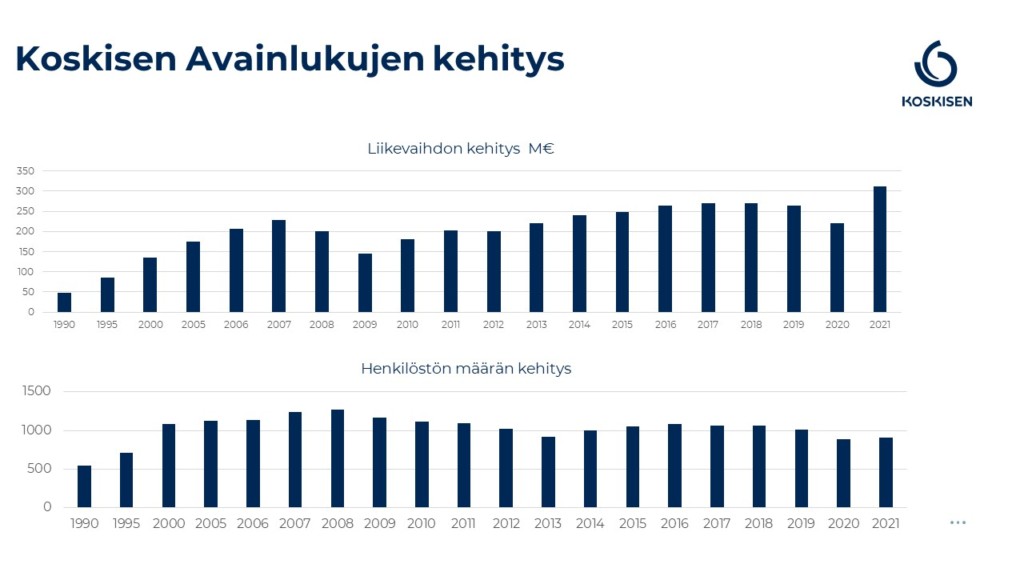
Koskinen’s net sales remained over 250 million euros in 2016-2019. In 2020, net sales decreased to 220 million euros, and last year they rose to 311 million euros. The renovation boom drove up saw timber prices in 2021, when Koskinen’s adjusted EBITDA margin rose to 20% and operating profit was 53 million euros (cf. 2020: EBITDA margin 5%).

Koskinen’s net sales development in 2005-2021
Source: https://koskisen.fi/konserni/koskisen-tarina/

For comparison, Koskinen’s year 2016: Source: Koskinen’s sustainability report 2016

  • Koskinen Group had net sales of 248 million euros and an operating profit of 4.2 million euros.
  • In 2016, according to the CEO’s review, Koskinen’s operational profitability was burdened by both operational factors and the inflexibility of the market price of coniferous logs in relation to changes in world market prices of coniferous sawn timber.

Here is another statistical example from a report on the impact of the sawmill industry in Finland published by Sahateollisuus ry (Finnish Sawmills Association) in 2021. Another profitability comparison can be found in the Spring Advisor analysis linked above.

https://sahateollisuus.com/wp-content/uploads/2021/12/st_vaikuttavuus_151221.pdf

Pages 48-50 of the publication provide more detailed information on the finances of Sahateollisuus ry’s member sawmills.

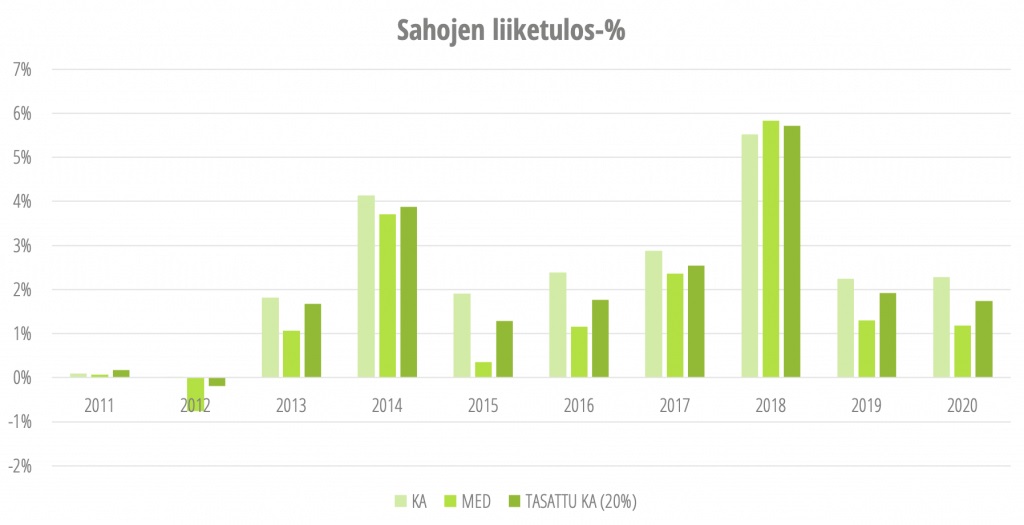
  • The comparison of sawmills’ operating results includes 25 independent sawmills.
  • The adjusted average operating profit percentage of sawmills has typically been around 2 percent.
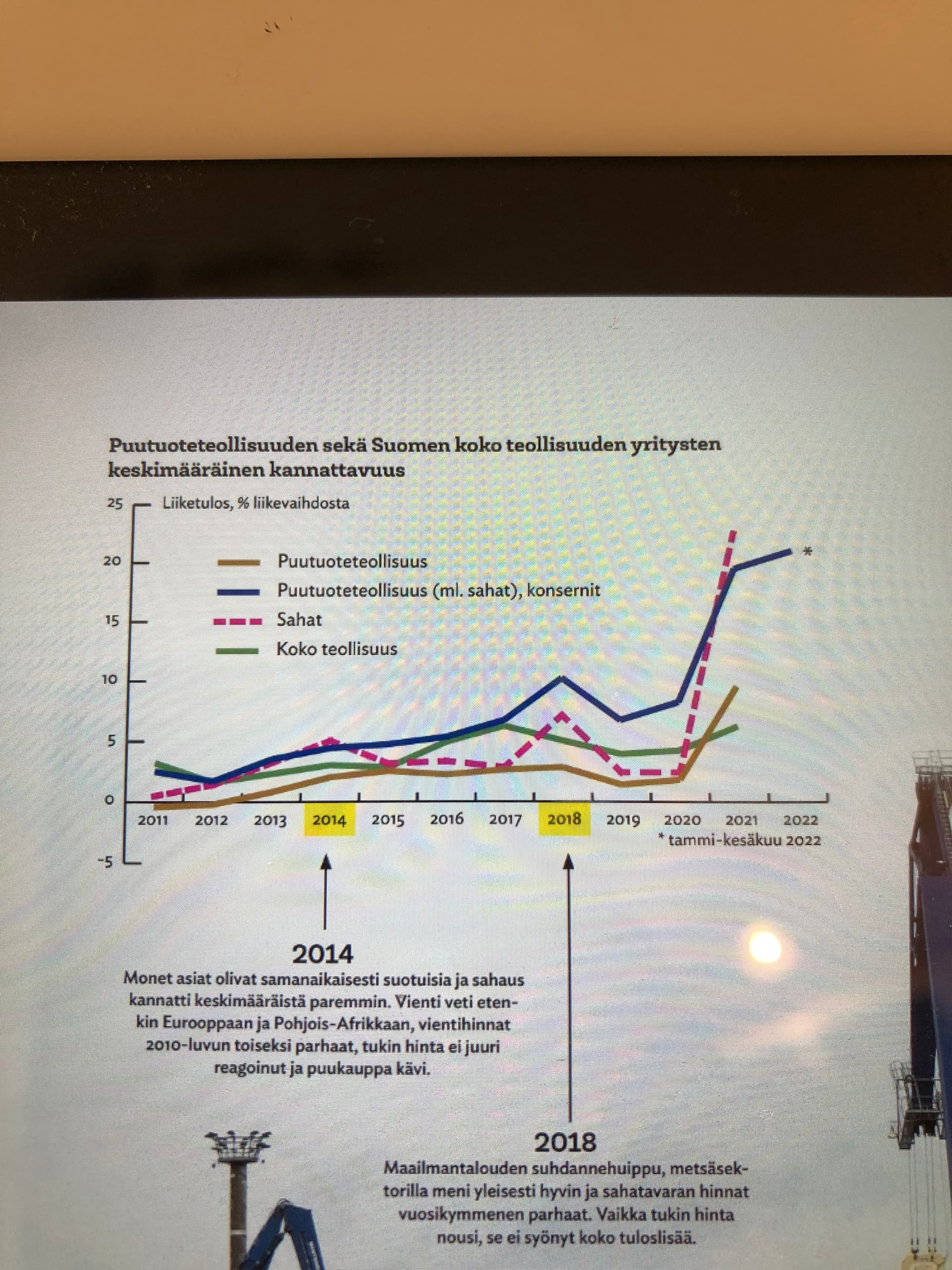
  • The peak years in the 2010s were 2014 and 2018.
  • In 2008-2010, the price of saw timber collapsed during the financial crisis. Even in 2011 and 2012, the average for sawmills was in the negative.


Image source: Sahateollisuus ry: Social and Economic Impacts of the Independent Sawmill Industry (2021).

The latest price peak was strong. The analysis from Spring Advisor Oy linked above stated that at the peak of the cycle in 2021, the average operating profit percentage of medium-sized sawmills reached as high as 18.7%.

A favorable market situation has also increased investments.

  • According to Sahateollisuus ry, many independent sawmills have made investments in recent years. These include: Koskisen Oy, Pölkky Oy, Junnikkala Oy, Kuhmo Oy, Verso Wood Oy, Veljekset Vaara Oy, and Hasa Oy.
  • This year, Metsä Fibre’s Rauma pine sawmill also started operations, utilizing approximately 1.5 million cubic meters of pine logs annually. Full capacity is expected by the end of 2023.

Metsä Fibre’s Rauma sawmill’s wood consumption will be almost at the same level as Koskinen’s.

The following information is from Koskinen’s sustainability report for 2021 (https://koskisen.fi/wp-content/uploads/2022/11/Koskisen-Vastuullisuusraportti-2021.pdf):

  • In 2021, Koskisen Oy procured approximately 1.6 million cubic meters of wood. Of this, Spruce was 52%, Pine 20%, Birch 27%, Aspen 1%.
19 Likes

Exceptional spike? Time will tell

1 Like

I’m not entirely sure what you were trying to say with that message. To my eye, the COVID spike was more than exceptional.

Those couple of previous cycles weren’t very special. When the interim period is still running on a couple of percentage points of EBIT, depending on the financing situation, most of the time is spent making zero profit.

An extremely thankless situation, especially for a long-term investor. If one intends to make money in such an industry, a speculative element must be included, and one must try to buy at the bottom, hoping for the next upward cycle to begin soon.

6 Likes

I also commented in the “investing in forestry” thread about how the quality of sawlogs wouldn’t be a major issue on a larger scale. However, in Koskinen sawmill’s situation, I see finding high-quality raw material as a rather serious risk, which could lead to the sawmill being forced to chase good timber lots at too high a price. The reasons are geography and product range.

I’ll be watching with interest, but I wouldn’t necessarily jump in at the peak of the cycle unless it’s extremely undervalued. A PE of 5, before I’ve looked at the numbers more closely, would be suitable for me.

P.S. Sawmill by-products are in high demand right now, and I’d guess the price is even 60€/MWh. I might jokingly calculate some estimate of by-product revenues sometime.

Edit. If the company itself has reported these by-product revenues, please link them :slight_smile: I’m in the woods so I don’t have time to look for them

9 Likes

Side streams probably account for about 10% of revenue. By-products account for about half of the log volume, and their revenue is one-fifth of the sawn timber revenue.

It’s indeed wise to be cautious about participation, as selling prices have apparently fallen back to their normal level. However, the price of raw material is still at record highs.

1 Like

Except that the compensation a forest owner receives for selling wood is almost the same in nominal value as in the 80s… due to the increase in all other prices and wages, the profit percentage from wood has therefore dropped. Many refuse to believe this fact, but it is true. Not to mention how overvalued forest property is compared to its returns. Practically all significant forest estates in profitable commercial areas are sold through competitive bidding, where the starting price only serves as a minimum, and acceptable offers are almost double the asking price.

8 Likes

Regarding Koskinen’s cyclicality, here are a couple of points from yesterday’s interview and press conference.

In yesterday’s published Inderes interview, Koskinen’s demand situation and the company’s profitability were brought up.

  • Verneri asked (recording at 5:10 min): “Has your profitability remained relatively stable, or was last year exceptionally good?”
  • CEO: “Yes, last year was exceptionally good. This year is equally so; looking at the last three quarters and the last 12 months, the figures are really good. We have been able to enjoy the strong demand that came after the Corona pandemic for our product categories. Historically speaking, these have been good years.”

An exceptionally good year, meaning a year that deviates from the ordinary.
The Inderes interview also highlighted the cyclicality of Koskinen’s industry. According to the CEO’s answer (12:10 min), Koskinen’s business portfolio consists of two very different types of businesses. In the panel industry, cyclicality is less pronounced, even historically. Within the panel industry, there are also two different types of product groups. The sawmill industry is more cyclical, but the impact of its cyclicality can be absorbed, supported by the panel industry’s cushioning effect.

In Koskinen’s press conference yesterday (11.11.), the company’s CFO stated in his presentation (from 48:15 min onwards):

(recording from 48.15 onwards):
“In 2020, revenue was relatively low compared to the following year’s revenue. The renovation and construction boom drove up sawn timber prices, which naturally also affected our demand and revenue growth. In 2021, revenue was the best in the company’s history to date. To some extent, the same development has continued in 2022. Revenue in the sawmill industry has remained good, as has the panel industry. The main driver for the sawmill industry was the continuation of positive price development in the early part of the year. Prices rose until Q2, and they have now decreased somewhat during Q3. On the other hand, the panel industry has been able to compensate, as it has been able to revise its prices.”

11 Likes