LapWall plans a listing on First North and a EUR 5 million share issue.
Including the recent acquisition (Termater), Pro Forma 2021 revenue was EUR 48.3 million and operating profit EUR 4.8 million.
The planned IPO is expected to consist primarily of a share issue, in which LapWall would issue new shares. The preliminary size of the planned share issue is approximately 5 million euros. LapWall plans to use the funds raised through the IPO to support the growth of its business and production capacity, potential acquisitions, and the Company’s general financing needs.
Financial targets and dividend policy
LapWall aims for significant organic growth
The Company aims to achieve a revenue of approximately 70 million euros by the end of 2026
The revenue target is intended to be achieved primarily through organic growth
Acquisitions are also possible during the strategy period
The goal is to maintain strong profitability in the medium term
LapWall’s medium-term goal is to maintain an operating profit margin of approximately 12–15 percent adjusted for amortization of goodwill (EBITA)
LapWall aims to distribute 30–50 percent of the profit for the financial year as dividends
Investments in line with the Company’s strategy, as well as earnings development and future prospects, among other things, will affect the payment and amount of dividends in the future
In February 2022, LapWall acquired the roof element business of Termater Oy and the factory properties used by Termater located in Veteli. Termater designs, manufactures, and installs roof elements with laminated veneer lumber (LVL) frames for the needs of industry, commercial construction, schools, sports facilities, and agriculture. Termater Oy’s revenue in 2021 was 12.9 million euros. Taking the business acquisition into account, LapWall’s unaudited pro forma revenue for 2021 was approximately 48.3 million euros and operating profit approximately 4.8 million euros.
-Video Topics-
00:00 CEO Introduction
01:17 What does Lapwall do?
02:40 Factories
03:16 Customers and products
06:06 Market size and growth rate
07:00 Seasonality and cyclicality
09:35 Competition?
12:07 Strategy and goals
14:00 Improving profitability
17:30 Why are you planning to list?
Good interview. Fundamentally, I’m not interested in anything even remotely related to the construction industry, but this seems to be a clear product business.
The CEO also gets points from me. He’s been involved from the start, clearly has a good grip on things, and a special mention for honestly stating about a couple of things that “yeah, we branched out then and it went wrong, and we learned from that, and now we’re focusing on our core business.”
Investments in production technology will surely enable reasonable profitability in the traditionally very inefficient construction sector, and it should be quite defensive as the intention is to grow only in the current market with current products.
If the price is reasonable, this could be quite interesting.
Someone more familiar with the industry could comment on what kind of business timber element construction is in Europe outside of Finland, and are there companies there for which Lapwall could be a potential acquisition target?
The construction industry is still a somewhat unfamiliar area for me, but by learning more about it, I’m gaining knowledge. I came across an article by Yle’s MOT about wood construction in Finland. The article leaves a somewhat negative impression of the general situation of wood construction in Finland, but I can’t personally assess its impact on LapWall’s operations and figures.
Below are a few highlights on the topic:
In Finland, the juxtaposition between wood and concrete construction is strong.
The Finnish government currently does not financially support wood construction in public projects, nor have regulations been made on the matter at present. The situation is very different in, for example, France, but LapWall expects changes to Finland’s situation in the coming years.
There is a shortage of timber, which has been reflected in rising prices. Demand is strong in Central Europe, and they are also willing to pay for timber there. Approximately 90% of Finnish timber is exported.
The price of timber has increased sharply in the last couple of years. Construction costs in general have also grown significantly, but timber prices have been one of the biggest drivers: https://www.nasdaq.com/market-activity/commodities/lbs
Domestic processing industries, house factories, log house factories, and CLT (Cross-Laminated Timber) factories often buy in 3-month periods, but often sell with 6-month or longer contracts. How does LapWall operate in this regard, and how do price fluctuations affect them?
Impacts of the situation in Russia
Earlier this year, Russia began restricting the export of raw timber from the country. After the war began, Stora Enso and Metsä Group announced they would stop importing timber from Russia, which, of course, does not help lower timber prices. In 2021, a total of 9.3 million cubic meters of timber were imported from Russia, which is about ten percent of the raw material used by the Finnish forest industry. In 2020, the same figures were 9.6 million cubic meters of timber and 12 percent of the forest industry’s raw material usage. Source: HS
This is not a comprehensive answer, but it might give some idea of the situation. This quote is also from the MOT article I linked above.
Haltia Nature Centre was built using Stora Enso’s CLT solid wood elements and sawn timber. Stora Enso’s wood products business is the largest sawn timber company in Europe.
Stora Enso’s strength lies in investments in CLT production, the manufacturing of massive wood elements. When Haltia was built ten years ago, the CLT elements were imported from Austrian factories. Central Europe is ahead of Finland in wood construction.
Miikka Pesonen, Sales Director, Stora Enso Wood Products: Indeed, wood construction has been strongly on the rise. We have many countries, like France for example, where public wood construction and also private wood construction have been supported. Yes, I see this as essentially a permanent trend change. There will be stronger demand for wood.
Stora Enso is supplying solid wood elements for an entire office campus being built in Paris on a nine-hectare area. This is a prime example of French solid wood construction. From the beginning of next year, France will have a wood-mandate in public construction. Half of the buildings must be wood.
A fact that says something about Stora Enso’s faith in Finnish wood construction is that the company does not have a CLT factory in Finland. When a daycare center is built in Tuusula, the wood elements come from the Swedish factory.
MOT: Where are you investing globally at the moment?
Miikka Pesonen, Sales Director, Stora Enso Wood Products: Well, currently mainly in Central Europe. We have a new CLT factory or solid wood element factory coming up in the Czech Republic. It is now closer to the market and still, if we look at Finland, Finland is a relatively small market compared to the Central European, German, Austrian, French markets, which are currently growing strongly in solid wood.
In the public offering, just under 300,000 shares, for institutions over 900,000 shares, and for staff about 81,000 shares. This means an offering of about 5 million euros.
The share price is 2.72 euros, which values the company at approximately 37 million euros, with a P/E ratio of around 8x (based on 2021 figures).
Clearly, I don’t understand anything about valuing a listed company, as I find it misleading to forecast earnings per share based on the number of shares outstanding before the IPO. If the number of shares outstanding before the IPO is approximately 12.4M and the earnings per share are forecasted for that number of shares, won’t it be diluted by almost 15% in the IPO when the number of shares increases by 1.85M shares? Or does the forecast not include the impact of the proceeds from the IPO on business growth?
This question comes up with almost every share issue. Here are the reasons I wrote in the EcoUp thread why we use pre-money in IPO research.
“Our IPO research has largely been based on the pre-money price before the share issue and the enterprise value (EV) before the issue (pre-money). I understand this is also a common practice. This way, for example, there is no need to take a stand on the outcome of the issue. The share issue does not affect the company’s enterprise value; the market capitalization increase resulting from the issue is theoretically completely offset (in practice, IPO costs slightly reduce efficiency) when cash flows into the company’s coffers from the share issue and net debt decreases.”
From these figures, it is quite easy to calculate what the P/E ratio is with the new number of shares. EV multiples, however, do not change with the issue, and for this reason, EV-based multiples are favored in IPOs. In the P/E world, I also believe one can argue that the balance sheet strengthening due to the share issue lowers the risk profile enough that a slightly higher P/E-based valuation is acceptable.
Regarding LapWall, we have partly modeled the investments to be made with IPO funds and their benefits for the coming years. Of course, I emphasize that, in my current assessment, the company could, if it wished, carry out this investment program even without IPO funds, considering the initial balance sheet structure, earnings and cash flow expectations for the coming years, and the extent of investment needs.
Imports from Russia have been mainly pulpwood and chips for years. Log imports have been very low, so if (and when) there is upward pressure on stumpage prices, I believe that the pressure will be on the varieties I mentioned, not on sawlogs. Domestic sawlogs have been the cheapest in the EU after Swedish ones in recent years, so I believe LapWall will be able to get raw material at competitive prices compared to other players in the industry in the near future.
To ensure no one is left with a wrong impression, let’s clarify that LapWall does not buy logs or other raw timber but rather LVL or sawn timber products made from logs by Stora Enso, Metsä Wood, Versowood, or other similar operators. Of course, the price of logs (i.e., the cost level of the aforementioned players) somewhat determines where the supply curve for LVL and sawn timber can be, meaning a low price for the initial raw material would be good for LapWall to some extent, even if the effect is indirect. I generally agree that any pressure for change on timber prices resulting from the cessation of Russian imports will primarily affect pulp rather than logs (though large forest companies buy timber as a whole, which can complicate matters on the log side as well).
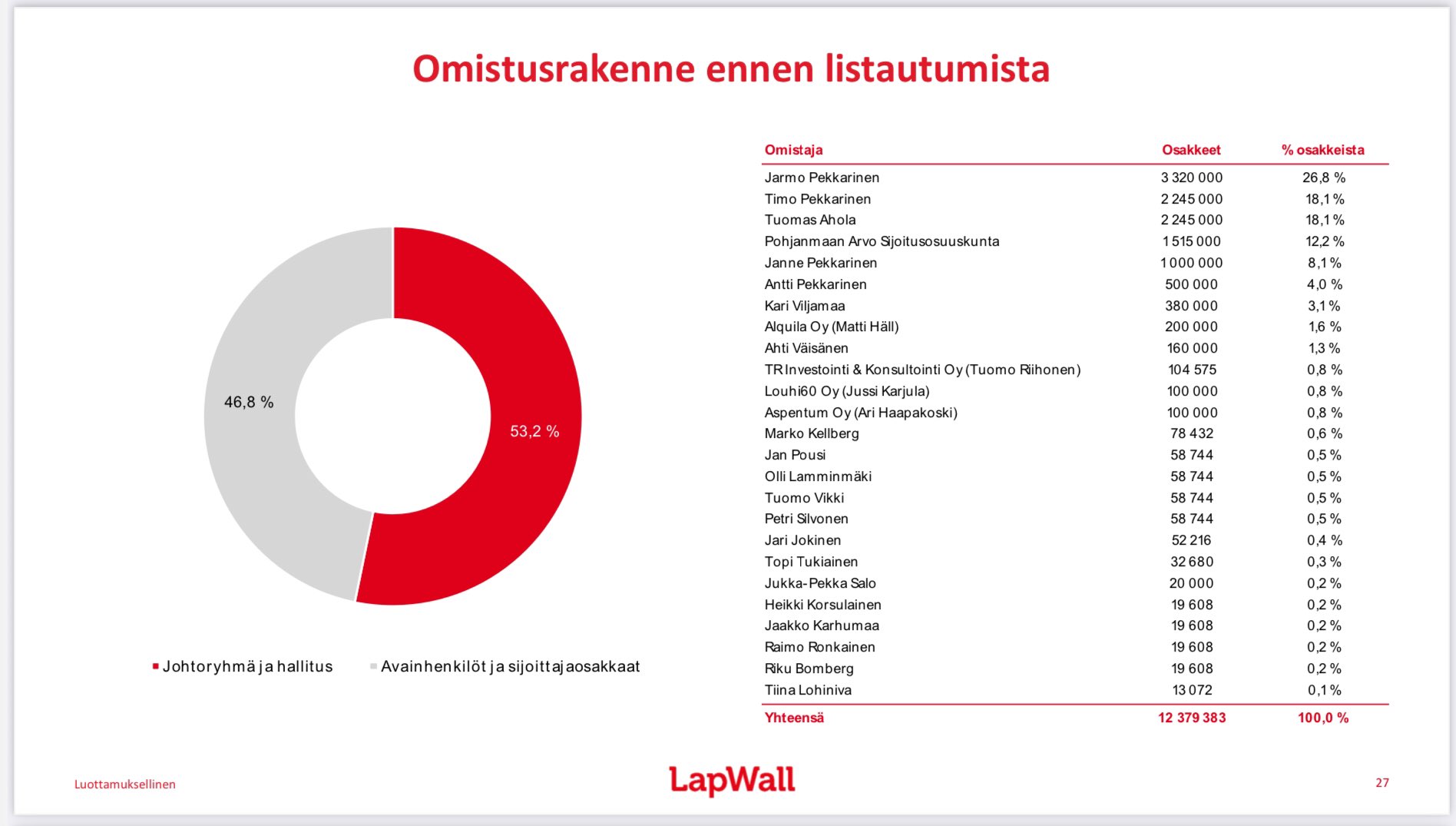
The trading volumes for LapWall’s stock after listing are concerning. Ownership is concentrated. Will there be large bid-ask spreads and low trading volume? What does the “swarm intelligence” think?
Here’s an article by Jorma Erkkilä of Salkunrakentaja about Lapwall. The article quotes Antti Viljakainen and the company’s CEO, among others. For those who have carefully read the thread and the links it provides, the article doesn’t offer much new, but it is still a good and concise information package about Lapwall.
“LapWall plans to use the funds raised from the IPO to support business and production capacity growth, potential acquisitions, and the Company’s general financing needs.”
"Pension insurance company Veritas and EH Konsultointi Oy have, in accordance with their subscription commitments as cornerstone investors in the IPO, committed to subscribe for shares offered in the IPO for a total of approximately EUR 1.7 million.*
The company’s current shareholders will not sell company shares in the IPO."
“We believe that the growth of wood construction and stricter building regulations, as well as environmental requirements, will support the growth of wood element construction in the coming years. The funds to be raised from the planned IPO would support our growth targets and the expansion of our operations,” the CEO states.”
I thought I’d get my small stakes out of the way for this year’s first IPO, even though the euro amounts will likely remain small due to the offering’s small size. On Monday, tomorrow, the next IPO will be announced.