Bitumen membrane roofs are indeed installed by heating them with a blowtorch, so especially during a dry spell like this, it’s quite easy for a flame to catch onto something. When done with professional skill, this doesn’t happen, but it’s easy to just hand a blowtorch to a summer trainee and point them toward the work area.
These are just guesses and recollections from my own days on construction sites. If the fire was confined to the roof structures, then there might not necessarily be any damage to the interiors beyond the smell.
I’ve been waiting for signals of strengthening purchasing power to add Kesko to my portfolio, but Nordea customers’ card payments are still down Nordea Corporate
We’ll have to see what the impact on the construction sector will be when we construction folks get a general wage increase in a few months, and on top of that, there’s the general tax increase for citizens…
I should mention that I know of many housing companies that postponed renovations when interest rates rose, but now this autumn, several of them are starting pipe, window, and facade renovations, so things are picking up at least in that regard…
Based on today as well, it seems that investors are starting to have faith in the future growth of Kesko’s revenue and profit. That purchasing power is increasing, construction and renovation are finally picking up, and car sales are starting to move. This is what I believe myself.
Or then there is just dividend hype in the air. Personally, I have been trimming my position a bit again and am now waiting to see if we return to the 16 euro price levels, allowing me to top up. On Monday, we should get the June sales figures. And soon, of course, the interim report will be out, and it will be interesting to see if any adjustments need to be made to the guidance.
I personally don’t really believe that we’ll see any significant recovery in construction yet. In car sales and DIY hardware store purchases, we might see a small front-loading of consumption during the summer before the VAT increase. And for the same reason, the September figures might be such that it would be wise to have some buying power available to add to the position when they are released.
In the grocery trade, performance was quite weak, and the decrease in the number of delivery days cannot be fully used as an excuse based on these figures.
What the report failed to mention is that in Sweden, stores have also been closed as a result of the K-rauta → K-Bygg conversion, which has had an impact on sales.
In the car trade, it is worth noting the weak market development, and in used cars, Kesko has actually gained market share.
An eight percent decline in the grocery trade, plus perhaps more expected declines in the building and car trade segments. The forum’s optimists were hit with a massive reality check all at once, right in the middle of summer.
While the decline is partly explained by the number of trading days, other explanations are hard to come by. Kesko’s strategy is clearly built for a different economic and consumer habit environment than the one the world is currently in. I’m starting to expect some announcements accompanied by action plans, just to show that the situation is at least being reacted to.
I also don’t believe the situation will improve until the eventual economic recovery is visible more broadly in society through things like increased construction and consumption. There aren’t many drivers for this visible in the world right now; instead, the charts are pointing in exactly the opposite direction. In this regard, Kesko is not only an indicator but also among the first to suffer.
I trimmed a third of my position yesterday, wondering if I was making an investment mistake. Now it seems I did, but of a different kind than I feared.
What do you think of Kesko’s grocery stores’ pricing policy? I personally wonder why Kesko is clinging tooth and nail to pricing that is clearly higher than other stores. Basic food products are consistently more expensive than at competitors. This is a fact. Apparently, it’s a taboo, however, because the admin deleted my previous post where I wondered about this.
In my opinion, pricing is exactly the reason why customers have fled Kesko’s grocery stores.
I wrote earlier that S-Group is currently wiping the floor with K-Group, but many here didn’t believe it. Let’s see when S-Group’s figures are laid on the table if my talk has been in line with what I’ve claimed.
There are many reasons for this. Automated warehousing, lower prices, and the general economic situation where people are switching to “cheaper” stores due to the tightening of their finances.
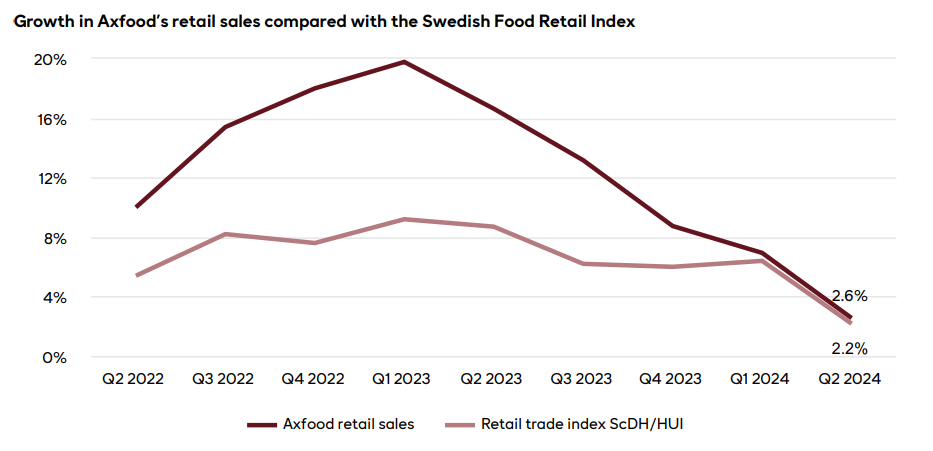
Sweden’s “S-Group,” i.e., Axfood (not a cooperative), reported Q2 figures in line with the market. This is a continuation of the narrowing growth gap between premium players and discount retailers. This was seen in late 2023 and Q1’24.
According to the report, consumer price sensitivity has continued, and comparable growth was fully in line with the market’s 2.2% growth.
Kesko’s Swedish peer ICA started more aggressive price campaigns earlier than Kesko, which may be one factor leveling out the difference. It remains to be seen whether the measures promised by Kesko to improve its price image are sufficient to increase market share in Finland.
To this, one could add the fact that the S Group is allowed to operate with thinner profitability, whereas shareholders expect Kesko to report good profitability. Additionally, the S Group’s volumes are larger than Kesko’s, which also provides an advantage for lower pricing.
And we can further add that Kesko does not use any uniform pricing; instead, the retailers determine the price level. Additionally, comparisons should be made between formats like Sale vs. K-Market, S-Market vs. K-Supermarket, and Prisma vs. Citymarket. The price difference between these isn’t that large, and I’ve noticed that for many premium food products, Citymarkets have rather kept their prices unchanged while Prisma has increased them.
As for the monthly figures, they are dire across the board. In my opinion, many have harbored rather delusional fantasies about the recovery of certain sectors this summer. But I must say, this time even the pessimist was disappointed. I look forward with interest to seeing what Kesko’s earnings guidance looks like on the interim report day.
And let’s not forget that, in addition to this, comparisons should also be made regionally. Here in the Suur-Savo region, Prisma has completely different food prices compared to, for example, Lahti, which is in the Hämeenmaa region. Our nearest Prisma and Cittari (Citymarket) are under the same roof, so comparing prices is easier…
Let’s take potatoes, grill sausage (A-quality), and salmon as a summery example. I get all of these from Citymarket because they are clearly cheaper there than on the Prisma side.
So, whatever the perception may be, if you want to put together an affordable shopping basket, you have to visit both. Lidl is the only one that has the same prices in all stores from Helsinki to Rovaniemi.
It must also be added that because Kesko’s grocery operations are entrepreneur-led, and the entrepreneur naturally needs their annual slice of a few hundred thousand, Kesko will never be able to compete purely on price with that corporate structure, as S Group can always afford to drop prices just a bit more. Conversely, this also feeds the profits of S Group and the suppliers, as they don’t have to sell at the absolute rock-bottom price either.
However, more than this, it is about price perception, which can be challenged through advertising. In my view, Kesko has not joined the price-cutting race for purely strategic reasons, but instead invests more in selection and quality. In the current economic climate, this is not a resonant message. On the other hand, entering the price-cutting race would mean losses for the reason mentioned above. So, it simply is not the right time for a grocery retailer operating with Kesko’s structure. This is why the reaction I called for earlier is needed.