Iris Energy Bitcoin mining and AI

Based on the earnings call, Iren sees demand exceeding supply, especially in “bare metal” solutions, and they are investing in additional capacity because they believe they are in a strong position.

However, to the question of whether Iren places its GPU orders “with a specific customer in mind,” Roberts replied that customers want capacity immediately, not months from now, and the nature of the business is faster-paced than building capacity. This sounded to me like agreements for the sale of capacity becoming available at the end of the year have not yet been made.

I myself have been waiting for the announcement of a significant contract, preferably during Q3. Based on the above answer, it is not coming yet. It makes me wonder a bit if this is more of a threat or an opportunity. And similarly, how the announcement of the first contract, e.g., in October-November, will affect the stock.

3 Likes

What happens to this stock if the AI bubble bursts, for example, next winter? I’m not saying this will happen, but I wouldn’t be surprised either. And probably the long-term investment would also collapse in the aforementioned situation, meaning double-trouble for Irene.

An interesting company, but whenever there’s talk of endless growth, etc., my hackles rise.

7 Likes

This is one reason why I would like some part of the investments to be sold with long-term contracts, even if they are not entirely optimal in a good market situation. If a seller’s market, for one reason or another, turns into a buyer’s market, keeping options open can backfire.

I do believe that these contracts will be made before the turn of the year, but until then, the risk level has increased.

1 Like

This was mentioned as the ‘worst threat’ to this investment case a long time ago by Frans Bakker & co. in a Sunday podcast.

But like everything in life, this isn’t entirely straightforward. The use of language models has probably come to stay, although it’s very possible that future demand has been overestimated.

One can also ask what happens to competitors, who still have to pay for outsourced services (in a price competition situation)?

BC (Bitcoin) is also volatile, but Iren’s all-in cost in mining is 41k, at the same time when everyone else is mining at a loss (correct me if I’m wrong, but no other profitable ones are known).

This advantage has also been achieved through vertical integration.

There are threats, but I personally see the impact of a potential AI bubble burst on Iren as:

  1. financing becoming more difficult (both loans and ATM due to an expected stock price drop)

  2. slower growth

And I see both as temporary, although we are talking about years, in my opinion. If BC (Bitcoin) doesn’t crash too much, this company will certainly be able to accumulate fabulous profits with it.

Why wouldn’t the most efficient compute provider succeed?

And it’s probably appropriate to also hear what AI has to say :face_blowing_a_kiss:

  1. Long-Term Sustainability:
    • Even in a bubble scenario, the AI infrastructure market is projected to grow from $244 billion to $1.01 trillion by 2031, suggesting that a correction might be temporary. IREN’s focus on energy-efficient, liquid-cooled data centers aligns with long-term trends like sustainability and regulatory pressures, potentially insulating it from short-term volatility.
    • If IREN can weather an initial downturn by leveraging its cash reserves and Bitcoin mining cash flow, its high margins could position it to capitalize on a rebound in AI demand.

Conclusion

If AI proves to be a bubble, IREN could face revenue shortfalls, stock price corrections, and financing challenges, particularly in its AI cloud segment. However, its high data center margins (97–98%), driven by low-cost renewable energy and liquid-cooled infrastructure, provide a competitive edge that could help it maintain profitability and capture market share in a downturn. Its Bitcoin mining operations offer a financial buffer, reducing reliance on AI revenue. While margins matter, their effectiveness depends on sustained demand and IREN’s ability to secure clients. Long-term, IREN’s energy efficiency and strategic partnerships position it to benefit from AI’s growth post-correction, but near-term risks from overvaluation and market volatility remain.

EDIT: Who has spoken of ‘endless growth’ and what was really meant by it? Everyone always aims to grow, but this is the first time I’ve heard the term in connection with Iren.

5 Likes

If you mean a colocation deal, then yes, they are made, but more money is needed. Currently, every deployed GPU is sold out instantly for months-years, plus it pays for itself in 2 years, and then covers infrastructure costs when an additional year is added.

Compare this to current colocation offers (e.g., the aforementioned McNallie money discussed this thoroughly): 7 years to pay back infrastructure costs.

Why the h*ll would you give away your crown jewels to some hyperscaler with questionable returns?

In fact, it sounds much riskier than keeping the lane open to do what you want.

1 Like

You are certainly right about this, and the management’s comments in the earnings call were similar. I understand that colocation deals are not attractive in the current situation. I need to listen to that McNallie.

I will most likely just have to calibrate my own expectations regarding the timing of contract news and trust that the company’s management’s assessment of their situation in capacity sales is correct. They have a strong track record of making the right decisions, and their trust is earned.

3 Likes

I personally think that the bubble formation regarding AI is greatest at the end of the value chain with the most refined product (OpenAI etc.), and the effects of a potential bubble burst would not extend so significantly to IREN. With a gold rush analogy: IREN doesn’t dig for gold

(although it mines Bitcoin, at least for now :sweat_smile: )

but sells shovels.

I didn’t reach the level of concrete details in my thinking, but I hope the thought process is understandable despite this.

6 Likes

Tämän yön podissa sukelletaan aiheeseen ’colocation 2.0’ niin kuin Dulce noita gpu-leaseja kutsuu. Piti lukea tämä erittäin hyvä postaus että homma aukeaa kun on ittellä niin paksu kallo.

AI-kupla:

In short, 0% down FMV financing is the fuel of the flywheel. It ensures that IREN can expand fleets at hyperscale pace without constantly pausing to raise billions in fresh equity. This capital efficiency is what allows IREN to seriously contend with CoreWeave, despite having a smaller balance sheet today. It is also what makes the model resilient—if AI growth slows, lease returns cap downside; if demand surges, IREN can lean into the flywheel and expand capacity faster than equity-reliant rivals.

Risk Sharing and Bubble Protection

The risk-sharing dimension is also critical. With a loan, IREN owns obsolescence risk outright. With FMV, much of that risk is shifted to the lessor, who has stronger secondary market capabilities and the ability to absorb residual shocks. In an industry where GPUs may depreciate 60–90% in three years if demand falters, this insurance is not theoretical. It protects IREN’s balance sheet from being saddled with billions of depreciated assets in a bubble unwind.

Suosittelen lukemaan koko postausryppään.

https://x.com/litigious_dulce/status/1962239645791506498?s=46&t=Gf87bhKtIDEQ8PoQTL96bQ

EDIT: Viimeyön space https://x.com/i/spaces/1OwGWeRoRaZxQ

5 Likes

I find it unrealistic to think that if the AI bubble were to burst, it wouldn’t significantly affect IREN. In previous bubbles, both good and bad businesses have come down significantly. It probably wouldn’t change IREN’s operating model, but it would clearly push the goalposts further ahead and the stock price would certainly come down.

I, myself, might expect the opposite situation, meaning I’m ready to lighten my position if, at the same time, we see new Bitcoin records, a proper AI boom (i.e., parabolic rises in those stocks), and a bunch of new customers (+ valuation compared to AI infra peers). I see this as quite probable within the next 6–12 months.

I agree that long, large deals would be attractive because they would accelerate IREN’s transition from a miner to the AI sector. When a larger portion of capacity moves under contracts, cash flows are easy to calculate, even if their margins are weaker. Based on the CEO’s interview, it seems that IREN is very selective and flexible in how they allocate their capacity. Naturally, the goal is to maximize returns by acquiring a broader customer portfolio with the best margins.

Over the next 6–12 months, there will certainly be a lot of news about new GPUs, construction projects, and customers, so there’s probably no need to wait too long for this case. The only hope is that the sector doesn’t bubble up and burst before then, but that IREN can be positioned in the right category with real customer relationships, and then cashing out the position will become timely for me.

10 Likes

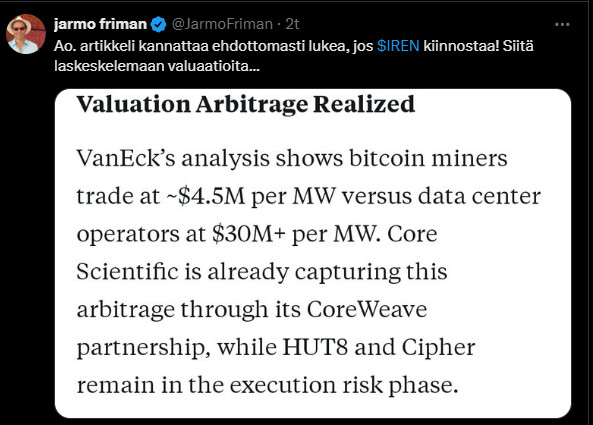
If anyone is still unclear what the re-categorization of a miner as a data center operator means, here are the numbers.

image

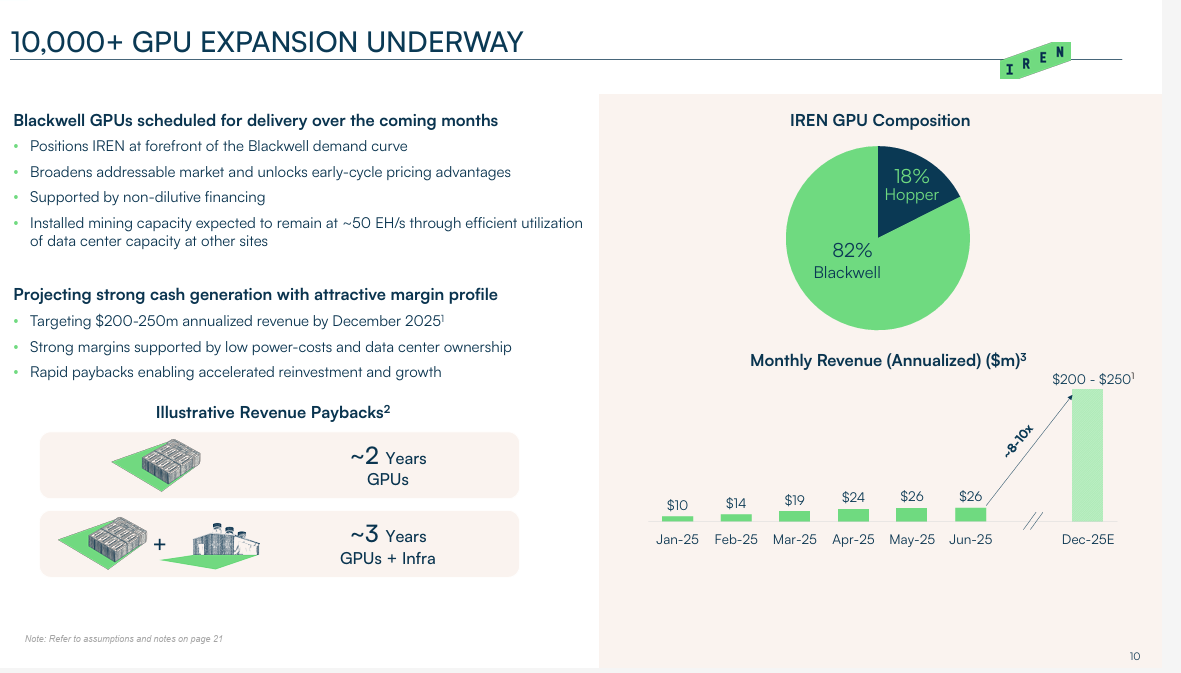
IREN will have 2,310 MW energized by April 2026, plus an additional 600 MW by H2/2027.

If we look at next year’s capacity of 2310MW (even if not all of it is yet in the commercialization phase), the valuation as a miner would be 10.3 billion vs. a data center company’s 69.3 billion.

IREN’s market value today is 7.2 billion.

14 Likes

I don’t see AI as a bubble, but there’s a steep forward bias in the hype. AI will change and revolutionize a lot, but not on the timeline that is being hyped and the market is front

15 Likes

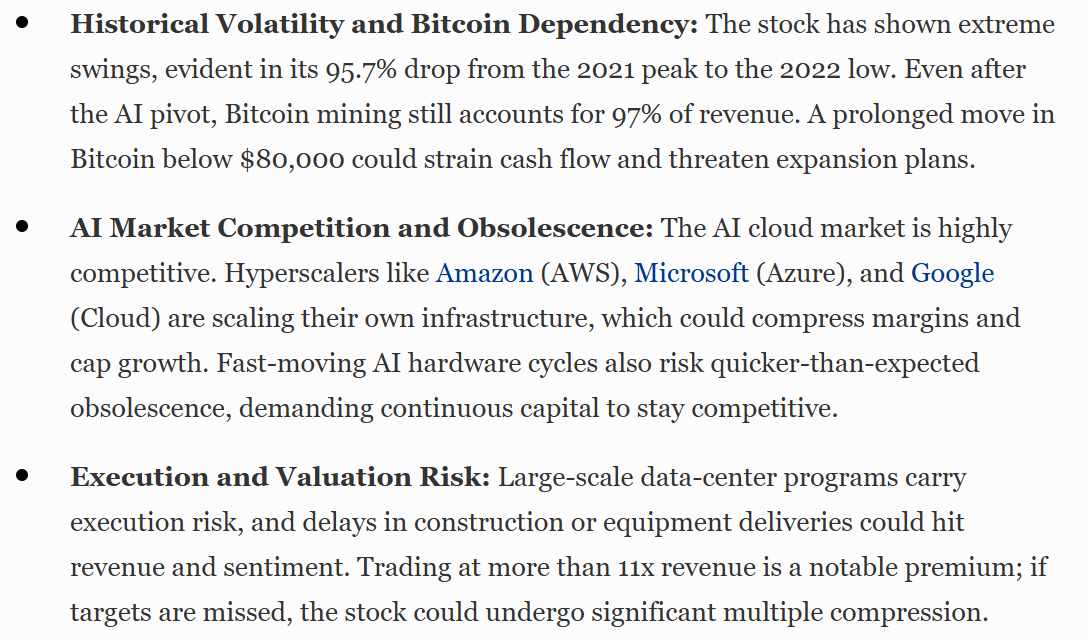
Forbes article with a conservative revenue assumption for 2027 - although it remains unclear whether they mean calendar year or fiscal year. I assume fiscal year.

How IREN Stock Can Double To $50?

Since I’m bullish, it’s probably best that I only pick out the mentioned risks :kissing_face_with_smiling_eyes: (I don’t exactly agree with the middle point, but it’s an important topic nonetheless)
image

The article itself is short and free of fluff, worth reading.

EDIT :police_car_light: Frans’ commentary on the 10-K has appeared on the airwaves. Regarding the risks caused by 1 big beautiful bill etc., this is the level of detail we’re going with, it’s worth following the discussion in case we get comments from specialists:

  1. Connection deposits
    As of June 30, 2025 we had paid $11.7 million of connection deposits for Sweetwater 1, as well as $13.5 million in connection deposits and $4.1 million in non-refundable connection costs for Sweetwater 2, with such payments facilitating a direct connection to the ERCOT grid. We expect to pay up to $13.5 million in connection deposits over the next 12 months, related to our Sweetwater 2 site.

:backhand_index_pointing_right: SW1: 1,400MW, $11.7 million paid.
:backhand_index_pointing_right: SW2: 600MW, $31.1 million paid+to be paid
Was SW1 secured earlier on, and therefor so much cheaper? Or is SW2 undergoing studies to upsize? :eyes:
Thoughts here?
@KashRamki @GideonOPowell

https://x.com/FransBakker9812/status/1963125705639600410

A few more takeaways.

  1. Frans is concerned about, among other things, Stock-based compensation (who wouldn’t be):

“..Or will we see $40m+ Stock comp every year now since the market didn’t care in these recent earnings? I’m not thrilled to have to look at $10-15m SBC every quarter.”

  1. then something peculiar from the BC world:

“And a funny detail about the purchase agreements with Bitmain: IREN gets a 10% discount for paying in USD, but if it pays in BTC, it must pay at a 11% premium to market. Instead of rewarding Bitcoin payments, Bitmain penalizes them — a stark contrast to the usual narrative where merchants prefer BTC for its appreciation potential.”

This was a quick overview.

“There’s a lot to unpack. But for a first detailed look, I thought these points would be interesting to IREN shareholders.”

9 Likes

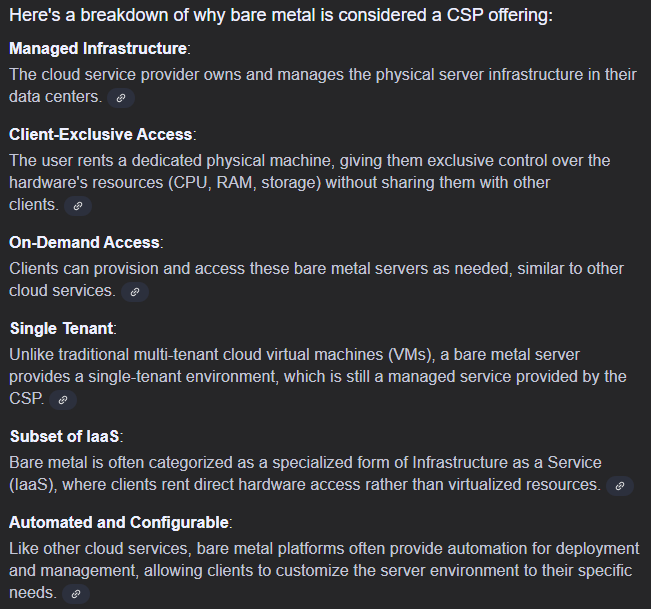
Well, I didn’t remember to ask the language model about this again, but I just did.

(“why is ‘bare metal’ offering considered as csp?)

image

Today we’re eagerly waiting to see if the monthly report is ready; it didn’t come yesterday on the fourth day as usual :thinking:

The wiser ones had calculated that 1500 GPUs should have been installed for the schedule of over 10k cores by the end of the year to hold.

9 Likes

And most likely the monthly figure is 2150. :grin:

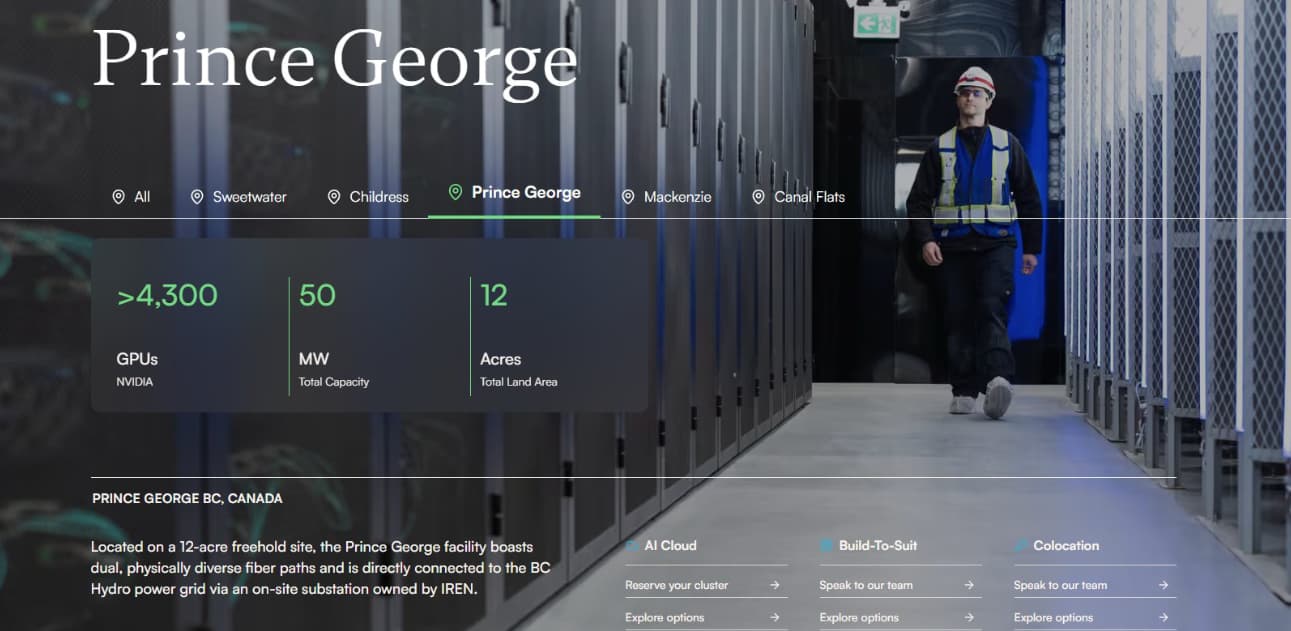
A fresh layout on the homepage.

image

15 Likes

This company is really moving forward incredibly fast. I wonder if we should set up a similar operation here in the Nordics.

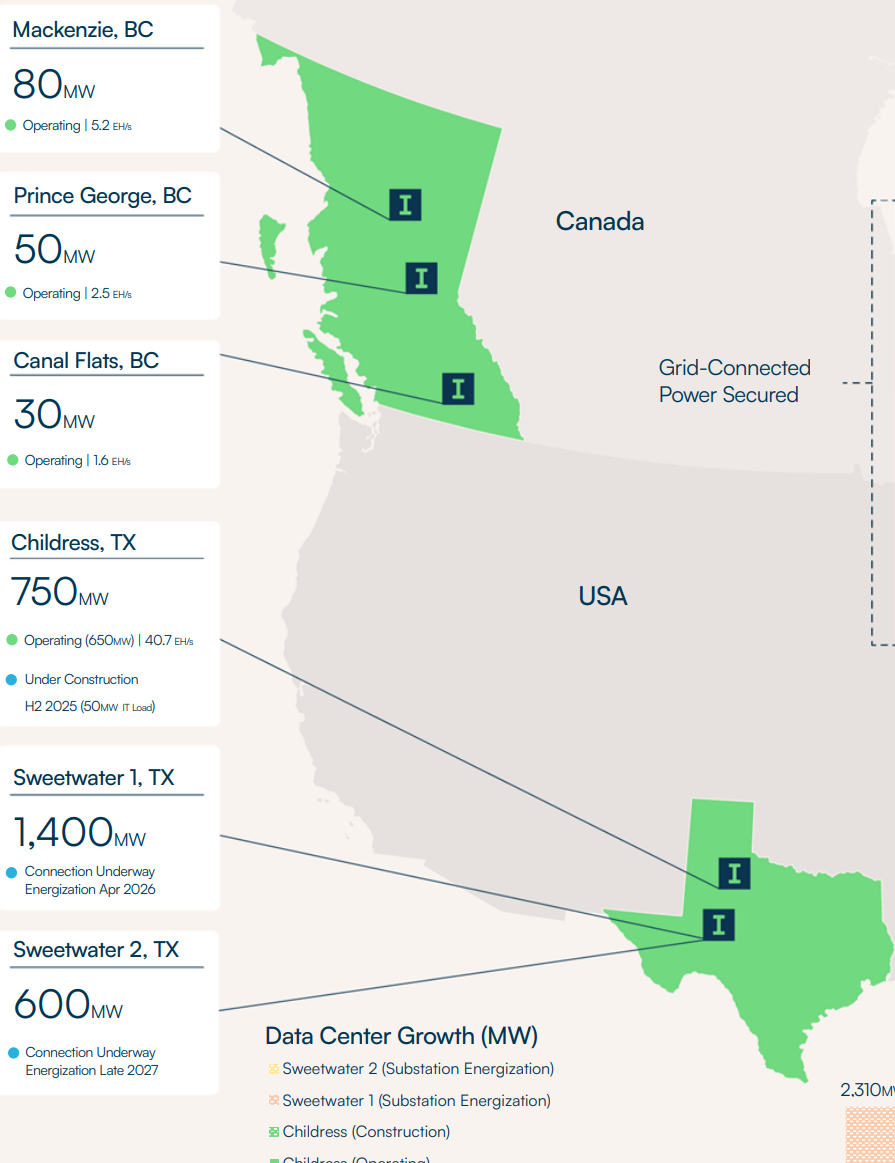
Hi! The August report is out ec8ec2a6-a1d1-4bb6-9cb9-bc2d436b9db9 and at the same time, the answer to this finally seemed to come (well, not exactly in MW, but still) - in image format (if these have been in previous reports, then my bad):

image

There are the exahashes by facility, summing exactly 50 (although they have been moved out of Canada again in August, I would assume, so they probably haven’t been running at full capacity).

The monthly report isn’t quite clear again regarding the most interesting part, i.e., the installed GPUs. The report states “scaling from 1.9k to 10.9k NVIDIA GPUs, including ~9k Blackwell GPUs
scheduled for delivery at Prince George over the coming months” but the PG slide updated just this weekend clearly states that we are already over 4k GPUs :man_shrugging:

Well, as long as it progresses
image

10 Likes

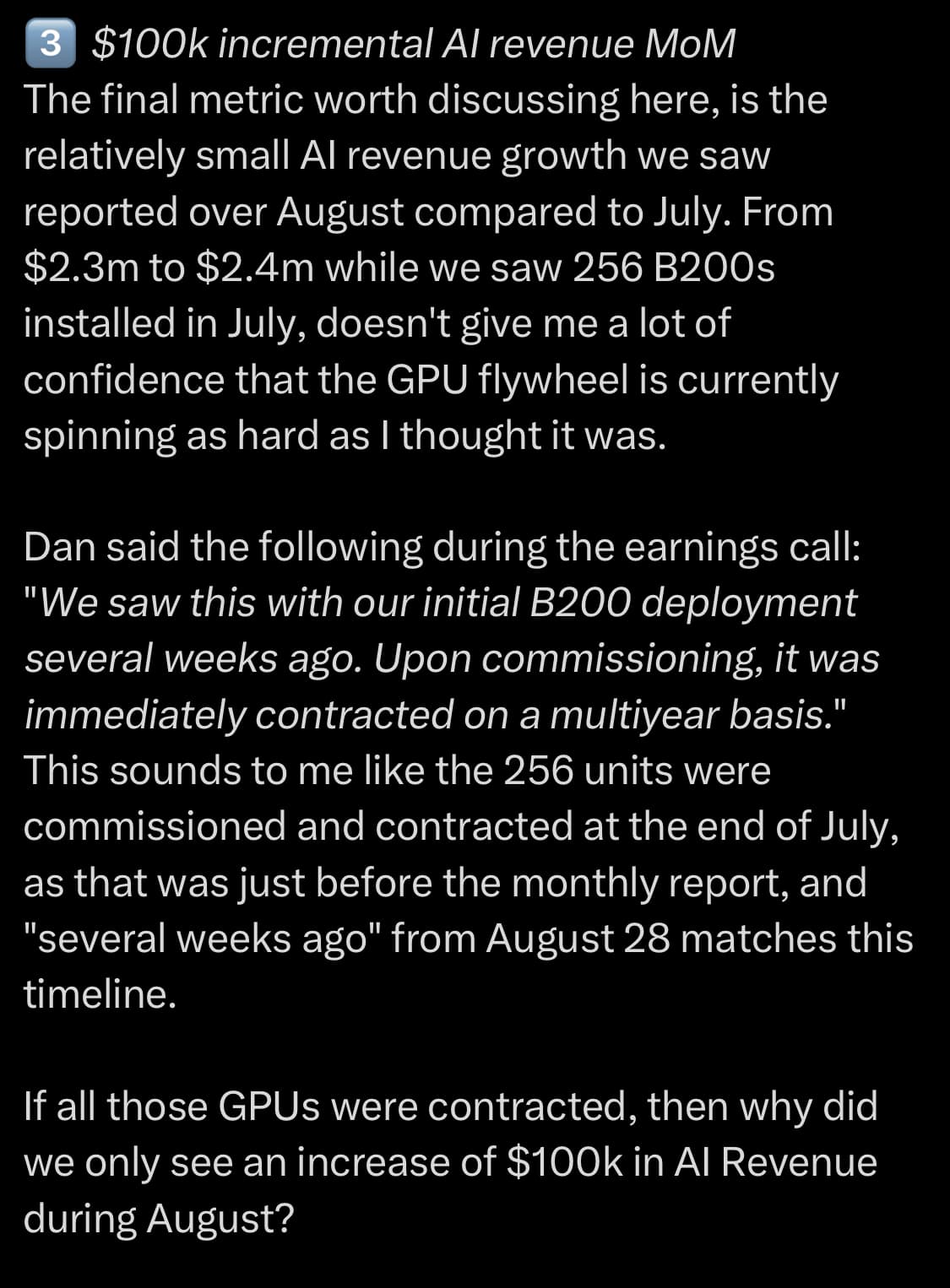
I still haven’t received an answer to my question, and it’s unclear how much of the current active power is being used by AI Cloud. These monthly reports always leave an annoyingly large amount of room for interpretation, and I haven’t figured out what IREN even reports when they talk about GPU quantities. Installed? Owned? Active? Ordered?

Having briefly scanned the reports, the GPU quantity hasn’t moved anywhere since December. They are still talking about that 1.9k GPU quantity. In the latest report, they also mention 10.9k GPUs, of which 9k are “scheduled for delivery at Prince George over the coming months.” So, presumably, the capacity is still around 1.9K.

AI Cloud revenue, at least, has moved from 0.8M in December => 2.4M, but the last few months have been pretty stagnant. Perhaps the reason is that all capacity has been sold out for the last 4 months. It’s hard to believe that not a single GPU has been installed this year.

1 Like

I started thinking about the tweet below. If contracts had been signed on the AI side, surely it wouldn’t show in these results yet — at least not significantly? Aren’t AI revenues recorded in these monthly reviews as the service is provided, rather than based on when payment is received?

IMG_8019

https://x.com/fransbakker9812/status/1965034132825931814?s=46

2 Likes

This, in my opinion, shows the downside of monthly reporting: the timeframe is only a few short weeks, and significant steps forward simply cannot be made every month. On X, analysts are nitpicking because they are living this case. However, the big picture is the most important, and IREN has promised big results by the end of the year. Whether the growth curve hits in August, September, or October changes nothing. Dan said in an interview that GPU installation takes several weeks (read 2-3 months), and they will likely only be recognized as revenue once the devices are in place.

BTW, it was hinted somewhere on X that the company’s name would change to IREN AI. I think this would be a great way to bring visibility to the business model the company operates and perhaps awaken some investors to re-examine the case.

image

11 Likes

Interesting sector. IREN was up +10% yesterday after-hours because a competitor got a deal with MS :sweat_smile: (I couldn’t find any other explanation than the market front-running Iren’s future deals)

https://x.com/mvcinvesting/status/1965159293197713849?s=46&t=qDMR_G-hy9voJ-cjq9_ZWA

6 Likes