It still mostly looks like IONQ insiders are in the right place at the right time:
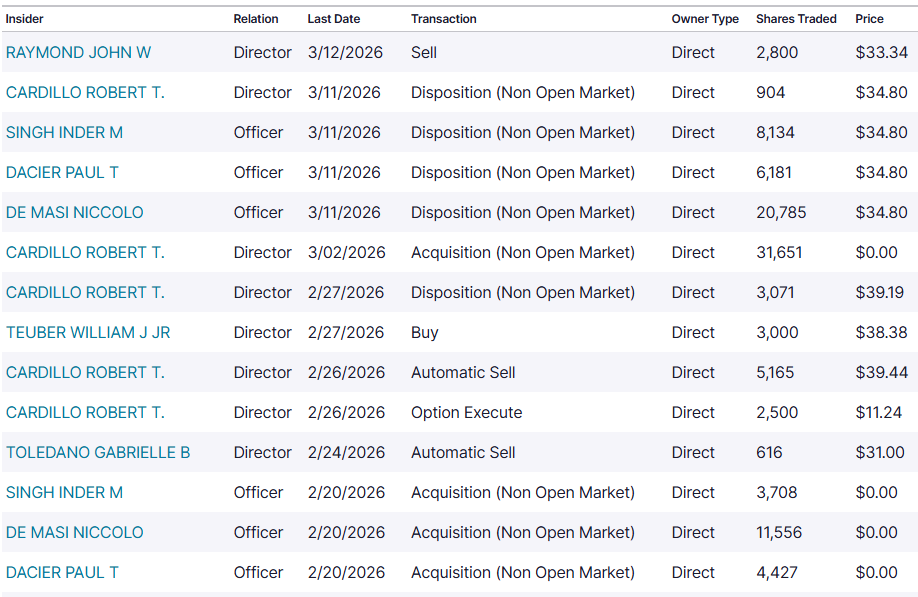
Cashing in on investors with hype while they still can. I still don’t see IONQ achieving anything else significant other than an even wealthier inner circle.
It still mostly looks like IONQ insiders are in the right place at the right time:
Cashing in on investors with hype while they still can. I still don’t see IONQ achieving anything else significant other than an even wealthier inner circle.
Greetings! I’ve followed the company quite little, and a few questions arose regarding IonQ’s revenue and backlog.
IonQ acquired Vector Atomic in the fall of 2025. As I understand it, the company’s backlog was 200 million and revenue was only 10 million?
Are these figures now baked into IonQ’s backlog numbers for this year? And could it be that a fairly significant portion of the forecasted revenue will be formed as Atomic’s backlog is recognized as revenue? One might assume that IonQ will work through Atomic’s backlog faster than 10 million per year. I’m just wondering how much IonQ’s core operations are actually growing, or if it’s more of a serial consolidator in the quantum industry?
Yes, as I understand it, they are included, and revenue will likely start to be generated from them at a faster rate than 10 million / year. There has been wisdom in the acquisitions because IonQ’s stock has been highly valued; IonQ has also received convertible bond financing, and the acquisitions have been made wisely by assembling a full stack, i.e., computing, sensing, security, and networks. Conveniently, with one stock, you get comprehensive exposure to quantum technology and thus diversification. This isn’t a nonsense company, because sensing is a reality today and the technology is used all the time; security is also a reality today – one must be prepared; networks are a reality today – at least in the US, they are being built; and finally comes the crown jewel, i.e., computing. That isn’t a reality yet. Whoever believes in its breakthrough is sitting tight on IonQ. You just have to wait. If computing feels implausible, you can pick more specific quantum companies from the US stock market list, such as Infleqtion (INFQ), whose value creation is based on the sensing side, although INFQ is also researching and developing its own quantum processor. This requires the patience of an ice fisherman; it’s hard to guess in which year computing will really gain traction, i.e., break through.
I wrote in the Investing in Quantum Technology thread, link to my post:
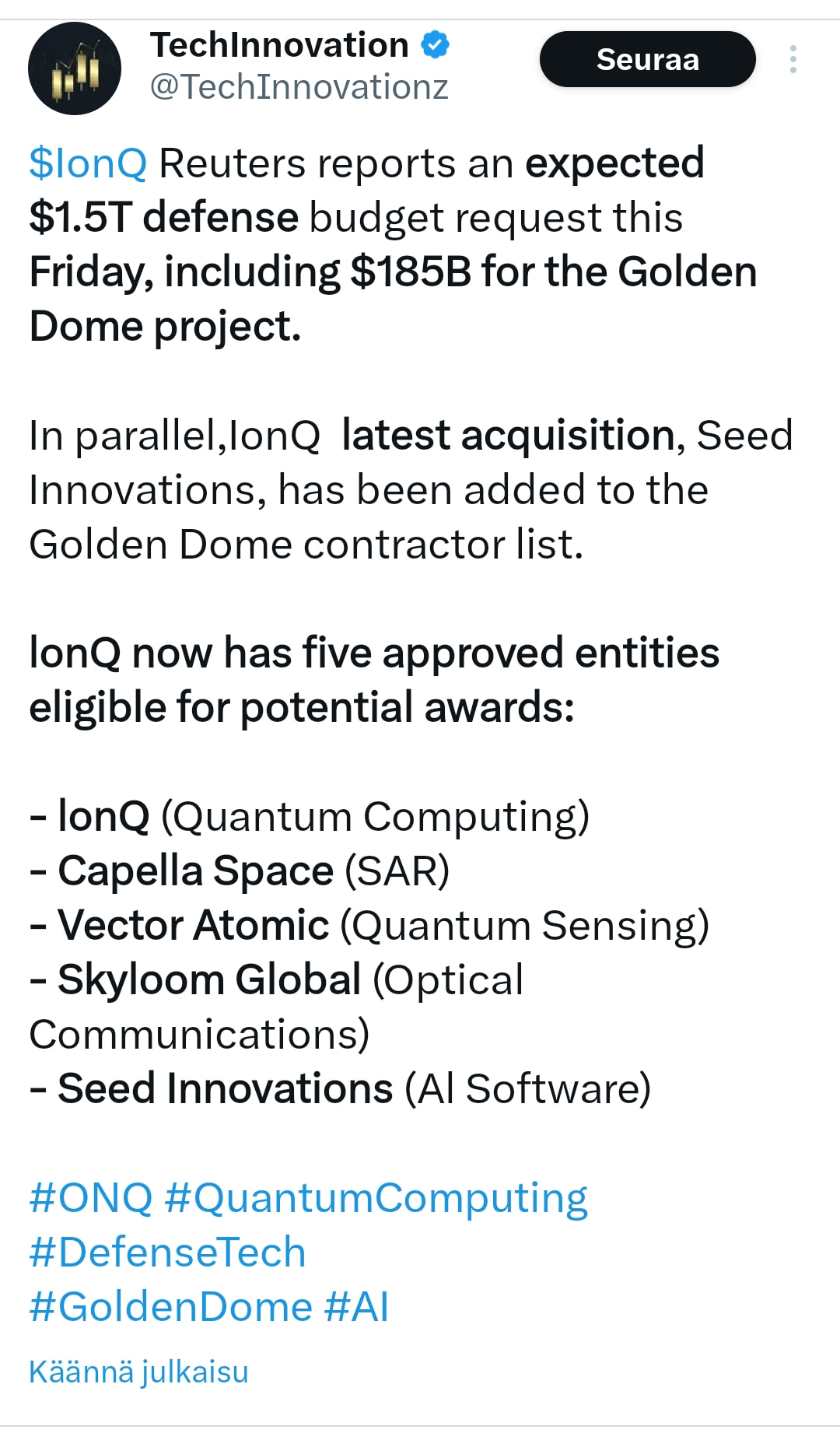
IONQ seems to be attaching itself to the upcoming Golden Dome with quite a few hooks and from many directions at once.
The US Space Force ordered $48.9 million worth of “space-to-earth” communication technology with wartime requirements from IonQ’s (Capella Space) subsidiary.
SDA Makes Second HALO Europa Award – Space Development Agency
IonQ Partially Owned Horizon Quantum Buys 256-Qubit Machine From IonQ:
Great! IonQ is really pushing this industry forward vigorously. This is an important step for $HQ. I should probably say a few words about this in the $HQ thread.
“We’re pleased to be selected for DARPA’s HARQ program. IonQ’s pioneering quantum interconnect technology can enable modular scalability not only for ion traps, but for a wide range of quantum technologies,” said Niccolo de Masi, Chairman and CEO of IonQ. “We look forward to collaborating with DARPA to strengthen national security by developing the quantum platform which can serve as a backbone for networking and scaling quantum systems - across qubit types - for advanced public and private sector applications.”
IonQ is building a quantum network solution with funding from the U.S. armed forces’ research organization, which is suitable for several different modalities (modalities include, for example, ion trap, superconducting, neural atom, photonic solution, etc.). And according to the release, the solution can also be targeted at civilian needs. IonQ clearly wants to be, among other things, the infrastructure platform for a networked quantum ecosystem.
IonQ - IonQ Selected for DARPA’s Heterogeneous Architectures for Quantum (HARQ) Program
And the second significant news of the day on the way to more complex networked quantum systems:
A good day for IonQ.
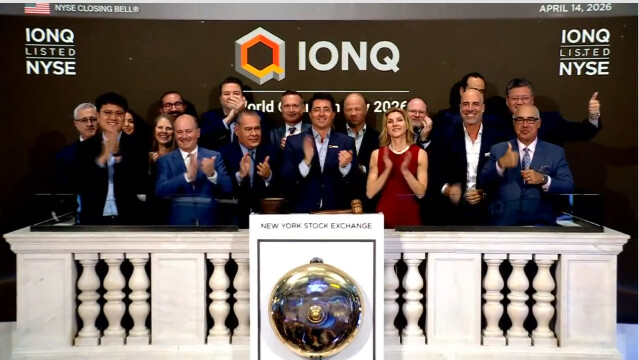
Niccolo de Masi will ring the closing bell at the New York Stock Exchange today.
It should be visible today from 10:56 PM to 11:00 PM (Finnish time) via this link:
IonQ seems to have some solid buzz going on right now. Today it’s Florida’s turn.
The headline sums it up well:
IonQ and Florida LambdaRail are building the first statewide quantum-safe network in the US in Florida. I also picked this up from the IonQ news:
introducing quantum networking, which shifts part of the security model from mathematical complexity to physics-based protection.
So, security based on mathematics is called Post-quantum cryptography (PQC). PQC is offered by many software companies, e.g., Cloudflare. IonQ has Quantum Key Distribution (QKD) in its service portfolio, where protection is based on physics. The general consensus is that QKD is used where 100% protection is required, such as in banks and the defense industry.
As a layman, I think that since PQC is based on mathematics, it too can be cracked with enough computing power. But QKD is based on physics. When using QKD, a quantum computer hacker is always detected immediately and the entire connection is terminated instantly. In PQC, a breach might not be detected.
So, this collaboration between IonQ and Florida is part of the creation of a broader quantum computer infrastructure.
I will now share my opinion on why IonQ is a company that is performing well in quantum computing now and in the future, and why IonQ is achieving and will continue to achieve brisk revenue growth, reaching GAAP net profitability sometime in the 2030s.
This is not an investment recommendation, but rather my opinion piece, and please do your own assessment of the stock. At the end, I’ve included Grok AI’s evaluations of quantum computing companies as a counterweight to my own assessment.
In April, two videos about IonQ were released on YouTube. The videos were made by Korean retail investor Shawn Kwon (@ShawnKwon11 on X). He has been an IonQ investor since 2021. The videos feature Korean text and some speech at the beginning, but don’t be misled—English is the language of the interviews. In the videos, Shawn interviews CEO Niccolo de Masi and Chris Ballance, head of Oxford Ionics (an IonQ subsidiary). Links are here:
Chris Ballance
[단독 인터뷰] IonQ(아이온큐) 양자컴퓨팅의 모든 것: 총괄이 직접 말하다
Niccolo de Masi
[[가을바람 단독 인터뷰] IonQ CEO 니콜로 데 마시, IonQ(아이온큐)의 미래를 말하다 ]](https://www.youtube.com/watch?v=X4TmxvSQ8Hg)
In this post, I will use excerpts from videos.
Remember - the quantum investor does not have it easy
These breakthrough companies break through unnoticed. There is no single point when the market starts pulling the stock price up. Investors experience constant turbulence, and many sit on their investments with losses for years. For IonQ, the so-called first phase (2021-2025) has been navigated—meaning the market questioned whether anything would come of this, and now the market has accepted the answer that something will come of it.
IonQ already has units generating continuous revenue
However, the market is very uncertain about what kind of financial results IonQ can achieve. I don’t have an exact idea myself, but de Masi estimates the company will double its revenue annually. 2025 was 130 million. Then 2026 260 million, 2027 520 million, 2028 1 billion, and so on. My own plan is that the aforementioned revenues will come from Q sensing, Q security, Q network, and Q space solutions; these already generate clear revenue in subsidiaries, and the technical solutions exist.
These keep the company in good shape, but appreciation might not happen much, perhaps not at all.
Actual quantum computing is still in the development phase
If actual quantum computing (Q computing) breaks through, on top of the aforementioned stable pillars, it can start generating a realistic foundation for significant value appreciation in the company. Next, I will explain why I see IonQ making a Q computing breakthrough within a few years—meaning quantum computing alongside bit computing will start producing significant revenue. Let’s get down to business.
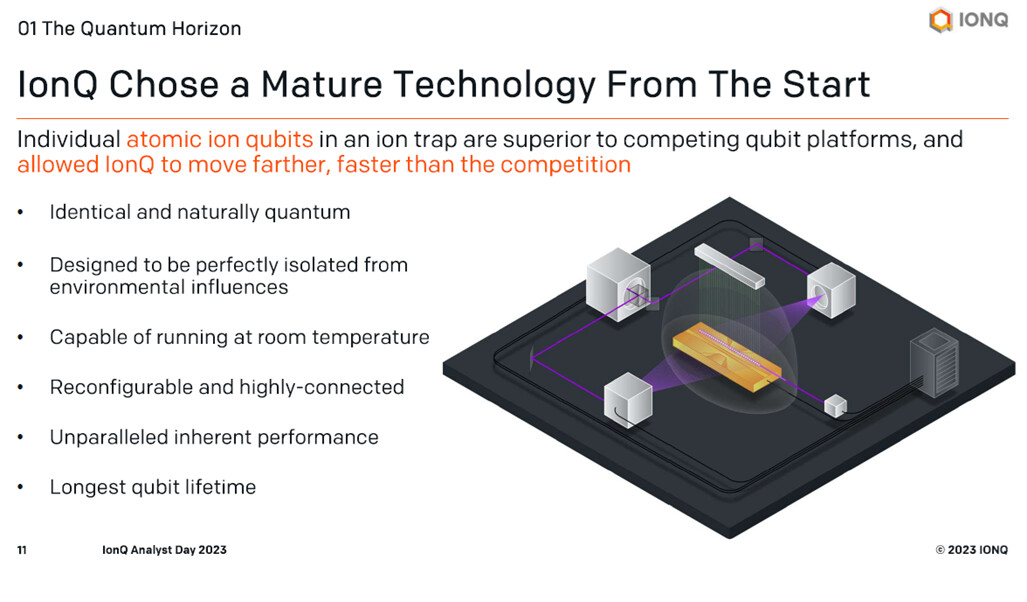
IonQ’s computing technology, Ion Trap, is right for this stage. The best quantum computing researchers and engineering industrialists on both sides of the Atlantic have ended up with it.
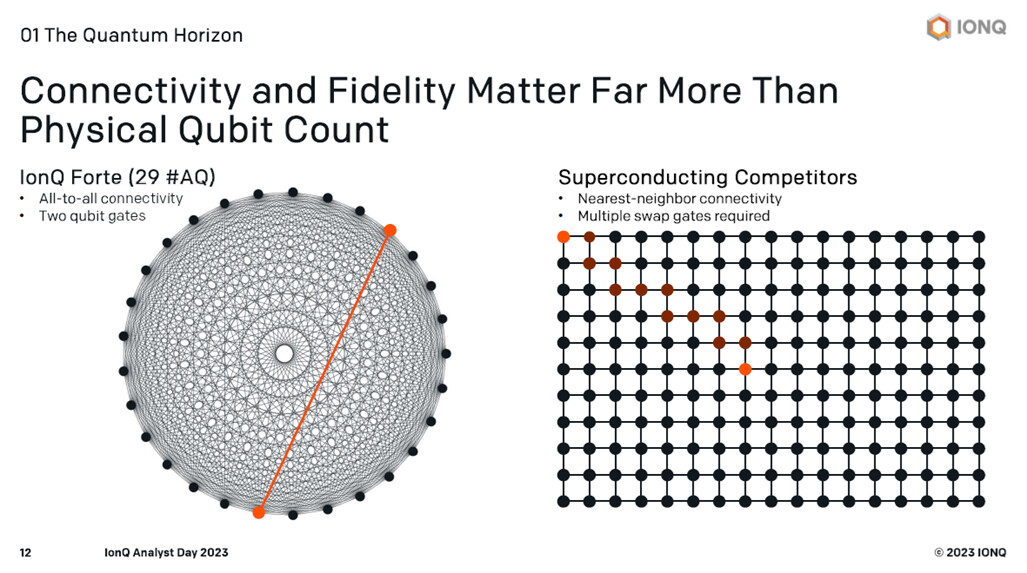
Below are a few slides from IonQ’s Analyst Day on September 19, 2023.
IonQ’s Chris Monroe can be considered the father of the current quantum computer boom; he has been in research teams of Nobel-awarded physicists: Chris Monroe has worked in the research group of Nobel laureate physicist David J. Wineland. David J. Wineland received the Nobel Prize in Physics in 2012 for his research on quantum systems. From 1992 to 2000, Monroe worked in the Ion Storage Group led by Wineland at NIST (National Institute of Standards and Technology). During this time, they demonstrated, among other things, the first experimental quantum logic gate, which is considered the birth of quantum computing in laboratory conditions.
In addition, it is good to note that:
Monroe completed his doctoral studies under the supervision of Carl Wieman at the University of Colorado;
Wieman received the Nobel Prize in Physics in 2001 for the experimental realization of Bose-Einstein condensation (together with Eric Cornell).
Thus, Chris Monroe has studied quantum computing for decades. Monroe’s research team chose the Ion Trap technology as the source of qubits based on decades of experience.
Chris Ballance is the founder & CEO of Oxford Ionics, acquired by IonQ, top researcher in trapped-ion quantum computing, background: University of Oxford, strong academic background. In the interview of the video I shared, Chris says that scalability is a key requirement for industrial quantum computing (= commercially profitable). According to Chris, atom-based or natural qubits scale, while synthetic ones do not (e.g., superconducting, etc.). Atom-based ones include ion trap (e.g., IonQ, Oxford Ionics, Honeywell Quantinuum, etc.) and neutral atom solutions (Infleqtion). IBM’s, Microsoft’s, Google’s, Rigetti’s, etc., synthetic solutions are good laboratory exercises, but may not lead to an industrial breakthrough as they scale less effectively than atom-based ones. In addition, as a new stock market newcomer, there is the Canadian Xanadu, which in my opinion lies somewhere between a synthetic and a natural qubit: Xanadu uses photonic quantum computing, where quantum information is in the quantum states of light. It does not use binary |0⟩/|1⟩ qubits, but continuous variables (CV); information is in the amplitude and phase of light. Quantum states are produced with squeezed light. Since this hardware solution does not use binary qubits, but continuous quantum states, I myself classify this into the so-called synthetic category. I might be wrong, but this is my opinion. The stock market is excited about Xanadu. Its market value is 60% of IonQ’s. This tells us that the stock market is guessing the values of companies. The market has decided to give all quantum companies a market value between 5-15 billion regardless of fundamentals.The core message of Chris Ballance’s interview is that, between neutral atoms and ion traps, the ion trap is better. Because an ion trap can achieve full all-to-all connectivity between qubits. Chris explains that in the neutral atom solution, atoms easily “pair up,” which is not desirable. In an ion trap, the ions remain unpaired. This is also illustrated by the second image I shared earlier, which features a circle and a red line between the qubits. I listened to that presentation live back in 2023, and the main takeaway was that the Ion Trap architecture is the best. In addition to the American company IonQ, universities in England such as Oxford and Cambridge (Quantinuum) have recognized the ion trap as an industrially interesting technology. It is hard to overstate the significance of the ion trap. Or actually, one can. In his video, Chris Ballance explains that processing qubits in the neutral atom solution requires the use of laser beams. Oxford Ionics has spent years developing the processing of ion-based qubits on a basic semiconductor, meaning a standard microchip. This solution requires no lasers. According to Ballance, a single microchip can accommodate 10,000 qubits. And by copying the microchips, the number of qubits increases correspondingly. Ballance also mentioned that as the number of ion-based qubits increases, “problems” do not accumulate because the ions do not interfere with each other, and precision and fault tolerance can be increased by multiplying the number of qubits. Currently, IonQ is able to build a 256-qubit solution. Beyond that, it remains to be solved how more than 256 but fewer than 10,000 qubits are connected (“wired”) to each other within the processor. This does not require physics, but engineering expertise. And connecting the 10k-qubit chips is done via optics/photons, for which IonQ has solutions, and memory is also needed, for which IonQ also has a solution. Solutions to the aforementioned matters were acquired through 2025 acquisitions.
According to Chris Ballance, 10k qubits is the beginning of the end, meaning that afterward, we get “deep quantum circuits,” which I interpret to mean versatile and useful quantum circuits. The 256-qubit milestone will be reached next year; if I recall correctly, the video estimated around Q2/2027. In the video, Shawn asked Chris when the quantum computing breakthrough will be achieved. Chris replied that the matter can be viewed academically, from a business perspective, or however one chooses to evaluate it. Chris says that what matters most to him is the development of quantum-based applications in such a way that the customer feels the solution created with quantum computing brings some value beyond a traditional bit-based solution. The benefit could be an application that requires quantum computing and is not otherwise doable, or quantum computing provides energy savings or a more precise end result, etc. Chris sees the change happening gradually all the time. And according to Chris, AI is a key accelerator of quantum computing, because they have been able to generate error-correction algorithms in a few days, whereas without AI it would have taken months.
According to Chris, IonQ is a platform company, and customers ask for a wide variety of things. For example, one might request the most powerful quantum computer available, while another customer might want a combination of different quantum computers. According to Chris, customers are clearly segmenting. I see it this way: the private sector wants powerful quantum computers, while the public sector orders infrastructure to enable the networking of quantum computers and strong encryption based on QKD technology (based on physics).
From Niccolo de Masi’s interview video, I will bring up Niccolo’s point that there is demand for quantum computing across many industries. But right now in the private sector, healthcare is the industry advancing most strongly toward quantum computing, because modeling molecules and similar elements is nearly impossible with bit-based computing.
SUMMARY
Demand for quantum computing is strong even in the private sector across industries. The ion trap is currently the most promising quantum computing modality, i.e., HW. In addition to IonQ, Honeywell’s as-yet-unlisted subsidiary Quantinuum utilizes Ion Trap technology.
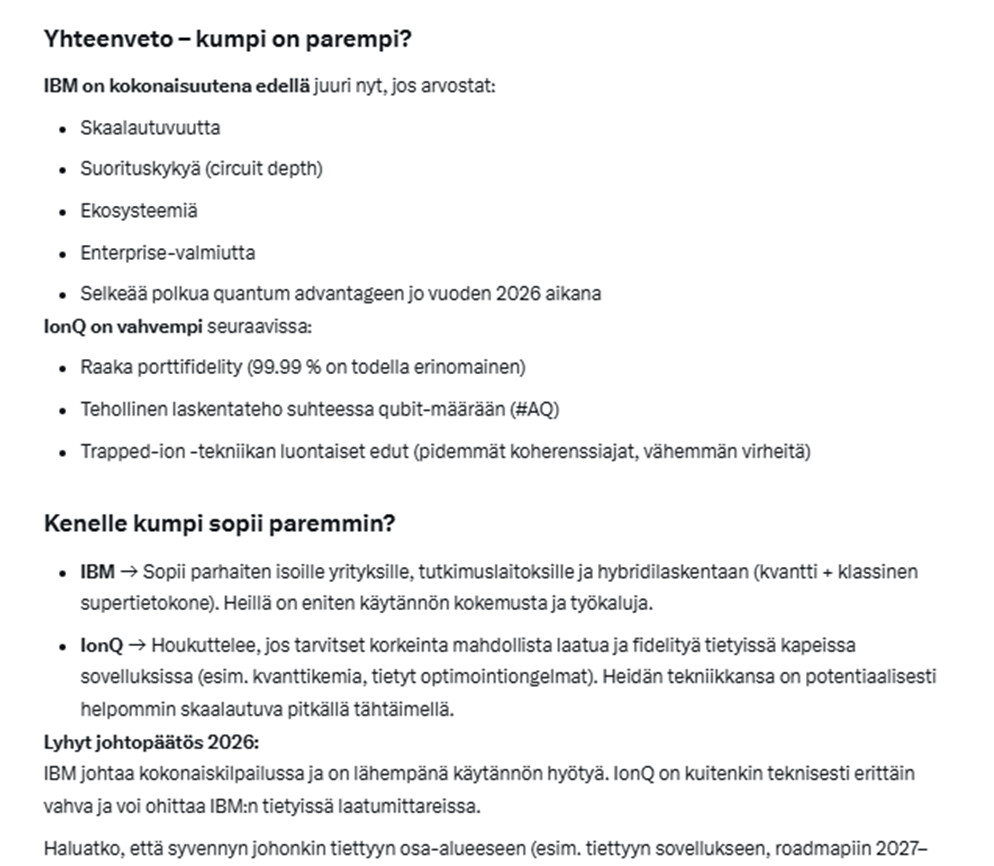
NEXT, INSIGHTS ON QUANTUM COMPUTING FROM GROK AI:
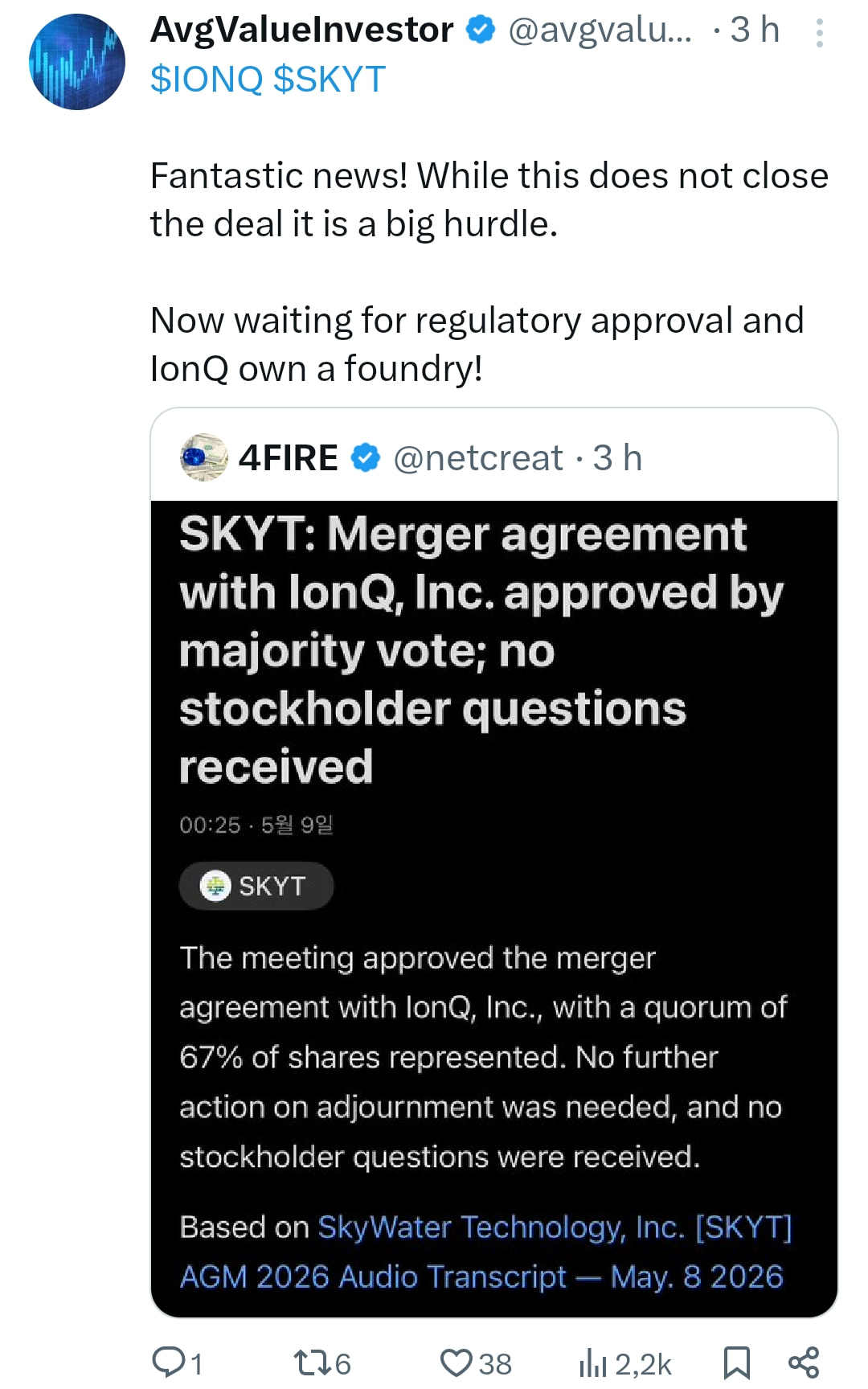
IonQ’s Skywater acquisition is under review by US antitrust authorities. There is a possibility that the deal will not go through. This is a somewhat similar situation to Nvidia’s attempt to buy Arm a few years ago. But it is also a different situation, because back then a US company tried to buy a British company, whereas now it is a deal between two US companies and investments in national security are also at stake.
IonQ-SkyWater Deal Faces FTC Delay after Second Request, Timeline Uncertain - TipRanks.com
How to approach the risk. Personally, I think that Nvidia survived the Arm loss (the deal was blocked for competition reasons), and Skywater is not a critical acquisition for IonQ. You can find peace of mind by reading the CEO’s letter to shareholders at the beginning of IonQ’s annual report, which was published yesterday. IonQ’s footprint on the entire quantum industry is already significantly large. There is something in the letter similar to Alex Karp’s letters; Niccolo de Masi puts himself out there as a personality. Against the backdrop of his physics background, one can well understand de Masi’s boyish enthusiasm for IonQ. The annual report can be found here:
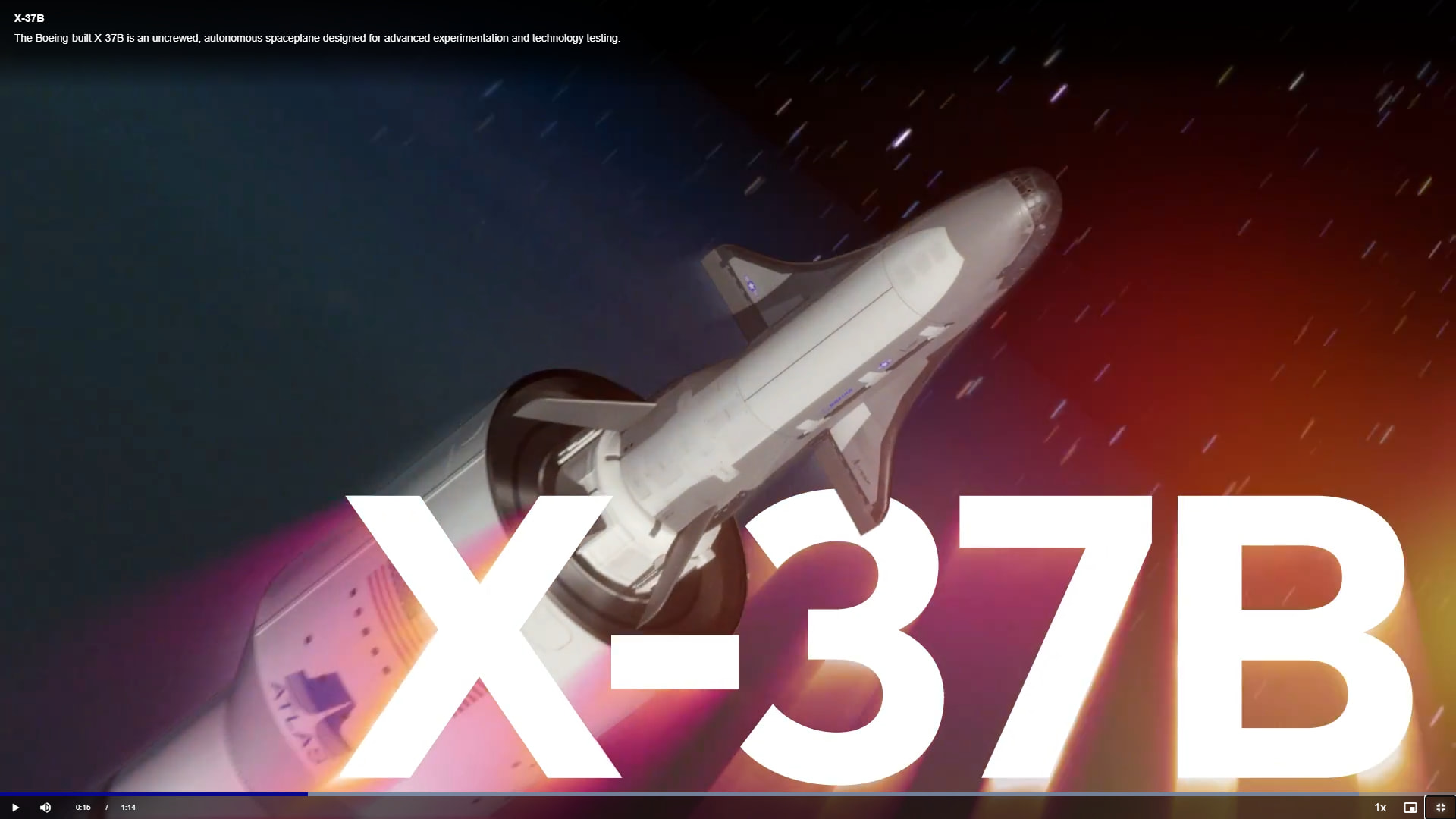
New in de Masi’s letter was the information that IonQ’s sensing & security capabilities enable the use of solutions not only in submarines but also in the US X-37B spaceplane. And as a fun fact, out of IonQ’s 1,500 employees, 300 are at the doctoral level.
And Happy May Day to the readers!
IONQ Q1 results are out
https://x.com/i/status/2052348263643193787
Niccolo de Masi on CNBC