Horizon Quantum simplifies and accelerates programming for quantum computing environments

For forum members, here’s a new quantum industry company called Horizon Quantum, to be listed on Nasdaq in spring 2026:

Horizon Quantum

The company presentation is structured in two parts: 1) I asked AI to summarize the company 2) My story why I brought the company here

1) AI Output - Company Background and SWOT Analysis

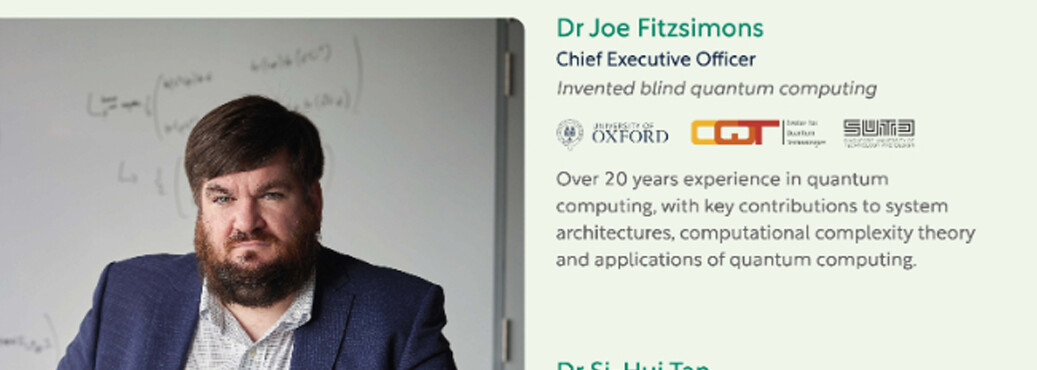
Founded in 2018 in Singapore by Dr. Joe Fitzsimons, former research professor and principal investigator at the Centre for Quantum Technologies.

Series A funding totaling approximately 21.3 M USD; led by Tencent, Pappas Capital, and SGInnovate, among others. Valuation approximately 500 M USD (2025).

Business & Technology

Develops program generator and translation tools (Triple Alpha IDE) that convert traditional code (Python, C, Matlab) into qubit-oriented programs.

The goal is device-agnostic software development: it operates on superconducting and neutral-atom platforms, among others.

Has released the high-abstraction-level Beryllium language, an object-oriented quantum programming source language within Triple Alpha.

Practical Achievements

By the end of 2025, they independently tested a self-built superconducting quantum machine in Singapore. The setup combines Maybell’s cryoplatform, Quantum Machines’ control electronics, and Rigetti’s processor.

Horizon is the first quantum software company with its own system for managing physical hardware.

The hardware testing environment is used to practice supporting other hardware architectures – the modular platform allows for expansion.

SPAC Mergers & Funding

In September 2025, a Business Combination Agreement with dMY Squared SPAC was announced. Following the arrangement, shares will be listed on Nasdaq under the ticker “HQ”, with a valuation of approximately 503 M USD.

In December 2025, 110 M USD in cash capital was raised through PIPE subscriptions, with investors including IonQ and a Fortune 50 technology company. Together with dMY’s trust funds, approximately 137 M USD would be available after the transaction.

Strategic Partnerships

Joined the QuEra Quantum Alliance in July 2025 to integrate its software with QuEra’s neutral-atom quantum machines.

The goal is to support software development for various hardware platforms as broadly as possible.

In summary:

Horizon Quantum is a Series A stage quantum software company operating in Singapore, which combines software development and hardware-level control on its own testbed. It develops high-level programming languages (e.g., Beryllium) and a modular Triple Alpha environment. Strategic steps including a SPAC listing ($HQ), supportive partnerships (IonQ, QuEra), and significant proprietary hardware make the company an interesting player in the quantum software ecosystem.
image

2) My Story: Why I Brought the Company Here

Dr. Joe Fitzsimons, CEO of Horizon Quantum (Nasdaq ticker for the company is $HQ), is also the company’s founder. He founded Horizon Quantum Computing in 2018 and serves as both its founder and CEO. I consider this a good starting point.

My interest also stems from the fact that HQ is being brought to the stock market through a similar SPAC arrangement as IonQ and Planet Labs in 2021. The SPAC arrangement is being executed by dMY Squared Technology Group, Inc. – a SPAC company whose key leaders have included IonQ’s current CEO Niccolo de Masi and dMY Squared’s current CEO Harry L. You. IonQ’s and Planet Labs’ SPACs were highly successful, meaning the companies received sufficient initial capital and had, and continue to have, a genuine concrete role and mission in the field of new technology.

For HQ, the market appears clearer than IonQ’s early journey in 2021, when I myself tried to wonder what superposition and entanglement meant, and IonQ’s revenue was initially around a million (now approx. 100X). HQ builds software libraries that connect the machine language of a quantum chip to higher-abstraction-level software codes used to program applications. In my opinion, this is a very obvious need. It’s also important that HQ builds its solution to be quantum HW independent, meaning whether the quantum chip solution (i.e., modality) is a pure atom, ion trap, superconducting, etc., HQ’s libraries give application developers the opportunity to focus on application coding (instead of thinking about quantum gate logic).

It’s also interesting that this December, HQ announced it had connected its software to its operational quantum computer. What’s fun about HQ’s quantum computer is that it’s a so-called ‘off-the-shelf’ quantum computer, not a branded complete solution, but rather HQ assembled the machine itself ‘in-house’ from commercially available components. The processor is Rigetti’s superconducting solution. Some believe that IonQ’s investment in HQ-SPAC this autumn includes a condition that HQ’s software will also be connected to IonQ’s processor.

As you can see, I, at least, am enthusiastic and interested in HQ from many angles. An investor wants returns, and in the spring, a company will be listed on the stock exchange with a valuation of approximately 1 billion and very low revenue. I tried to find HQ’s income statements, but SEC filings from the US stock exchange authority constantly bring up SPAC legalities, and I didn’t find the actual financial figures. But that’s okay, the company will go public with a terrible valuation, and the stock will immediately have high volatility. I don’t really know what else to say about the stock. And if I describe myself as an investor, I am an AI software investor. And when I read the following news on December 9th: “Horizon Quantum to Debut Object-Oriented Language for Programming Quantum Computers - Horizon Quantum today announced the debut of Beryllium, a hardware-agnostic, high-level language for programming quantum computers,” I concluded that this is great, this company must be followed. Here is the link to the aforementioned news:

Horizon Quantum to Debut Object-Oriented Language for Programming Quantum Computers

This is indeed a technological breakthrough company, just like its cousins IonQ and Planet Labs.

23 Likes

Horizon Quantum ($HQ) began its stock market journey through a SPAC arrangement on Friday. The best material I’ve found so far on the company is this 8-K report, which starts with “dry texts” but then presents clear “slides” in the PDF:

Form 425 for DMY Squared Technology Group INC filed 01/12/2026

My initial comment: Well, it’s a small company. As I understand it, it’s debt-free and has over 100 million in cash after the SPAC. What interests me about the company is that it’s in a pick-and-shovel type position regarding quantum hardware (HW) companies. This means quantum computing companies won’t run out of money in the coming years, and they are in a hurry to develop applications. This is why there’s demand for this company, as it builds software snippets/libraries between the quantum processor and applications, easing the burden on application developers by abstracting the machine language required for processing the quantum chip.

This is not investment advice, but the company fits my investor profile very well. I like to enter with a small sum into such a company that is unknown to the general public, unprofitable, debt-free, has an absolutely small market capitalization (now perhaps around 400-500 million), and offers high scalability of solutions. The downside risk is limited because at a share price of $4-5, the 100 million in cash begins to create a floor for the market cap drop. But the upside is quite limitless. This is precisely the reason why I’m not enthusiastic about indebted IT companies – they can go to zero. But with these debt-free ones, you stay in the game even through bad times. As a disclaimer, I must say that the company’s income statement and balance sheet figures have been difficult to find, and I cannot 100% confirm its debt-free status. But this will become clear when earnings reports start coming out.

5 Likes

Interesting! However, it’s not entirely clear to me what the great added value is, for example, compared to open-source Qiskit or even Qrisp, which for a quantum layman like me is like commanding basic Python without much concern for the underlying computing hardware.

So, is the idea that this translates any code to quantum hardware (perhaps also intelligently and “automagically” selecting optimal pivots, e.g., for topology)?

I also can’t help but wonder how this will fare in the world of AI-assisted software development, where code models can handle quantum quite well, at least based on my own small experiments, and can incorporate things like routing and the aforementioned pivots into optimal algorithm writing. Then again, more demanding tasks are probably still written as close to the “hardware” as possible, perhaps rather than with such a so-called black box (cf. DeepSeek’s CUDA optimizations, even though there are tons of higher-abstraction libraries and SDKs on top of CUDA that make things easier).

Although finding algorithms (at least coherent ones) is almost a more limiting factor in quantum today than the computing machinery itself, it’s not immediately obvious to me with a little research how this company would displace these already fairly established libraries, which indeed obey Python and can be mastered with a couple of days’ work.

2 Likes

Good points @Roope_K. I’m also a quantum layman, but when I looked through the PDF attachment I shared above, the answers lie in those slides. But in my own words, the point is that there isn’t a single quantum processor yet that can outperform a supercomputer. However, once 70 high-fidelity qubits are assembled, then it will be seen which libraries/software can handle the computation. And at that point, the logic of quantum gates and the handling of quantum memory combined with error correction must be resolved. My understanding is that the machine language programming of a quantum processor that exceeds the computing capacity of the toughest supercomputer in the bit world has not yet been solved, because the final solution requires human brain work and strong physics. In that moment, artificial intelligence will be used to speed up reaching a solution, but many things will be solved by human creativity in interpreting quantum physics for machine language control of a quantum processor. I have listened to interviews with the company’s CEO, Joe Fitzsimons, where he describes the C programming language as giving hints about the kinds of things that are being solved close to the “hardware.”

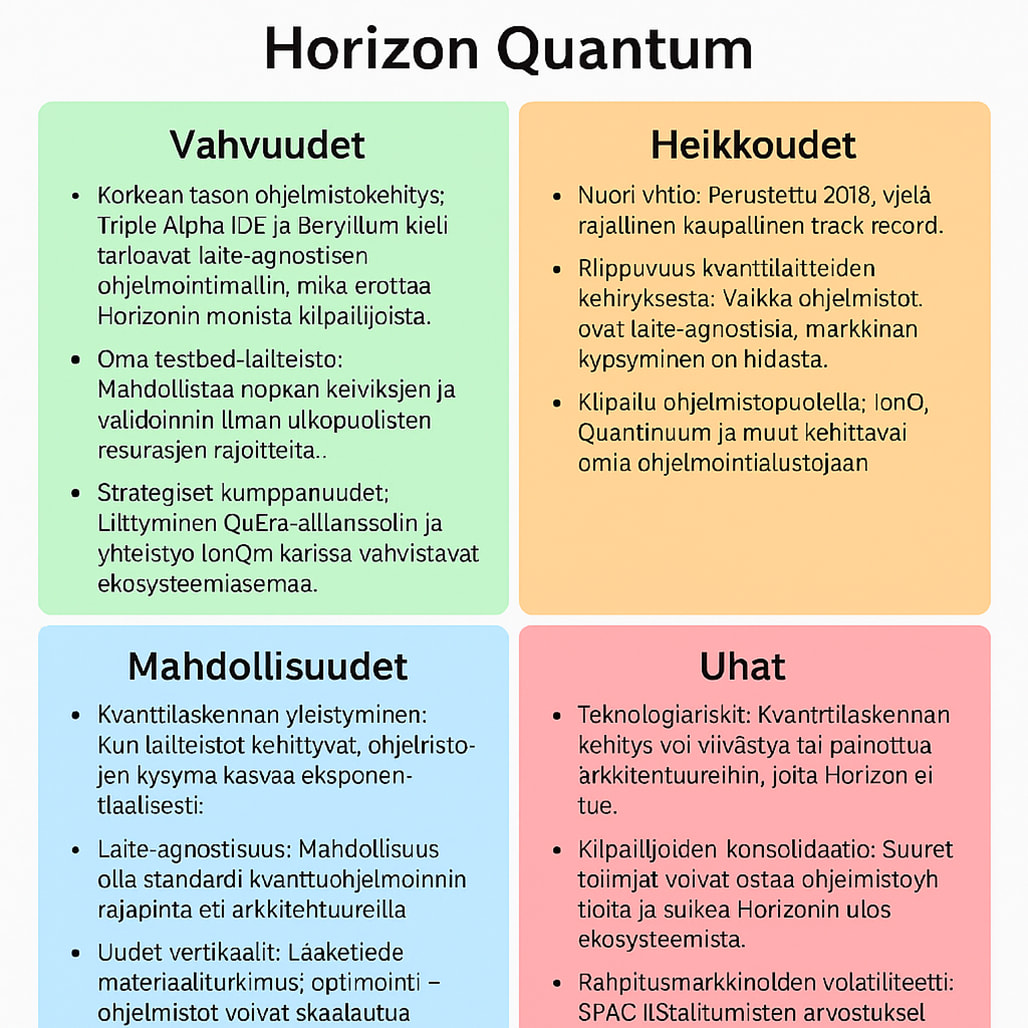
This slide set nicely explores this issue from different perspectives. I picked another image that is very relevant to our discussion.

and this too

1 Like

I’ll have to follow this!

Still, I’m a bit skeptical. If I understand this case correctly, the company’s value proposition is primarily that it aims to make writing efficient quantum algorithms easy, even for those who don’t understand the first thing about the physics of the underlying computation, routing, or pivot choices. It’s a bit like in classical computing, where you don’t really have to care about the ALU, MMU, CU, or much else about the operation of the von Neumann architecture to write an efficiently working program. Quite smart!

But I just don’t believe such a need will arise anytime soon, for several reasons. Firstly, I don’t believe that quantum supremacy algorithms will be written using such a black box; instead, they will be optimized directly for these coherent qubits. Simply because, for example, optimal pivots can be calculated by brute force, guaranteeing that the number of operations is minimized (i.e., coherence is maximized). It’s slow, and perhaps in the future, the AI of such a black box compiler will achieve almost the same result (there’s already good research on this, which I’ve also had the opportunity to contribute to), but even small percentage deviations introduce completely unnecessary decoherence. This is why, at least at the beginning of the quantum era, it’s just more profitable to handle the job as artisan work.

Secondly, I don’t believe that the volume of quantum programs will grow quickly enough for software and algorithm development to limit industrial scale. The workloads to be transferred to quantum circuits would first need to be identified, and there should be some idea of how to write them smartly before any automatic solution can begin to compile them even close to optimally in a way that makes volume development easy. Currently, the bottleneck is precisely in that identification and smart writing, which, as I understand it, this black-box solution does not handle – instead, it optimizes volume.

Thirdly, the aforementioned open sources are constantly stabilizing and developing. Universities are continuously producing new experts who have been cultivated to use them. There’s a lot of moat to be overcome, and AI assistance blurs the need for higher abstraction, as it’s already quite easy to write reasonably optimal code in natural language.

It would certainly help to grasp this case by playing around with, for example, IQM’s quantum machines. You can command them by building a quantum circuit with Qiskit, Cirq, or Qrisp. You don’t need to know anything about quantum machines, and with a little Python knowledge, you can write code to break the secrets of, for example, the Bernstein-Vazirani algorithm with a couple of hours of practice – or in a few tens of minutes with AI assistance, if you don’t want to deeply understand the essence of the algorithm and quantum programming. That’s why I’m a bit bearish on this – especially in the short term.

You can access IQM’s 63-qubit star-topology machines and resonator machine for free here: https://resonance.meetiqm.com/

3 Likes

I picked up that news from IonQ’s thread. $HQ is a company that doesn’t yet have much commercial revenue. My following writings are not investment recommendations. I just want to say what interests me about this company now.

In the US stock market, it seems that companies are only doing IPOs at a very mature stage, for example, OpenAI or SpaceX. Those who invest in these companies during/after the IPO only get in after a significant increase in value. But for example, $HQ is a genuine venture capital target – a company in its seed phase. Are there many such opportunities available? Probably not. My point is that after the SPAC/IPO, the company has just over 100 million in cash. The company’s market value is 260 million. Now, what’s happening is that $HQ bought a quantum computer from IonQ for maybe 15 million. And then IonQ will start buying software platforms from $HQ. And this way, $HQ will gradually start showing revenue. You have to start somewhere. The reader is probably wondering that it’s not real revenue, but a magic trick! But when you think about it, the fact is that $HQ gets revenue, and the stock market likes it as such. The exact same thing is happening in the Nvidia + hyperscalers + neoclouds “community”. I myself don’t believe in the total collapse of these house of cards, because the world’s wealthiest capital market (USA) is assimilating these “communities” into the normal market as best it can. So $HQ is a zero-revenue seed company that is nevertheless in a good family, where it can calmly grow and develop to stand on its own feet after 3-4 years. There’s a good podcast on this topic:

#270 - Investing in the Quantum Future with dMY Squared Technology Group Chairman Harry You - Absolute Return Podcast | Podcast on Spotify

2 Likes