Investing in Quantum Computing (QC)

Quantum computing has rapidly emerged as one of technology’s hottest topics, and in the autumn of 2024, the stocks of companies in the sector have experienced a sharp rise. Particularly the sector’s ETF investment instrument QTUM ETF has attracted attention – its trading volume multiplied in November and again in December. This reflects the market’s growing interest and belief that quantum computing can revolutionize applications in areas such as artificial intelligence, logistics, medicine, and finance.

The purpose of this thread is to:

  • Share ideas about investment opportunities related to quantum computing.
  • Discuss the sector’s development prospects and future potential.
  • Evaluate risks and consider when companies in the sector could achieve profitability.

The quantum computing market is currently red-hot and hyped, but this brings both opportunities and risks:

  1. Growth Potential: The sector is estimated to grow into a multi-billion market over the next decade.
  2. Risks: The technology is still developing, and commercial applications are only in their early stages. Competition between different companies is also fierce.
  3. Profitability: Most companies in the sector are still in the research phase, and achieving profitability may take years.
  4. Investment Targets: Which companies or ETFs are worth investing in?

What do you think about the future of quantum computing? Do you see it as the next big technological revolution or just an overhyped trend? What kind of companies or funds should be followed? And most importantly – is now a good time to jump in, or are prices already too high?

Let’s start the discussion! :rocket:

35 Likes

An interesting ETF has already been brought up a few times on the forum: QTUM: The Next Generation Quantum Computing & AI ETF. This fund tracks the BlueStar Quantum Computing and Machine Learning Index, which includes approximately 71 companies of various market capitalizations worldwide. The fund’s goal is to offer investors the opportunity to benefit from the growth potential of quantum computing and artificial intelligence.

Unfortunately, the QTUM ETF is not directly purchasable in Finland, even though it can be found on Nordnet’s website (Defiance Quantum ETF – Nordnet). Despite this, you don’t have to remain a complete bystander – you can invest directly in the companies included in the fund.

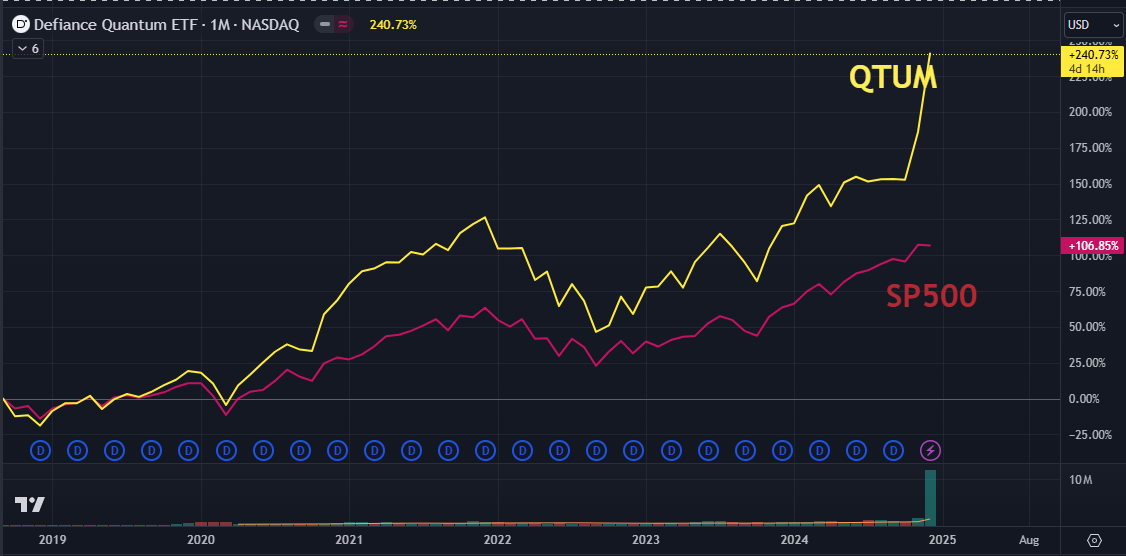
The fund’s performance has been impressive. In 2024, QTUM surpassed the YTD returns of AI ETFs such as XAIX and WTI2. Furthermore, it has clearly outperformed the S&P 500 over several years.
image
Although QTUM is not purchasable in Finland, the companies it includes are. I have bought these, and actually only Alchip is completely missing from my portfolio, as it is listed in Taiwan or on the OTC market in the US. Focusing only on the top 10 companies has been a perfectly viable tactic.

QTUM top 10 holdings:

D-wave Quantum Inc QBTS $9.90 3.29% 2,435,455 $24,111,005
Rigetti Computing Inc RGTI $15.44 2.87% 1,359,634 $20,992,749
Ionq Inc IONQ $48.24 2.22% 336,375 $16,226,730
Palantir Technologies Inc PLTR $82.14 1.55% 138,374 $11,366,040
Alchip Technologies Ltd 3661 TT $3.00 1.51% 113,102 $11,061,996
Teradyne Inc TER $130.84 1.49% 83,479 $10,922,392
Tower Semiconductor Ltd TSEM $52.93 1.48% 204,481 $10,823,179
Taiwan Semiconductor Manufacturing Co Ltd TSM $203.06 1.43% 51,555 $10,468,758
Marvell Technology Inc MRVL $115.71 1.42% 90,094 $10,424,777
Onto Innovation Inc ONTO $172.45 1.41% 59,869 $10,324,409

The up-to-date contents of the ETF can be checked here:
QTUM Full Holdings - Defiance ETFs

A few selections from outside the top 10 show that even this ETF has to seek investment targets from larger players by market capitalization, even if they are only remotely involved in quantum computing :slight_smile:
14. Nokia
19. Nvidia

As a surprising observation, Alphabet (Google) is only found in the fund at position 22, even though it is one of the pioneers in quantum computing research. This may be due to Google’s revenue still being heavily reliant on other business operations. Nevertheless, I would not exclude Google from my portfolio.

24 Likes

Does anyone have any idea why this ETF is not available for purchase in Finland? Because exactly these kinds of technology ETFs would be needed right now, not in 5 years.

7 Likes

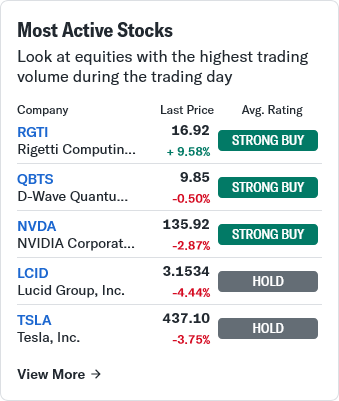
The sector has been the most active in the USA for several days now. Current situation:
kuva
Trading volumes have been incredible for a month now, and so have the returns. The three largest QTUM holdings are in the portfolio. RGTI has already increased 13-fold in a couple of months. The same vibe as with PLUG back in the day.

6 Likes

Due to the tug-of-war between the EU and the United States, Europeans cannot buy US ETFs, nor can Americans buy European ones.

Someone classified as a professional investor can buy.

6 Likes

Any thoughts on how the turn of the year affects quantum companies? I have Rigetti and D-Wave in my portfolio with nice returns.

1 Like

I’m not going to guess anything about the turn of the year. But these EV/S figures are soaring to crazy levels. It’s probably just a matter of when the bubble bursts. No one can know that beforehand. Every day the burst is just closer.
image
image
image

The combined revenues of these three for 24q3 are less than 17 million dollars.
Rigetti: 2,380,000 USD
Ionq: 12,400,000 USD
D-Wave: 1,870,000 USD

Only Ionq’s revenue has been growing at a rate that justifies a high P/S ratio:
image
image
image

US market top 20 P/S
image
source: Free Stock Screener - Search, Filter and Analyze Stocks - Stock Analysis

8 Likes

Understanding these companies and seeing their future potential requires quite a lot of work, and that’s why, in light of the numbers, they might look quite wild right now. I’ve only had enough energy to understand IonQ. IonQ has completed a quantum computer factory in Seattle. The company’s management didn’t build that factory head over heels. The first $25 million machine was delivered to Basel this autumn. The company now has an order book worth over $60 million. From the last Q3 results, I picked a couple of essential lines here:

2024 Financial Outlook

  • For the full year 2024, IonQ is raising its revenue expectations to between $38.5 million and $42.5 million, with between $7.1 million and $11.1 million for the fourth quarter.
  • For the full year 2024, IonQ is reiterating its previously stated bookings range of between $75 million and $95 million.

I am prepared for a large volatility in IonQ’s stock for 2025 (price range somewhere between $10-$150). IonQ’s customers are such a professional group (Basel, US Air Force, Oak Ridge Lab, Hyundai, Airbus, etc.) that they haven’t built their cooperation on sand.

I encourage you to dig deeper into these Q-companies; it’s an interesting new market. A diversified Q-portfolio, as has been discussed in this thread, is a smart move, as some companies will wither, and a couple will surely take the whole pot in the coming years.

9 Likes

I’m sharing the following article here because it talks about quantum technology from many different angles. Some company might specialize in, for example, quantum teleportation, which could revolutionize telecommunications.

“Quantum teleportation is a way to securely share information over long distances without physically transmitting it.”

Northwestern Engineers Achieve Quantum Teleportation Over Existing Internet Cable

5 Likes

2024 revenue of 42.5m will be realized. After this, IonQ will double its revenue every year, meaning it will grow by 100% for the next five years.

In analysts’ forecasts, EPS is increasingly negative every year, at least as long as forecasts are available, but in our forecasts, we would have a 30% net margin in five years. This is better than Nvidia’s for most of its existence, with the exception of very recent times.

In 5 years, revenue will thus be 1360 million. With a 30% margin, 408 million will remain below the line.

Cash flow is currently almost three times the revenue in the negative, but in the future, shareholders will no longer need to be diluted, and no new financing will be required.

Because the market estimates that IonQ will continue to grow like a rocket, it values the stock at a 40 P/E in 2030. In this case, the mcap would be 16.3 billion.

The mcap is currently almost 10 billion, so that would correspond to an annual return of about 10%.

In what respect is the above, in someone’s opinion, a relatively rosy scenario, too bearish, or does the expected return satisfy?

10 Likes

Hello to the thread! Let’s start with a disclaimer: although I’ve been seriously studying quantum computing for the past year in an EU inter-university “quantum expertise accelerator,” my understanding of quantum mechanics underlying computing technology, for example, is completely non-existent, and therefore some of my claims might be utter nonsense :slight_smile:.

If we start with the industry’s growth prospects and potential, these are, in my view, undeniable. While quantum computing is, at least in my opinion, already a reality today, for example, in the defense industry, it’s probably quite pointless to consider the current hype and/or any key figure-based valuations in these investments. We’re talking about VC-type investing here, and the smartest approach is likely to look at who, in terms of probabilities, has the right technology choices, the most competent R&D, the most credible customers, the deepest-pocketed investors, etc. If you’re not just looking for quick wins, these current market caps of a few billion are negligible if/when workloads can be broadly shifted from binary transistors to qubits for processing.

In a way, quantum is, in my opinion, a relatively easy sector in the stock market. The opportunity space is quite limited, and the capital requirements are insane (expertise and funding) – the probability game isn’t impossible from my perspective. I believe the big winners in the near future can already be narrowed down to perhaps about ten listed companies and a couple of other unlisted players (pleasingly, IQM from Finland is one of these players).

In my opinion, the most critical factor reducing probabilities is processing technology – and at least for me, this is where my focus is most intently. It now appears that superconductivity and ion traps are the ones vying for dominance (though there are others, of course). Superconductivity likely offers better scaling potential if breakthroughs are ever made in key bottlenecks, whereas ion traps require engineering innovations rather than physicists’ breakthroughs.

In my view, the most central quantum technological challenge for the ultimate breakthrough is the quantum memory coherence problems. Small errors in runtime quantum computing (the correction of which is now rapidly improving) are minor compared to the fact that qubit information might remain in memory for a maximum of a few seconds. Many have yearned for quantum computing as a solution to, for example, AI’s energy consumption challenges, but a modern-day Einstein would practically need to solve this problem first so that a model could be stored in memory and wouldn’t need to be retrained with every inference command.

I also believe that the corporate landscape will still change significantly here. It’s unlikely, for example, that Nvidia, sitting on tens of billions in cash reserves, will wait idly by for some quantum venture worth a couple of billion to take away its HPC computing business. Similarly, Google, for instance, has the muscle to buy out competitors or competing technologies to prevent disruption, as that Willow wasn’t a mega-announcement yet.

IonQ is my bet alongside the tech giants. IonQ seems to be in a very good position from many perspectives. Of course, the ion trap must be the winning choice in this case. IonQ also has a CUDA-type platform under development (excluding the SDK). If history can teach us anything, it’s very likely that there will ultimately be 1-2 big winners during its breakthrough penetration, and they will have the opportunity to lock users into their platform for years or decades.

PS. If you have time during the Christmas holiday, I recommend practicing quantum programming, for example, as offered by CSC. In a couple of hours, you can get a very good understanding of the practical functioning of the most essential basic concepts of quantum computing: Noppe

44 Likes

The expected return includes the assumption that IonQ already has stable demand and that the company will not go bankrupt. If and when the company reaches 2030, then quantum technologies may be in sight and perhaps also in use, which will be discounted from 2035 to 2030, and the valuation may then be something other than what we calculate today. The expected return is very satisfying :slight_smile: , because with the expected return, the company stays alive and can thus, as a bonus in the coming years, create values that we do not yet really know how to identify as numbers today.

6 Likes

This recent Jussi Halme’s video fits well into this thread. :slight_smile:

Quantum computers can revolutionize the world in the same way as artificial intelligence, but are they also the next billion-dollar opportunity for investors? In the video, I go through what quantum computers are, their potential, the biggest challenges, and the most significant companies, such as IBM, Google, and Microsoft, that are leading this technological breakthrough. Should you jump into this development now – or wait?

I also cover investment options and risks that quantum technology brings. Perhaps a technology ETF could be the safest way to be part of this revolution?

If you are interested in technological megatrends and investing, this video is for you!

3 Likes

Carbon nanotubes, and thus our Canatu, are an interesting name for the future of quantum computing.

Here’s an article from September.

5 Likes

Pretty nice video, but investing in some technology ETF is deceiving oneself. A bit like buying the phone company Nokia in 2007 when touchscreen phones were making a breakthrough. Safe, but the main point is missing.

Besides QTUM, I haven’t found any ETF focused on quantum computing. For now, I’m diversifying myself into the largest stocks of the QTUM ETF, which can be bought from US stock exchanges.

The problem with technology ETFs is that they all currently focus on artificial intelligence and the cloud. They are very susceptible to the MAG7 bubble bursting.

In QTUM, the three tiny companies that make quantum computers have the largest weighting. But there are many large and stable companies there that are not hyped. That’s where the diversification for a quantum portfolio can be found. Each company in the portfolio must be studied separately.

3 Likes

Let’s not turn this into a Mag7 bubble debate :slight_smile: . But… In my view, it’s a bit contradictory to think of tech giants as being in a bubble and, on the other hand, to believe in breakthroughs like quantum computing. The current valuations of mega-tech companies specifically include the idea that these companies will continue to find the philosopher’s stone in the future, for example, precisely in quantum technology, which will enable the growth and profitability that justify their current valuation.

As I wrote above, I would not count mega-tech companies out of the quantum game – quite the opposite. Of the Mag Seven, at least Google and Nvidia are already obvious quantum players with their current operations, even in quantum mechanics. For example, Nvidia’s Cuda Quantum is a rather forgotten future investment: Quantum Computing Solutions from NVIDIA

And I’m sure Meta, Microsoft, Amazon, etc., will also find their own ecological niche in this trend just as agilely as in the AI boom (e.g., in terms of computing energy efficiency, new services, etc.). As I also wrote earlier, if they wish, these companies are certainly capable of taking over these multi-billion quantum computing companies when needed – this has also been demonstrated by the current AI investment wave (MS → OpenAI, Amazon → Anthropic, etc.).

Summa summarum: in my view, by simply owning Nasdaq, one can get involved in quantum computing very nicely, exactly the same way one got involved in the AI boom.

12 Likes

I appreciate your opinion. I do consider it very likely that some of the MAG7 companies will play a big role in quantum computing – possibly even all of them. Perhaps ‘bubble’ is too strong a term for them.

The MAG7 are already large, true to their name. It’s quite unlikely that they would, on average, increase tenfold in the next 10 years. That’s the magnitude I’m looking for when searching for investment targets in quantum computing. This would mean an annual growth of about 26%. Although the MAG7 are excellent companies, they might not necessarily be very good investments, as their growth potential is more limited than that of smaller companies.

As I wrote earlier, Ionq, Rigetti, and D-Wave are small, and their valuation multiples are very high. The risks are high when investing in these. That doesn’t mean one couldn’t invest in them, but I would reduce the risk by diversifying. In my opinion, Nasdaq100 or other technology indices are not the right diversification ‘bus’. You feel like you’re safely on your way, but you fall asleep, and the bus takes you to the wrong city.

I would be interested to hear which small or medium-sized listed companies are developing products with growing demand along the quantum computing development path. On my research list are:

  • Micron Technology (in my AI portfolio)
  • Skywater Technology
  • Palantir (in my AI portfolio)
  • Snowflake (in my AI portfolio)
  • Coherent Corp
9 Likes

Unfortunately, a lot of the companies that have moved significantly don’t have the fundamentals to back it up.

For example, QUBT seems to be a company full of red flags. QUBT High on Hype - Too Many Red Flags

4 Likes

Here’s a video discussing the same topic as in this thread:

Here’s another one

7 Likes

Nvidia CEO Jensen Huang’s remarks caused IonQ, D-Wave, and Rigetti’s stocks to plummet 50% today.
Quantum computing stocks take a hit as Nvidia CEO predicts long road ahead | Reuters

Jensen Huang:

“If you kind of said 15 years… that’d probably be on the early side. If you said 30, it’s probably on the late side. But if you picked 20, I think a whole bunch of us would believe it”

Of course, knowledgeable analysts rush to praise Huang’s statements. Let’s forget for a moment that Huang’s job is to sell Nvidia’s products now. In 15 years, in 2040, Huang will be 77 years old and will not be selling quantum computers then.

Google’s goals are slightly more optimistic:

Short-term goals (early 2020s):

  1. Improvements in quantum computer accuracy:
    • Develop more effective quantum error correction techniques to reduce computational errors.
    • Achieve systems that are practically useful for research.
    • For example, Google’s Sycamore 2 is aimed at even more precise computation.
  2. Expansion of cloud platforms:
    • Google’s quantum computing platform Quantum AI will be made more widely available to businesses and researchers.
    • Testing quantum computing in the cloud will become easier for more users.
  3. Application-specific breakthroughs:
    • Development of the first significant practical applications, for example, in materials science or solving optimization problems.

Medium-term goals (by 2030):

  1. 1000 logical qubit system:
    • Google aims to build a functional quantum computer with at least 1,000 reliable (logical) qubits. This requires scaling the number of physical qubits to tens or hundreds of thousands.
  2. Breakthroughs in industrial applications:
    • For example, the development of new materials, better medicines, and the solution of complex optimization problems with large computational models.
  3. Integration of quantum computing and AI:
    • Utilizing quantum computing in the training and optimization of AI models.

Long-term goals (mid-2030s and beyond):

  1. Million-physical-qubit system:
    • Google aims towards scalable quantum computers with millions of physical qubits. Such systems would be powerful enough to solve complex problems that traditional computers cannot handle.
  2. Commercial revolution of quantum computing:
    • Quantum computing will become practical tools for businesses and governments, which can utilize it in large systems such as energy grid optimization, climate modeling, and financial market predictions.
  3. Creation of a universal quantum computer:
    • The ultimate goal is to build a general-purpose quantum computer capable of performing any computational task faster and more efficiently than traditional supercomputers.

Google builds quantum computers itself and invests in long-term breakthroughs, such as the development of a general-purpose quantum computer. Its timeline is more ambitious and focuses directly on enabling quantum computing.

Nvidia acts more as an enabler by providing software and hardware that support quantum research and its integration into current technologies. Nvidia aims to leverage the opportunities of quantum computing in a supporting role.

At Nvidia, Huang started promoting the AI strategy in 2012, and AI became central to Nvidia’s strategy in 2016. It has been 9 years since then, and active development has likely been ongoing for about 13 years. Google’s CEO Sundar Pichai is now 52 years old and, given his age, would have time to see Google’s quantum strategy through. In 2040, he would be 68 years old.

This is, of course, not ultimately the product of individuals, but their current statements should be placed in the context of their own careers.

12 Likes