I can admit that I don’t understand, and never will “truly” understand, how a quantum computer works. For me, the problem with the “only invest in what you understand” saying is that it would practically exclude many industries. I don’t understand how a phone works either, but I can understand why it’s important to people and why they want to buy them. What interests me about quantum technology is its revolutionary potential, and for Finland’s sake, I hope that quantum computers will yield real-world benefits within a couple of years.
The quantum sector is probably in a bubble, but so are many other sectors. We’ll find out later. It doesn’t hurt anyone to invest in quantum companies, even if they don’t understand anything about the technology itself. In reality, not many people can understand it, because the field is so new and practically requires a PhD in physics.
I’d love to hear more about this. The company delivers these optical links to satellites and other space debris, and is not inherently “quantum”. So what’s not working here?
PARIS, France – Axiom Space and Spacebilt announced plans Sept. 16 to deliver a data center node with optical communications links to the International Space Station in 2027.
Skyloom Global Corp., a U.S. leader in space-based optical communications technologies, today announced it has completed delivery of 44 flight-ready Optical Communication Terminals (OCTs) to York Space Systems. These OCTs will be integrated onto York satellites to support York’s numerous orders for the Space Development Agency.
With this delivery, Skyloom has now produced and delivered a total of 88 OCTs, all manufactured entirely in the United States.
US Air Force Awards Skyloom $18M to Develop Hybrid Space Optical Satellite Communications to Support Assured C3ISR
I, on the other hand, believe that such a niche hot dog stand can very well serve IONQ’s broader goal regarding QKD networks, Iron Dome, etc.
There’s a fundamental difference in that you know with sufficient accuracy what a phone can and cannot do. I don’t understand anything about oil refining either, but I know enough about what oil can and cannot be used for. The problem with quantum computers is that advertisers like De Masi can throw around “quantum chemistry,” “quantum trading,” “quantum in space,” “quantum networking,” “quantum add anything here,” and investors get excited, when the reality is that adding the word “quantum” to something usually doesn’t solve anything; it just makes the problem harder. It’s starting to seem that if a practical quantum computer is ever achieved, its benefits will be very narrow. The problem for investors is that most of those who have the expertise to bring expectations down to earth make their living from the field, so what motivation do they have to curb the hype that keeps them employed?
Companies and industries that the general public doesn’t understand at all are in the best position to extract money from investors, as long as they can generate buzz around the companies. Our domestic Qt is a good example of a company where I’ve been reading messages for years that clearly indicate the writer doesn’t understand at all what the Qt product is and what it actually does. People are worried about Apple Carplay, which has no impact on Qt’s business. Or they ponder completely trivial things creating moats for the company. Qt didn’t, at least, dip into investors’ pockets in the form of share issues, but the hype generated around the company has rewarded insiders very generously.
The question isn’t whether Skyloom has a business niche. I can’t evaluate that. It very well might, but replacing radio waves with optical applications in data transmission is no more “quantum” compared to radio waves than LED lights are compared to incandescent bulbs. A prime example of tagging anything with “quantum” to make it sexy.
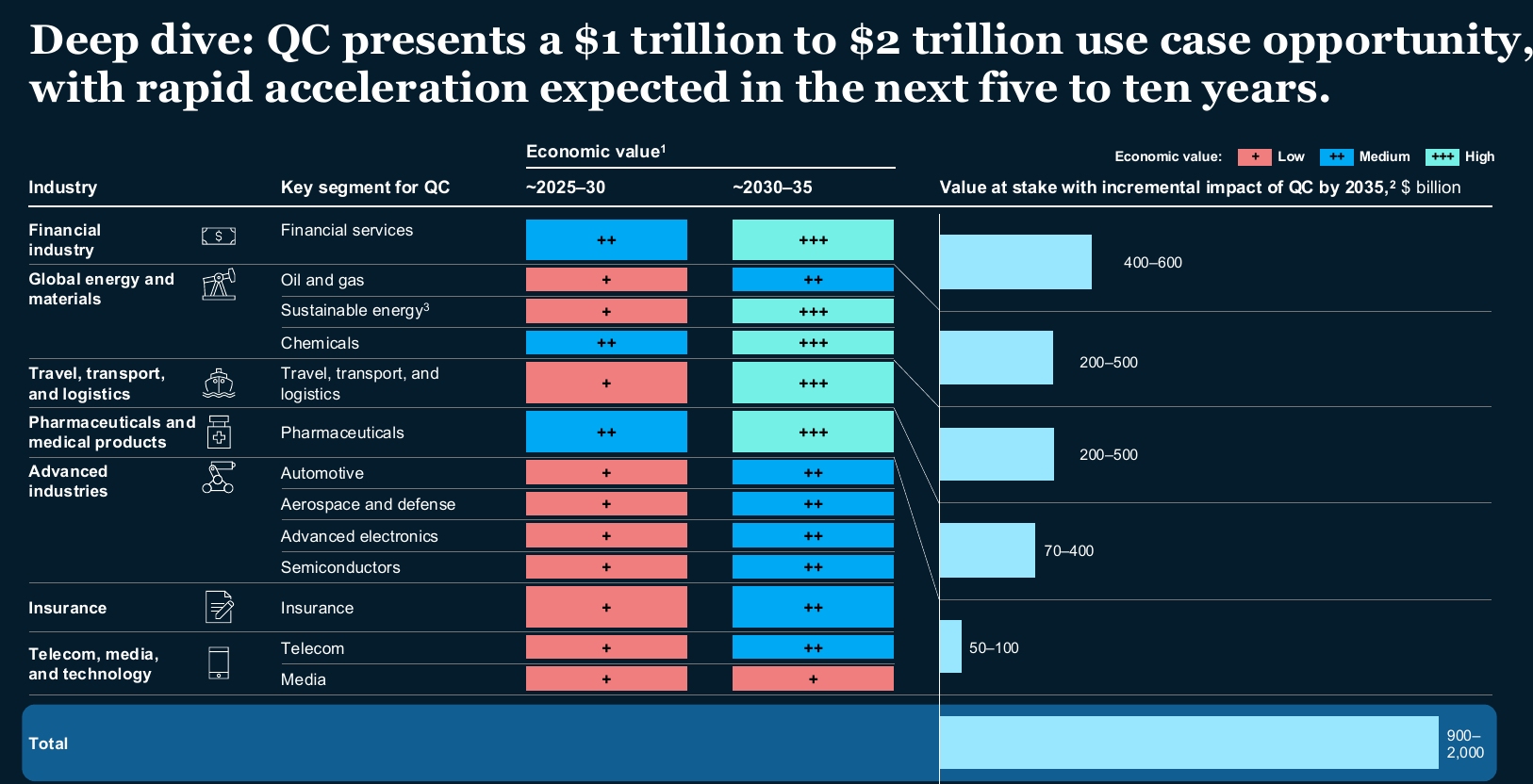
Excerpt from McKinsey’s quantum monitor (summer 2025). It’s noteworthy that McKinsey may have to accelerate its timelines by approximately 5 years in the next update, if IonQ performs according to its roadmap. This becomes clear by reading the entire package (computing, QKD, etc.). The table below does not include sensing, networks, security, etc., but rather QC.
That said, this is clearly high risk/reward. And NdM is a salesman in his speeches, I agree. One just has to try to look past the hype at the hard and concrete metrics. I, for one, am primarily interested in this company because of Oxford Ionics’ architecture.
It seems to me that if a machine with millions of qubits is achieved according to the roadmap, the next bottleneck will be the applications layer / software development for all customer scenarios. Well, IONQ is also trying to tackle this proactively with recruitments / customer-centric demonstrations / investments like Classiq, etc. But the shortage of skilled professionals is chronic across the entire industry.
Here’s a reality check from an industry player on Forbes’ hype article:
In summary, many proposed quantum applications require careful reality checks. It’s useful to categorize them:
Near-term feasible and useful: Quantum cryptography (QKD/QRNG) – already deployed; Quantum-safe encryption (PQC); Possibly certain niche optimization (if problem size is tiny and coherence is enough) – limited cases.
Medium-term potential with hardware scaling: Quantum chemistry/material science – likely to show advantage as qubit counts and fidelity improve; Some structured optimization or Monte Carlo acceleration – once error-corrected qubits come, we might see quadratic speedups used in finance risk analysis or logistics, but classical competition is stiff.
Long-term or uncertain: General big-data analytics, generic machine learning speedups, solving NP-complete problems at scale – these are either unlikely (NP-complete is believed intractable even for quantum) or require major breakthroughs (both in algorithms and hardware). As one report put it, a wide range of oft-cited applications will “require significant algorithmic improvements” to become practical – we can’t just count on the quantum hardware alone to deliver magic.
Cybersecurity leaders should remain skeptical of grandiose claims (especially on short time horizons) and seek out peer-reviewed evidence or prototype demonstrations. Being optimistic about quantum’s future is fine – indeed, new algorithms might surprise us – but we must base investments and preparations on realistic assessments, not hype.
Heights Capital Management is a quant fund, which is probably directly translated as a quantitative fund. By the way, it has nothing to do with quantum physics or quantum computers; it means they practically generate investment returns using various mathematical strategies. This entity has made two financing deals with IonQ under the following terms:
IonQ received: 3 billion dollars from Heights Capital Management
Heights Capital Management received: Shares worth 1.87 billion and 7-year warrants worth 3.79 billion at the time of the deals.
IonQ’s owners received: This deal to be paid as share dilution.
What Heights Capital Management does with those warrants depends on their strategy. They certainly aren’t waiting for the stock price to rise to the agreed conversion price. A traditional hedge fund strategy is either to short the stock or sell options forward, with the warrants acting as a backstop. In any case, Heights Capital Management will make a hell of a lot of money with these, as long as IonQ stays afloat and doesn’t go bankrupt.
I would rather describe the situation as Heights Capital Management being able to make a deal with 10 times the normal warrant coverage due to IonQ’s financial situation. A fairly normal coverage in such cases where financing has to be sought from hedge funds when it cannot be obtained elsewhere has been 1 warrant for every 4 shares. Now it’s almost 3 warrants for every share.
I wondered where this nickname came from, but then I noticed that, according to NASDAQ’s website, de Ma$$i has sold 105 million worth of IonQ shares this year alone. Is this where the man’s nickname comes from?
In my opinion, the terms of the warrants do not seem bad at all, considering the premiums and exercise prices.
Massinen was entirely self-invented; the man’s SPAC was as you know. He also publicly stated that he sold the related shares, but intends to keep the other shares he holds.
No one is forced to invest in this, and the risks are high. Nevertheless, I see good upside if the case succeeds.
Yeah, the stock is unlikely to be diluted at those warrant strike levels. Or in that case, the hedge fund would hold over 30% and a $17 billion slice of the company, and the current shareholder’s ownership would have been diluted by 24% solely due to those warrants. Of course, I don’t believe those warrants will ever be redeemed.
Still, it says a lot when one has to seek financing from a hedge fund on worse terms than a normal stock market “startup,” and that investment by Heights Capital Management, in particular, has nothing to do with indicating institutional confidence.
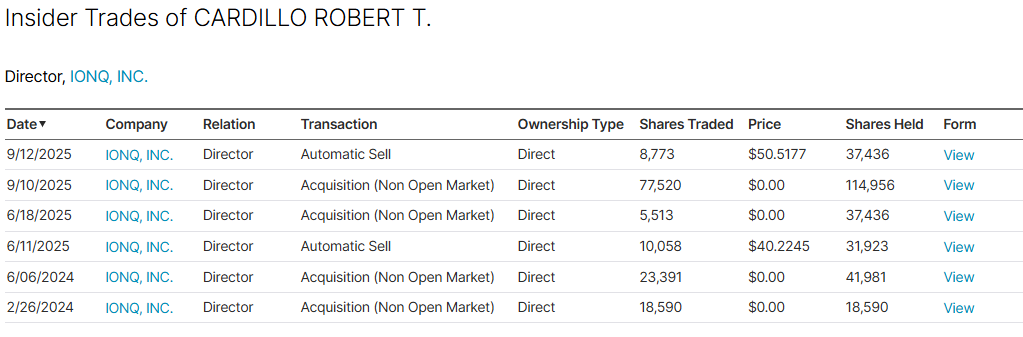
Well, they didn’t stop there; on 11.9, shares worth 715 thousand were sold. Of course, the reason mentioned was covering the tax implications of new stock awards. This is a bit of a strange explanation, considering that this year alone, Niccolo has cashed in over 270 million from exiting the previous SPAC that ultimately ended in a zero-sum result, while at the same time selling off nearly $106 million worth of the current money-burning machine.
Furthermore, the company’s management has an automatic stock sale plan mentioned in the Q1 quarterly report, to which changes have only been made by Robert Cardillo, who increased the number of shares to be sold included in the plan. Undeniably, Niccolo is a tough guy when it comes to printing money for himself.
One can believe what one wants. I do not recommend believing all the marketing material from advertisers. Very likely, quantum computers, if one can be implemented with any useful features, will, due to the nature of the machine itself, be applicable to a very narrow commercial field. Moreover, after just a couple of days of getting acquainted with the company, there’s a strong feeling of the traditional “money out of investors’ pockets into insiders’ pockets” vibe.
Despite minor government shutdown delays, I would assume that those golden dome contracts can be obtained after the turn of the year. They are valuable, and it is known that IonQ will be involved. I would guess that the company will give 2026 guidance once these have been clarified.
The goal, says IonQ’s CEO Niccolo de Masi, is to get to a valuation of $1T. “We’re physicists who are also capitalists.”
De Masi acknowledges incumbents will try to dominate until they can’t. “Then they’ll try to buy your firm,” he says, alluding to takeover interest but declining to be drawn on details.
de Masi also says he “would be shutting down my division at IBM if I announced it was five years behind [IonQ] and at 10 times the cost”.
He says the US and UK must collaborate to halt Chinese tech supremacy over the west. “There’s going to be, frankly, a vast panic on when people get a whiff that China is trying to crack RSA-2048 encryption.”
The agreement will enable Heven AeroTech to integrate IonQ’s quantum computing, quantum networking, quantum sensing, and quantum security technologies into its autonomous aerial systems, helping redefine mission resilience, stealth, and operational performance in GPS-denied environments.
Fantastic interview with Robert Cardillo, Executive Chairman of IONQ Federal. Note the following relevant to IONQ:
Robert has dedicated his entire career to the intelligence community. He started as an analyst in his early 20s monitoring a specific sector of Russia during the cold war, and ended up serving as the 6th Director of the National Geospatial-Intelligence Agency. He was later hand picked by James Clapper to be the first Deputy Director of National Intelligence to oversee intelligence integration amongst the various agencies.
At this point in time, he believes the intelligence community is shifting its mindset to lean more into open commercial partnerships. This is a slow shift but is needed for a various of reasons including the requirement of different skillsets (LLM’s, quantum, etc.).
As Executive Chair of IONQ Federal, he views his role as an “orchestrator” of federal engagement. He notes three examples of projects that he is currently involved in:
A) Oakridge National Labs - They are engaging with IONQ on Hybrid Quantum Computing.
B) Department of Commerce - Ongoing discussions regarding market security.
C) Pentagon - He confirms IONQ has Golden Dome applications for both sensing and networking, which he believes can collectively “put together coherence in a very incoherent picture.”
When asked about timing of commercial use cases, he interesting states that QKD (quantum security) is a proximate (immediate-near term) risk (jokes that he cant provide exact timing).
Views quantum sensing as very interesting but slightly farther out in terms of adoption. Also notes we will start seeing classical / quantum hybrid computing.
Why has he decided to join IONQ after spending his entire career in the intelligence community? He believes IONQ has all the pieces needed to succeed in each area of quantum technology, and believes the quantum race is just as crucial as the space race. In his words there will be no medals for second place.
Robert Cardillo is a rather moderate guy; I, on the other hand, believe that the quantum race is much more significant than the space race. In the space race, the most essential thing was to get something into Earth’s orbit.
In the quantum race, the USA must strive to be number one. When you are number one, you know what the opponent can do. The aforementioned requirement for 1st place applies to both the Department of Defense and intelligence.
And then, on the civilian side, a whole new world opens up when quantum-accelerated AI mills or AI-controlled quantum mills start solving molecular and atomic level problems. For example, in material design.
My own “gut feeling” is that the breakthrough in quantum work in the coming years will be 100X more significant than the conquest of space. Now, if someone behind the screen is thinking, “justify it!” My justification is that everything I have seen, read, and imagined during my life leads to what I wrote.