History Corner: history of the stock exchange, financial history

In the history corner, you can discuss the history of the stock market, global history, and all the curiosities that come to mind :slight_smile:

Let’s start with this: if 2018 ends in positive territory, we will have the stock market’s longest bull run since World War I.

image

9 Likes

Let’s continue our history corner. Credit Suisse has published the latest data on long-term stock market development. (For more on this, check out InderesQA).

Here’s an interesting and illustrative picture of how the center of gravity of the global economy has shifted away from Europe in just over a hundred years:

The shares of European great powers, namely the British Empire, Germany, and France, have dwindled, while the USA has risen and remains a true economic superpower. The size of China’s stock market is still small: perhaps we’ll see it overtake the USA before 2100 if economic growth continues?

2 Likes

Cumulative and real (inflation-adjusted, dividends reinvested) returns 1900–2017:

06

Source.

Today marks 10 years since the fall of Lehman Brothers. Juha Kinnunen, Erkki Vesola, and Petri Aho from our team recall where they were when Lehman fell and what the market’s plunge looked like through their eyes. Juha also makes good points about the similarities between the pre-crisis era and today, and how the stock market crash affected his investment style.

2 Likes

Oh, those were the days. I wish we could experience something like that again :smiley:

Thanks for the excellent video!

I remember the financial crisis like it was yesterday; I had made my first stock purchases in the summer of 2008.

My first purchase was Sponda via Eqonline in July 2008.
The first couple of months were quite calm in the markets, and I even managed to make a small profit on my initial investments. Little did I know what was coming…

In September 2008, after Lehman’s bankruptcy, things started to happen. Profits turned into losses very quickly, and after that, losses piled up significantly every day…

Then, for over 6 months straight, we took a beating almost daily, excluding momentary bear market rallies :smiling_face:

As a novice investor, I naturally couldn’t wait to find out where the bottoms were. Instead, constantly falling stocks just seemed cheaper and cheaper, and I just had to buy them when they were cheap. At its fastest, the price almost halved in a few weeks after I bought (e.g., Rautaruukki and Metso).

At some point, I sold everything because I couldn’t take it anymore. And then I bought the same stocks back cheaper, of course. At that point, I managed to avoid the bear market for a short while, but I probably couldn’t stay out of the market for more than a week. I thought a bull market was just around the corner, and I certainly didn’t want to miss out on that.

I ran out of money many times during the autumn of 2008; if I managed to scrape together more, everything was poured into stocks. Patience would have been a virtue, but I didn’t have any…

But I wouldn’t trade that experience for anything; experiencing that with your own money at stake is a truly educational experience, and I believe I learned more during that time than in many good years combined.

An interesting topic, I hope others who remember that time will comment…

Autumn 2008, never forget…

3 Likes

Thanks :blush:, and what an interesting and vivid recollection—I hope more of these will surface here over time!

In “honor” of the October Revolution (Julian calendar October 25, November 7 in our calendar), a small look at what the revolution in Russia did to the stock market in 1917:


A guy who looks like Lenin from Eisenstein’s film October.

Perhaps the most extreme example (alongside Mao’s China and Weimar Germany’s hyperinflation) of what social upheaval can do to the value of assets; this time, assets literally went to zero. Before World War I, Russia was a “hot” growth market where the French, in particular, invested their money. For some reason, however, imperial Russian bonds were still trading in Paris a couple of years after the revolution, even though the hope of repayment was almost nonexistent.

2 Likes

A quick look, maybe it will inspire some history buffs. :nerd_face:

Last weekend marked 100 years since the end of World War I.

The stock markets were treated differently by the war. The outbreak of the war completely surprised the markets, causing the worst financial crisis of the century (the depression of the 30s possibly being the only one worse): uniquely, stock exchanges were closed for half a year (this has never happened on a global scale before or since, at least not yet, WWI). Many people think that WWI was predictable, but for many contemporaries, its realization was a complete surprise, or at least for the financial market (the market is generally very bad at predicting political turns).

In the US and Britain, the stock market performed well even considering inflation, while Germans tasted defeat in the stock market as inflation completely destroyed savings.

Here’s a good paper from Ferguson on markets in the World Wars.

Edit. Blumman’s morning letter also has a good collection of articles:

"The Risk of Another World War

A century after the end of World War I, the chances of such a nightmare happening again seem remote. Of course, they seemed pretty remote 100 years ago, too.

Just before the start of the Great War, Hal Brands writes, Europe hadn’t seen continent-wide hostilities in about a century, and experts thought globalization had ended such great-power conflicts for good. Sound familiar? Then all hell broke loose. The lessons of that, Hal writes, are that peace is more fragile than you realize; that war will be much, much worse than you expect; and that risks rise when the U.S. retreats from the world stage – as it seems to be doing under President Donald Trump. Read the whole thing.

To hammer that last point home, Trump spent the weekend making World War I remembrances in France as awkward as possible, highlighting his ambivalence toward European allies and the post-World War II order the U.S. anchored and enjoyed for decades. So far, this is mostly window-dressing and bluster: His administration has quietly been increasing its spending in Europe, Bloomberg’s editors note. Emmanuel Macron, in response to Trump’s mixed signals, has called for a new European self-defense force. But Europe still can’t muster the kind of manpower and firepower the U.S. provides to NATO, Bloomberg’s editors note.

Still, as Leonid Bershidsky notes, avoiding future conflicts will require a level of cooperation and flexibility not currently in evidence. World War I’s aftermath, Leonid writes, is proof of how poorly handled peace can lead to decades of horror.

More World War I Reading: The war changed the military forever; in many ways today’s armies, navies and air forces are still fighting it. – James Stavridis"

2 Likes

Tomorrow, Finland turns 101 years old. As a Finn, there is much to be proud of from the past 101 years: Finland has been a remarkable success story, transforming from a poor agricultural nation into a prosperous welfare state. Finnish companies have also succeeded, richly rewarding their owners in the process: the stock market, adjusted for inflation, has grown 390-fold during independence, if dividends were reinvested. On average, the stock market has cumulatively yielded approximately 6% per year during independence.

Let’s raise a small toast to that. :clap::finland:

This period includes the civil war, two world wars, a couple of near-hyperinflations, several crises, the Cold War, the transformation of the economy from agriculture to industry and then to a service-dominated economy, the collapse of the Soviet Union, and globalization. Overall, listed companies have adapted and been able to create value for their owners. It’s impossible to foresee the major themes of the next 100 years, if the stock market even exists for the next 100 years, but global warming and technological development will most certainly shape it.

4 Likes

What better way to spend time around Christmas than amateur historical research? This old-looking but relatively comprehensive website about Finnish publicly traded companies came to mind:

https://www.porssitieto.fi/

You can find basic information about practically all publicly traded companies there (including those that left the exchange long ago), such as share series, offerings, etc.

One of the strangest birds on the stock market ever was probably “Holding” or the Compensation Shares holding company, whose shares were used to compensate those who lost their property in the war for financial damage (the markka had drastically lost its value as a currency, making Holding’s stock market shares good liquid assets).

https://www.porssitieto.fi/osake/holding.html

A very peaceful Christmas to all forum members.

5 Likes

The latest stock market stats are available again, so let’s update them here:

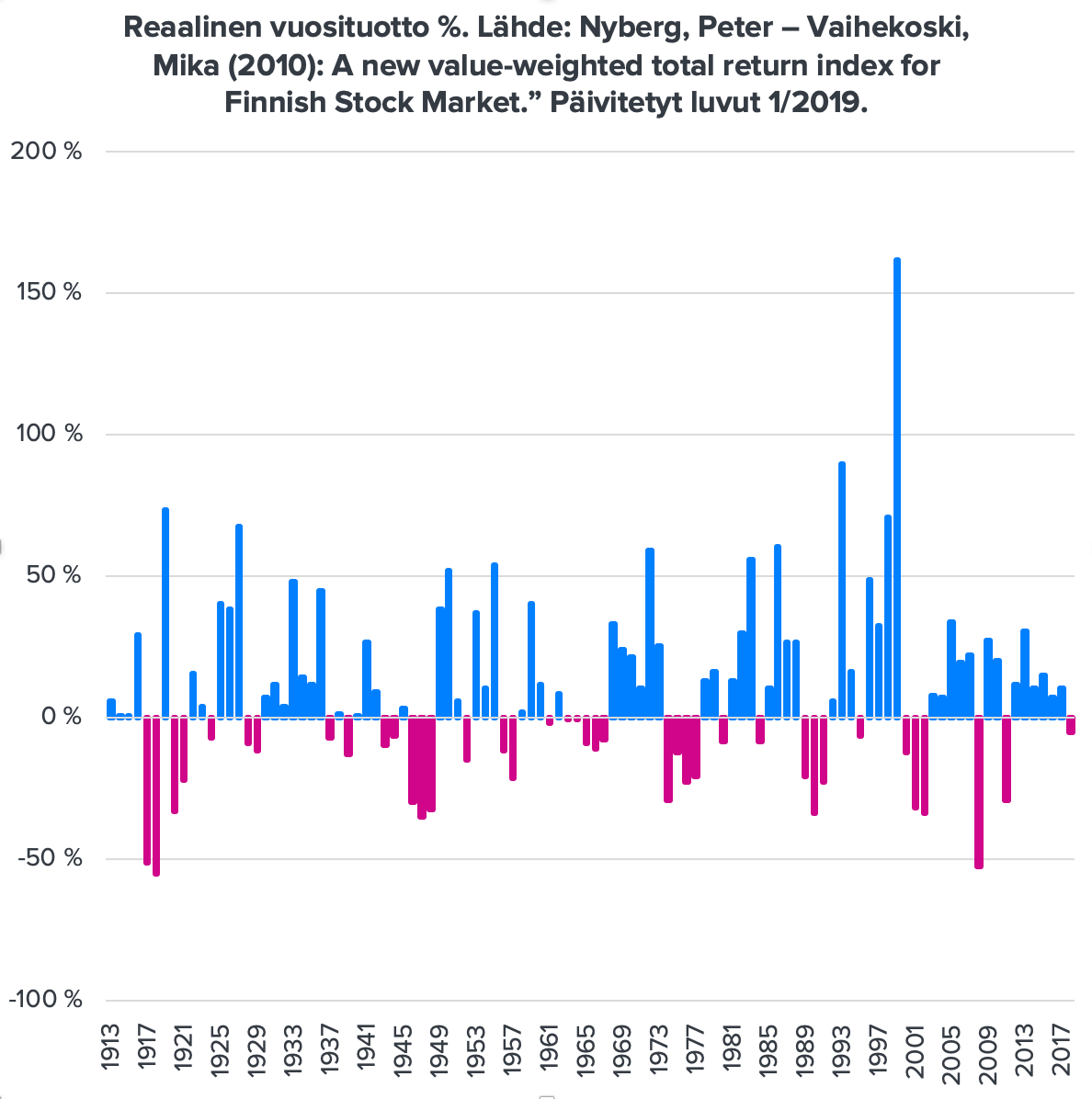
The cumulative, inflation-adjusted real return (calculated by reinvesting dividends) of the Helsinki Stock Exchange (Helsingin pörssi) throughout its history has been 5.35%.

-There have been 39 losing years out of 106. The market has fallen by over 50% in three years and risen by the same amount in ten years, in real terms.

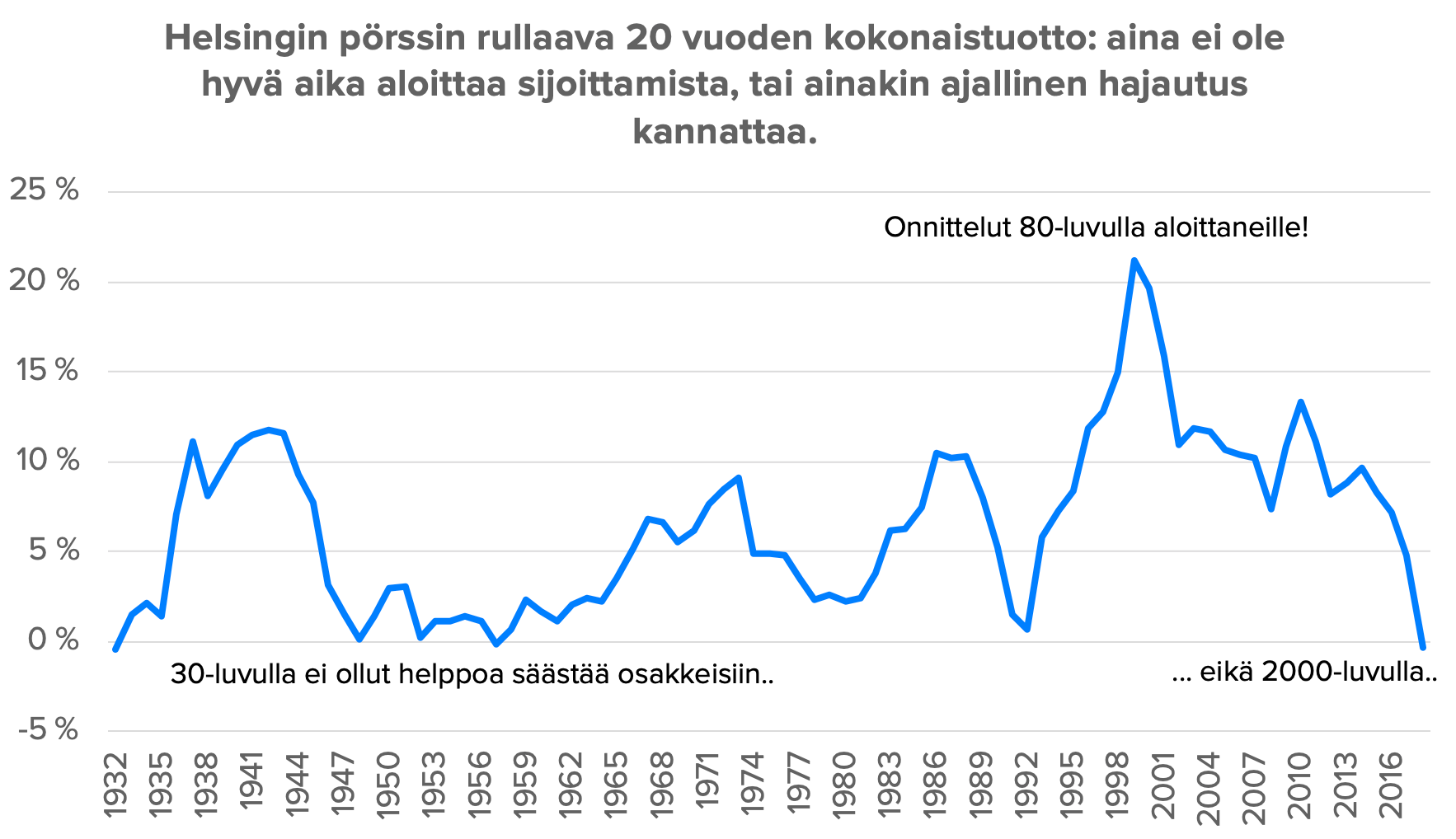
-If we look at 20-year rolling returns, we can see that starting to invest with a lump sum is not always profitable: congratulations to those who started in the 80s; those who started in 2000 hopefully had their time diversification in order.

Addition: here’s a more comprehensive article on the history of the Helsinki Stock Exchange (Helsingin pörssi) Helsingin pörssin historiaa: kuplia, manioita ja unohduksen kausia - Inderes

4 Likes

Thank you. These are important statistics and it’s great that they are available here.

Question: Last time, in 2018, the picture showed a CAGR of 6%. Now it has come down to 0.65%, which is quite a lot. Why is this?

1 Like

In the last picture, it was rounded from 5.5% to 6% for simplicity. The CAGR is naturally also affected by the rest of the year to some extent.

1 Like

I came across a tweet on Twitter about the long-term economic growth of Great Britain, which was the first country to industrialize and from where a lot of data is also available:

The British economy grew by 2.1% in both the 19th and 20th centuries, in terms of GDP. Average working hours have correspondingly decreased, and productivity has increased. Many current commentators and economists always lament when the 3-4% growth periods of the late 20th century are largely over in Western countries, but this current period of weak growth is, in the big picture, almost “normal” or a return to normal, to a couple of percent growth. The rapid growth after the Second World War is partly explained by women’s participation in the workforce, a trick that is difficult to repeat (robots?).

1 Like

I’m copying today’s tidbit here, which I posted in the Stock Investing group:

Today’s tidbit: government debt. I wonder why many commentators often have a black-and-white view of government indebtedness. Too much debt is always too much, but debt is not always a bad thing; on the contrary. There’s a good and concise article on the topic in Alphaville (requires free registration):

“The basic message in the end was: debt is probably not good on net, but you can use it, it’s not the end of the world, but use it for the right things. If the economy is very weak and monetary policy cannot be used, use it. If there is public investment to be done, the infrastructure is in terrible shape, use it. Don’t use it for no reason at all, so don’t have the deficits we have in the US at this point. It doesn’t make any sense. But you can use it. It’s a tool, it’s not a tool you should avoid to use at any price. It’s a tool you should use when you need to.”

https://ftalphaville.ft.com/2019/01/30/1548824403000/Give-the-kids-permission-to-fool-around/

For companies, debt can be a way to expand or “optimize” their capital structure, and everyone accepts that, but government debt is often approached with zeal or shame.

In short: consumption debt and excessively large deficits for too long are bad and limit the national economy’s room for maneuver, while controlled deficits and investments in sensible projects are good.

49


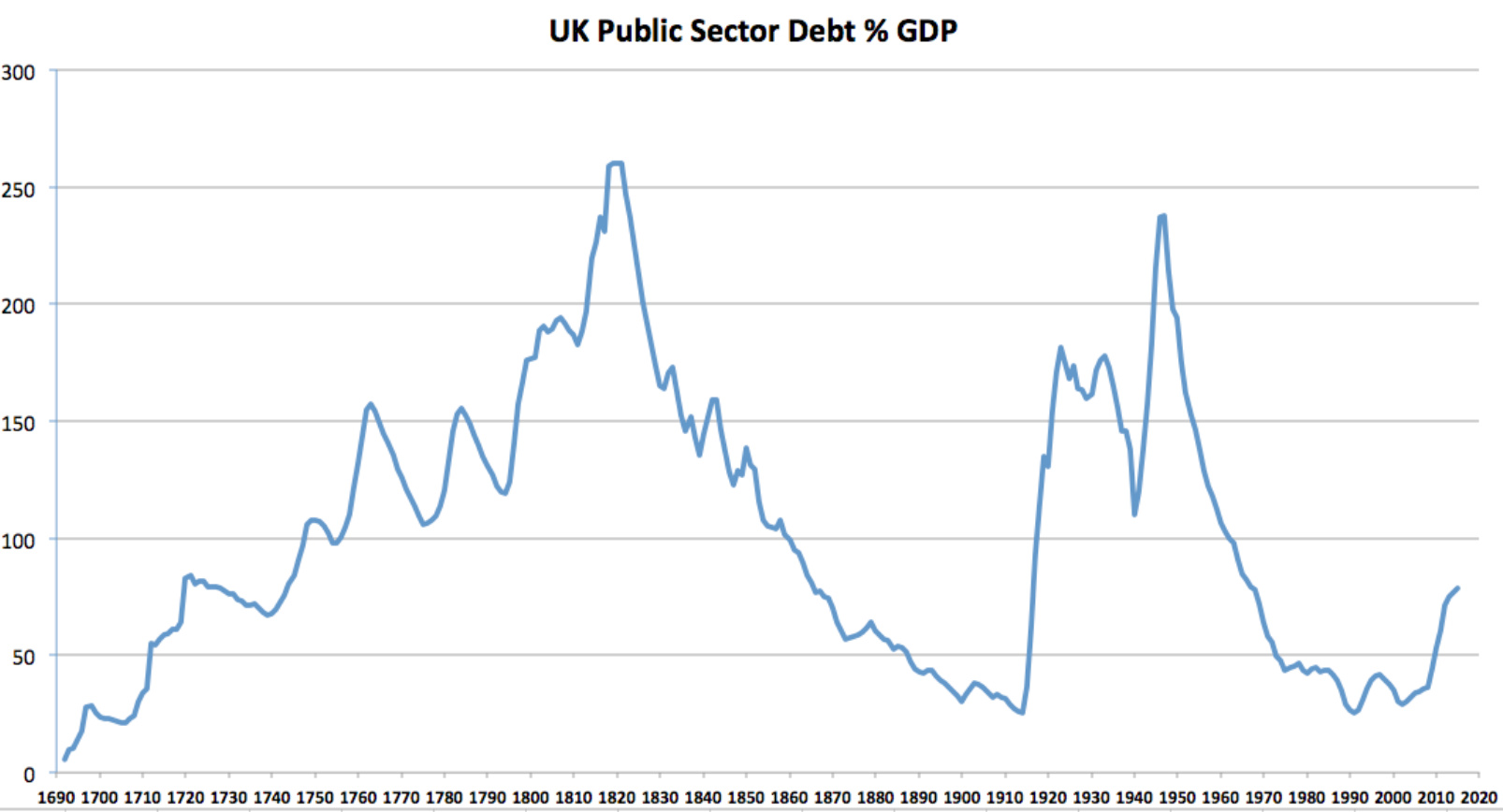
For example, the United Kingdom has managed to overcome large amounts of debt through economic growth. After the Napoleonic Wars, debts were actually reduced, but after the Second World War, the debt pile was shrunk through growth.

2 Likes

Yup. When it grows right, even debts turn into receivables::slight_smile:

Pondering,

FA Masse

I have the same feeling after the fifth grog…

1 Like

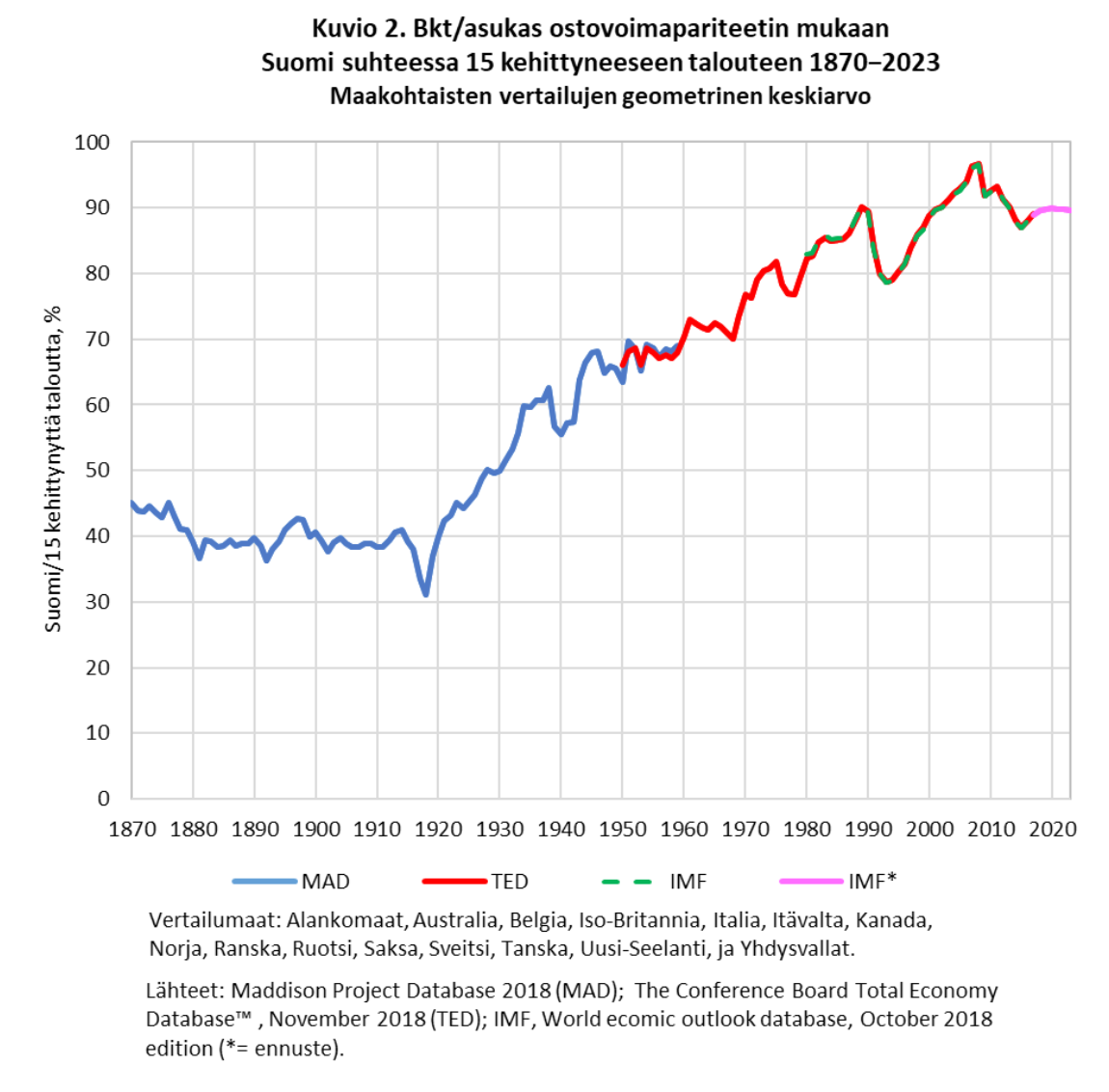
Finland can be considered a great example of growth from a “developing country” to a developed economy from the 1940s to the 2000s, but the last 10 years are not very flattering, as seen in the picture. Among the Eurozone countries, Finland is at the bottom in terms of GDP per capita development.

Blog post on the topic (my economics history professor back in university): Paluu tulevaisuuteen – Taloutta ja historiaa

This chart is also “illustrative” in its purpose: compared to its peers, Finland is falling behind. Before the financial crisis, one might have thought that the few percent difference could be caught up, but now it seems difficult to achieve.

2 Likes

Massive study, in plain language, on the most likely way to generate excess returns (for super-nerds)

GlobalFactorPremiums.pdf (1016.4 KB)

Still need to digest it, but in short, “trend is your friend,” carry trade pays off, and selling in May pays off.

A bit of a tough pill to swallow for value investors. :wink:

2 Likes