Feel free to post here if you have any good book recommendations related to investing, even for a beginner saver like myself!
6 Likes
I read Sjögren & Hikiä’s “Vaurastumisen reseptit” (Recipes for Wealth) as my first investment book and liked it at the time (I got it as a gift when I was about 19). It had good sections, at least regarding personal finance management and basics about different asset classes. You also need to be able to filter a bit, as some topics are given too much emphasis in the book. However, it’s easy to read and not too long 
I should read it again myself now after 4 years, I’d probably see things with fresh eyes.
4 Likes
First, I must say this is a good and necessary thread. I’ve read over half a dozen books, from which I’d highlight my top 4:
-
Graham: The Intelligent Investor. This is a good book, although financial terminology isn’t my strongest area… so I couldn’t internalize everything in such a long book with one reading. However, I tried to pick out the main points, and the most important ones were a) Graham’s mindset of a margin of safety and b) determining fair value based on a deep analysis of a company’s business. Everything should be based on these premises. Not the easiest book for a beginner, though.
-
Lindström: Succeeding in the Stock Market. A good book on value investing; I should read it again.
-
Saario: How to Invest in Stocks. A good basic book as a beginner’s first guide, but not all “hundred evergreen tips” may apply as such.
-
Erola: The Best Investment. A good basic book on index investing. Index investing is probably the most sensible way to generate long-term returns if it’s not a passionate hobby one wants to dedicate time to. I’m no longer interested in index investing myself because I want to spend time on this and also seek alpha by taking a view. I prefer to directly own companies and thus be directly involved in their story.
Other: Inderes’s investment school, videos, podcasts, and above all, their in-depth business analyses are everything to me for opening up the, at times, antiquated mindsets presented in older books in a modern, suitable way. The world has changed since Graham’s time, for example.
Secondly, as an “average person,” I simply cannot perform an in-depth business analysis of companies at the same level as the professionals at Inderes. Once I acknowledge this, admit it to myself, and follow my own investment plan while also following Inderes’s recommendations (albeit with a bit of criticality), I believe the long-term outcome will be good… My own portfolio still lacks big successes (multibaggers), but I am quite hopeful for the long term. I’m only completing my third year of this beloved hobby, and the first year or two were spent learning the basics.
P.S. Even in a bear market, the most important psychological factor, I believe, is the certainty that one has bought stocks sufficiently below the business’s fair value. In the long run, the stock’s valuation is likely to correct towards its fair value.
Next on my reading list:
- Graham: Security Analysis
- Malkiel: A Random Walk Down Wall Street
9 Likes
To support reading, Goodreads (owned by Amazon) is highly recommended: https://www.goodreads.com/ It helps you remember books you’ve read and those you’re interested in, and also makes it easier to spot books that fit your mood. 
I must recommend a read from the platform world: Modern Monopolies: What It Takes to Dominate the 21st Century Economy (https://www.goodreads.com/book/show/26114480-modern-monopolies?ac=1&from_search=true). Investment literature on platforms is quite scarce. However, this book offers an exceptionally insightful breakdown of modern business logic and ecosystems. 
"What do Google, Snapchat, Tinder, Amazon, and Uber have in common, besides soaring market share? They’re platforms - a new business model that has quietly become the only game in town, creating vast fortunes for its founders while dominating everyone’s daily life. A platform, by definition, creates value by facilitating an exchange between two or more interdependent groups. So, rather that making things, they simply connect people.
The Internet today is awash in platforms - Facebook is responsible for nearly 25 percent of total Web visits, and the Google platform crash in 2013 took about 40 percent of Internet traffic with it. Representing the ten most trafficked sites in the U.S., platforms are also prominent over the globe; in China, they hold the top eight spots in web traffic rankings.
The advent of mobile computing and its ubiquitous connectivity have forever altered how we interact with each other, melding the digital and physical worlds and blurring distinctions between “offline” and “online.” These platform giants are expanding their influence from the digital world to the whole economy. Yet, few people truly grasp the radical structural shifts of the last ten years. In Modern Monopolies, Alex Moazed and Nicholas L. Johnson tell the definitive story of what has changed, what it means for businesses today, and how managers, entrepreneurs, and business owners can adapt and thrive in this new era."
5 Likes
Thanks, @Erno_Hilvenius, for the great book recommendation; that’s going on my reading list too… These platforms are clearly the new thing of the 2010s and often a highly scalable business… A successful investment can therefore be very profitable…
2 Likes
Heikkilä&Vilén Show features a slightly different book recommendation: Sinuhe the Egyptian.

5 Likes
Nalle Wahlroos’s Ten Most Destructive Ideas in Economics. Not exactly investment literature, but I actually read the book twice.
7 Likes
During my summer vacation, I came across an extremely interesting and good blog by John Huber. If you can read English, I warmly recommend it to everyone: http://basehitinvesting.com/author/johnhuber/
Huber writes about value companies, the relativity of valuation (a P/E of 40 is cheap if a company is growing fast, even a P/E of 5 is too much for cases ripe for bankruptcy), and the importance of adaptability.
3 Likes
Here’s a good text from his 2017 performance as a pick. The text discusses anchoring, selling too early, Apple, and Tencent http://basehitinvesting.com/saber-capital-annual-investor-letter/
1 Like
I checked my Goodreads profile for 10 investment books that I have rated 5/5. I can recommend these myself, although the reasons vary. Some are excellently written, while others contain brilliant content. Not all of them are purely investment books, but they all have a strong link to the topic.
The books are not in any particular order, and I must also note that I have become a more demanding reader and, consequently, a reviewer. This means that older books might have received 5 stars, while today they might get 4. Nowadays, even a very good book gets 4/5 if it doesn’t significantly bring anything new to me. At this point, I have consumed so many investment books that it is somewhat challenging.
Modern Monopolies: What It Takes to Dominate the 21st Century Economy - Moazed, Alex
A must-read in the age of platforms. Erno already mentioned this earlier.
The Outsiders: Eight Unconventional CEOs and Their Radically Rational Blueprint for Success - Thorndike Jr., William N.
An excellent book on how to create shareholder value.
What’s Behind the Numbers?: A Guide to Exposing Financial Chicanery and Avoiding Huge Losses in Your Portfolio - Vecchio, John Del
Requires a fair amount of expertise and can be dry if the topic doesn’t interest you. It helps to better understand how results can be manipulated and, on the other hand, what factors can indicate problems.
The Greatest Trade Ever: The Behind-the-Scenes Story of How John Paulson Defied Wall Street and Made Financial History - Zuckerman, Gregory
I found this to be an interesting story. It might not be for everyone, and it’s not instructional material. However, I might question a 5/5 rating today.
Market Wizards & The New Market Wizards: Conversations with America’s Top Traders - Schwager, Jack D.
Read a long time ago, but I remember it being very educational then. Especially regarding how completely different investment styles can make money. I recommend it for opening up one’s own thoughts; I found it very interesting. These are the first two books in the series, and more have been released, but for me, the main glow has perhaps faded. All of them have been read, of course.
Investment Biker: Around the World with Jim Rogers - Rogers, Jim
The story is central here, which probably resonates if you’ve ever dreamed of circling the world on a motorcycle. Investing is also touched upon, and Jim is a man of action. Of course, there’s another similar book, about circling the globe by car.
Tao of Charlie Munger: A Compilation of Quotes from Berkshire Hathaway’s Vice Chairman on Life, Business, and the Pursuit of Wealth With Commentary by David Clark - Clark, David
The most recent addition. Behind the amusing quips lies great wisdom. Light reading, which earns extra points.
Security Analysis: Principles and Technique & The Intelligent Investor - Graham, Benjamin
These are simply legends. They have stood the test of time extremely well.
If you want to purely entertain yourself, then Wolf of Wall Street (Jordan Belfort) was excellent in my opinion. Of course, you won’t get investment tips from there, except perhaps how to identify a swindler. Additionally, it’s worth mentioning that Michael Lewis’s finance-related books are, in my opinion, very good and entertaining thanks to an excellent writer. Sometimes the story might even override the facts, but books like The Big Short, Boomerang, Liar’s Poker, and The Undoing Project are, I think, excellent.
There are many others, of course, but let’s start with these.
14 Likes
Good list, I’ll have to order a few of those books. 
I was about to throw in the traditional “library card = free books, no need to order, money into stocks” here. Those on the list might not be so easy to find in libraries, or are they? Sometimes the English language makes finding them difficult.
Good list from Juha.
2 Likes
I just finished Nassim Taleb’s Skin in the Game, which reminded me that Taleb’s books are also suitable for those reading investment literature.
In my opinion, the best of his works are Fooled by Randomness and The Black Swan, although if you really enjoy dredging economists and bankers, you should also read Antifragile and the aforementioned Skin in the Game.
Black Swans make you think about portfolio risks from a new perspective.
4 Likes
I once listened to a lecture from a guy who worked in the leadership of the Fukushima rescue efforts. The most important lesson from the case was the “black swan,” meaning “always expect the unexpected”… There, a tsunami exceeding all design basis for the nuclear power plant’s safety killed 20,000 people, causing a nuclear accident at the same time. Fortunately, no lives were lost in the nuclear accident.
Nuclear safety [1], [2] probably doesn’t directly relate to investing, but both economic development and nuclear safety are analyzed and monitored extensively with qualitative and quantitative metrics. Comprehensive history is also available for both topics, but in both, a black swan is still possible 
2 Likes
There are some great tips here! It’s a shame I don’t have a reading list, as recommendations for even good books tend to be forgotten. However, here are a couple of macroeconomics books I’ve read recently and can recommend:
Nouriel Roubini: Crisis Economics: A Crash Course in the Future of Finance. The financial crisis thoroughly analyzed by “Dr. Doom” and proposed solutions for the future. A good reminder that there’s room for improvement in systems
Finnish perspective: Raimo Sailas: Laman taittaja (The Recession Breaker). Sailas’s autobiography is interesting reading for anyone interested in Finland’s economic history and, in my opinion, a well-written book. Sailas is one of my favorite economic policy commentators and has witnessed many economic booms and busts, which is evident in this hefty volume.
2 Likes
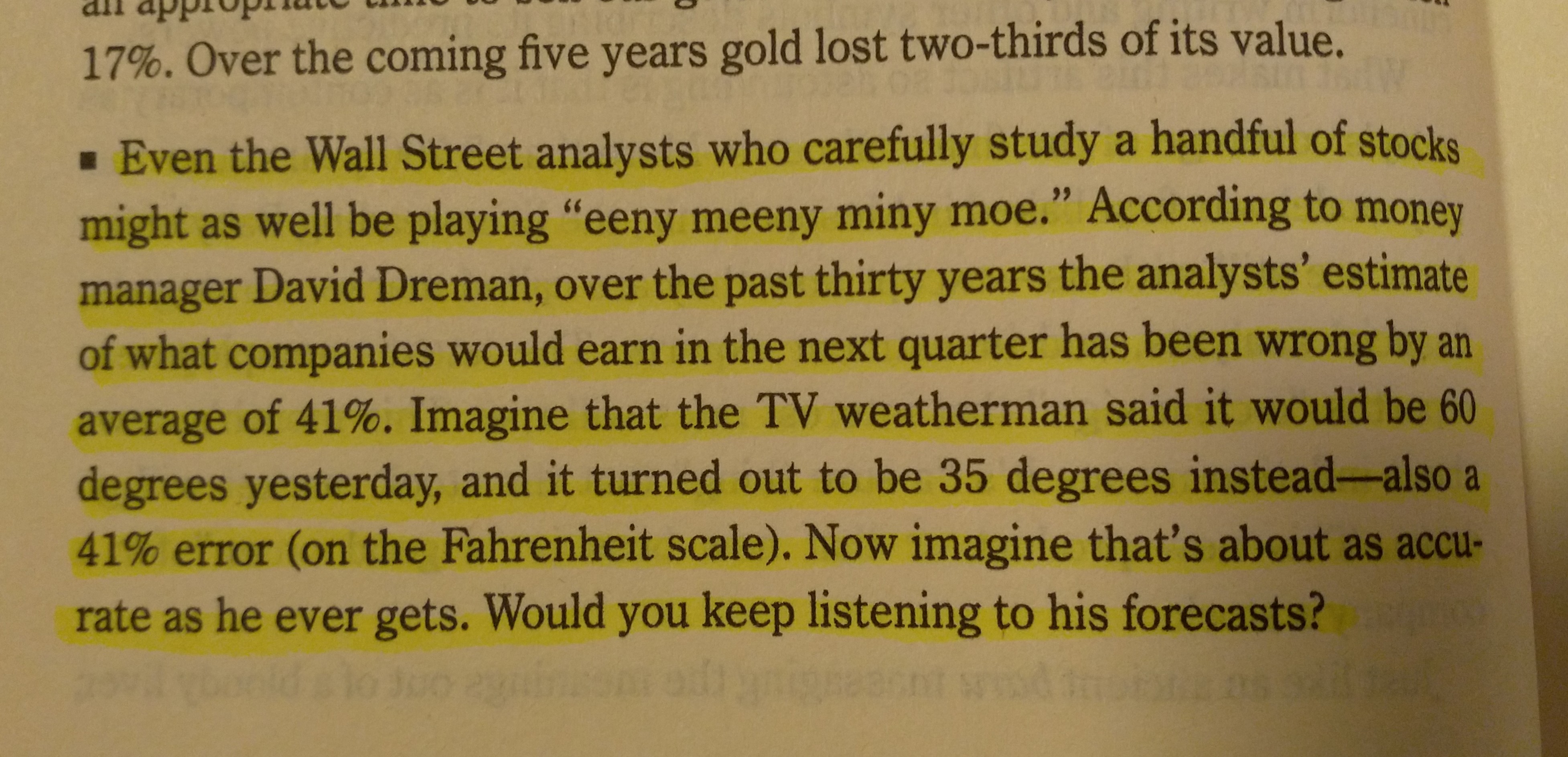
Jason Zweig’s “Your Money & Your Brain” is a very insightful book if you’re at all interested in the psychology of investing. It’s full of educational material about one’s own cognitive biases, and good explanations for the funny phenomena that occasionally appear in the markets.
And since we’re in the realm of analysts, and (worryingly) many here seem to read analyses like a believer reads the Bible, here’s a small excerpt from Zweig’s text:
1 Like
Aki Suokko and Rauli Partanen: The Age of Energy.
If you’re more interested in numbers, does anyone have a good textbook they’d recommend? University of Applied Sciences/university etc.
When age starts to bear down, the Inderes platform is all that Uncle Masse needs to keep up with Mr. Index, or sometimes even get ahead! I already told Verneri in German, “Hier ist alles!” He probably didn’t understand it as a compliment…
Well, nothing to do but read the Morning Reports and watch some fun videos.
3 Likes