Ouch. It requires a bit of research to open up 


1 Like
For history buffs: How did investors diversify in the late 1800s?
https://core.ac.uk/download/pdf/82982916.pdf
Academic research on the topic. On average, investors had a diversification of about 4-5 stocks (I’ve actually encountered similar figures in research on modern-day Finland: many investors have one or two telecom stocks…), meaning some form of diversification was sought as popular capitalism advanced in a prospering Great Britain towards the end of the 19th century.
The text also highlights how information about stocks was generally acquired at that time. Main sources included newspapers, or many investors preferred companies whose offices they might live near. The amount of information was likely very low, and the market relatively inefficient.
A somewhat related, lighthearted image:

1 Like
This was also reflected in the valuation. Getting rich through investing was therefore no more difficult than it is today. It was even considerably easier if you knew how to do a little research and choose investment targets.
This is where the problem arises. When states incur debt, it slows down renewal as there isn’t the same need to make structural reforms. Finland is a prime example of this. Government debt rarely goes into investments. Even in Finland, over ten years of accumulating debt, the road repair backlog has also grown. Debt is debt, however.
The state is really inefficient at doing things. In a normal interest rate environment, government investments cause prices and interest rates to rise, which detracts from private sector consumption and investment. If government indebtedness is seen as a good thing, it practically means that the state is considered an efficient spender of money. In that case, we can also discuss why not increase taxation so that the state can spend more.
The current situation is completely exceptional, and states genuinely have the opportunity to spend without significantly reducing the private sector’s spending. Since central banks keep interest rates at zero, states should indeed incur debt. The problem arises when interest rates rise, and governments’ debt servicing costs explode. This creates situations where interest cannot be paid without tax increases or significant reforms. States would then continue to incur debt simply because they are already indebted. This is by no means sustainable and, for the reasons mentioned above, causes the private sector to spend less money.
1 Like
I’m going to break down some elements and claims from your response, which I would appreciate if you could clarify/substantiate.
Can you find any studies to support the claim that “when states incur debt, it slows down renewal”?
Indebtedness itself hardly slows down reforms; the capacity to borrow more and unlimited access to the debt market might, however. The current situation, where central banks, in their quantitative easing frenzy, are losing their independence to politicians, is indeed happening, one could argue, but it is due to their laxity, not intrinsically to state indebtedness. To my understanding, central banks are still independent, and if someone had “balls” like Volcker did in taming inflation back in the day, they could shut down debt taps with a snap of a finger and disregard the stock market’s loud whining.
I would phrase it the other way around: often, state debt crises, or sharp spikes in debt, have ultimately led to reforms when debt was no longer available and the IMF’s grasp threatened to squeeze the wallet (Latin America in the 80s, Finland in the 90s, Asian countries in the late 90s, etc.).
Here, it would be good to differentiate the various roles the state has. The state is, however, just an entity living in time, in constant change. The “efficiency” of the state is also difficult to measure, because its roles are not always dictated by people who only consider discounted cash flows. It’s also good to recognize that there are a few hundred different states, and generalizing among them can be crude.
For example, in the case of Finland, it’s also good to realize that people’s daily lives are significantly affected by municipalities, not just the “state.”
If we are talking generally about the public sector, when considering efficiency, several interest groups, opportunity costs, and impacts should be taken into account, for example, in preventing youth marginalization, often even decades into the future.
To my understanding, for example, the Finnish public sector, and Finnish society in general, despite all the vilification and disparagement, is relatively efficient, and by many measures, our standard of living is among the best in the world. In a large part of the world, this is not the case, and one can probably safely say that the further one goes from the Nordic countries, the more “inefficient” states are; they can even be outright hostile “monopolies of violence” to citizens, to use Weber’s terms.
What I want to say concisely is that, as an “animal,” the public sector appears to be somewhat more complex and not as black and white as its critics often imply. Of course, this is also an ideological question: if one believes 100% in the free market and the omnipotence of individual liberty, everything done by the state is likely a worse alternative. Others, again, believe that free markets lead to the dominance of powerful players, and individuals do not know what is best for them. The truth probably lies somewhere in between.
I agree with this: currently, state deficits are not really taking away from the private sector if the funds come significantly from central bank vaults, indirectly through banks, of course. Even if interest rates do not rise for a long time, a significant portion of citizens and savers will at some point start reacting to what feels like reckless indebtedness and may ironically start over-saving themselves, fearing future tax increases. That, in turn, slows down the economy, even though public debt was supposed to stimulate it. This would therefore seem logical; if you have time, you could research studies to see if there is empirical basis for this assumption (now, for example, in Finland, consumers are living like there’s no tomorrow even though the public sector was indebted for a long time). I will also try to dig when I find time.
Practically, a similar situation where the public sector is furiously indebting itself and central banks are assisting as friends, in recent history, only brings to mind the world wars. In the United States, also in the 60s, the central bank was pressured to keep interest rates low with the Vietnam War and the building of the welfare state, but these do not otherwise correspond to the current situation at all (economic and demographic structure, level of development, commodity scarcity/abundance, no physical capital destruction, etc.).
2 Likes
I posted this article on the historical guidelines of the Fed already in the “Stock Market Direction” thread, but it’s also good to keep it here.
A few excerpts that might be interesting when considering the current situation:
- The Fed’s independence has been “iffy” multiple times during its history, and it has bent to the will of politicians (for example, during the depression of the 1930s, 1937–1950, 1960s, etc.). Trump’s “threats” last year were therefore nothing new; on the contrary, sometimes the Fed has been almost on a direct leash, especially during times of crisis (world wars).
- The Fed has relied on prevailing economic frameworks in its economic understanding and assumptions. As is generally the case in science, we can retrospectively observe its development and that old assumptions were often completely wrong. How many current assumptions, which the Fed still believes in, will later be proven wrong?
- The central bank has been very fallible, partly due to incomplete information and understanding of how the economy truly works (there is probably much less of that knowledge than is shouted over coffee cups and now on forums
 ). It is very possible that the Fed doesn’t really know what it’s doing even now.
A healthy dose of skepticism is therefore due towards the central bank as an institution and its capabilities.
A little illustration of the history of interest rates as an addition:

2 Likes
A small piece of “economic history” for the week (now we’re going so far back in time that we’re venturing into other territories).
I was reviewing the history of debt and came across the Sumerian word ama-gi, which, according to current understanding, is the first word meaning “freedom” in human history for which sources can be found. Amagi, or amargi, literally means “return to the mother,” but in practice, it refers to liberation from debts, debt forgiveness, or the freeing of slaves by their owner.

According to current understanding, the concept of lending (with interest, “virtual currency” is known to have existed throughout human history) and the first “consumer loans” originated in Mesopotamia over 2000 years before the Common Era. Naturally, from time to time, peasants would fall into such severe debt that an amagi, a debt reset, had to be organized to maintain social peace. For new kings, this was also an excellent way to begin their own regime and gain popular support.

1 Like
I’ve been reading a bit more about debt recently. What constantly stands out is how public debt, in particular, has practically always been “complained about”:
“At every stage in the growth of debt it has been seriously asserted by wise men that bankruptcy and ruin were at hand. Yet still the debt went on growing, and still bankruptcy and ruin were as remote as ever”
This is how historian Macaulay commented on early 18th-century commentators, when Great Britain began to accumulate heavy debt due to the new central bank and continuous warfare. The development of Great Britain’s debt, the world’s first modern economy, relative to the size of its economy, can be seen in the graph below.

(Source: Centre For Macroeconomics)
The same continued later:
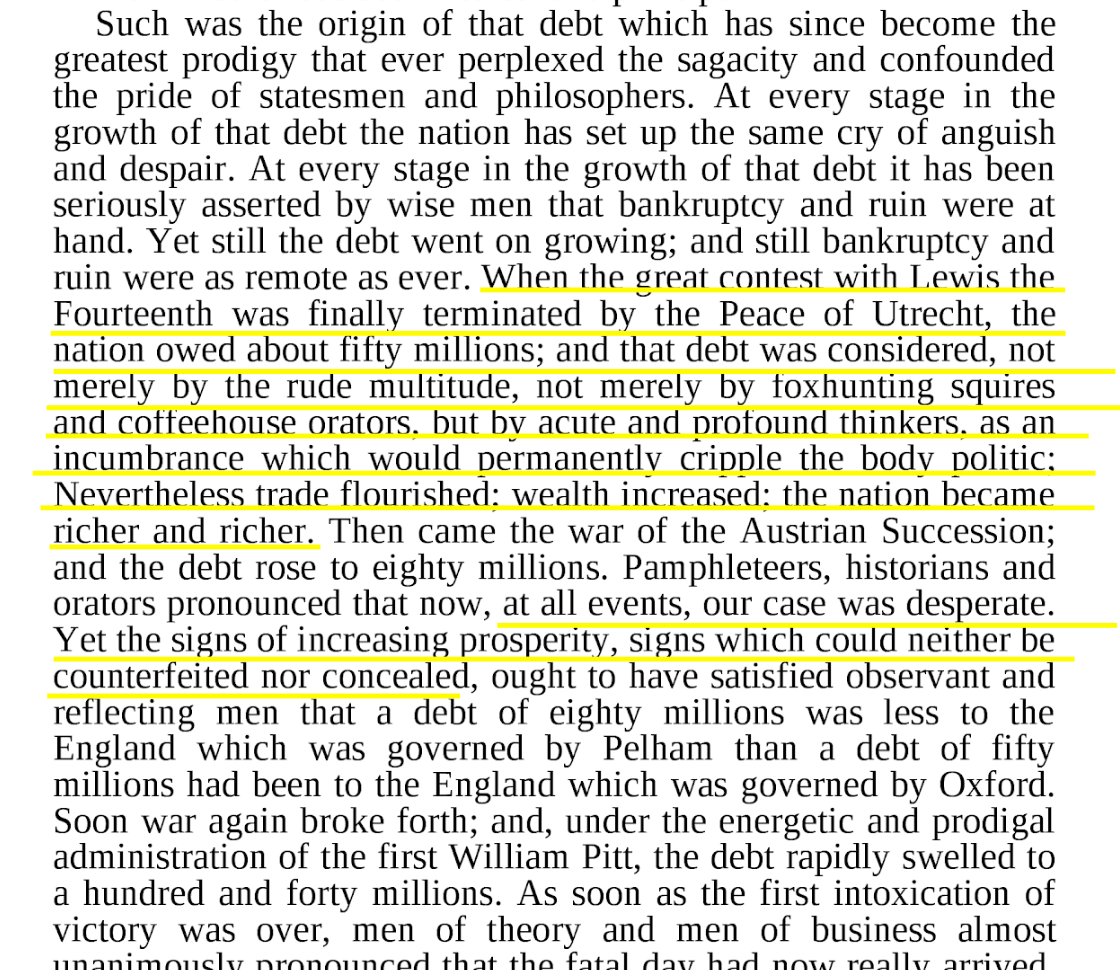
Adam Smith also commented on public debt in his work The Wealth of Nations (1776), how there is always capacity to bear more and more of it, though he warned that the limit would eventually be reached (it hadn’t yet reached 100 percentage points).

Addition:
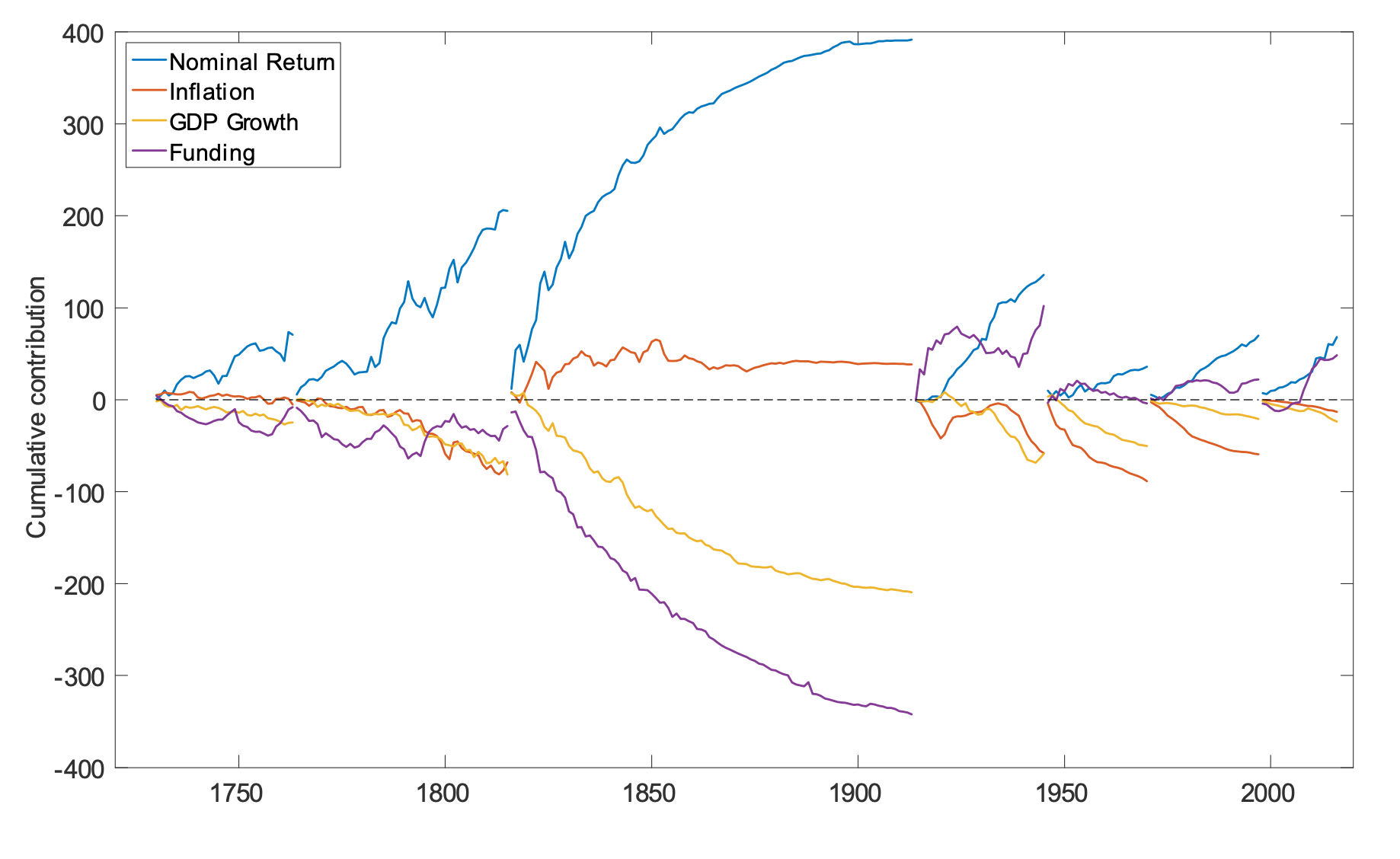
An interesting graph showing how debts have been managed in Great Britain. In the 19th century, in an environment of stable prices, bonds performed well, and a fiscally disciplined state effectively paid them down over the century. After World War II, debts were managed through inflation. It will be interesting to see how welfare states intend to maintain cost discipline and repay their loans in the future…
3 Likes
I talked with Marianne on the podcast about debt, and the podcast also included a section on the history of debt. I mentioned many of the same points that I’ve put in this thread. It included trivia such as France’s 17th-century imaginary currency, why debt forgiveness is important, medieval Irish slave girls as a measure of value, consumer loans in Mesopotamia and debt as a tool of power, and how the distinction between real economy vs. monetary economy is foolish when the entire modern capitalist system is built on modern banking.
1 Like
Three parts of a stock market rally. The Economist 1866:
First, smart investors see opportunities, then the rest, and finally all kinds of opportunists join in. These things seem to change slowly, if at all.
2 Likes
Luckily, Verpu and other wise people from Inderes are the “early detectors” of our time 
And the really great thing about this is that they share their knowledge here on the forum immediately, allowing Masse and other fortune seekers to still get in cheaply : Or to sell in time before the stock price crashes…
Masse, who made his fortune with Inderes’ advice
1 Like
Yes, sometimes it would be good to zero out debts – both between friends and between different countries. Then life can start again with a clean slate.
And if this doesn’t get resolved amicably at the company level, then it should be done by force: it’s more elegantly called bankruptcy
Masse, Associate Professor of Debt History, Lesson No. 1
1 Like
@Verneri_Pulkkinen Since you like to dig into history (and publish the most shorted stocks), what do you think is the biggest short position ever in the Helsinki stock exchange?
2 Likes
Yeah, sometimes it would be good to zero out debts - both between friends and between different countries. Then life would flow again, starting from a clean slate.
Lend me money
1 Like
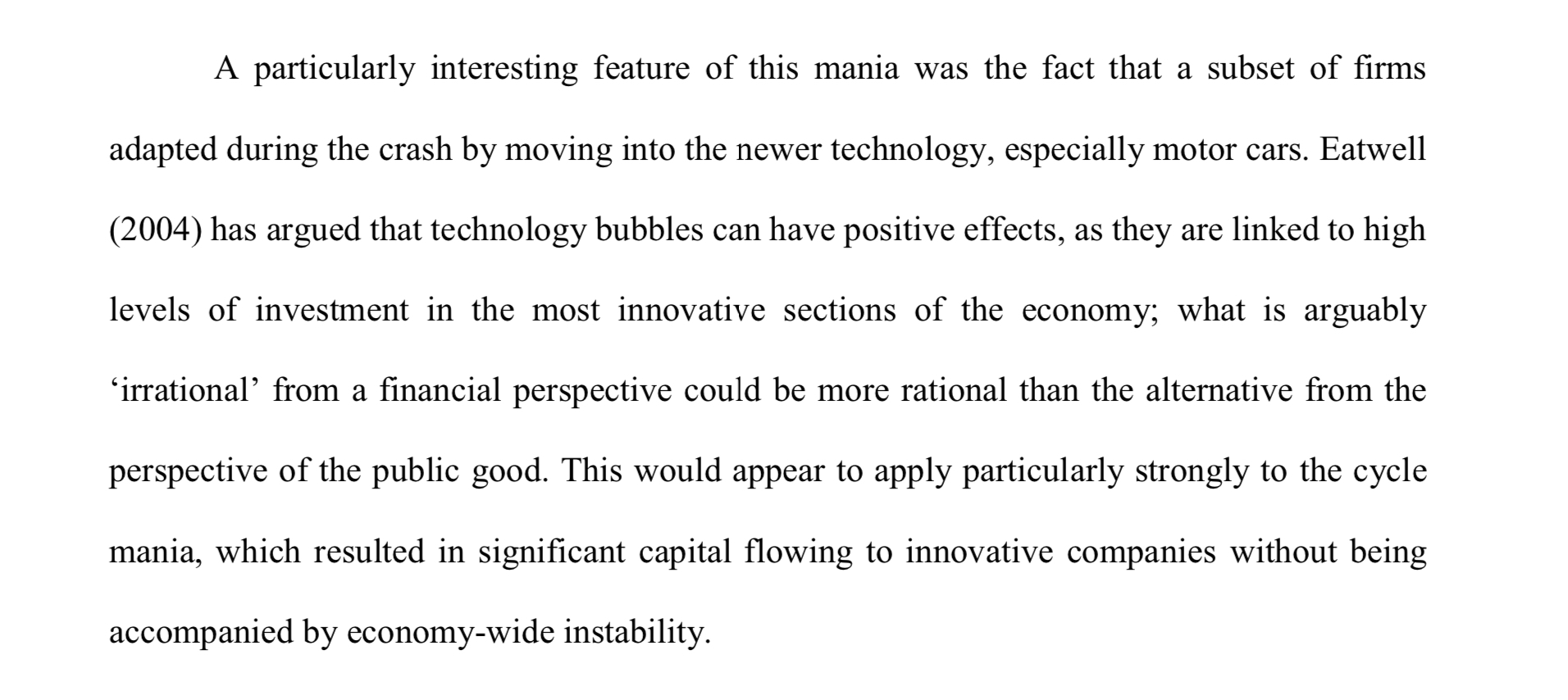
I’ve never heard of this before: the bicycle craze of 1895–1900! Bicycle stocks, the tech darlings of their time, tripled and then crashed by 75%.

 http://www.quceh.org.uk/uploads/1/0/5/5/10558478/wp16-06.pdf
But it wasn’t all bad: bubbles can finance new innovations. Many bicycle manufacturers adapted and moved into the nascent automotive industry.
4 Likes
Let’s revive this history corner. I stumbled upon a blog from 2005 that almost indirectly anticipates zero interest rates:
The author points out that interest rates have chronically decreased throughout history as capital has grown (note that interest is paid for scarcity; no scarcity, no interest!) and transaction costs have simultaneously decreased (risks can be diversified quickly and efficiently).
5 Likes
Has anyone been following how the Shiller P/E is updated on this page: Shiller PE Ratio - Multpl
The dot is in a “peculiar spot” relative to the curve. According to the curve, the P/E is rising, but the dot shows a decrease, which sounds logical given the low-pressure stock prices.
What interests me greatly now is the E in the divisor. Monthly earnings can be found here: S&P 500 Earnings by Month - Multpl
The latest reported month is March, and we are already in August. When will this update? I understand that earnings season is still ongoing, but some report differently. When will it be updated? If you look at the linked monthly table to see what earnings data falls out from those ten years, my area of interest becomes clear. The months are quite modest. This is related to financial history in that these are the three worst earnings months since the Financial Crisis.
4 Likes
I have a bad habit of browsing old digitized Finnish newspapers. You can find funny anecdotes and (stock market) phenomena tied to their time. Following stock market matters surprised me – I assumed there would only be a few mentions of them in basic newspapers. For example, the first major stock market crash was followed surprisingly closely in Finnish newspapers.
Below are examples of gramophone stocks and rayon stocks!


Addendum: The disappearance of Loewenstein from an airplane was a sensational news story of its time. He was (according to Wikipedia) the third richest man in the world at the time.
6 Likes
How about the recent history of stock markets? I’ve been thinking about creating a thread on stock market “fads,” but we could also go through them here since they’re history. I mean all kinds of new trends that have emerged and for which suitable investment products have been developed. What fads come to your mind? At least the following novelties aimed at individual investors over the years come to my mind:
- The rise of mutual funds in the mid-1990s
- Technology stocks (the so-called tech bubble) around the turn of the millennium
- Index investing from the early 2000s
- Emerging markets, especially the so-called BRIC concept in the mid-2000s
- Commodity investing around the financial crisis
- Frontier markets in the early 2010s
- Responsible investing 20??
- Cryptocurrencies 20??
- Cannabis stocks 20??
- Technology and AI 20??
(The timeframes are approximate; I don’t remember the exact dates when all of them started to gain public awareness)
The above-mentioned things have stuck around; I can’t immediately recall any new phenomena that have completely disappeared.
4 Likes
Here’s a bit of older stuff to bring some perspective on what kind of crazes there have been:
Some trading companies in the 18th century
Railroads 1850–1870
Bicycles ~1900
Car companies 1920s
Conglomerate boom 1960s
“Nifty fifty” 1970s
More recently… In Finland, the blind pursuit of dividends seems to be a perennial trend…
3 Likes