Solar panels on the roof - Real dividends in the sunshine?

This year, solar panels have gained popularity as Europe plunged into an energy crisis. In this thread, let’s consider acquiring solar panels as an investment and examine how profitable they actually are. Or are they not at all?

I’m not much of an expert on the subject, and my own panels have only been installed for less than half a year. Hopefully, this thread will still provide some benefit to readers. In this first post, I’ll share my own experiences and present the data collected so far for others to see. My perspective will certainly emphasize living in a detached house, as heating consumes electricity differently than, for example, in a terraced house.

First, a few words about solar panels. Panels and systems are compared using the kWp value (peak kilowatt), which describes the panels’ power under certain standard conditions. You can think of it as the maximum power of the panels, even if it’s not exactly accurate. Close enough. The higher the kWp value, the more electricity the system can potentially produce.

In addition to the panels, a solar panel system includes an inverter, which converts the electrical energy from the panels into a suitable form to be fed into the property’s electrical grid. The inverter is the most expensive single component of the system and must be sized large enough to handle the power produced by the panels. For example, my system is 4.32 kWp, and the inverter is 6 kW. Many inverters offer real-time monitoring, which is a nice feature. Of course, some systems also include a battery bank to enable the storage of produced electricity, so that excess production can be used for one’s own consumption, e.g., at night.

What then is the “correct” size for the system? I can’t answer properly; someone wiser might do it better. However, I will try to clarify the matter through my own system. For a small-scale producer, electricity production is tax-free, even the sale of surplus production. However, if the panels were acquired for income generation, rather than for personal consumption, taxes must be paid (more information from the Tax Administration’s website). If I recall correctly, the limit was at least 100 kW with Helen, so quite a lot of panels would need to be acquired to exceed that.

Unfortunately, panels usually produce the most when one’s own consumption is at its lowest. So, it might not make sense to size the system such that there is no overproduction at all. In the summer, most of the production goes for sale, but in spring and autumn, a completely different amount goes for personal use. I’ll show some of my own charts on this below.

Now to my own experiences. My system was acquired in March 2022, and its size is indeed the previously mentioned 4.32 kWp (12 * 360 W panels), costing 8900€. Here’s my first piece of advice for those considering panels: research prices at least superficially beforehand. I didn’t do that and was just excited about the panels, which led to me overpaying. I estimate that the same system could have been obtained for up to 2000€ less. The panels have a 25-year production guarantee (meaning they will still produce >80% of their nominal power then) and the inverter has a 10-year guarantee.

You can get a household deduction for panel installation. In my case, the installing company stated the labor cost as 3625€, of which 40% is 1450€. With a deductible of 100€, 1350€ can be deducted from the price of the panels after the deduction (more information from the Tax Administration’s website).

The surplus can be sold back at the spot price, or at least in Helen’s case, it can be “stored” in a virtual battery, in which case 13 c/kWh is credited (8/2022, as prices may change). I made an agreement to sell at the spot price. There is no transmission fee to pay for the transmission of sold electricity in Caruna’s network.

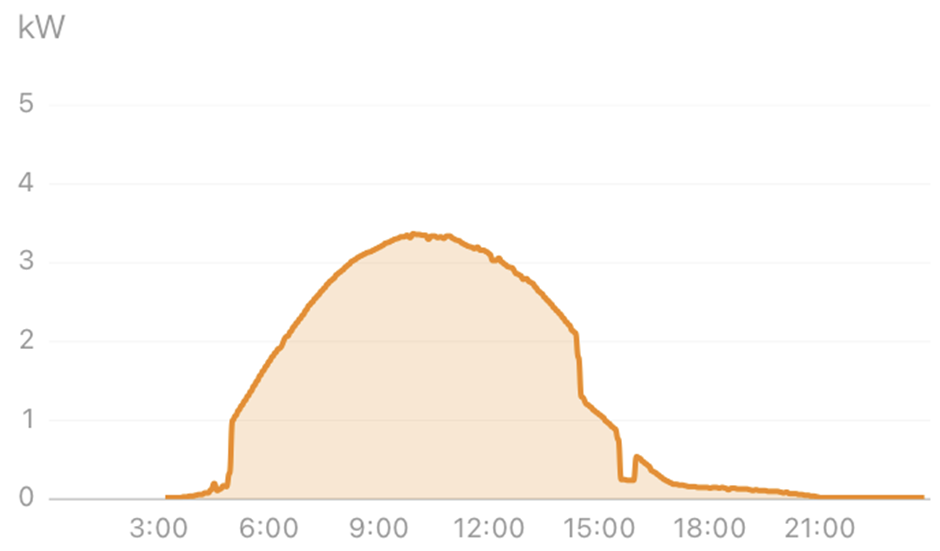
We live in Lohja, and our detached house has a steep roof, with all panels on one slope facing roughly southeast. There are no shading trees in front, so on a sunny day, the production profile looks approximately like this:
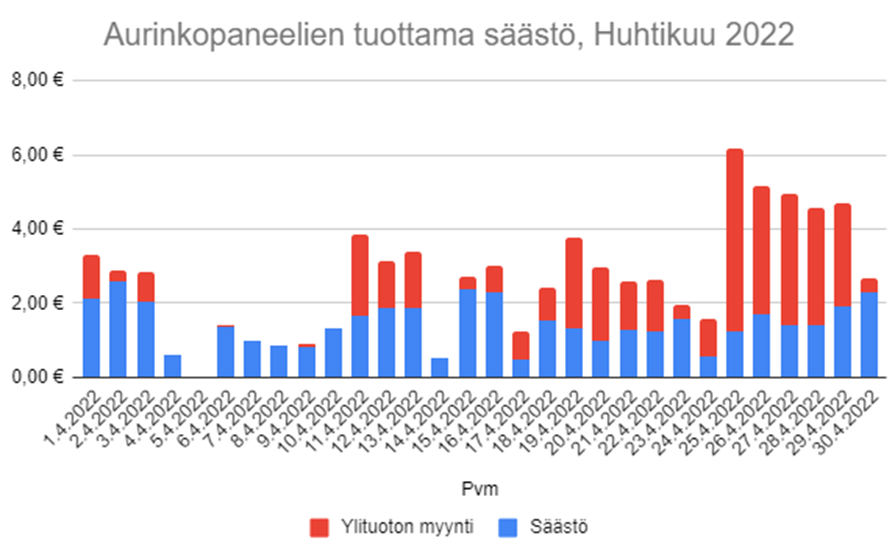
Then to the actual data. I have calculated the panel yields once a month and drawn some charts. For calculating the portion used for personal consumption, I have used the current 6.96 c/kWh contract (plus transmission ~7 c/kWh and tax ~3 c/kWh), which may be something completely different next year. The sold portion has been calculated directly from spot prices.

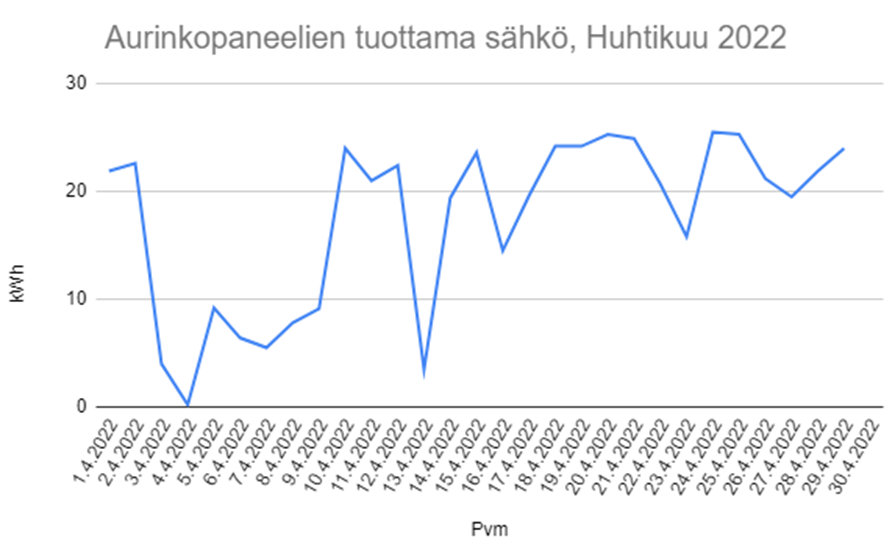
Let’s start with April, which was the first full month with the panels. April was reasonably sunny, although there was a week of snowfall in the early part. A total of 525.8 kWh of electricity was produced, of which 272.4 kWh went for personal use. The average price of sold electricity was 12 c/kWh.
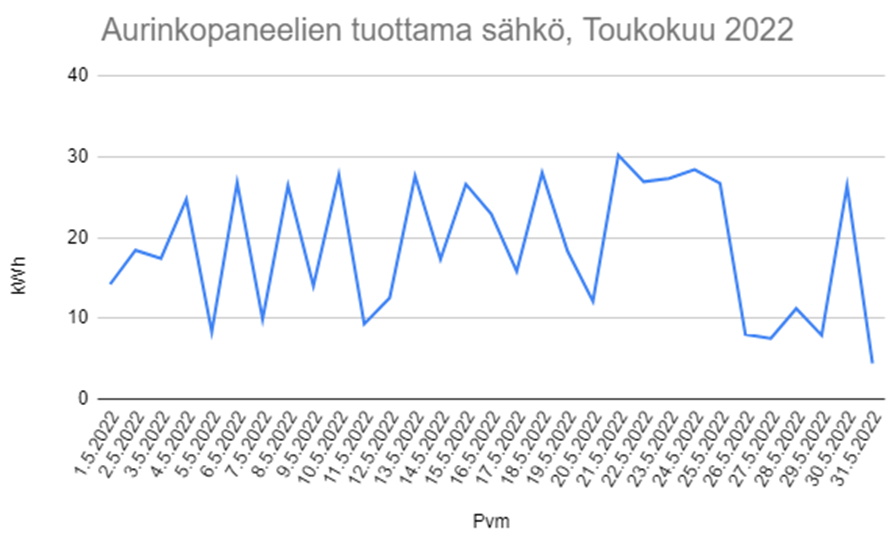
May was also very sunny, and production amounted to 583.1 kWh, with 232.05 kWh for personal use. In May, the outdoor temperature was still relatively low, which slightly increases the efficiency of the panels (~5-10%). The average price of sold electricity rose, being already 17 c/kWh in May.
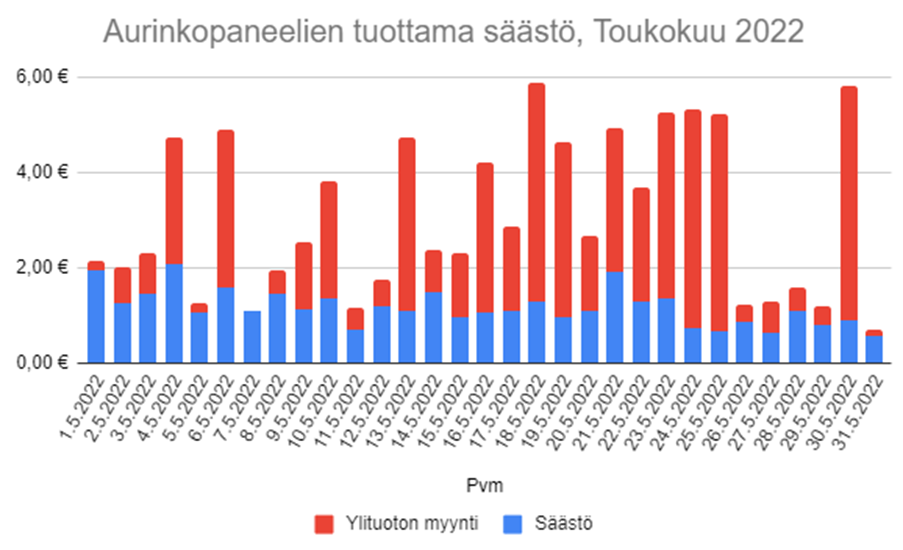
In June, electricity production was very good, 677 kWh (only 203.9 kWh for personal consumption). The average price of sold electricity was the same 17 c/kWh as in May.
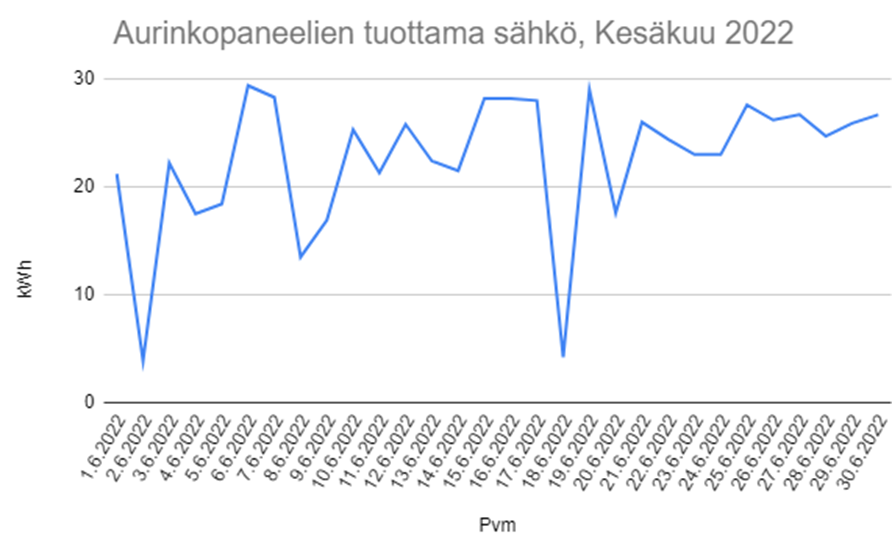
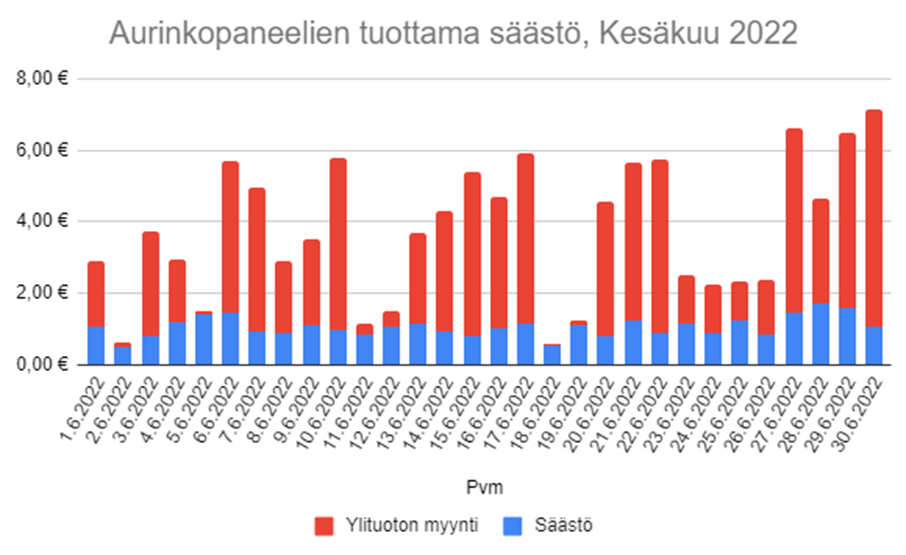
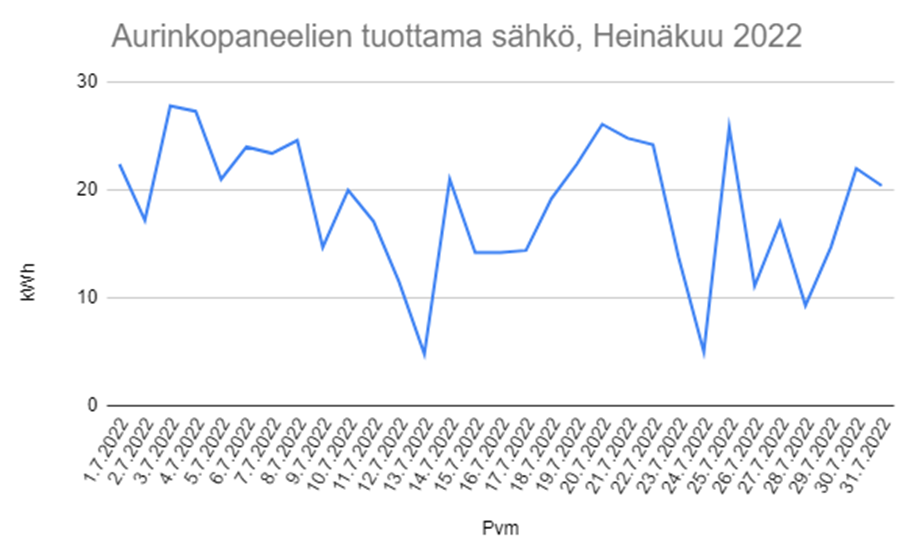
July’s electricity production was roughly at the same level as in May. However, spot prices continued to rise, and the average price of sold electricity was already 26 c/kWh.
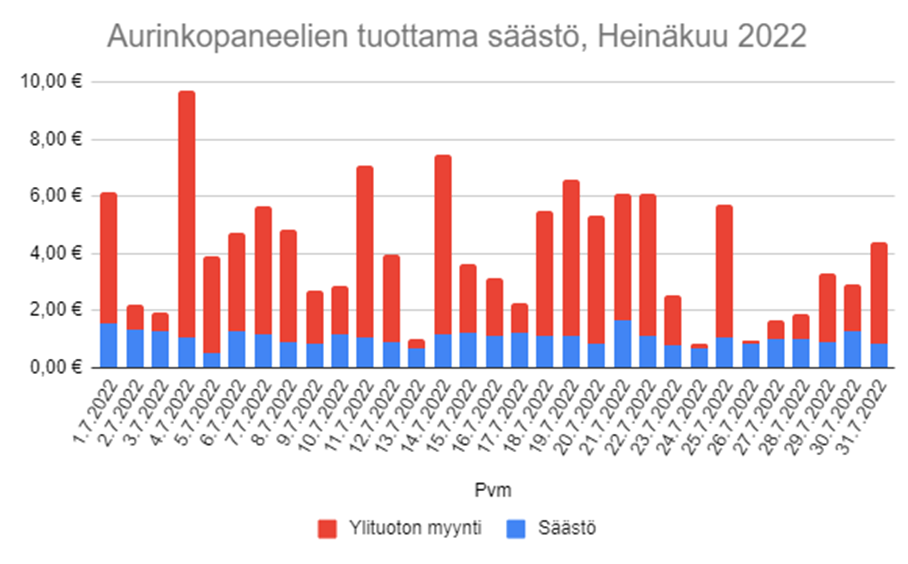
In summary:
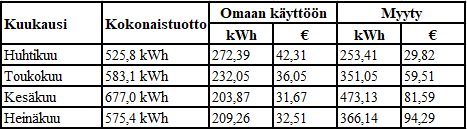
Sellers heavily touted that the payback period would easily be less than 10 years. And this was before Russia invaded Ukraine and prices started to skyrocket even in the summer. Of course, with the increased prices, we are clearly closer to that claim, but many things they said were quite a load of nonsense.

It would be nice to hear forum members’ thoughts, experiences, and tips on the topic. Many were interested in panels when it was discussed in the Coffee Room. Hopefully, this introductory post wasn’t too confusing :grimacing:

EDIT: corrected the columns in the last image.
EDIT2: added a note about the transmission and tax portion when buying electricity

135 Likes

Thank you for the interesting post! Could you explain the summary table at the end a bit more, as it wasn’t immediately clear to me. :grinning:

If we look at July, when 209.26 kWh went to own consumption. How is that €366.14 formed if the electricity price was €0.26/kWh? And why did only 32.51 kWh go to sale, and not 575.4-209.26 = 366.14 kWh?

3 Likes

That’s what a battery rack is for, right? Charge the batteries to full during peak hours and then use them during “off-peak” hours.

2 Likes

Ugh, the columns got mixed up. Thanks for pointing that out, I fixed it!

4 Likes

Yes, you can indeed get one. I don’t have experience using one or with its cost; it would be great to hear if anyone here happens to have some. As I understand it, some DIY enthusiasts have built battery packs from electric car batteries.

3 Likes

In the US, they even use regular car batteries; you don’t need special electric car batteries.

But there are also commercial special racks where you can add plug-and-play batteries as needed, and it works directly :slight_smile:

2 Likes

Thanks for starting this thread! I’m expecting my own 16 panels within a couple of weeks for the unshaded east and west slopes of my gable roof. The contract mentions 6 kW, but I think that might be more related to the inverter I ordered? We’ll see. My neighbor just installed 30 panels on their south-facing roof. It will be interesting to compare. They’ll probably get a good peak at midday. I, myself, am expecting more even, moderate, and long-lasting production starting early in the morning. Especially the evening sun seems to produce for a couple of hours from the west during summer, even when my neighbor’s panels are already in the shade. We also use Helen. A new two-year contract at €0.09/kWh. I understood that direct selling of surplus production at the daily rate is more advantageous than Helen’s virtual battery, but I admit my broad ignorance for now. Something still makes me hope for electricity price increases. I also need to think about how to time my own consumption in the future, especially electric car charging. Is seasonal electricity still worth it?

P.S. A little over €9k, minus the household deduction. A small Central Uusimaa company, about a month’s delivery time from an order placed in early July!

15 Likes

The panel output seems to be around 400 W, so 16 * 400 W = 6.4 kW. The inverter is probably a bit larger, so it’s not quite at its power limit. I’m surprised at how “good” the output still is in the afternoon when the sun is no longer shining on the panel. By the way, the best day for panel output isn’t completely cloudless, but rather a light cloud cover when the panel no longer receives direct sunlight. Instead, the ideal would be if the sun shines all day through a small hole in an otherwise lightly cloudy sky :joy:

Currently, selling surplus production is indeed more profitable than a Virtual Battery. With a Virtual Battery, you get paid 13 c/kWh for surplus production, and the service also has a monthly fee depending on the system size. For example, last month the average price for sold surplus production was 26 c/kWh. Of course, if spot prices drop back to around 4 c/kWh, the Virtual Battery will be more profitable.

Now that you still have a relatively cheap fixed-price contract compared to the spot price, it might be most profitable to sell as much generated electricity as possible to the grid and time your consumption to the evening and night. An electric car can be conveniently charged overnight. I recommend at least monitoring outputs and prices a bit to get an idea of where the best returns are available.

It also sounds like a much more reasonable price than what I paid, I certainly gave the sellers a good deal :roll_eyes:

3 Likes

You are right. From the inverter. With only eight panels working at a time, I thought they could be added later. It’s exciting. I repeat, a good thread for future experiences.

I haven’t found a good discussion comparing panels. I threw myself at the mercy of the seller. From the lottery, I got these: HI-MO LR4 60HPO 375M. In 20 years, those will probably be a good joke (a terrible product name already).

Could there still be some work to be done in customer communication, even now?

Good opening. However, the correct way to calculate the value of electricity for one’s own use is energy+transmission+taxes, which with old contracts comes to around 15-20 cents/kWh. At current levels, this means even 30 cents or more. This would significantly shorten the payback period.

20 Likes

True, and that’s actually how I calculate it in Excel. For some reason, I only wrote the electricity price in the message. On top of that, there’s also the transmission and tax, so the purchased electricity costs about ~16 c/kWh with my contract. If the price of electricity in the future is, for example, at the current ~20 c/kWh level, panels will become more profitable all the time.

1 Like

I partly disagree with this. Panels rarely produce their nominal maximum power, and a cost-effective way is to undersize the inverter relative to the system’s maximum power. An inverter can generally be overloaded by at least 1.3 times within warranty. Even more so in newer models.

An inverter that is too large for the system also reduces production at low voltages in the morning and evening, because the inverter does not get enough current to start/stay on. Of course, a larger inverter is justified if the intention is to increase the number of panels later.

Many thanks for starting the thread! I was looking for a similar thread earlier, and it’s interesting to follow others’ calculations.

18 Likes

I’ve also had panels for about half a year now. 18 x 370Wp and a 6kW inverter for about 8300€ including installation in Uusimaa. Installed on the south-west facing roof slope.

Here’s the production:

Edit. I’ll quickly add the financial savings calculation for 2022 to date (the inverter calculates that too). Of course, it can’t measure the electricity consumed that comes from the panels. Currently, the price of bought and sold electricity is about the same at 13c/kWh (including transmission and tax), as I have Helen’s virtual battery (one year free of charge). I’ll have to switch to spot price when this year’s contract ends.

20 Likes

How costs are affected:

  • maintenance and cleaning of panels
  • more difficult snow removal from the roof and snow removal from panels
  • more difficult roof maintenance
4 Likes

This is a good point, which I hadn’t even considered. If the panels are on different sides of the roof, for example, they probably never reach maximum power. In my system, the highest instantaneous output has been 4.2 kW, which is very close to the system’s “maximum”. Usually, it doesn’t reach such a high output, but hovers around 3.5 kW.

@CorruptedConsultant I have a Solis inverter, and it also calculates the price for the output based on the price fed into it. Unfortunately, it doesn’t know how much goes to self-consumption and what the spot price is, so you can’t rely much on it. That’s why I have to fiddle with Excel myself :smile:

@Nortti1 all true. I’m answering again based on my own experience. According to the seller, the panels are maintenance-free and do not need to be cleaned separately. Rain takes care of it. The steepness of the roof, in turn, ensures that snow does not accumulate on the panels but slides off. On a flatter roof, the situation with snow would be different. But at the moment, in my calculations, these have been given a cost of 0€ as the roof is also new.

As I wrote, I just happen to have the same sold and purchased price until the end of November, so one inverter tariff is enough. :smiley:

I guess I’ll have to do some Excel work myself next year.

My roof panels have been in place for almost five years.

  • No maintenance has been needed.
  • Snow has not needed to be removed. In spring, snow melts quickly from the panels as they are on the south-facing slope.
  • Roof maintenance, i.e., moss removal and possible painting, must be done before installing the panels. It’s difficult later, as the panels would first need to be removed and then reinstalled. On the other hand, no moss has appeared under the panels there. Apparently, it’s too hot and dry a place, as the panels are installed right near the ridge.
9 Likes

That’s exactly it. Here’s a good video on the subject. More panels are better than a large inverter. Peak power is rarely available.

4 Likes

Last June, I inquired about solar panels.
I couldn’t get quotes for just equipment delivery; everyone only offered “turnkey” deliveries.
The location is in Satakunta and easy in every way: terrain, roof angle, cable routing, etc.
Of course, installation is eligible for a household deduction if it hasn’t been used for the year yet.

The point of the post:
Comparison/bidding is worthwhile, as the price difference between the most expensive and cheapest “turnkey” packages was as much as 2801e

My own project was put on hold because I intended to install it myself, and I couldn’t get the equipment.
The installation prices were too high for my taste.

17 Likes

I have a 5.1 kW solar power plant and a 4.5 kW inverter, meaning it limits output to 4.5 kW. The inverter could have supported over 6.5 kW of panels; oversizing the panels relative to the inverter’s capacity is more sensible, as it’s cheaper, starts generating power faster, etc. You should definitely check prices; this cost a little over €7000 last November, or about €6000 after the household deduction. Considering price increases and so on, it might be a bit more expensive now. I’ve been looking for inverters, and I’m adding systems myself when I have time. I plan to order panels and an inverter separately and have the installation done as hourly work; I’m sure standard electricians can handle it. It’s a good idea to contact the electric company early on if you’re not going for a turnkey system. This system is on the roof; the next one will be on the wall. I strongly recommend that if you can do a ground installation and adjust the panels’ vertical angle, definitely put them on the ground. You can play with spring and autumn output and keep the panels free of snow more easily. Plus, if you’re going to install, go big immediately; appetite grows with eating. Some also use micro-inverters. You can find more information on the Imaisenergia and Lämpöpumppu (Heat Pump) forum.

11 Likes