Here we go with two horses, market leader Enphase on the inverter side and market leader Jinko Solar on the panel side. Enphase’s earnings report is approaching and the stock is currently up +15%.
4 Likes
Q1 earnings report from Enphase, here you go. Revenue doubled with a 39.2% margin. Households are starting to transition to more self-sufficient energy production.
4 Likes
However, the guidance is weaker than expected, predicting zero or slight growth. The summer months are peak season for installations, and traditionally, sales grow annually in a trend-like manner. Now, a significant drop is predicted. This is not surprising, given all sorts of restrictions in place almost everywhere, and installation work, etc., is done physically on-site. It is possible, of course, that inventories have been reduced, and this will return to normal levels at a later stage. I need to read the CC (conference call) when I have time.
It will be interesting to see if the Israelis’ views are in line with this.
I’m currently waiting to see if Ampner goes public.
3 Likes
Enphase promises a 25-year service life warranty, while its closest/worst microinverter competitor, SolarEdge, promises a more modest 10 years.
Hopefully it will come at some point in the coming years, so we can offer domestic engineering skills.
1 Like
Interesting stock reactions. Solaredge’s guidance was much better than Enphase’s compared to forecasts, but despite this, the stock prices are, at least as an initial reaction, moving in different directions. The result also included a significant amount of one-time earnings.
With ENPH, it’s worth paying a little attention to option programs and share-based compensation. The company’s share count grew by 20 percent in a year, or 23 million shares, with a value well over a billion dollars. Quite a lot for a company worth 5-6 billion dollars. The company plans to buy back its own shares for a maximum of 200 million dollars, meaning it will use a significant portion of its cash for share buybacks, which at most will only buy a few million shares at the current market value.
The markets are growing and there is room for several players. Enphase’s product portfolio is good at the moment, but competitors also have interesting things coming and much larger resources. I just wanted to bring a different perspective and draw attention to the company’s generous compensation system and the subsequent cash drain. Old owners will certainly be grateful, but this is not necessarily to the benefit of those jumping in now.
However, they have pretty similar COVID behavior. Jinkosolar is still in a slump, but perhaps it’s more of a bulk supplier? Are there any negatives about Jinko other than perhaps hazy Chinese figures? I might pick up more of it and perhaps lighten up on Enphase a bit.
I’ve been wondering the same about Jinko; it’s been stuck around the $15-16 mark for an agonizingly long time. The numbers are good, there’s a buyback program, a growing market, a technological lead… what’s the problem?
I’ve come to the conclusion that the weight of American stock trading is so significant that their current prevailing attitude towards Jinko’s home country and distrust of business transparency is keeping the price down.
It should easily be above $20; I have a small monitoring batch of 150 shares.
Americans tend to favor their own companies. This is easily seen in the valuation levels of foreign peers.
Panel manufacturers haven’t made much money profitably for a long time. It’s a commodity business, even though Jinko (JinkoSolar) is apparently the most cost-efficient player in the industry.
I agree with the previous comment. In the solar energy sector, panel manufacturers are not the most interesting targets for long-term stock investors. It feels like their stock prices don’t really move anywhere. Sometimes there might be a spike driven by a momentary industry boom, but in the long run, they have rooted at the same levels. There are so many manufacturers that we even have a few here in Finland  .
Today, even the Chinese are acceptable… Jinko +10%, stock firmly over $17 and Enphase broke the magical $70 mark. Enphase is probably boosted by its entry into the big boys’ Nasdaq Mid Cap 400 list and tomorrow’s annual meeting.
Jinko released a new panel, Jinko launches PV module with record output of 580 W – pv magazine International
This is one of those days when the entire solar energy sector is doing well:
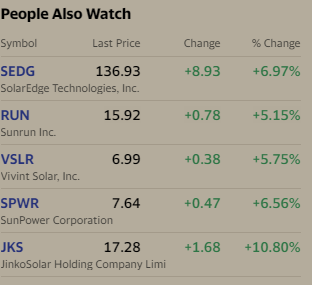
Of these, I only have Enphase in my portfolio. Things are moving at a fast pace right now. Too fast?
They strongly claim that institutional investors’ big money has only now reacted to this, and it is clearly visible in Q4/Q1 investments, with BlackRock being the most eager. The P/E ratio is already starting to make me dizzy and shake my desire to hold, but tomorrow’s annual meeting will probably tell us which way things are going.
For me, Enphase and Jinko represent purely solar companies, and I also have a slice of Encavis, which works with energy parks (solar and wind).
Is that Jinko available on Nordnet under that monstrous name, which is JinkoSolar Holding Company Limited American Depositary Shares (each representing 4?
Yes, that’s it
1 Like
How are solar energy companies and the industry doing right now? How would you act with regard to different listed companies at the moment? I would love to hear your thoughts on the matter.
I’m very interested in the industry in terms of investing, but I’m a novice player in the field and I don’t yet know how to read the right signs with the right clues, etc., if I can put it that way.
Would it be sensible to start researching companies based on funds? The field also interests me, but my competence and even interest aren’t really enough to analyze companies’ competitive advantages. I was thinking of investing in iShares Global Clean Energy ETF through NN monthly savings, which owns companies like Enphase, praised on this forum. Not the most optimal solution, but I believe the sector has potential.
The shorts are active. I wonder if it was the same firm that had a dollar price target for the stock years ago. Sour grapes, said the…
I bought some at $39. It might not be a long-term hold, so we’ll see if it recovers from here.
Oh, there was already a discussion in the other topic, but I’ll leave this one.
1 Like
Enphase’s website features remotely controllable micro-inverter models of various power ratings, to which the respective panel group is connected. Enphase handles remote monitoring.