Let’s open a dedicated thread for Amazon followers to track this star; there didn’t seem to be a direct thread before. What are your opinions on this company? Are you invested?
And of course, Q4 results soon 
Let’s open a dedicated thread for Amazon followers to track this star; there didn’t seem to be a direct thread before. What are your opinions on this company? Are you invested?
And of course, Q4 results soon
Huh huh..
“… but the real bombshell in today’s report is that CEO Jeff Bezos will step down as CEO and “transition” to the role of executive chair in Q3 2021, ending an era at Amazon; Bezos will be replaced with Andy Jassy - currently the CEO of Amazon Web Services - as CEO of the entire company at that time.”
Oh right, some numbers too
With all that in mind, how did Amazon do? Well, it was another blowout quarter for the retailer:
Looking ahead, the company’s guidance was also solid:
Not rallying in the post-market. The CEO change was probably quite a significant piece of news.
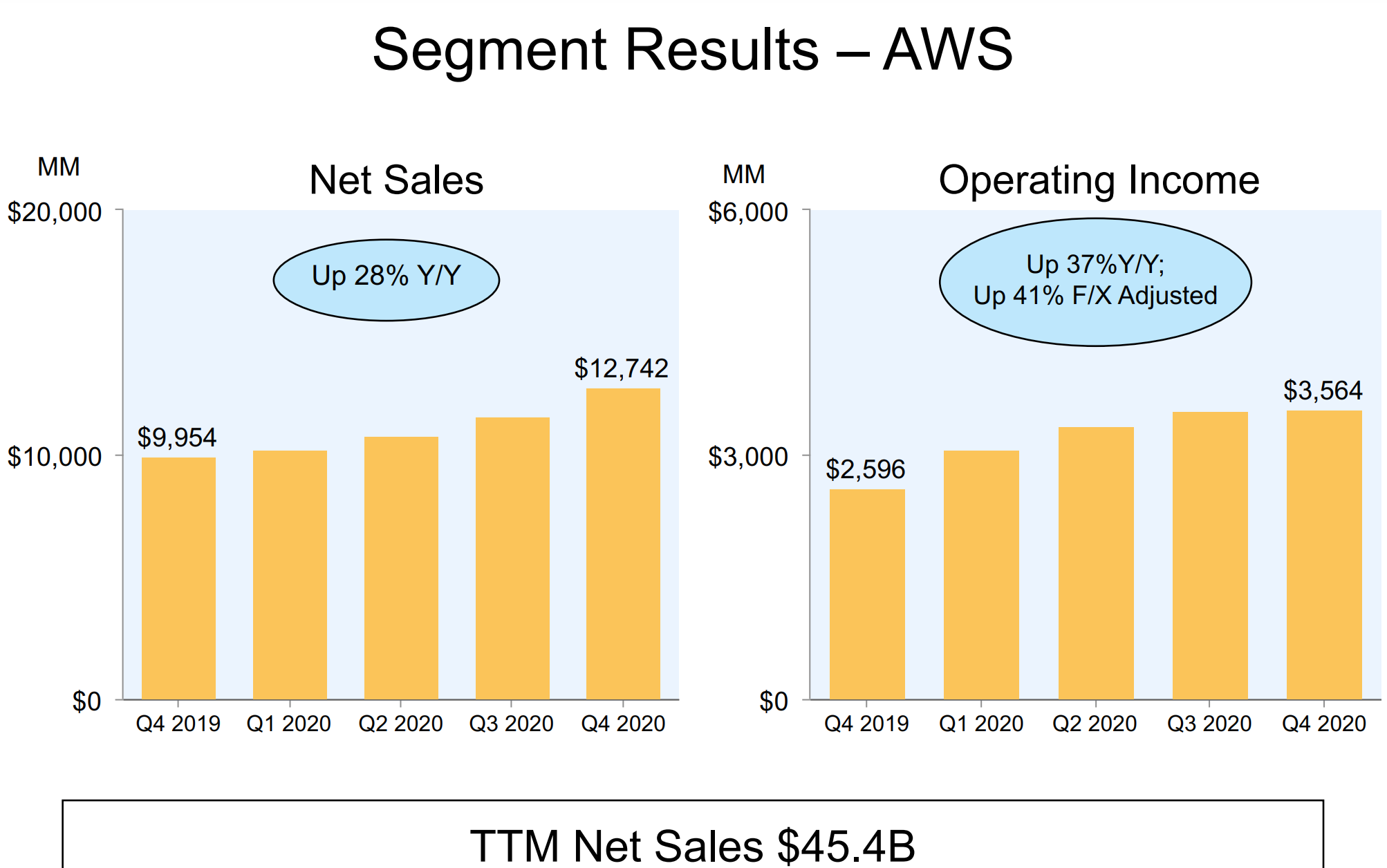
AWS is slowing down rapidly. It’s clear now that Microsoft will soon take over the number one spot. Of course, Google and others are lurking in the background.
AWS’s boss is moving to the CEO position. It will be interesting to see if they can revitalize the business to its old growth figures.
AWS seems to be a significant portion of Amazon’s valuation because it generates strong profitability and enables many other units to stay afloat. E-commerce alone is likely not a business with an EV/Sales of 4x.
My Amazon is up +110%. However, the unit price is so high that it’s difficult to add more, so I’ve been buying Nasdaq100 ETFs instead. A split would be great.
I remember buying Amazon right when Verneri said in a video that Amazon’s growth curve was so parabolic it was about to curve upwards to the left 
It’s hard to grasp in Finland how Amazon has become so completely intertwined with the everyday life of the average person elsewhere… People buy groceries and all sorts of goods from there, they use it instead of Google if they want information/reviews on all kinds of items/books/movies, whatever. With the same subscription and service, Amazon also provides music and videos, audiobooks, and the AI speaker Alexa is already becoming a family member.
Interesting perspective. I’d be happy to hear more if you have more specific justifications. Azure’s relative revenue growth has also slowed down considerably over the past two years. As far as I understand, Microsoft also doesn’t report absolute figures to avoid comparison with AWS. The slowdown in growth is understandable given the scale of AWS and Azure.
AWS is like putting the fox in charge of the henhouse, which is certainly a problem, especially for large clients. Why move data to a company that might eventually become a competitor? A lot of companies, especially in retail, have moved their business to Azure.
Google’s cloud operations grew by nearly 50 percent last quarter. While the operation is still small, it has practically unlimited resources to grow the business. It also became clear from the CC call that the order book grew to $30 billion last quarter from $19 billion.
This is of course true when talking about the biggest player in its field. However, it doesn’t answer my question about growth stagnating or Microsoft taking the top spot, but rather relates to the challenges Amazon will need to solve in the coming years. I wouldn’t say that growth is stagnating when AWS’s absolute revenue has steadily grown by $10 billion per year in recent years (without going into currency adjustments here in more detail). For a company of this size, I think that’s exceptionally stable growth. With Amazon’s multiples, this naturally has to be the case.
However, investors live by percentages.
It doesn’t matter how many billions come from there if relative growth stagnates
The pandemic has given a tremendous boost to e-commerce, but as mentioned above, is it a business that justifies high multiples, especially if the growth of this spearhead slows down further?
If AWS’s revenue alone were to grow by 10 billion annually throughout this decade, and on top of that, Amazon, true to its nature, could find new growth drivers alongside it, I would be more than satisfied as an investor. Relative growth tends to slow down as a company grows. Of course, Amazon’s profile as an investment target is changing and has already changed, while valuation multiples have also become significantly more reasonable. I agree with you that AWS was the weakest link in Q4, but I’m not worried yet.
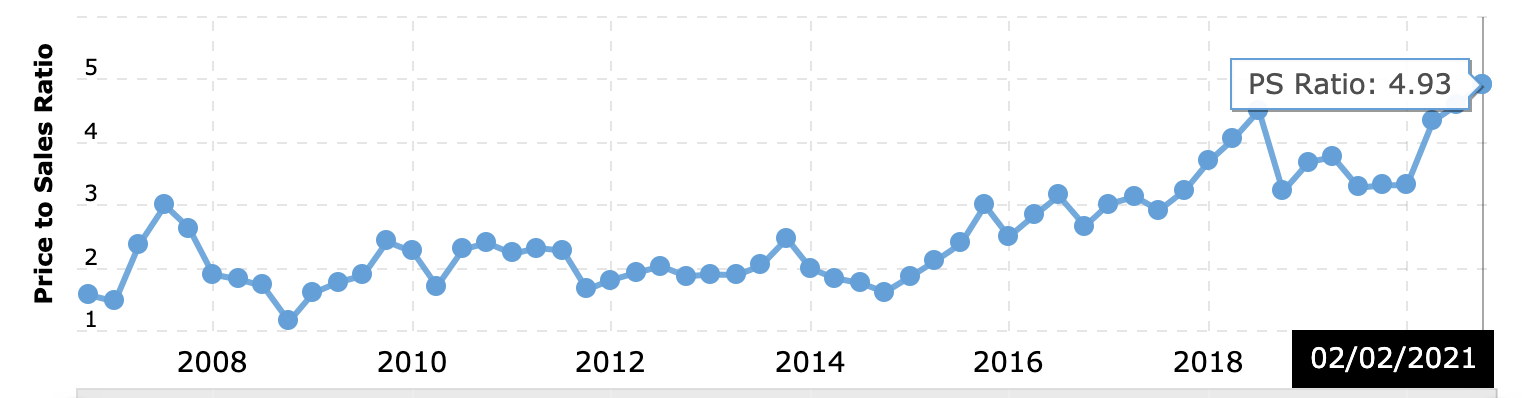
This “humanization” of the multiples is a funny comment, because in reality, Amazon is more expensive than ever. This is when comparing valuation to revenue. Why I would look at this is the fact that the company invests so incredibly much that even though it has now accidentally become profitable, it certainly doesn’t optimize its profits. That multiple stretched when AWS’s success came to everyone’s attention.
It’s good to remember, however, that even with its scale, e-commerce still has a massive runway ahead. Global retail is over 20,000 billion in size. Amazon’s revenue is not even at Walmart’s level yet. Of course, competition in that sector is fierce and margins are modest even for the best.
Does Amazon live in a vacuum? The historical development of the P/S multiple alone tells us nothing about Amazon’s current expensiveness if it is not put into context. It is true, of course, that it is above its historical average.
My intention in my previous message was to say that I don’t think it’s worth thinking of Amazon as just e-commerce or AWS, because during its existence it has shown its ability to grow completely new and profitable business areas from scratch with the support of existing ones. Its roots extend into so many parts of society that it is difficult to comprehend, especially from a Finnish perspective. I also do not believe that AWS’s growth will falter; instead, I see huge potential in it for the future. The appointment of a new CEO is also very interesting news from this perspective. The question in Amazon’s case is mainly about what “the next AWS” will be, although of course, there is already all sorts of things under AWS. For example, in the Other segment, advertising revenue is predicted to grow to $85 billion by 2026 (https://www.cnbc.com/2021/01/12/amazons-ad-business-will-gain-most-share-this-year-analyst-survey-.html), and this will certainly not be the only source of new revenue streams. Amazon dares to take risks and develop, and it has the means to do so. However, the political and regulatory growth limits set by society and Amazon’s immense size as an administrative challenge are, in my opinion, the biggest threats in the future. This is, of course, closely related to how best to create shareholder value in the coming years. Summa summarum, when considering Amazon as a future investment, I think it is short-sighted to think of it only through AWS or e-commerce, because Amazon, if anything, is more than the sum of its parts. In Bezos’s own words: We have things in the pipeline that will continue to astonish.
The title is certainly more than true. Even though it has been sluggish for almost half a year after the shocking rise of last summer. The CEO change announcement probably created some tension.
So I’ve been waiting for the right time to buy, as you can’t add this one every time it dips. I’ve also been researching analyst recommendations quite a bit, as I might not have as good an understanding as they do. CNN lists 51 analysts, of whom 44 recommend “buy,” 5 “outperform,” and 2 “hold.”
The price target low is $3420, median $4000, and high $5200. This still predicts quite strong growth, as the median price target would mean ~30% growth.
Amazon is discussed quite little on the forum, so it caught my eye when, among others, @Verneri_Pulkkinen wrote in March 2020 that “Players like Apple, Amazon, and Google are interesting, but not at current prices yet.”
I don’t mean this as hindsight, but rather to illustrate how it must have felt expensive then, just as it feels now, and yet significant growth is still promised.
You shouldn’t follow my advice too closely on Amazon! Amazon’s pricing is somewhat difficult due to its different types of businesses.
The most telling case is probably when a few years back I recommended Amazon to my dad and sister when it dipped to somewhere around $1300, and I, instead, bought more Verkkis (Verkkokauppa.com). A year later, Amazon was +70% and Verkkis -50%.
Well, one invested in a tech company making money with cloud services and platforms, and the other in an online store selling goods. Different results
(Yeah, Amazon sells stuff too, but…)
Amazon generates criminally little discussion here, considering the company’s quality and growth rate.
The company once again grew at a juicy +40% pace. International retail, in particular, grew by +60%.
Where do the limits come, is always asked at quarterly releases?
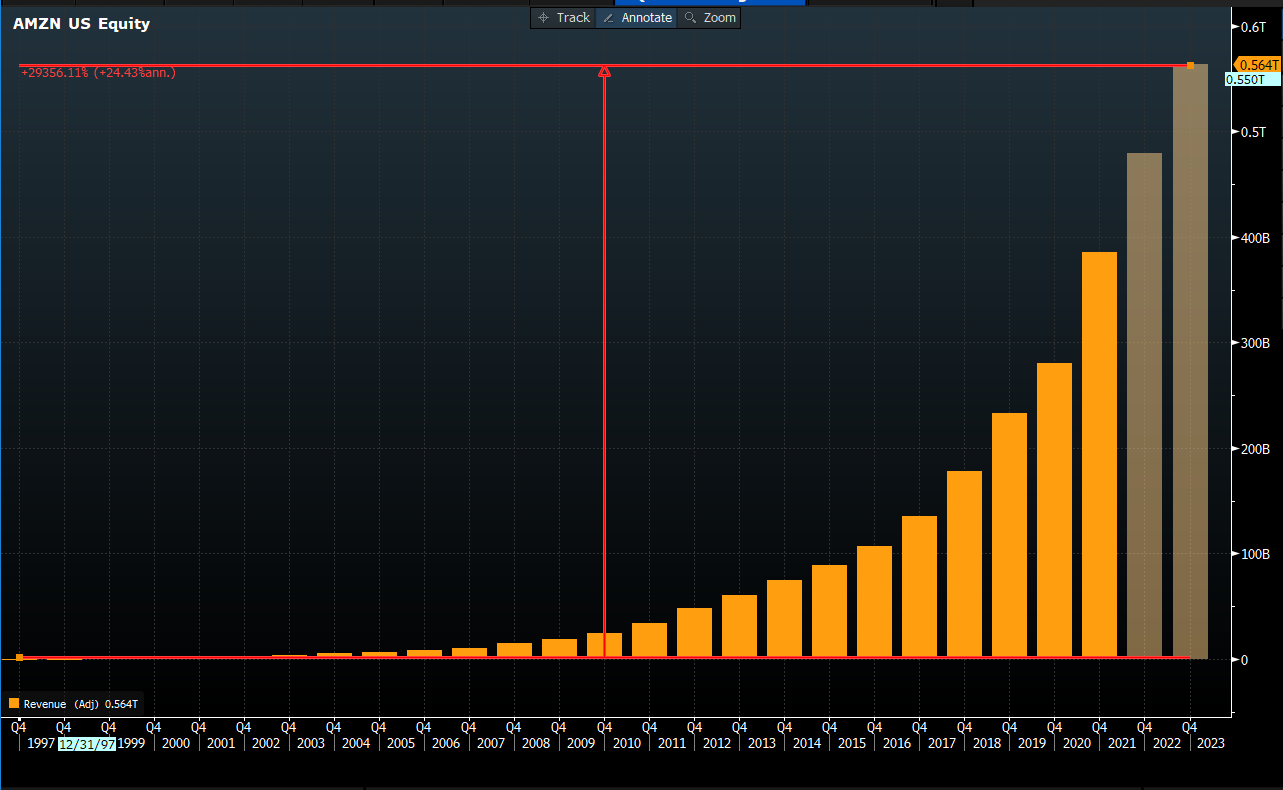
Amazon’s TAM (total addressable market) is simply enormous. Global retail is now approximately $25 trillion. Of course, AMZN cannot get all of it, but the company’s total revenue is not even half a trillion yet (Walmart’s is approximately $550 billion). AWS, streaming, etc., also still have enormous growth potential.
In fact, according to Bloomberg’s data and near-term forecasts, AMZN’s revenue has grown by approximately 24% per year since its inception:
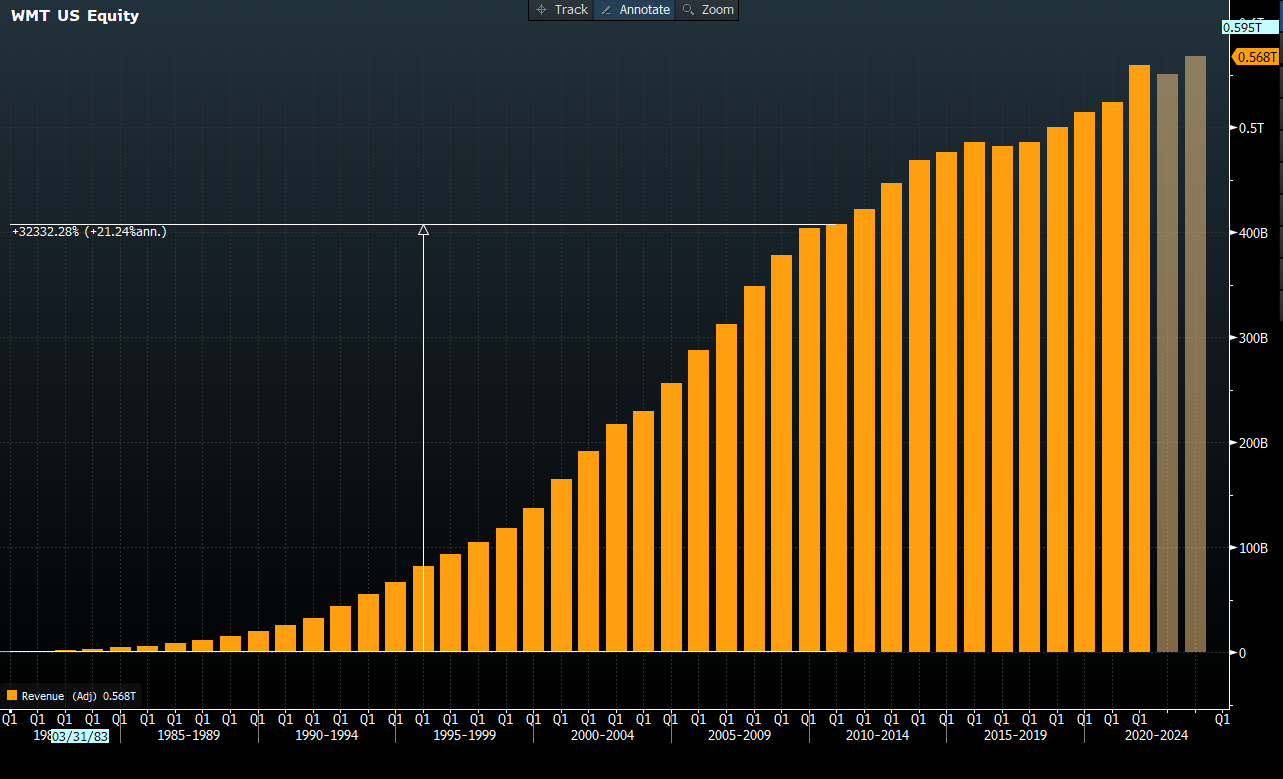
Data for Walmart was only available from the 80s, but it also pulled a spurt of over 20% per annum from 1980-2010, after which the pace has calmed down. And Walmart did that without e-commerce!
Amazon is an exceptionally good company but not as remarkable a phenomenon as one might think at first glance.
Amazon is a ROCKET 
• Operating cash flow increased 69% to $67.2 billion for the trailing twelve months, compared with $39.7 billion for the trailing twelve months ended March 31, 2020.
• Free cash flow increased to $26.4 billion for the trailing twelve months, compared with $24.3 billion for the trailing twelve months ended March 31, 2020.
• Free cash flow less principal repayments of finance leases and financing obligations increased to $14.9 billion for the trailing twelve months, compared with $14.3 billion for the trailing twelve months ended March 31, 2020.
• Free cash flow less equipment finance leases and principal repayments of all other finance leases and financing obligations increased to $16.8 billion for the trailing twelve months, compared with $11.7 billion for the trailing twelve months ended March 31, 2020.
• Common shares outstanding plus shares underlying stock-based awards totaled 519 million on March 31, 2021, compared with 513 million one year ago.
• Net sales increased 44% to $108.5 billion in the first quarter, compared with $75.5 billion in first quarter 2020. Excluding the $2.1 billion favorable impact from year-over-year changes in foreign exchange rates throughout the quarter, net sales increased 41% compared with first quarter 2020.
• Operating income increased to $8.9 billion in the first quarter, compared with operating income of $4.0 billion in first quarter 2020.
• Net income increased to $8.1 billion in the first quarter, or $15.79 per diluted share, compared with net income of $2.5 billion, or $5.01 per diluted share, in first quarter 2020.
Q2 results should be out in a couple of hours. I had to look up what analysts are expecting from Amazon.
               Estimate for Q2 2021 (FY)	Q2 2020 (FY)	Q2 2019 (FY)

Earnings Per Share ($) 	      $12.47	      $10.30	      $5.22
Revenue ($B)	              $115.4	      $88.9	          $63.4
AWS Revenue ($B) 	          $14.2	          $10.8	          $8.4
It will also be interesting to see how monstrously these estimates are surpassed.
https://www.investopedia.com/amazon-q2-fy2021-earnings-report-preview-5194475
Johan’s results are out:
After-market looks like -5%
I think I’ll take advantage of this dip. The most important thing, AWS, continues on a strong track.