Alokas interviews

180. Midnight_Rendezvous

M_R is a forum member who brings good vibes and joy, and above all, knows how to write fluent, content-rich text that often includes a little twinkle of joy.

Whether his posts are lighter and more fun or more serious and business-oriented investment topics, they exude, in my opinion, a good general education and naturally also a suitably sensible openness to various matters—there is no narrow-minded, black-and-white, extreme fanaticism to be detected in him. :slight_smile:

Although M_R may occasionally enjoy observing the world go by in peace, he has the ability to condense even more difficult subjects into an easily digestible, content-rich format. His replies and texts radiate a genuine curiosity about life and various things in general, which is particularly great because he possesses healthy self-criticism and the ability to laugh at himself—as smart and confident people often do. :slight_smile: His attitude toward investing is also, in my opinion, quite exemplary.
1. Tell us in fifty words who you are.

I am a student in my early twenties, a passionate investor, a hobbyist content creator, and I love playing the greatest game in this world.

2. Tell us three things few people know about you.

  • I am a diehard fan of 1980s culture. Sometimes it feels like I was born in the completely wrong decade. The action movies, pop, and metal music of that era really hit the spot, with a special mention going to Miami Vice.
  • I have won a Finnish championship in a team sport.
  • I like to deeply study things that others might feel are useless, such as history and trivia. Delving into military history and monitoring ongoing events is, in my opinion, very pleasant pastime.

3. What interests and hobbies do you have besides investing?

I like to read and listen to a lot of books. I also consume a lot of podcast and video content, and sometimes I even create content myself on topics I find amusing. I would love to consume considerably more cultural content than I currently do, but in this hectic internet age, time always seems to run out. Then, of course, fitness sports and crafts bring a fun variety to everyday life.

4. What is a typical weekday like for you?

I usually skip this part in texts, as I don’t find it interesting at all. Let’s just say that I brew Juhla Mokka coffee and eat the cheapest rye bread from the grocery store.

5. What are you like as an investor?

Nowadays I have shifted significantly towards fund investing, as a result of poor stock picking. However, I try to select riskier funds that I believe will beat the performance of the MSCI World, albeit with higher risk. As a spice to this, I have GARP-style stock picks of quality companies in my long-term portfolio and cryptos bought at the all-time high.

6. What is your investment history?

I started investing in 2020, and I can say that there could hardly have been a more educational experience during these years. I have tried everything along the way with varying success, from fundamental-based value investing to trading with leveraged products and holding cryptos. The only thing I deeply regret in my investment history is getting into value investing, which in the 2020s has been quite disastrous for my returns. The generally recommended investment books have been almost exclusively a nuisance in this regard, with the exception of Peter Lynch and Reminiscences of a Stock Operator.

If I were to start over now, I would invest exclusively in index funds and only figure out other options later. At this point, it is probably worth mentioning that despite my loss-making stock-picking history, my trading portfolio is in the green. :smiling_face_with_sunglasses:

7. What kind of portfolio do you have? How have you built it from a diversification perspective?

My portfolio consists of 75.11% funds, 21.77% stocks, and a total of 3.10% Bitcoin and Ethereum. The U.S. tech weighting is relatively heavy, leverage is used, and the portfolio’s volatility sometimes terrifies my risk-aware basic nature. However, the leverage is of good quality, such as a student loan, so the roof won’t fall in even in the worst-case scenario.

My biggest positions are in the S&P 500, Nasdaq 100, and Momentum MSCI World ETFs. I have spiced this up with Nordic stock picks like Evolution, Lifco, Investor, Atlas Copco, and Novo Nordisk. The Nordics are there because I feel the companies are clearly better than, say, Central European carbon-spewing and capital-intensive companies. It doesn’t hurt either that many of these companies are in a strong market position in their respective industries.

I have aimed to diversify even more broadly by industry and geography starting from 2025. Geographically, the portfolio is gradually starting to resemble the All Country World Index more than just the US, thanks to the addition of emerging markets. Increasing diversification has happened almost by itself as stocks and cryptos have fallen. Building a portfolio where the different investment targets would correlate less with each other or move in partly opposite directions would be interesting. On the other hand, I don’t want to become the owner of any bond or real estate portfolio, simply due to the limited returns.

8. Which two stocks did you last buy for your portfolio, and on what grounds?

I’ve tried to reduce stock picking, so I had to check Sheets.
In the summer of 2025, I bought more Investor from the Stockholm Stock Exchange. I believe in the Wallenberg family’s ability to create value and the company’s stability. All the companies in their sphere are, in my opinion, quite well-suited to quality criteria. Investor’s long-term return hasn’t been bad either, by the way. Investor’s annualized total return over the last 20 years is 15.1%, beat that.In the spring of 2025, I ended up buying Novo Nordisk due to weight-loss drugs and its perceived defensiveness. I also wanted more pharmaceuticals in my portfolio. I had been following the stock for a long time, since around 2021, and had skipped buying it because of Denmark’s outrageous withholding tax. Valuation levels that had dropped from their peak felt attractive, and well, how did that turn out. I had already decided to stop picking falling knives, but when you could get it cheap, it was almost mandatory to buy.

9. What does your stock-picking process normally look like step by step?

Identifying a quality company based on literature, forum, or Fintwit content. Understanding the core business process and figuring out where the cash actually flows into the company’s coffers. Determining the amount of insider ownership and transactions. Reviewing the valuation level and financial metrics. In practice, it should meet the following criteria: Forward P/E under 25, ROIC over 20%, Gross margin over 60%, Operating margin over 20%, and Quick ratio over 1. I usually don’t listen to the CEO’s honeyed words, but I do go through the company’s materials to some extent. In the best-case scenario, you find an analysis of the company made by a trusted party. Honestly, you shouldn’t listen to me here because of my poor track record; Terry Smith of Fundsmith and the Finnish Sifter have a better-presented quality stock-picking process.

10. What does your stock-selling process normally look like step by step?

Then you sell when a quality company turns out to be of lower quality than estimated, and at this point, the stock price has often already dropped significantly. I have made mistakes in this assessment many times in one direction or another, or made this assessment way too late. You shouldn’t compound your losses by gradually adding to eroding companies, a piece of advice I have actually managed to follow.

11. What have been the most memorable moments of your investing career? And what did you learn from them?

The 2022 bear market and selling U.S. tech stocks during the decline. It hurts the heart when you think about the wealth-destroying impact this has had. This hurts almost as much as not daring to go say hi to your crush in middle school. The lesson is: do not sell a quality company just because of a broad market decline.

Russia’s war of aggression against Ukraine in 2022 and shorting Helsinki Stock Exchange companies suffering from it using mini-futures. Despite all the bad feelings, I managed to make some of the best trades of my trading career measured by the return-to-risk ratio. The lesson from this seemed to be that I can function relatively well even under immense stress and pressure, which might have been the cause of the next experience.

Driving into the 2025 liberation day with an oversized risk position and panicking to sell almost perfectly at the bottoms for zero return on that position. Even by holding this, I would already be in the green, although looking back this seems easy, but a massive loss would also have been possible. Following the news regarding the trade war was indeed very destructive and mainly led to miscalculations and negative thought patterns. The dithering that followed liberation day resulted in a kind of ego death regarding my abilities as an investor, which I haven’t been able to or wanted to start rebuilding. The lesson is that true competence and performance can differ from one’s self-image.

12. What do you consider to be your three best traits as an investor? What, on the other hand, is your biggest area for development as an investor? If you could choose one person to help you develop in it, who would you choose and why?

My best traits as an investor are broad information-gathering skills and experiences across various markets, investment styles, industries, investment instruments, and companies. In addition to this, a wide-ranging knowledge base and overall understanding acquired through literature.

My area for development is an unhealthy obsession with some new investment target, where addressing weaknesses and downsides gets bypassed or downplayed in the excitement. An area for development could be improving processes and following them better. Bouncing between different investment styles has made it harder to create functioning processes, as various downsides emerge from all of them, clouding decision-making.

I don’t want to sound like an annoying fan, but I have to choose Mikko Mäkinen. I have drawn a lot from Mäkinen’s writings into my own thinking and actions. Few high-level investors bother to share their own insights, know-how, and failures with others so generously, even though the pace of writing has unfortunately slowed down in recent years.

13. Tell us about these companies in 60 words per company as an investment:

- Evolution
Evo is a Swedish former quality company that is the market leader in its niche of providing live casino games (yuck). When forum discussions turn into “when will X buy?” style, it might be a good time to take a closer look at the company’s quality. As my longest-standing investment and an incurable Evo bull, I am very biased to say much about the company. Profit distribution is implemented tax-efficiently in the form of buybacks.

- eQ
Perhaps the highest-quality company on the Helsinki Stock Exchange, which has experienced hiccups due to the real estate market and interest rates. The company’s new strategy was not comprehensive enough in my opinion. I am definitely not a fan of real estate investments, but the indirect exposure through the company could be interesting for diversification purposes. The size of the paid dividends is a bit annoying, but understandable due to private ownership.

- Witted Megacorp
I am indeed very bearish right now regarding all software companies. Nothing personal against the well-communicating Witted, but I believe that artificial intelligence will completely revolutionize this field in the coming years, and worse than current companies want to think. Opportunities may certainly arise for a contrarian if sentiment turns overly sour along with the stock price decline.14. What are the most important websites for your investment activities? Mention at least five and justify your choices. (Inderes.fi must not be mentioned)

  • Sijoitustieto. Mikko Mäkinen’s blog is, in my opinion, a source worth its weight in gold. Aki Pyysing’s blog is also able to dish out new ideas from time to time, as long as the content isn’t about politics.
  • Twitter (X). Great investment content, as long as you ignore all the other trash, curate your own timeline, and use lists. Good accounts in my opinion are Citrini, Arne Ulland, and TheShortBear.
  • Google Gemini. I bounce ideas back and forth with the AI regarding portfolio holdings, various strategies, and content, improve Sheets tables, and translate Swedish-language reports. It feels weird that just a few years ago such an assistant wasn’t available. Still, it’s not a good idea to outsource decisions and thinking entirely away from yourself.

(ping @Mikko_Makinen, you’ve been mentioned x2 in this interview, I pinged you so you’d notice, regards Alokas)

The following are perhaps relevant more just in terms of general economic information, as the benefit to investing is very limited.

  • Spotify. Out of many podcasts, an example is Sijoituskästi, which is good when there’s actually a guest related to investing. Norway’s oil fund Nicolai Tangen’s In Good Company is also good.
  • Arvopaperi. I’m not really a fan of Finnish financial journalism, but Arvopaperi occasionally has stories that stand the test of time. Personal interviews are in my opinion the most useful content of the publication, and regarding the OmaSp mess, there has been excellent investigative journalism.

15. You are an excellent meme artist, how do you manage to come up with such ingenious and funny memes? Are you the same kind of humorist in real life?

Memes just come to my mind naturally by following the forum, which doesn’t happen to me quite as much in other contexts. A broad general knowledge and familiarity with both pop culture and meme culture are, in my opinion, significantly helpful in being able to create something new and funny. Fintwit also has a relatively active investment meme culture, so you sometimes get ideas from there. Finland partly lacks that kind of factual humor culture represented by Patrick Boyle, who YouTubes about investment matters humorously, and the British series Yes Minister. It also helps, of course, that you make so many memes that the bad ones are forgotten and only the good ones rise to the surface and stick in mind. In real life, I don’t consider myself very funny at all, and I don’t necessarily tell jokes at all. I perhaps follow discussions closely and then throw in some sharp observation.

16. You seem like an optimistic and positive person, where does your positivity and good attitude stem from? Can you give a couple of tips on how one could improve their own mind & attitude?

Hehe, the persona conveyed on the internet can sometimes be somewhat flawed. Inside me actually lives a little doomer-Wojak who enjoys walking in a rainy suburb listening to Kino, pondering the unsustainability of the Finnish societal structure and the sanity of moving to Sweden to escape taxes.

But anyway, there are too many negative things in the world, and just thanking a coworker or a stranger for a good job or telling them something can save their day. I’ve done some YouTube videos, and actually the number of people reacting to videos—even out of thousands of viewers—is very limited. That’s why I try to comment on the content I like, knowing how few others bother to do so. In Finland, the culture in some places is still to only scold for bad things and leave thanks for successes unsaid, which completely poisons the culture and causes dissatisfaction.

For example, there’s no need to verbally bash the model portfolio team or analyst for past performance. The unvarnished scoreboard and professional pride already take care of that side. I’ve sometimes heard that causing bad feelings is easy and causing good feelings is harder, so I’ve just aimed here to belong to the camp of the good guys.

17. If you had to choose four from Inderes’ staff and four from the Forum as well to manage your portfolio for ten years, who would you choose and why?

From the staff, Team Femmesalkku, meaning Kaisa and Marianne, due to their international quality weighting and interesting picks. Verneri as a history buff and fellow history enjoyer, to bring a longer-term perspective. As a portfolio manager, one should actually choose someone who thinks differently than oneself, but when listening to Atte’s portfolio review and Sijoituskästi sometimes felt like listening to oneself, then Atte.

Making choices from the Forum becomes tricky, as the forum is full of only better-than-average investors. Wallet_Nahlroos and CitizenJ could build an optimal leveraged ETF portfolio in terms of financial theory and return-risk ratio. Pohjolan_Eka would operate with surgical precision in the fashionable and hot commodities sector. An explorer like Eka would dare to be sent, like Citrini’s analyst, to the oil fields of Guyana or the Chilean lithium mine. I like semiconductors way too much, but the hard drive inside my head has a limited amount of space, so Jarnis would handle this plot with his own expertise.

(ping @Kaisa_Vanha-Perttula, @Marianne_Palmu, @Verneri_Pulkkinen, @Atte_Riikola, @Wallet_Nahlroos, @CitizenJ, @Pohjolan_Eka, and @Jarnis - I pinged you, my good friends, because you were mentioned regards Alokas :slight_smile:

**18. What kind of goals do you have in investing? How do you plan to utilize the wealth accumulating from your investing?**Pääasiallisena tavoitteena on pääoman ja oman tietotaidon kasvattaminen. Omalla kohdalla sijoittamisesta saatu tietotaito saattaa olla jopa tuottoja arvokkaampaa urakehityksen kannalta. Hauskana haasteena ja tavoitteena voisi olla omaisuuden rakentaminen välttelemällä iltapäivälehtien verokoneeseen päätymistä. Osaltaan minua huvittaisi operoida salamyhkäistä sijoitusimperiumia, kuten Erkki Etola ja Kenneth Dart tekevät. Sukupolvia kestävän sijoitusyhtiön rakentaminen voisi olla egoa hivelevää, vaikka kestävän rakenteen luominen tällaisessa olisi haastavaa ja haudassa saisi pyöriä jatkuvasti, kun joku oman elämänsä rokkitähti Midnight Rendezvous IV menisi kaatamaan kurkusta alas koko perheyhtiön kassan, jossain Lillehammerin hiihtokisojen katsomossa. Jonkun auton ostaminen voisi kiinnostaa tulevaisuudessa, harmi vaan, että olen liian nuori yksityisautoilun kultakauteen verrattuna. Selvästi realistisena tavoitteena on oman eläkesalkun rakentaminen, kun Suomen himmelistä ei kuitenkaan saa 50 vuoden päästä mitään irti.

19. Alokas lukee paljon yhtiöistä, mutta yhtenä ongelmana on, että kokonaiskuvan muodistaminen – ja sitä kautta näkemyksen ottaminen – ontuu. Olisiko sinulla antaa vinkkejä tähän ongelmaan?

Itse koen kehittyneeni tässä ehkä eniten lukemalla runsaasti kirjallisuutta, esim. erilaisten johtajien elämäkertoja ja pelaamalla pelejä, joissa pääsee liikuttamaan sotajoukkoja tai miettimään erilaisia strategioita ja kehityskulkuja. Enkä tarkoita sellaisia Paradoxin pelejä, joita varten tarvitsee jonkin opaskirjan ja työttömyysjakson opetellakseen pelimekaniikat. Nostaisin tähän itseäni miellyttäneistä Frostpunkin ja Tropico 5:n. Pelivertaus saattaa tuntua joistakin oudolta, mutta mielestäni tässä on, ehkäpä ainoita tapoja, joilla tavallinen työssäkäyvä voi päästä ajattelemaan strategisen tason asioita. Lisäksi nostaisin eräiksi auttaviksi tekijöiksi oleellisen tiedon suodattamisen valtavasta tietotulvasta sekä tekoälyn kanssa keskustelun ja sparrailun. Kokonaiskuvan ja vielä todellisuutta vastaavan kokonaiskuvan, luominen on kyllä haastava ongelma ja en keksi siihen helppoja ratkaisukeinoja tai hopealuoteja. Itse ainakin kuvittelen pystyväni muodostamaan kokonaiskuvia, mutta suunnitelmat eivät useinkaan kestä nyrkin iskua suuhun. Tästä syystä katsoisin mielen elastisuuden, mukautumiskyvyn ja uuden arvion luomisen muuttuvissa tilanteissa olevan tärkeämpää.

20. Mistä haluat kiittää Inderesiä ja sen Foorumia?

Inderesin sisällöt on mielestäni ihan maailmanlaajuiseenkin sijoitussisältöön verrattuna laadukkaimpia ja samaan aikaan vielä viihdyttäviä. Foorumi on poikkeuksellisen hyvä yhteisö, jotain voin kyllä kiittää monesta asiasta, kuten oman tietotaidon merkittävästä kehittymisestä ja hyvistä nauruista. Kiitollisuus yhteisöstä on suurempi kuin pystyisin ikinä sanoittamaan. :folded_hands:


Kiitoksia erinomaisista vastauksista M_R! :folded_hands:

Sinä ja sinunlaiset tekevät foorumista paremman ja mukavamman paikan, kiitos. :slight_smile:

Joskus sitä jotkut ovat pohtineetkin, että miksi tuoda pahaa mieltä ja vihaisia omia mielipiteitä, kun voi tuoda myös hyvää mieltä ja sisältörikasta asiaakin yms. (esim. M_R:n tapaan).

Näiden hänen kauniiden sanojensa jälkeen meidän on mukava lähteä viettämään viikonloppua:

Inderesin sisällöt on mielestäni ihan maailmanlaajuiseenkin sijoitussisältöön verrattuna laadukkaimpia ja samaan aikaan vielä viihdyttäviä. Foorumi on poikkeuksellisen hyvä yhteisö, jotain voin kyllä kiittää monesta asiasta, kuten oman tietotaidon merkittävästä kehittymisestä ja hyvistä nauruista. Kiitollisuus yhteisöstä on suurempi kuin pystyisin ikinä sanoittamaan. :folded_hands:

Kiitoksia ja miellyttävää viikonloppua teille kaikille! :slight_smile:
36 Likes

181. Pörssipatruuna

Pörssipatruuna is a knowledgeable and high-quality writer whose texts combine expertise with a pleasantly clear style of expression. He has an unpretentious, approachable style that makes reading his messages smooth and engaging. :slight_smile:

If there is a message from him in a company thread, many people will certainly pause to read it thoughtfully, because it is very likely to contain relevant, value-adding material for investors, and in a clearly readable format.

I see writers like Pörssipatruuna as pillars of the Forum, bringing more than their share of goodness to the Forum, both through their attitude and their content-rich investment-related posts. He has written interestingly about various companies and also shared thought-provoking ideas about investing on a more general level, so his posts have surely given many people good ideas to support their own investment activities. :slight_smile:

1. Tell us in fifty words who you are.

Feet firmly on Finnish soil, but head out in the world thanks to years spent working and studying from Shanghai to Mexico City. First, blue-collar jobs ranging from concrete pouring to practical nursing, but lately in academic roles in the eye of geopolitics and market storms. Past the better side of 50 and using the Aura River as a landmark, “on this side of the river” (täl puol jokkee). A humanist at soul, but with a capitalist chamber in my brain from an early age.

2. Tell us three things few people know about you.

I could talk about anything from my cow-milking diploma to Argentine tango courses. Otherwise, fittingly for this forum, I could state that I have ended up being a closet capitalist. I generally keep a pretty low profile about my investing hobby on a personal level. Why?

In both my professional and private life, I also deal with people in economically difficult situations. A chest-thumping stock market profile would not be the ideal thing in these cases. Surprisingly many people still view investment income in the spirit of Dire Straits’ “Money for Nothing” song. To investors, money would flow in “for nothing,” and reactions, in my experience, vary.

Isa Hudd recently wrote a column for Inderes stating that talking about money should be more open than it currently is. I basically agree, but in this matter, “To each their own.” I wouldn’t really benefit from coming out of the closet, and based on diverse experiences, I’ll let it be (even though, frankly, it does bother my mind). Financial shark Martin Paasi, who has operated in Stockholm and Helsinki for years, says in his new investment book that most people who have grown wealthy are pretty much invisible about their money. Today, instead of maximizing the public, face-bearing profiling of my extensive investment activities, I focus on maximizing my investment returns.

(ping @Isa_Hudd, I tagged you so you’d notice you were mentioned. :slight_smile: regards, Alokas)

3. What interests and hobbies do you have besides investing?

So many that there isn’t enough time. Music ranging widely from the mother of rock Sister Rosetta to JVG and Edith Piaf. Check out, for example, The Economist’s article from the turn of March and April on the empowering effect of music on the brain! Sports ranging from judo to football, as well as functional exercise, which is why I have a fairly large storage of renovation and forestry tools. A broad interest in nature, which has also resulted in mushroom and fish dishes at home. There has been enough reading and eagerness to study. In my extensive bookshelves, besides fiction, there is a lot of history and sci-fi, which has had a certain influence on my investment targets and methods.

4. What is a normal weekday like for you?

Pretty much the standard formula: up in the morning and off to work at the office or home office – off duty at the end of the day. Sports almost every day and getting immersed in something interesting: a book, a company, etc. The same formula if I’m away on a work trip.

5. What are you like as an investor?

A daring risk-averse person and increasingly a contrarian to some of the holy doctrines of the field.

I concentrate, take strong views, and nowadays fire Fat Bertha in the biggest market tumults. I shove stock certificates into my vaults with both hands during the deep trough of the corona crisis at the end of March 2020, the rattling period of the Helsinki and Stockholm exchanges in 2022–23, and in the wake of tariff-Trump’s liberation day last year. The entire 2020s has been a glorious time for an investor like me who has shredded Peter Lynch’s timing doctrines, armed with permanent war chests and leverage readiness. My coolness in stock market panics has a direct cable to my history hobby: wars and plagues have come and gone, but the market is and remains = take advantage.

As a balancing factor, trading in the deep and long end is a No-go zone. I might research a sector or company down to the cockroach level for even years before striking. Then the minimum holding period is for the next decade in the Munger-esque spirit. In purchase evaluation, the Grahamian margin of safety has a biblical status. Stable cases that plow forward even in storms end up in the portfolio ahead of hype stocks. The goal is cases yielding 10+% per year over the long haul. Fama-French’s quality company theory on the outperformance and low risk of boring companies rules increasingly.

I would believe that thanks to the teachings of the aforementioned paragraph, the number of massive loss cases in my investment history is 0. The lack of a major stock corpse must also be a certain sign of Ms. Fortune’s fondness for me. But Verdi’s opera also sings “La Donna è mobile,” and this affectionate relationship between us could therefore end at any time :blush:

6. What is your investment history like?

I have started some sort of saving from my early school days, and I went to my first job on my own initiative at 6-7 years old, pulling recycled paper sleds around my home village like the Volga boatman. Important during the lean years of my youth and life were my regular “investment extras.” In connection with summer and Christmas jobs, etc., part of the earnings went to consumption, and often, for example, overtime went straight into the sock (savings) and into savings investments. Compound interest started rolling from the early years. No pinching pennies or conspicuous consumption, but a moderate lifestyle. Instead of JVG’s “Tili tuli, tili meni” (The paycheck came, the paycheck went), completely different tunes have been playing in my head:).

Starting from the roots of mobile-Nokia, the stock market became my number one grinding mill for a few years. I was precariously employed in the mass unemployment Finland of the 1990s, but wildly courageous, I bought an apartment for a pittance from the scrap heap of the real estate crash of that time, located in a prime spot. As a third front, fixed-income instruments entered the picture as the 2000s approached—excessively and at too low yields. Thus, the master shot of real estate investing turned into the misfire of oversized fixed-income investing. The stock market only started becoming my main target again in the 2010s. First, I dumped my fixed-income products into Börde’s Moloch maw, and then the sales proceeds of my first apartment, which had turned into an investment apartment.

7. What kind of portfolio do you have? If one of the stocks in your portfolio doubles next year, which one would it be and why?

As stated there, nowadays a fairly concentrated stock-picking portfolio. In addition to Hesuli (Helsinki Stock Exchange) and Stocholm, my equity holdings have been from the NYSE, London, and Germany. There are certainly ETFs and fixed-income products as well, but in a minor role.

I hope that not a single company in my portfolio doubles next year:) Instead of my long-standing 10%+ annual return companies, I would presumably have fallen for some hype stock. Conversely, I don’t see a single company in my portfolio as next year’s death rattle.

8. How have you thought about your investments in terms of diversification?

Instead of diversification, I’ve thought more about concentration:) My goal is companies from about half a dozen different sectors: energy, pharmaceuticals, money markets such as banks & insurance companies & asset management, renewable forest industry, and my likely return to tech companies. The ideal number of companies is around a dozen, max 15, so that one can follow them properly.

Except for some small-cap graveyards on Hesuli and Stockholm, stocks are quite priced in the market right now. Therefore, I am increasing the share of fixed-income products, pondering a rematch in real estate investing, and maybe even an index kickoff. I do make equity purchases as well, but mostly complementarily. For example, on the small-cap side, I’m investing more in Alma Media (as long as times get better, it will take off like a pike in the reeds?). I will return to the stock market in a big way as soon as the right moment arrives.

9. It came up during our conversation that you don’t have any “indexes,” so I’ll ask: why don’t you have index investments in your portfolio? Could you consider them in the future, and in what situation would you end up adding them?

Permitting market conditions allow, I am a devoted stock picker. This means quality companies bought at a discount, because this way the returns are—to use Finnair’s terminology—upgraded compared to, say, index, real estate, or fixed-income investing. Still, I don’t have any dogmatic aversion to index funds. For example, I am currently investigating the purchase of country index funds for Poland, Denmark, and Indonesia (if space permitted, I would explain why these 3…).

Everyone’s favorite target, the S&P 500 index? Elon Musk’s rocket company, ChatGPT, and Anthropic have recently reportedly juggled the rules of the US stock market. Said companies are immediately admitted to indexes without the previously applicable one-year fundamental review. This could rot the entire structure and force S&P 500 index investors into, for example, Musk’s megalomaniacal space datacenters (this would otherwise be a spot for Verner’s 15 minutes). On the other hand, many of the mega-tech, software, etc., companies that have driven US indexes are under the threat of disruption and others of stagnation. Political country risk is through the roof. Whether the winning streak of the 500 will continue for years to come is an obvious question.

10. Your investment thinking seems to combine several different emphases. How do you perceive the entirety of your strategy?

In my chest of drawers, I have membership cards for 3 parties: the dividend party, the share buyback party, and the company growth and development party. So party congress invitations are plentiful! It depends very much on the company, its stage of development, and its sector whether it makes the most sense to pay a dividend, buy back shares, or push for growth. My favorite model is moderate dividend payment, share buybacks when the stock price is below fair value, and simultaneous robust research and digital investments. And on top of that, sensible acquisitions when a good opportunity arises.

Specifically to make the Hesuli investment strategy succeed, I would still aim my chainsaw at dividends, share buybacks, and corporate subsidies. Finnish companies must increase research and development investments and digital & AI pushes. There are wonderful exceptions, but too often Finnish trade and industry is a textbook example of the laggards in Carol Dweck’s classic book “Mindset: The New Psychology of Success.” Fortunately, business organizations have also started growth-poking courses, so a wake-up call!

**11. What has been your single biggest investment mistake and what did you learn from it?**No one is playing Edith Piaf’s bravura number ”Je ne regrette rien” around one of my investments. Cardinal sins piled up in my Spinnova investment. Hype, FOMO, investing in a company with no production or revenue model, belief in the binding nature of partner AI agreements (AI agreements), throwing my sacred investment principles out the window, and so on. On top of this, I messed up utilizing my 90% loss in taxation. Thanks to the heavy oversubscription of Spinnova’s IPO, I only got a handful of shares, which saved me from losing large absolute sums. But not from eternal scars. Still, with double thumbs-up, I hope for Spinnova’s recovery, and fortunately, small signs of awakening have been seen.

Omission can be an even greater mistake than commission. At least for me. Two trusted analysts from Stockholm that I had been following for a long time pointed their fingers years ago at Prysmian and Nvidia, which had ended up in the bargain bin. I bounced it around and turned it over, the cash was lined up, and my buying pants were dug out. But that final press of the buy button was never executed. My portfolio would be twice as big today if…

12. Analyze these companies in a hundred words as an investment target:

- Nordea

Over half a million owners, led by the Nordics, can’t be wrong? Not a single exclusive mega-driver, but a bundle: AI-boosting and cost-cutting with a target EPS of €2 in 2030, the EU starting to simplify banking regulation in the summer, the economy and housing market picking up at some point, banks as an industry being more stable than before and deserving a slightly higher valuation level, and Nordea’s assets under management (AUM) swelling like rising dough. It’s pointless to expect either a rocket ride or a collapse from this company, but rather steady progress fueled by generous dividends and share buybacks.

- Orion

Helsinki Stock Exchange’s Lucky Luke? Orion’s stock market publicity focuses on a cancer drug making an insane amount of money, even though all the company’s other divisions are also running nicely. It is trying to bounce up to the next size class and expand its operations globally. In the stock market, nothing comes with a guarantee of success, but Orion has one under patent protection into the 2030s. In other words, the company has a good half-decade to find sequel recipes for its massive success, and until then, both the firm and its owners will be bathing in money.

- Fortum

Helsinki Stock Exchange’s Donald Duck? A first-class medal in our economic history for blunders in corporate transactions. But today, one of the best real estate investment targets in the Nordics with an interesting AI driver? As is well known, according to Anders Oldenburg’s calculations, the value of the company’s hydropower plants alone is over €20/share. On top of this are nuclear power plants, circular economy units, district heating plants, consumer electricity, and a dash of wind and solar power. Data centers are already being planned next to every other parish village, and perhaps those industrial electricity-guzzling investments will come too. A strong guess that it will make additional moves in Poland.

- UPM

Eppu Normaali’s “Murheellisten laulujen maa” (Land of Sorrowful Songs) plays when the forest industry is discussed. A bad cycle, Nordic wood prices are eating into margins, the Southern Hemisphere’s short-fiber pulp is devouring the Northern long-fiber market, and China is coming in strong into an industry that has failed to renew itself with higher value-added products. On top of this are disputes over clear-cutting, ditch-drainage messes into water systems, freshwater pearl mussel destructions, etc. But in the words of Tuomari Nurmio, “The night’s only beacon” exists? UPM is shaping up to be a biochemistry, energy, and focused conglomerate whose largest mass production is precisely the winning short-fiber pulp of the south. The Swedes recently calculated the company’s intrinsic value at a little over €33 per share.

13. Based on your portfolio and investment journey, you have built strong financial flexibility for yourself. Have you ever aimed for early financial independence, or has investing been about something more from the beginning?

Originally, my saving and investing resembled drifting: vaguely for a rainy day and to raise my own standard of living. Only when I swapped my fixed-income instruments and investment properties for stock market chips, and investment returns immediately grew 2-3 fold, did I realize that I was capable of living on that income if I wanted to. In addition, the intellectual side: stock picking is by a horse’s length more interesting than tedious bonds or real estate. It has also happened that in several of my jobs, the intellectual capital I have gained from investment activities is widely applicable. Megatrends, technological leaps, regulators’ plots, and the like are basic porridge in my current paid job as well. Instead of dropping out of working life and FIREing, investment activities have propped up my work and vice versa, and also enabled me to take on the role of an American-style patron investor.

PörssiPatruuna had several good question ideas — ones I wouldn’t even have known how to ask myself. The following three questions (14–16) are based on his thoughts/suggestions, which I have modified and shaped a bit.

14. Real estate investing is tickling your fancy again, but you are not ready to return to it lightly. What is bothering you the most about it right now?

As a long-term ex-landlord and tenant, I would have the intellectual capital, and with my renovation skills, I could drive costs down and returns up. From a real estate buyer’s perspective, the price level is starting to look delicious. So a return to the field would be tingling, and for example, I have listened to Frans-Mikael Rostedt’s excellent real estate investment videos on Inderes’ pages. However, I am hesitating primarily for 2 reasons. In the extreme, stock ownership is a single press of the buy button in a Levi slope restaurant or under a palm tree in Las Palmas. Real estate entails a lot more non-digital work and hassle. Another personal reason is a single company: Fortum (see above). So I am already heavily invested in one of the most interesting real estate conglomerates in the Baltic Sea region. But let’s see!(ping @Frans-Mikael_Rostedt, I tagged you so you notice you’ve been mentioned :slight_smile: regards Alokas)

15. This was also an interesting question idea from you, because patronage investing has remained foreign to me and probably to many others as well. Patronage investing has risen to a larger role in your portfolio than before, what is this about?

Gaius Maecenas, advisor to Roman Emperor Augustus, broadly supported cultural life with his own funds, from which the concept of patronage has expanded. It’s particularly typical in the US. In Professor Vesa Puttonen’s new book on the use of investment millions, it is stated that great pleasure arises when you are able to help others with your own enrichment.

There is chaos in the world, and geographically speaking, most of Finland is turning into a rust belt. At the same time, I have lifted myself from the penny-pinching conditions of an ordinary Joe through my own work and investing into the wealthiest decile. In addition to enriching the lives of my inner circle, I have directed both my funds and my free time to benefit those in distress and endangered. Quite extensively. The targets have been cultural history, the environment, the destitute and homeless, Ukraine, and the like.

I don’t hold ideological idols. But if I had to choose, the Nordic countries’ most significant Enlightenment era thinker Anders Chydenius would do as a candidate: an advocate for capitalist free trade and those in distress. In the end, my “patronage investments” are the most valuable ones :blush:

16. At your request, I gladly included this great question idea as well; your attitude toward technology companies has clearly changed over the years. What experiences and observations have guided this change?

In past years, there was a period when my stocks consisted of little else than the tech cases of that time. I feel at home with them, among other things due to my sci-fi preferences. The spiritual swan song for my tech investing was experienced after messing around with Meta’s (Nasse) metaverse companies: no connection to fundamental figures, stock prices going up and down like superballs, a disruption troll lurking around any corner, etc.

And the metaverse vibe continues in the market. For example, in the quantum field or SMR small modular nuclear power, it’s not even known if technologically or economically viable equations will ever be achieved. Yet hype and FOMO are running at high gears. In AI, on the other hand, precursors of stagnation are starting to show in companies like Microsoft and Nvidia. Anthropic is raising disruption terror in ChatGPT, software companies, and cybersecurity. As a technology, AI is advancing like wildfire, but its unpredictability as an investment target guarantees a stormy ride for many in the future. Still, I am circling AI like a cat around hot porridge and intend to sink my paws into it from some angle. So that that big body missing from my portfolio so far would be created? :slight_smile:

17. How do you keep your emotions under control when making investment decisions, so that you don’t, for example, get swept away by FOMO?

The FOMO punk has indeed bitten me a couple of times. For that reason, the whip marks of Käärijä’s song “Piiskaa” are deservedly at least mentally on my back. As another disciplinary measure, Swedish investment expert Cristofer Andersson’s books “Börspsykologi” and “Mera börspsykologi” have ended up achieving the status of a catechism. The down-to-earth books fueled by practical examples serve as reminder notes whenever I’m digging out my buying pants. I have increased my analytical interaction with various AI programs with a FOMO filter. Utilizing analysts’ fundamental reports and detaching oneself from dopamine-scented social media are self-evident vaccines for defeating the FOMO punk.

18. What would today’s Stock Patron say to a young Stock Patron who has just started investing?

The Greenhorn-Fledgling-Beginner-Junior-AlokasPatruuna would receive the following messages:

-Hard work, eagerness to learn, and the willingness to take the investment bull by the horns from early years will take you really far if you want to.

-In the current mediatized carnival atmosphere of investing, an image of its noisy complexity is created. On the contrary: persistence and focusing on the basics make it simple - and fruitful.

19. Regarding Alokas’s eternal problem, how do you distinguish a justified investment idea from a mere ‘trap that looks cheap’?

There are damned competent people on social media, but easy-talkers abound too. Focus on the few most reliable ones and forget the other 90%. Theft more spray, rays, hype, and FOMO crowds around a company, the greater the reason to turn on the fire siren. You can never get too deep into a field or a company. Analysts are already at the core and mirror your views against theirs, but always make the investment decision yourself using your own thinking. Remember that companies’ multiple figures can be twisted if necessary based as much on science as on art. If you use AI, run the same analysis through more than one program – and then compare the results. Especially if it’s a fledgling and publicly listing firm throwing out grandiose TAM figures in the IPO, forget it immediately. Study once, twice, and for good measure a third time the company’s earning model and its durability.

20. Who do you especially want to thank, the forum members and Inderes?

From the forum’s fencing of opinions, valid warnings about companies’ roaches, valuable X-rays of companies’ figures juggled “by all the rules of science and art”, user experiences and terms of brokerage houses’ products and services, the latest industry news, and a heck of a lot more have been found. Every post is a valuable and hat-tip-worthy contribution for the good of people’s capitalism! But not forgetting the funny memes :blush: Suppilovahvero’s version of Edvard Munch’s painting “The Scream” depicting the zombie-like state of Finnish investors a couple of years ago has particularly stayed in mind. Things are different now, right!?Here at Inderes, I want to thank the entire staff for their competence, endless energy in following the ever-accelerating corporate and economic landscape, and patience with us readers’ questioning and sometimes even barbs :slight_smile: The French financial supervisory authority recently published statistics showing that a whopping 5–6% of Asterix’s descendants invest actively in some way. In Finland, the figure is many times higher, and Inderes has surely played a significant role in this. Bravo!

(ping @Suppilovahvero, I pinged you so you notice you’ve been mentioned :slight_smile: regards, Alokas)


Thanks for the insightful answers, Patruuna! :blush:

The forum has valuable contributors like Pörssipatruuna, who brings high-quality content and a great spirit to the community. Forum members like this also encourage others to be positively active through their own example.

You can also tell that Patruuna has been outside the mere investment bubble, which shows in the ability to look at the big picture comprehensively… and with patience. :slight_smile:

And here is the piece of art by Suppilovahvero mentioned by Patruuna:

Thanks again to Patruuna, thanks to the readers & likers, and have a wonderfully relaxing Friday everyone! :slight_smile:

54 Likes

Thank you, SijoittajaAlokas! It’s an honor to be interviewed – and at the same time, very useful. I had to reflect on and think about my own “investor identity” from its roots to the present day. Successes and blunders. Goals and future plans. Also my role as a “closet capitalist” :slight_smile:

It was especially beneficial to consider in the answers how to move forward from here. There are certainly pockets in the market, but generally, stocks are fully priced, and thus, what about future returns? In other cheap asset classes, on the other hand, there are warning signs. The big picture and possible next steps became clearer.

Hopefully, the thoughts written above are helpful to readers, and good luck to future interviewees! :flexed_biceps:

28 Likes

Evening Patruuna! :slight_smile:

It was an honor to interview you, as I said; you produce valuable content for the Forum and generally lift the Forum’s spirit with your actions.

You write excellently on various topics and ideally in a way that both beginners like me and seasoned veterans can get a lot out of your posts/highlights. Great reflections!

I wish everyone a peaceful and pleasant spring weekend! :slight_smile:

6 Likes

182. Verneri Pulkkinen facing Alokas’s challenging current questions

The markets have been abuzz with AI in recent years—and for good reason—and furthermore, very recently, events in the Middle East in particular have caused a lot of discussion and panic among us investors.

Sometimes I forget to look far ahead in my investing, and crises and trendy themes in particular tend to muddle my thinking… though AI is here to stay, so calling it a trend might sound like an understatement.

In any case, I wanted to get some help for us investors so that we could look further into the future, and also gain the ability to examine the markets more broadly and with less panic, so I asked Verneri a few questions regarding AI and crises. :slight_smile:

1. The market is constantly facing crises, and they are often at least partially already priced into the rates; meanwhile, they also take up a lot of attention. Do investors forget the longer-term picture and key trends in such situations—and if/when they do, how should one approach it?

They are easily forgotten, at least initially. That’s no surprise, as humans naturally react quickly and instinctively to sudden threats. In these moments, deeper reflection takes a backseat. The legend himself, Warren Buffett, has aptly quipped that he could invest even if the mail arrived 10 days late. The message is that you don’t need to, or even shouldn’t, react to everything immediately; instead, let the dust settle first. If you invest in agile and adaptable companies, they will navigate through various global situations.

2. AI is indisputably a massive and significant trend, but can the enormous attention surrounding it and other trendy themes lead to other important (perhaps boring and unsexy) long-term trends—and simultaneously undervalued opportunities—being overlooked by the market?

Yes. Following the news, it feels like the distribution of investor attention is like a tuned-up Pareto principle: not 20%, but 2% of companies get 80% of all the attention. For example, among the S&P 500 companies, the discussion practically revolves around the 10 largest ones. Right now, the conversation is heavily centered on AI. When the big floodlights are focused on one part of the stock market, cheap opportunities may arise elsewhere for an investor walking with a flashlight. Previously unpopular but now hotter sectors included European defense stocks and the banking sector. As I just pointed out in the Vartti (The Quarter), even a year ago, the oil and commodity sectors were out of favor. The war in Iran suddenly brought them back into the limelight. Personally, I like to engage with boring and stable businesses that aren’t in the spotlight—at least not yet.

3. There is a lot of talk about AI, andifiably so, but at the same time, among the hottest AI companies, surely not everyone will be a long-term winner. Do you see the market focusing too much on certain companies and sectors, even though very large and more sustainable beneficiaries could also be found in industries that most wouldn’t perceive as such?

Tough question. The AI boom has evolved and expanded significantly since ChatGPT went public at the end of 2022. Initially, the rise concerned NVIDIA and the largest “hyperscalers” like Meta and Microsoft. Since then, it has expanded to all sorts of “neoclouds,” memory, and cooling systems. Soon, even a man-and-a-van (Toyota Hiace) workshop might have some connection to the AI boom, but I can’t see that in advance. AI seems like a general-purpose technology. It may be that the biggest beneficiaries are its users, not the model developers or the hyperscalers running the data centers, if language models cannot differentiate themselves from the competition. If a market economy works, the benefits should flow to consumers rather than just corporate profits.

4. When the Middle East crisis raises oil risk and rattles the market, do various overreactions occur that a long-term investor can use to find buying opportunities—and what longer-term effects from such a crisis might persist in the market even after the crisis?

Crises have been good buying opportunities in recent years, as the market’s leveraged players and funds operating with who-knows-what strategies sell quickly, causing a real waterfall in stock prices. Retail investors have been fiercely buying these dips. It’s rare for good companies to dip all on their own: it takes some global crisis that makes investors sell all stocks, throwing the baby out with the bathwater. These are, of course, opportunities for the long-term investor.

I would point out, however, that not every 10% drop automatically means stocks are significantly cheaper. Furthermore, some crises can actually escalate. It’s even a bit dangerous how investors have learned to buy every dip and have been rewarded with rapid recoveries.

After the war in the Middle East, regardless of how things proceed now, one would think many actors would have an interest in building more resilience. Persian Gulf oil countries adding more pipelines to the Red Sea, Asia perhaps creating larger strategic reserves, etc. If the crisis remains smoldering at a low level and the situation roughly normalizes, the stock market’s optimism is justified, and the long-term impacts will remain limited.


Thank you for the excellent answers! :slight_smile:

It’s easy to panic during crises and FOMO after much-talked-about things while forgetting the big picture, the “hidden” opportunities, and long-term matters in general.

With Verneri’s answers, many will surely find food for thought and perhaps also peace of mind. :slight_smile:

Thank you and have a peaceful and pleasant spring weekend, everyone!

34 Likes

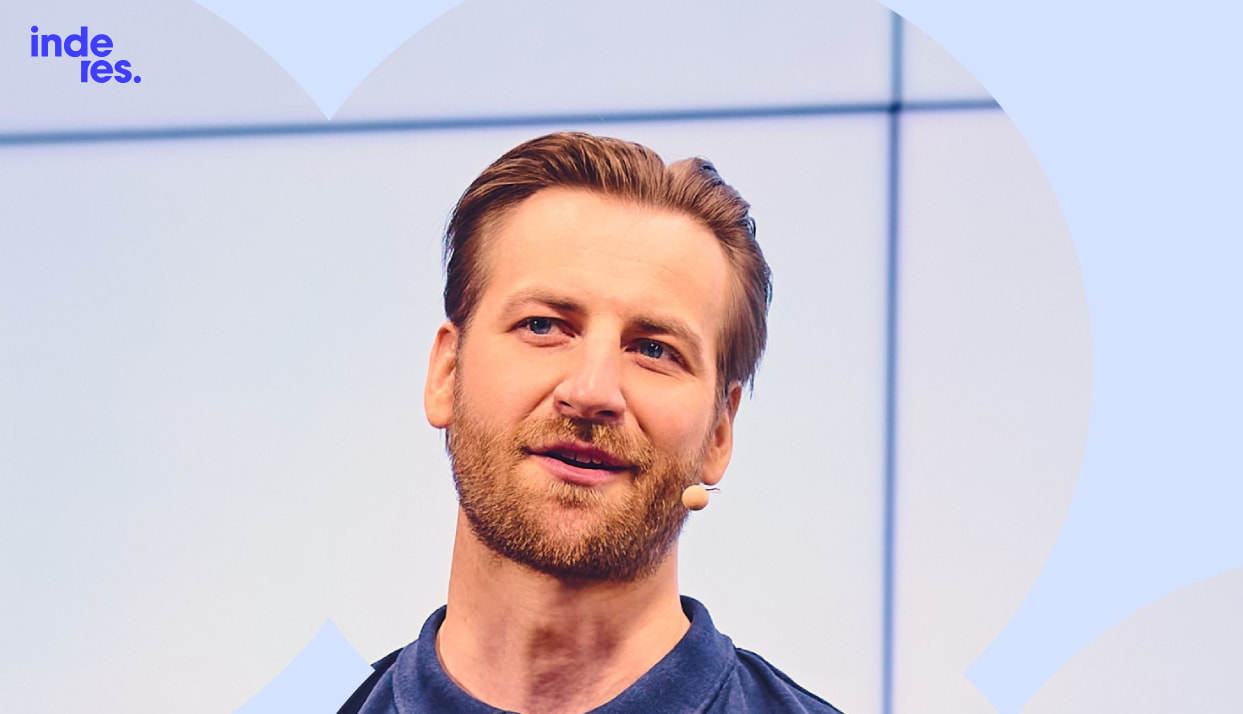
Thank you for the good questions and for using a photo of me taken before the small-cap bear market.

Here is the latest one from yesterday, which didn’t end up as the official new profile picture:

50 Likes

183. Marianne Palmu Facing the Rookie’s Challenging Macro Questions

We didn’t actually stray too far from the themes of the previous interview, where I questioned Verneri about the market’s big picture, because this time we are also facing some very heavy and significant questions. In my opinion, Marianne was exactly the right expert to answer these new reflections of mine, which delved into, among other things, the so-called ”new normal”, the importance of observing market psychology, and the most typical mistakes market analysts make in the midst of crises. :slight_smile:

1. For me — and as I understand it, for many other investors too — there has been a growing sense over recent years that the markets and the economy are becoming increasingly difficult to predict. Movements seem more unpredictable and faster than before. During the Trump era, this feeling has only intensified. So, is this a new normal, an imagined new normal — or just a normal normal?

I’ve pondered this a lot myself, and I think we are to some extent facing a new normal: the pace of change has accelerated. This is evidenced by the fact that the lifespan of companies in the S&P 500 index has shortened in the 2010s to a third of what it was 50 years ago. Of course, the change brought by AI is one factor here, but the strong emergence of geoeconomics in general adds its own spice to the stock market soup. This is also reflected in investor sentiment: for example, in a recent Investor Barometer commissioned by the Finnish Foundation for Share Promotion (Pörssisäätiö), 38% of respondents said that the geopolitical situation has increased passivity and caused investors to take a wait-and-see approach. On the other hand, for 26%, the situation has had no impact. I believe these various crises have also increased our tolerance for facing them.

2. Sometimes in a rapidly changing environment — and perhaps otherwise too — it’s easy to follow the short term and individual indicators. But in crises and a volatile market environment, should one do exactly the opposite: step back, look at long-term trends, and seek perspective from history?

The Rookie is onto something essential now, because that is exactly what one should do: instead of panicking, think about how long an impact crises actually have on a company’s future cash flows. Of course, there are many aspects to this: it’s not pleasant when fuel prices rise and inflation rears its head again, as it takes a bite out of personal finances.

3. Related to the previous themes: as an economist, how much do you think about or follow investment and market psychology phenomena in your work? If you do, how — and why do you think they are important?

I’ve started thinking about them increasingly in my work and when making investment decisions. Psychological phenomena, such as anchoring and herd behavior, become more pronounced during crises. Getting to know companies and understanding economic phenomena is an important part of investing, but in my opinion, identifying and overcoming the pitfalls of investor psychology separates the wheat from the chaff as investors.

4. What about the most typical blunders that investors and, for example, market analysts make in the midst of fresh crises or other big events? And do you have any practical tips for what an ordinary investor could think — or do — in such situations?

In addition to the aforementioned, a negativity bias occurs in the middle of big events: there is a tendency to overreact to bad news. The spiral is further fed by the fact that bad news gets more space in the media because it sells better, as our caveman brains react to coming threats. The best thing you can do in such a situation is to follow your investment plan and not jump the gun – or put on your ”buying pants” when fear is at its peak.


Thanks for the excellent answers, Marianne!

For investors – and especially in my case – the most fatal mistakes often stem from neglecting (or not understanding) the basics; those same mistakes that could easily be avoided by focusing on the essential. However, if you end up staying up until 2:30 AM on a weekday reading about Japanese Purchasing Managers’ Indices, even if you don’t even invest in Japan, there’s no point wondering why the result in the ”Hesuli” (Helsinki) exchange is nothing but ”turska” (big losses). :upside_down_face:

Probably one of the most common and biggest mistakes for us investors is fidgeting too much, forgetting the big picture and the long term. The answer to reducing losses isn’t adopting some EV/PE/dividend%-FCK2U gadget or reading about the accuracy of Indian small business figures at three in the morning. :grinning_face_with_smiling_eyes:

Happy Vappu to the Forum! :heart_suit:

31 Likes

184. Metso IR Responds: Copper and Other Questions Weighing on Investors’ Minds

Copper has sparked a good amount of discussion on our forum, particularly in the Metso thread. I decided to take action and send Metso a set of questions regarding copper and a few other related topics on the side.

In drafting these questions, I received valuable help from @Timo_Huhtamaki – big thanks to Timppa! The best ideas came from him, while any weaker points and the final wording of the questions are entirely on my account. So, if there are errors or inaccuracies in the questions, the blame lies here. :slight_smile:

Regardless, we received some great answers to the questions :smiling_face_with_sunglasses: :backhand_index_pointing_down:

1. Declining Ore Grade and Demand:

Copper grades are falling, meaning much more rock must be processed for the same amount of copper. Is this a great opportunity for Metso to sell more and more efficient equipment, or… on the other hand, does the declining profitability of customers threaten investments?

The decline in ore grades is one of the key structural trends in the mining industry, directly affecting customers’ production volumes, energy consumption, and cost structures. For Metso, this is both an opportunity and a demand coming from customers. Lower grades mean that to produce the same amount of metal, customers must process significantly larger quantities of rock. This increases the need for higher-capacity, energy-efficient, and reliable processing solutions. This is where Metso’s strong expertise in crushing, energy efficiency in grinding, flotation, and overall process optimization stands out.

On the other hand, declining ore quality affects customers’ unit costs, and investment decisions are targeted toward technologies that can lower production costs. This favors suppliers who can demonstrate measurable improvements in energy efficiency, uptime, and metal recovery. In other words, for Metso, this is an opportunity to create significant added value for customers.

2. Copper Recycling and E-scrap:

How large a portion of copper revenue currently comes from recycling compared to traditional mines? How do you estimate the copper recycling market will grow in general, and how does its profitability and price sensitivity vs. virgin copper affect your growth targets and sales mix?

Copper recycling, and especially e-scrap, is clearly a growing market, but the development is still in its early stages. Recycling and e-scrap currently represent a very small part of Metso’s copper-related revenue, but it is a strategically growing and technologically demanding segment where we are selectively present.

The growth dynamics of the recycling market differ from traditional copper:

  • The quality and composition of raw materials vary more
  • Processes require high metallurgical expertise
  • Profitability and investment appetite are sensitive to fluctuations in prices and cycles

Metso sees that recycling complements primary production but does not replace mines, especially due to electrification, the energy transition, and the structural growth in copper demand. However, demand is growing at such a pace that the share of recycling is expected to increase, much like what has happened over the years in aluminum, for example.

3. Technological Lead and Patents in Copper Smelters:

What is Metso’s true head start in copper smelters? Do you have patented expertise and/or a “moat” that cheaper competitors cannot copy within the next 10 years?

Metso’s competitive advantage in copper smelters and metallurgical processes is based on an extensive portfolio of technology and process expertise built over decades. In particular, flash smelting, developed decades ago, is in a class of its own when it comes to low-emission smelting solutions. This technology is protected by numerous patents and is, of course, still being further developed.

4. Energy Consumption, ESG, and Pricing:

Do customers actually pay a “Metso premium” for energy- and water-efficient equipment due to tightening requirements, or is the lowest price still clearly the dominant factor for buyers?

Customer behavior here has clearly changed, but there are always case-specific differences. That is, customers are willing to pay for efficiency if it is economically justified.

Energy and water efficiency are often a ‘license to operate’ and are related to:

  • Obtaining operating permits and meeting regulatory requirements
  • Managing Scope 1 and 2 emissions
  • Direct cash flow as energy prices rise

The value Metso offers is based on Total Cost of Ownership (TCO) optimization, meaning:

  • Lower energy consumption
  • Better uptime
  • Lower water consumption and waste volumes
  • Extensive service business and support close to the customer

Consequently, customer decision criteria relate to the total cost of ownership (TCO) rather than just the purchase price, and the cheapest initial investment is often not the most competitive option.


Big thanks to Metso for the great answers! :folded_hands:

These will certainly provide both enjoyment and concrete benefits for us investors. I believe this also benefits Metso itself; through these answers, a broader group of investors gets an even better picture of the company’s operations in this field. :slight_smile:

Thanks to Metso, thanks to Timppa, thanks to the readers, and have a great weekend! :slight_smile:

27 Likes

185. Frans-Mikael Rostedt answers Alokas’s questions about the IT services sector

Not just two words, nor even one; Frans-Mikael Rostedt and @Joni_Gronqvist produce a commendable amount of material on IT service sector companies and the overall industry outlook. Everything from extensive reports to company updates and excellent videos is available – huge thanks to the guys for these! However, I would still like to ask a few targeted questions on topics that interest me regarding this sector, even though they have certainly been touched upon at least partially in their previous content.

My questions may be what they are, but the interviewee’s answers were very rewarding this time as well. :slight_smile: :backhand_index_pointing_down:

1. A few years ago, the IT services sector appeared to many investors as a broad field where returns were easily accessible. General macro challenges have certainly weighed on companies in the industry, but technology development and the growing role of AI in particular have created a sense that the industry might be stagnating and power is shifting increasingly to large pioneers. On the other hand, it’s unlikely these “winners” would have massive margins to skim and growth ahead, even if such “concentration” occurred. Is this interpretation unnecessary dramatization, or in what direction do you see these things moving?

The industry was a true gold rush in the 2010s and expanded tremendously during the hot years. To put it crudely, between 2015-2022, success meant simply being able to recruit good talent. We even have many incredible growth stories on the stock exchange. For example, Gofore and Witted.

Now, in my opinion, we have moved into a phase where development is more efficient and companies are much more focused on profitability than during the boom era. This in itself, even without AI, has made the industry much more “mature” and has clearly tightened the competitive landscape.

Now AI brings its own flavor to the mix and streamlines development very significantly. I believe that in the broad context of the entire industry, the years of hot growth are behind us. At the same time, there will be new success stories in the industry, as Data and AI consulting, for instance, is currently experiencing strong growth.

I think it’s normal that in the IT services sector, there are always areas that rise and fall. Even 10 years ago, one couldn’t imagine the extent to which development resources are needed for everything today. Now AI potentially accelerates this change 10x, and the challenge is that some sub-sectors will decline very sharply. New competition will certainly emerge, but it is vital for companies to gain access to emerging fields. I believe the fundamental principles of consulting will not change. That is, you sell people to solve a problem. Now, people can be supported by a “code factory,” while the experts themselves focus on communicating with people and managing that “code factory.”

Rapid changes are, of course, difficult. Especially when the business is based on hourly billing of people. There may be a mismatch in expert profiles regarding what customers want to buy now. This will divide the market into winners and losers, and I personally follow business trends in companies closely. If revenues are on a continuous downward trend, the price paid for the company will also be very low.

2. What should an investor follow in IT service companies if we set aside familiar valuation multiples and key figures for a moment, even though they are very important—for example, are NPS scores and employee turnover still relevant metrics for these companies? And is it possible to monitor how well companies in the industry are utilizing AI in their own operations?

NPS scores are, in my opinion, very relevant. I believe that in the future, the bar for the quality of experts sold by IT service companies will rise (it already has), and this naturally requires companies to be able to recruit top talent.

Change negotiations naturally lower employee satisfaction levels, but unfortunately, they have been necessary for many, as business grew significantly in past years, but now operation volumes have clearly decreased for many. However, it is more important than streamlining to get revenue back on a growth path / stabilize the decline. This has required investments in sales from almost all companies. In this kind of business, the sky won’t brighten through streamlining if revenue just continues to decline. Or then one must accept the new situation and transform into a company whose core activity is the constant honing of profitability by continuously streamlining various operations. This is, however, very difficult in an expert business like the IT services sector, where one of the key factors differentiating companies is their ability to attract top talent.

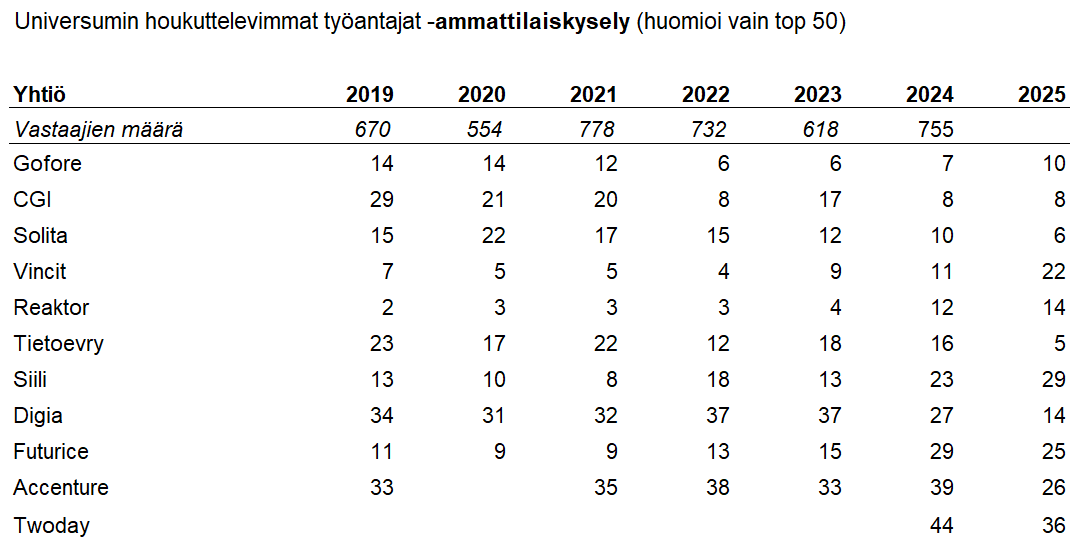
I personally have followed Universum’s Most Attractive Employers statistics, which I find to be a quite good metric. It is difficult for smaller companies to get on this list, but I think the trend in the statistics speaks well of a company’s development in this area. Of course, such surveys have their own challenges. In a difficult cycle, “steadier” companies and those whose business is going relatively well have—surprise, surprise—emerged as winners.

Other key metrics that are good to follow, but difficult to access, are: fixed costs relative to revenue and gross margins. Companies must be able to operate with a sufficiently light cost structure, or else inevitable project fluctuations will hit profitability hard.

As for utilizing AI, it is unfortunately impossible to monitor in practice in any reliable way, at least in my opinion. Some companies globally report AI-related business, which improves visibility slightly in this area, but these classifications always involve a lot of uncertainty regarding what is actually counted as AI business.


Many thanks to Frans for the great answers! :saluting_face:

Even though the duo has covered the industry and companies excellently, as an investor, I needed a bit more “grip” and deeper thoughts on these aforementioned themes. :slight_smile: And while reading these answers, it occurred to me that things are often looked at far too one-dimensionally. Frans’s reflections will surely help broaden the perspective for both myself and probably others, so that in the future we might be able to think about and examine this sector more diversely and in a less black-and-white manner. :slight_smile:

Have a nice weekend everyone! :slight_smile:

20 Likes

186. Jarmo Pekkarinen PART 1/2

(This didn’t fit in one message, so the interview is in two parts – hit the character limit. :))

I managed to get the much-praised CEO of LapWall, Jarmo Pekkarinen, for an interview. He is a hardworking and forward-moving guy who has been hyped up especially for his investor relations skills – and in my opinion, they are top-notch too.

Jarmo seems to believe in his company because he talks about it boldly and openly here and elsewhere. For instance, he has also invited people to his factory – this is precisely the commendable modern investor relations.

You can always just issue a short stock exchange or press release and wait for Kauppalehti to call, or organize an expensive event for a few dozen people. But on the other hand, you can also build a good image for your company for free alongside these: by talking about it like Jarmo does, for example, on the Forum comprehensively, patiently, and in layman’s terms, thus serving both beginner retail investors and wealthier and more professional parties at the same time.

A genuine passion for what he does and a strong commitment to his company shine through him, which inspires trust in him and, above all, in LapWall. :slight_smile:

1. Tell us in fifty words who you are.

I am an entrepreneur, investor, and the founder and CEO of LapWall Oyj. I have been building the company with a long-term perspective since 2011 towards becoming a genuinely industrial product company. I am particularly interested in why some companies succeed and others do not. I believe in continuous development, long-term ownership, strong leadership, and hands-on execution.

2. Tell us three things that few people know about you publicly.

1. I started entrepreneurship already as an elementary schooler with onion farming and making snowplow marker posts.

2. I have raced rally cars, driven the Arctic Lapland Rally four times, and crossed the finish line three times.

3. In the winters, I often commute to work by skiing across the lake on forest skis.

3. What interests and hobbies do you have besides investing?

Exercise and an active lifestyle are important to me. My hobbies include golf, cycling, padel, pickleball, and playing floorball in the +35 age league. I also like making firewood and otherwise doing things practically with my hands.

In addition, I am interested in leadership, production development, the industrialization of construction, and matters related to the competitiveness of companies. I also enjoy exploring new business models and product company thinking.

4. What is a typical weekday like for you?

I usually wake up at the same time around 6:30–7:00 a.m. Breakfast is almost always the same: oatmeal, berries, yogurt, and a fried egg.

If I am in Pyhäntä, where I live, in the winter I usually go to work by skiing across the lake on forest skis, and in the summer by bike. Sometimes I might also go by snowmobile. I always try to join the factory’s “morning parliament,” where a lot of good, down-to-earth discussions take place.

My days consist of meetings, sorting out various matters, preparations, and meeting visitors. I am mostly at the Pyhäntä factory and try to do a factory tour every day. It is important for me to see things in practice and be close to the organization.

I am also a keen sauna-goer and usually take a sauna every day. On winter Mondays, after pickleball games, I head to the Pyhäntä winter swimmers’ sauna, where there is always good company to chat with.

5. What kind of investor are you?

I am an extremely long-term investor and owner. I hardly invest in shares of listed companies, but instead strive to make direct investments, particularly in unlisted companies whose operations I can influence myself.

For me, the most important thing is to understand the business, competitiveness, and especially the management. I prefer to invest in companies where I believe in the long-term development of shareholder value.

I am also a real estate investor, although I reduced my housing holdings at the right time. Real estate investing is not very profitable at the moment, although location still plays a very significant role. However, I believe that when the market is generally uninteresting, very good investment opportunities can come your way.

6. What is your investment history?

I bought my first detached house in 1995, and that was practically the start of my real estate investing. I became a small shareholder in the company where I worked in 2000. I bought Sonera shares back in the day during the height of the hype, and they resulted in a significant loss at the time. That was a good lesson in investing.

In 2000, we built a detached house in the Oulu region. In 2002–2003, we moved to Pyhäntä for work, and my wife and I became shareholders in Maustaja Oy, which was owned by seven different families.

In 2007, I moved on to become the CEO of Mellano Oy. After that, we have owned and developed investment apartments, ski resort operations, restaurant operations, a bowling alley, retail, and spa business operations. About a hundred apartments have been built, along with various other real estate and business projects.

I also founded Iccuna Oy in 2012, but I am no longer involved with the company. LapWall was founded in 2011. I have also been involved in Aitoenergia Oy, which was later sold to Geonova Oy. In addition, we own significant stakes in NK Tekniikka Oy, among others, as well as a company that has Polaris dealerships in Rovaniemi, Oulu, and Ranua.

I like being involved in companies where I can concretely influence things.

7. What is your work history?

I started my career practically already in elementary school. I had onion farms and also made snowplow markers. I am the son of a farmer and forest owner, so farm and forest work became familiar to me at a young age. At home, we learned to work, and that has had a huge impact on my entire mindset.

After graduating as an engineer, I worked at Ponsse as a development engineer and project manager in various tasks. After this, I worked as a product development and quality manager and later as a production manager at Tekniseri Oy.

Following that, I moved to Maustaja Oy as a production manager and to the company’s board of directors. From Maustaja, I moved to become the CEO of Mellano Oy.

I was one of the founders of LapWall in 2011 and have served as the company’s CEO ever since. In addition, I have been involved in the boards of directors of several different companies since 2003.

I have actively studied economics and management throughout my career, including in Aalto University’s JOKO program. I have always been particularly interested in why some companies succeed and others do not.

8. What kind of portfolio do you have, and what are its largest holdings?

LapWall Oyj is by far my largest holding. In addition, I have significant holdings in several unlisted companies as well as in some real estate properties. The holdings include, among other things, apartments, real estate, and shares in companies operating in various industries.

I have never been an active stock trader, but rather view investing with a very long-term perspective. I strive to invest in targets where I deeply understand the business and where I can also influence matters myself.

Thus, the majority of my investments have been in unlisted companies and entrepreneur-driven businesses. For me, the most important things are the business’s competitiveness, management, owner mentality, and the long-term development of shareholder value.

9. What does your stock-picking process normally look like step by step?

I hardly invest in the shares of listed companies, because I simply do not have the time to follow them deeply enough. I strive to invest in targets where I understand the business extremely well and where I can also influence matters myself.

For me, the most important things are the business’s competitiveness, management, and the long-term development of shareholder value. I have never been interested in quick profits or active trading.

I have also learned the hard way that in investing, you must trust your own analysis and understanding. In the autumn of 2021, I invested about 150,000 euros in a company that I was not completely convinced about investing in. I made the investment partly based on the example of other good acquaintances. I sold the shares in 2024 and the investment resulted in a loss of about 115,000 euros.

Judged in hindsight, the decision to sell was the right one, as the value of the share has fallen further significantly. This reinforced my idea once again that in investing, decisions must be made based on one’s own understanding.

10. Could you describe in three hundred words what kind of company LapWall is?

LapWall is a Finnish industrial product company that manufactures standardized and configurable roof and wall element systems for construction needs. We do not sell individual elements or warehouse products, but our customers buy complete element systems and solutions delivered and often also installed from us. LapWall operates solely in the B2B market.

LapWall’s strategic goal is to move ever more strongly from a project-driven operating model toward a product company where the competitive advantage is based on a standardized product system, controlled variation, efficient production, and strong design ownership. In practice, this is about a configure-to-order model, where a standardized product system, limited variation, and controlled execution form the basis for competitiveness.

Currently, about 80 percent of our volume is already based on standardized solutions in line with product company thinking. LapWall’s strength is not a single element but the entire element system, which enables the efficient, high-quality, and rapidly executed construction of a wide variety of buildings.

Although our products mainly use wood, we do not compete with the material but with the overall solution. Our products are excellently suited for hybrid construction as well as steel- and concrete-framed buildings. The most important thing for the customer is a cost-effective, responsible, and reliable overall package.

Our core competitive factors are high quality, delivery reliability, continuous R&D activities, strong production expertise, and highly automated production. At the core of our strategy is not growth at any cost, but a scalable business model where growth simultaneously improves efficiency, quality, and profitability.

We believe that the future of construction increasingly belongs to industrial manufacturing, standardized solutions, and efficient building systems. LapWall does not compete only with other element manufacturers, but against alternative ways of building. Step by step, we have gotten closer to LapWall’s offered solution being a genuinely highly competitive alternative alongside concrete and steel.

11. What are your favorite things about your job? What is the least pleasant aspect of your work?

It is extremely motivating and great to be involved in building a company from an idea all the way to practical execution. I like that ideas turn into concrete actions, production, deliveries, and ultimately satisfied customers. I enjoy developing new operating models, products, and solutions, and being able to genuinely put them into practice.

I also like working with people a lot. LapWall has an extremely committed and professional staff, and it is great to see how doing things together, good cooperation, and a common goal show in daily work and the end result. I have always been a very hands-on leader and still thrive extremely well in the everyday life of the factory, in the middle of production, and in discussions with the staff.I am interested in continuous improvement. I have long been extremely interested in why some companies succeed and others do not, regardless of the industry. Leadership, production, strategy, competitiveness, and the industrial operating model are things I ponder practically on a daily basis.

The most challenging part of the work is usually situations where agreed-upon matters do not progress or translate into practice as they should. Strategies, plans, and decisions alone do not solve anything; what is decisive is how things are genuinely made to work in practice throughout the entire organization. I have learned that leadership is, above all, execution and the ability to make the organization operate in accordance with shared goals.

I have also learned the hard way that wrong leadership appointments can become very costly for a company. Many times, I have perhaps watched situations for too long before making the necessary changes. As long as I have something to contribute, I want to be involved in building LapWall’s future.

12. What are your greatest strengths as a CEO? And is there any specific area in which you would particularly like to develop as a CEO?

My strengths as a CEO are particularly related to long-term development, strategic thinking, and the ability to combine practical execution with overall management. I am extremely interested in why some companies succeed and others do not, and I have spent a lot of time studying leadership, production, competitiveness, and business models, as well as developing them in practice.

I also consider one of my strengths to be the ability to see the business as a whole. I am genuinely interested in production, design, sales, strategy, profitability, and the development of shareholder value. I constantly strive to develop the company in the long term toward a clear target state.

I am a very hands-on leader and strongly believe that leadership must be visible in everyday work. I thrive in the middle of production, talk a lot with the personnel, and want to understand things at a practical level. It is also important to me that the organization has a clear direction, shared goals, and the opportunity to succeed in its work.

I have also learned a lot through mistakes. My biggest mistakes have been related to leadership appointments and the fact that in some situations I watched things for too long before making the necessary changes. I have also learned that growth that is too fast without sufficient control can become a very large risk. For example, building the businesses in Sweden and Norway taught us a great deal about how important controlled scaling and proper timing are.

As a CEO, I still want to develop particularly in organizational leadership, the development of management models, and how a large number of people, processes, and goals can be made to function as efficiently as possible as a single entity. I strongly believe that a company’s competitiveness is ultimately decided in its leadership.

13. What do you see as LapWall’s three most important value drivers over the next five years? And what do you see as the biggest longer-term risks to the company’s value creation, and how do you plan to respond to them?

I see LapWall’s most important value drivers over the next five years as the progress of the product company strategy, the development of production efficiency and automation, and the strengthening of our market position.

The first and most important value driver is the increasingly strong transition from a project company to a product company. The more we are able to standardize solutions, manage variation, and steer projects in accordance with our own system, the better the business scales. I firmly believe that the future of construction is increasingly moving toward industrial manufacturing, standardized solutions, and efficient building systems.

The second very significant value driver is the development of the LapWall Production System (LPS) and the continuous improvement of production efficiency. We have invested very heavily in production, and Pyhäntä Factory 3 in particular is the largest investment in LapWall’s history. Its successful ramp-up and the utilization of its full potential are one of the company’s greatest opportunities over the coming years, but at the same time also one of the central risks if we fail to utilize the investment as planned.

We still see very great potential in automation, flow production, standardization, and the continuous reduction of the cost price. Particularly in roof element production, we have taken significant development steps that have demonstrated how large an impact production efficiency and standardization can have on competitiveness.

The third key value driver is related to market position and building continuous demand. LapWall has by far the largest capacity in the industry in Finland across five factory units. We also believe that customers will increasingly buy total solutions in the future instead of individual products. Combining roof and wall element systems, delivery and installation logistics, and building continuous demand are a central part of our strategy.

We also see a very great opportunity in the fact that the use of prefabricated element construction will expand in the future to even more building types and application areas. We do not believe the market is finished; rather, we believe it is only just developing.

We also see that our worst competitor is not another element manufacturer, but alternative ways of building. If we can continuously improve our competitiveness relative to other construction methods, the market potential is very large.

The biggest long-term risks are related to failing to carry the strategic transformation through far enough. The greatest risk is not necessarily the market, but getting stuck halfway between project construction and the product company model. Rapid growth that is too fast, uncontrolled complexity, wrong leadership appointments, or strategic dilution can also pose significant risks.

We respond to these risks with long-term strategy work, continuous development, strong leadership, production standardization, and by keeping our focus very clear. We have also learned the hard way that it is not worth doing everything at the same time.

**14. What kind of employer do you want LapWall to be known as among its employees? And what concrete methods do you use to keep the team motivated, well-performing, and genuinely enthusiastic about their work?**LapWall’s operations are strongly guided by its values, key success factors, and three core elements at LapWall: cooperation, a shared goal, and the opportunity to make an impact. We want the entire personnel to genuinely feel that they are part of a shared team where everyone is playing towards the same goal.

I want LapWall to be known as an industry trendsetter, an honest and straightforward operator whose word can be trusted. What is promised is also delivered. We want to be a reliable partner for our customers, but at the same time also a workplace where people feel their work is meaningful and can be proud of what we build together.

It is important to us that the personnel genuinely have the opportunity to influence operations and the development of the company. I strongly believe that the best ideas often arise in the everyday reality of production and from people’s practical experience. When the entire personnel participates in development, it simultaneously builds commitment, motivation, and a strong LapWall spirit.

LapWall’s goal is to create a work environment where cooperation works, people respect each other, and everyone can develop continuously. We want coming to work to be a positive experience. Doing things together, an open discussion culture, and the opportunity to succeed in one’s work are extremely important matters to us.

Motivation and well-being are also built for the long term through good management, clear goals, functional processes, and ensuring people have the right tools to succeed in their work. I strongly believe that a company’s competitiveness ultimately builds on people, culture, and management.

We also have a very strong desire to continuously develop our operations. We do not believe that a good company is ever finished. Continuous development, cooperation, and the desire to do things better are precisely what set a successful company apart from an unsuccessful one.

15. How do you see LapWall’s situation enduring if construction remains subdued in the coming years and wood or environmental themes do not draw particular interest — is there then a risk that revenue and profitability will face a hard time? On the other hand, if the market turns clearly for the better, the Finnish economy picks up, and wood and sustainability trend strongly, how can LapWall respond to rapidly growing demand so that margins also remain healthy?

The construction market is always cyclical, and no company is completely immune to market changes. Of course, LapWall is also affected if construction remains extremely weak for a long time. However, I see that LapWall’s competitiveness is based on much more than just wood or environmental values.

Our competitive advantage is based on a broad product and solution portfolio, by far the largest capacity in the industry, an efficient and transparent project management model, and the ability to combine design, production, logistics, and installation into one managed whole. For the customer, the most important things are a functional overall solution, a competitive price, good quality, delivery reliability, and efficient execution.

We also see that wood and sustainability only become genuinely significant to the customer once other matters are in order. In LapWall’s solutions, sustainability is not a separate entity, but is built as part of the entire operating model. This is evident, for example, in material efficiency, logistics, production efficiency, recycling, and the management of the entire supply chain. We already see this as a competitive advantage today, but if the importance of environmental values continues to grow in the future, we see it as a clear additional opportunity for us.

We also see that our worst competitor is not another element manufacturer, but alternative ways of building. If we can continuously improve our competitiveness relative to other construction methods, the market potential is very large even in a weaker market.

In recent years, we have invested very heavily in production, automation, and capacity. LapWall has by far the largest capacity in Finland across five factory units, and especially Pyhäntä Factory 3 enables significant growth in the coming years. Roughly speaking, the investments have already been made to enable us to even double our volume from the current level. The production facilities are ready for this.

At the same time, the development of the LapWall Production System (LPS), standardization, flow production, and the continuous reduction of the cost price are a central part of our strategy. If the market turns clearly for the better, I believe LapWall is in an extremely good position to benefit from it. We are able to increase volumes significantly without a corresponding increase in fixed costs, which creates an exceptionally good foundation for profit development as well.

We also believe that customers will increasingly buy overall solutions in the future instead of individual products. Combining roof and wall element systems, delivery and installation logistics, and expanding the use of element construction to an even wider range of building types support long-term growth. We also see very large opportunities in, for example, data center construction, where industrial construction, delivery reliability, speed, and large entities are emphasized.

In the long term, we believe construction will increasingly shift toward industrial manufacturing, standardized solutions, and efficient building systems. LapWall’s entire strategy is built around this change.

16. Sweden and the rest of Northern Europe might offer major opportunities for the company in the future if we look a bit further ahead – more than a couple of years, is it possible that a few years from now LapWall would start aiming beyond Finland’s borders, and what is the biggest hurdle to significantly growing exports?

I definitely see that in the long term, there may also be significant opportunities for LapWall outside Finland’s borders. The industrialization of construction, standardized building systems, efficient production, and sustainability are megatrends that are not limited to Finland alone.

However, we have learned a great deal from history. If I were to do something differently, I would not enter the Swedish and Norwegian markets in the way we did back then. We essentially entered the new markets too quickly and with too few resources to build the business. We did not have sufficiently strong prerequisites or sufficient control for such intense scaling at the time. It was an extremely educational experience.We have learned that internationalization cannot be based on mere growth or the pursuit of revenue. It must be based on a clear competitive advantage, a controlled operating model, a strong product company logic, and ensuring that our home market and operational execution are in extremely good shape.

I see that LapWall’s most important task right now is to fully utilize the capacity built in Finland, develop the product company model, strengthen competitiveness, and specifically bring the full potential of the Pyhäntä Factory 3 into use. We have already made investments to enable us to grow volume very significantly from the current level.

Another very interesting opportunity in the future is related to our current customer relationships. We increasingly have customers who operate not only in Finland but also in other markets. Through this, opportunities may open up for LapWall to participate in projects outside Finland’s borders as well through existing customer relationships.

During the current strategy period, however, we are mainly focusing on the Finnish market and on strengthening the product company model, competitiveness, and operational performance. At the same time, we are preparing so that in the next strategy period LapWall will have better readiness to grow its business outside Finland’s borders as well.

In the long term, I believe that if we can build a genuinely highly competitive and efficient product company model in Finland, it can open up opportunities internationally as well. In my opinion, the biggest threshold for significantly increasing exports is not the market, but the ability to maintain competitiveness, a controlled operating model, quality, and profitability even when scaling.

I have also learned that in business, there is practically never a completely risk-free situation. If nothing is done, that in itself is a very big risk. Competitors will then easily overtake you from the right and the left. The crucial thing is to make decisions based on available information, but in a controlled and timely manner.

17. I “ordered” this single question from forum user @JHeiskanen: In August, LapWall announced it would supply a roof solution for a data center project in Kajaani. Have any data center projects come to LapWall since then? If not, why not?

The Kajaani project went extremely well, the customer was very satisfied, and LapWall’s installed solution worked excellently. We were also able to develop the product and overall solution so that the project’s requirements were met very well.

We are involved in several projects and discussions related to data centers, but we cannot publicly announce all projects. In practice, we always need the end customer’s permission to be able to talk about projects in more detail.

Data center construction fits LapWall’s operating model extremely well because it emphasizes large entities, fast execution, high quality, and delivery reliability. We see this market as very interesting for us in the future as well.

We will share more about the projects when it is possible and when we have the customers’ permission.

18. You are certainly one of the most hyped investor communicators in Finland (for good reason!). What personally inspires you to invest so much time specifically in investor communications, and what concrete benefits do you feel the company gets from this? Also, do you think this openness and activity have any downsides?

I think of investor communication above all as building trust. It has always been important to me that investors, owners, and other stakeholders understand as well as possible what LapWall is doing, where we are going, and how the company is being built for the long term.

I also feel that in Finnish listed company culture, communication has often been too distant, cautious, and difficult to understand. I have wanted to bring more openness, down-to-earth practicality, and concreteness to communication. I strive to tell things as honestly as possible — even when everything does not go perfectly.

Overall, however, I spend quite a little of my working time on investor communications. Of course, it is of great importance to investors, but I see it as also having significance for our customers, partners, and LapWall’s desirability as an employer. At the same time, this is strategic and systematic activity that broadly benefits the entire company.

I also see that direct and open communication about how things really are has value. We want to tell things as directly and openly as possible when it is possible. I believe that in the long term, honest and consistent communication builds trust much better than overly cautious or vague communication.

I also feel that the CEO must be genuinely visible and approachable. If owners invest their own money in the company, they must have the opportunity to understand as well as possible what kind of company LapWall is and what kind of people are building it.

Of course, openness and activity also have downsides. When you operate visibly, all sayings and doings are noticed. In addition, openness can sometimes help competitors understand the operations better as well. Therefore, the balance between openness and trade secrets is very important.

Still, I believe that in the long term, the benefits of openness clearly outweigh the disadvantages. In my opinion, Finland would need more courageous, open, and owner-oriented investor communication.

36 Likes

186. Jarmo Pekkarinen PART 2/2 (did not fit in one message, character limit was reached)

19. A novice discusses with investors, but without JP-level IR expertise — what three tips would you give so that the job is handled as elegantly as you do?

I don’t know if “JP-level IR expertise” even exists, but I have learned a few things over the years.

The first and most important thing is honesty and authenticity. Investors usually notice quickly if communication is too constructed, vague, or inauthentic. You don’t have to try to say everything in “stock market language.” I personally strive to tell things as they are, without unnecessary excuses.

Back in the day, I received good advice from an older investor and experienced entrepreneur: it’s either results or an explanation — and he wasn’t interested in explanations. That has stuck with me. I don’t want to explain things away; instead, I aim to describe situations as directly and honestly as possible.

The second important thing is to understand the business deeply enough. Good investor communication isn’t a performance; it’s about genuinely understanding where competitiveness, value, and results come from in the long run. You should aim to tell investors as concretely as possible how the company is being built and what the competitive advantage is based on.

I haven’t overthought the matter beyond that. I’ve simply thought about what I would want to hear as an investor myself. In my opinion, that is a very concrete and good starting point for investor relations.

The third thing is consistency and perseverance. Trust isn’t born from one good interview or one successful quarter, but from the fact that actions and communication are consistent year after year. If you promise something, you should also strive to keep those promises as well as possible.

I also don’t know how to be anything other than myself. As a boy from a farm, I learned from a young age to work hard and take responsibility. Out there, making excuses didn’t help much; instead, you always found in front of you exactly what you had concretely achieved. This has had a major impact on how I approach leadership, entrepreneurship, and communication even today.

20. What do you want to thank Inderes and the Inderes Forum for?

I want to thank Inderes and the Inderes Forum above all for the polite and professional discussion culture. It feels genuinely good and valuable. Finland needs more open, constructive, and long-term discussion about companies, business, and ownership.

I have also appreciated the fact that the discussions involve a lot of expertise, thorough research, and genuine interest in the companies. Good questions also challenge us to think more deeply and constantly improve our operations.

I also appreciate that from what I’ve followed of the discussions, the so-called “excuse-makers” usually get a hard time—and rightly so. Investors are smart people, and in my opinion, constant explaining is often a way of underestimating investors. In the long run, what matters most are results, competitiveness, and the ability to execute things well in practice.

In my opinion, Inderes has done very important work in developing Finnish equity culture, investing, and ownership. This benefits the entire Finnish corporate field in the long run.

Welcome to visit us at LapWall to get to know our operations and our people, to discuss, and to form your own view of what LapWall is in practice.


A huge thank you to Jarmo for the comprehensive and excellent answers! :slight_smile:

Jarmo has received a lot of praise, especially from those who have met him in person. Furthermore, based on what I’ve read of his messages and my brief correspondence with him, he seems to encounter all kinds of people genuinely and very kindly. :slight_smile: This adds a nice flavor to investor communications as well.

Reliability and how one treats/encounters others often say a lot about a person. :folded_hands: It’s good to look in the mirror and understand others, though in appropriate proportion—quite often, outbursts and criticism toward others are seen exactly from those who should especially look in the mirror. :slight_smile:

I want to further thank Jarmo for his wonderful Forum activity, and let’s hope that many other representatives from different companies follow his example… (and… yes… there are other good examples here, e.g., in the Witted thread @Harri_Sieppi and @markus.huttunen1) and of course, we forum members strive to behave so that they don’t want to run away from here. :grinning_face_with_smiling_eyes:

Thanks and have a great Friday! :slight_smile:

43 Likes

Hi there!

There won’t be an interview today, Friday (the day just turned) :slight_smile:

But there are good interviews on the way — questions have been sent out in many directions.

There have also been requests for certain individuals, and I’ve been trying my best to reach them. Some are just a bit harder to catch, and sometimes things only materialize after a long delay anyway. :slight_smile:

As a bit of light relief, here is the performance of my Nordnet portfolio for everyone to admire; in addition to this portfolio, I have PYN Elite and a tiny bit of cryptos, as well as a moderate amount of cash. :backhand_index_pointing_down:

Have a great weekend, everyone! :slight_smile:

15 Likes

187. Kilpikonna

Kilppari has a little over 100 posts on the Forum – not a huge amount, but he had nonetheless stuck in my mind for his good memes, excellent investment-related highlights, and texts… especially his great company thread opening posts. :slight_smile: Well… over the past couple of weeks, a couple of high-quality investment videos by him were released, and that’s when the thought crossed my mind to ask him for an interview. :slight_smile:

Kilppari’s writings give the impression that he knows how to look at things from many different perspectives and objectively, without rushing too much. Above all, his attitude and desire to learn bode well for his investing career. And let’s not forget that he seems to have the ability to look at his own actions honestly, which is particularly important for long-term development.

It’s great that Kilppari has become active on our Forum! :slight_smile:

1. In fifty words, tell us who you are.

Born in 1998, from Oulu, having settled through twists and turns in the Helsinki metropolitan area for at least a while. Works for the state. Family includes one child, two dogs, and one wife. Free time is spent lifting iron at the gym and, lately, making videos in front of the camera. The stock market hooked me in 2019 and has kept a tight grip ever since. The learning continues.

2. Tell us three things few people know about you.

-I have visited Kesäranta [the Prime Minister’s official residence], and the prime minister at the time grilled sausages for me.
-I worked for a year in a Swedish-speaking region, even though my grades in Swedish in higher education were really poor.
-I am a single-event Finnish champion.

3. What interests and hobbies do you have besides investing?

The gym and sports in general are a big part of life. I train more in a powerlifting style, meaning I’m more interested in long-term development of strength levels than the mirror image. It has a lot in common with investing; nothing happens in a single week, but when you do the same basics long enough, the results start to show.

4. What is a typical weekday like for you?

Weekdays changed quite a bit after our firstborn arrived, but the rough framework is this: wake up between six and eight, breakfast and reading the news. After that, a walk with the dog and child, and throughout the day I follow investment-related content. Whenever possible, the afternoon also includes a trip to the gym.

The content of my workdays varies a lot due to three-shift work.

5. What kind of investor are you?

I am a (quality) dividend investor with a long horizon. Mentally of the Buffett–Munger school, though gut feeling naturally sneaks in sometimes.
Occasionally I make short, a few days long trades; success in these has been mixed.
I try to look for companies that clearly produce better-than-average returns on invested capital, companies with a durable moat and that grow their dividend year after year. I buy monthly and try to use technical analysis for timing. The journey here went through Valoe and other cheap stocks, which is exactly why I appreciate my current discipline.

6. What is your investment history?

-I started investing on a friend’s tip in September 2019 with no background whatsoever. Money had always interested me, but I hadn’t studied investing.

On Sep 23, 2019, 500 € was deposited into the account and – naturally, since it was cheap – 2,000 shares of VALOE were bought at 0.1 €.
Outokumpu and Sotkamo Silver were also bought on the same day, justified probably by a friend’s tip.

Purchase orders for Lehto Group and other “cheap companies” also appear on the bank statement during the autumn. There was no strategy or plan, and the activity reflected that.

This triumphal march continued for a few months, and then Corona hit, and the hard-earned Euros melted before my eyes.

Luckily that happened, because back then the reason to study investing grew, and this learning is still ongoing.

Along the way, there have also been close calls. I was about to become a real estate investor and seriously considered buying forest a couple of times, partly out of investment intent and partly out of the desire to “do things.”

I suppose you could call it investing when I ran a business for a few years alongside my studies. The return on that was experience.

7. What kind of portfolio do you have? If you had to hold two of your stocks for at least 5 years, what would they be, and why?

The portfolio now holds shares in 14 different companies and three different funds. I’m bad at saving in funds, even though I should. For a short while I manage to monthly save into them, and at some point I sell when I need money for stocks.

Right now, Sampo and UNP.
Sampo is a bedrock-solid, stable insurance company that generates steady, growing owner value through dividends and buybacks. The combined ratio is top-notch in the industry, and earnings grow moderately year after year. In other words, exactly the kind of boring company you can forget in your portfolio for years.

UNP is one of the two giants of the Western US railroad duopoly, whose moat is practically irreplicable. No one will ever build a competing transcontinental rail network again, or at least not very cheaply. Pricing power, scale, and high return on capital make it a machine that grinds out cash through all cycles.

8. What are the last two stocks you bought? Also, explain your rationale for the purchase.

In May I added Huhtamäki; an old limit order had been left in the portfolio, and when placing it, the price-to-quality ratio felt right.I also opened a completely new position in Waste Management.
WM passed the multi-stage screening with flying colors, and TA also gave the green light to buy. What makes Waste Management interesting is its boring yet essential business. Trash is generated regardless of the economic cycle, and a large player benefits from economies of scale, pricing power, and a strong position in its home markets. This is precisely the kind of company that doesn’t stir up big emotions, but can churn out cash flow year after year. Some pick up cigarette butts, others pick up trash.

9. Which two stocks did you sell lastខ្ញុំ? Also, explain your reasoning for the sales.

-I sold all my shares in Flowers Foods. A risky purchase completely against my plan materialized, and I took heavy losses. Tuition fees.

The second one was Sampo; this was one of those short trades. I didn’t empty the whole pot.

I am worse at selling than buying.

10. What does your stock-picking process normally look like step-by-step?

Stock picking starts with adding interesting companies I come across to an Excel tracking list.

The next step is getting to know the company and the industry. I go through familiar key figures: return on capital, free cash flow, debt, EPS, dividend-related metrics, moat, and competitive advantage.

The end result is either: rejected, watch, or buy. Rejected companies are removed from the tracking list, those that result in “watch” stay on the list and I review them irregularly, and “buy” means the company gets on the technical analysis list, and if TA shows green for buying, then I buy.

In other words, a company has to pass through many filters to get into the portfolio. Sometimes I take too many shortcuts and it costs me; I wish I wouldn’t take shortcuts.

11. What are your three strengths as an investor? What do you consider to be your biggest area for improvement as an investor, and if you could choose a teacher for this, who would you choose and why?

First is patience; nowadays I have the composure to stay in the market even when there isn’t action and excitement all the time.
Second is discipline; I have made pretty detailed plans for myself and I try to stick to them.
Third is a continuous desire to improve, which involves hanging out on the forum, consuming investment content, and challenging my own styles and decisions.

An area for improvement would be having the discipline to stay away from stock price charts. This only exposes you to stupid and sometimes unlucky trades.

As a teacher, I would definitely choose Buffett.

He is the core of my entire investment philosophy. Buy excellent, wide-moat companies at a reasonable price and let them churn out returns for decades.
It is specifically from him that I would like to learn a cure for my own weakness: the patience to stay away from price charts. Buffett’s saying “our favorite holding period is forever” should be kept in mind when making trades.

Berkshire is built on top of insurance float (like Sampo) and owns a railroad, BNSF (like I own UNP). So my two most important companies are straight out of Buffett’s playbook. Surprisingly.

12. Tell us in about 100 words per company what you think of them as an investment:

Automatic Data Processing

ADP is a classic asset-light quality company and a massive mover of cash flows. It serves over 1.1 million clients and pays wages to over 42 million employees in more than 140 countries. In 2025, revenue was $20.6 billion and the net margin was around 20%, which indicates a highly profitable business model. A special feature is the float: ADP temporarily holds clients’ payroll and tax funds, and in 2025 the average balance was $37.6 billion. This generated $1.2 billion in interest income.
The moat is created by scale, customer retention, data, and switching costs.
Risks include the potential impact of AI on payroll competition, the employment situation, falling interest rates, and valuation.

Elisa

Elisa is a defensive Finnish telecom company and above all a stable cash flow machine. The company’s strength is predictable subscription and service business, a strong market position, and good profitability. Elisa is not a fast-growth story, but rather a company of steady returns and stability. The dividend is attractive to an investor, but its room for growth is not unlimited, as a large part of the earnings is already returned to owners. Digital services and international software business bring additional optionality, but do not yet change the big picture. Elisa is best suited for an investor looking for stability, predictable cash flow, and a calm dividend yield in their portfolio.

UnitedHealth Group

UNH was long the nobility of healthcare quality companies, but now it is clearly more of a turnaround company whose direction is not yet certain. Revenue for 2025 was $447.6 billion and grew by 12%, but guidance for 2026 points to a revenue decline of about 2%.
The biggest risk is the DOJ criminal and civil investigation related to the Medicare business. At the same time, the company still has massive scale, Optum’s long-term potential, and the possibility of margin recovery.
Q1/2026 beat expectations and guidance was raised, which supports the turnaround story. Hemsley’s ~$25M insider purchase reinforces the signal, but this is no longer a pure defensive quality company. The DOJ is now the biggest single variable.

13. You started the thread “Rautatieyhtiöt - Todelliset salonkivaunut” (Railroad Companies - The True Parlor Cars), would you highlight a few companies from the industry there that an investor might want to follow, and briefly explain why exactly those are interesting?

-On the forum, we hear that many have taken seats in the parlor car, but the true parlor cars are UNP and CN.

Two earnings machines of the industry.

Union Pacific (UNP) is a western US duopoly giant, whose current biggest excitement comes from the Norfolk Southern merger. If the deal goes through, it will create the first coast-to-coast rail operator in the United States, an industry-shaping event worth following regardless of whether you own the stock.Canadian National (CNR/CNI) is a network extending from east to west and south to the Gulf of Mexico, the only North American railway touching three coasts. Perhaps not as interesting as UNP, but a consistently high-quality earnings machine with a strong return on capital.

14. Your profile says “Member Card in the Dividend Party” — is this just a joke, or does it have some basis in reality related to, for example, dividend friendliness?

  • I am dividend-friendly. The dividend is not my main criterion, but it is a good indicator for a company. If a company is able to pay and grow its dividend year after year without debt increasing or investments suffering, it often speaks to the quality of the business. A high dividend yield, on the other hand, can also be a trap, so I don’t look for the highest percentage but rather a sustainable and growing dividend stream. Paying taxes on dividends may be my way of compensating for the unproductivity of government officials.

I also gladly visit the meetings of my own “buying party”.

15. Your investment strategy says “Use borrowed money wisely”, could you tell me more about this… what does this concretely mean?

  • Finns perceive loans, and especially investing with borrowed money, as risky. I strive to use investment loans and have calculated rough maximum amounts for loans in different situations. A 100% leverage does not suit my personality. Nor is being without leverage always suitable.

I have used and hopefully will continue to use borrowed money to buy the dip; the latest successful example was when I bought stocks with a loan during the US-IRAN conflict a day or two before the bottom.

Borrowed money can only be used if I know in advance where my personal pain threshold lies and when leverage needs to be reduced. It must not be an emotional decision, but a pre-thought tool. Right now, investment loans are in use, but a large amount is also in reserve waiting for a dip. If my investment rate were at maximum when entering a dip, I wouldn’t be able to buy more, and that would annoy me to no end.

16. How do you use technical analysis in your investing, and do you feel you have benefited from it in your own investing?

Technical analysis came into the picture last summer. With it, I strive to at least avoid the biggest losses and sniff out potential buying moments. I don’t follow head-and-shoulders-butt patterns, but rather indicators and their combinations.

One example of continuous learning is that going through companies with various indicators took a lot of time. That’s why I created a few of my own TradingView indicators, into which I combined all the indicators I follow and their threshold values for selling and buying. Now these tools show green if the moment is good for buying, and red if it’s best to be cautious.

I feel I have benefited!

17. You have a rather fresh YouTube channel: https://www.youtube.com/@osakepoimija.
What kind of a channel is this, and what kind of material is coming up in the future?

  • I founded the channel partly on my spouse’s suggestion; she isn’t all that interested in investing, and since I like to follow other investors’ activities, she asked why I wouldn’t start making videos myself.

On the channel, I strive to make investment and economy-themed content: company presentations/analyses, opening up my own investing style, and comparing different investment styles and other hopefully interesting and generally useful content on the subject.

The goal is not to make content based on quick wins, cryptos, or hype stocks, but to build a calm investment channel where companies are reviewed from the perspective of a long-term owner. I also want to show my own learning process, not just ready-made answers. I believe that is also one of the best ways for me to learn more about the subject. Saying things publicly with my own face exposes me to quite a bit of pressure, and I hope my facts are in order then. If a viewer avoids one Valoe-style mistake with the help of my videos, the channel has been useful.

18. You are forced to choose 6 portfolio managers for your portfolio for 10 years, you must choose three from the forum members and three from Inderes’ staff, who would you choose and why?

Valkoinen peura digs out extremely comprehensive information about various companies and produces a clear end result from it.

Lyly and Immo would bring experience and perspective. In addition, based on the forum, they seem like a sensible guy (“tolokun mies”).

Shinjuku-mies, on the other hand, represents long-term, month-after-month steady grinding, and the investment style seems quite similar to mine.

Sauli Vilén is a respected analyst and to my knowledge one of the ones with the hardest track record. He knows the asset management side down to the last detail.

Antti Viljakainen already follows companies that I have in my portfolio. He is on top of things, so there’s no point in taking anyone new to replace him.

The third would be Marianne Palmu, who would bring a macro-level perspective along. I try to patch that up myself through technical analysis.

Into their custody I would dare leave my portfolio. I think the end result would be pretty much in the same playing field with my own plan.

(ping @ValkoinenPeura, @Lyly_ja_Immo, @Shinjuku-mies, @Sauli_Vilen, @Antti_Viljakainen and @Marianne_Palmu, I pinged you so you notice you’ve been mentioned, regards Alokas)

19. Alokas still has challenges in stock picking to analyze companies completely independently. How do you manage to compile things so well into a clear and understandable whole — as your writings and videos well demonstrate?

Thanks for the praise!

I can’t do it completely independently yet either; the materials that inevitably come my way shape the image of the company or the idea of what affects the company and how much.
There is actually no secret. It’s about repetition and the same template every time. (With minor variations between industries)
I run every company through the same sieve: return on capital, cash flow, debt, dividend, moat. When the structure is always the same, it is easier to follow.I write only about what I myself understand and see. If I cannot explain something simply, I don’t understand it well enough yet. Therefore, clarity is more about discipline than talent. Simple is beautiful.

20. What would you especially like to thank the forum members and Inderes for?

I want to thank the forum members for the free analyses and the time that everyone shares here. On the forum, you get to read different perspectives, and often well-reasoned ones. Without the forum, my investment journey would likely have been much rockier and more expensive. And I don’t mean a marble-paved road. It is of great value that a retail investor gets to read other people’s thoughts, mistakes, successes, and well-reasoned views. It also forces you to think better yourself.

Thanks to Inderes for making investing approachable and for building a place where company management, analysts, and retail investors meet on the same platform as equals.

And thank you to Alokas for the interview — it was fun to stop and think about these.


Thanks once again! :slight_smile:

It’s great that our Forum has such a high-quality writer on investment topics who, through their pleasant demeanor, makes the Forum an even better and more enjoyable place.

Sometimes we forget what a great place this Forum is, and here Kilppari summarizes it excellently:

Thanks to Inderes for making investing approachable and for building a place where company management, analysts, and retail investors meet on the same platform as equals.

Thanks to all readers and have a great Friday! :slight_smile:

33 Likes

Thanks again to Alokas for the interesting interview! :handshake:t2:

11 Likes

188. Verneri Pulkkinen answered Alokas’s questions again about macro stuff and a bit more

Investors, for good reason, discuss the big picture of the economy and macroeconomic phenomena a lot, such as interest rate decisions and US employment figures. I enjoy reading about these myself, but I often wonder how I could utilize the macroeconomic things I follow in my own investment activities – or if an ordinary investor can even properly benefit from them. So, I started developing some questions related to the topic… for none other than Verneri.

And then a couple of other questions also came to mind, which I decided to throw at Verneri to ponder. :slight_smile:

1. How can an ordinary investor utilize macro data if the same information is available to everyone in near real-time across every media and channel? In other words, is following macro data a real competitive advantage for an investor or “just” mainly a basic requirement for a serious stock picker?

It’s difficult to gain a competitive advantage from macro data: everyone from hedge funds to private investors follows it, it’s not always very accurate, and the usefulness of the data depends on the interpreter. To top it all off, many people’s interpretations of the economy are colored by their own ideological views.
But it is definitely beneficial. Macro data helps in understanding the economy. Companies live within the economy. Economic growth sets the framework for earnings growth. The economy affects interest rates and inflation, which in turn directly affect stocks.

2. Should macro data be used more for stock selection or rather for assessing risks and the market environment in general? It feels like many of us “stock brothers” are looking at our portfolio’s (risk) stock picks in depression while indices are hitting All-Time Highs (ATH).

I can sympathize with that feeling.

I would say it’s more for assessing the market environment in general. But of course, if you invest in oil companies, commodities, banks, or basic industries, it is important to assess and monitor the economy. For Nordea, for example, it matters a lot where interest rates are moving and how well the economy is doing. If interest rates rise and the economy weakens at the same time, it could manifest as, for example, increased credit losses.

3. Despite the era of the giants, I ask… how can a situation be explained historically and in light of market psychology where stock indices stay flat or even fall, driven by large companies, but at the same time under the surface – somewhere among the small and mid-cap companies – a relatively broad and strong bull market is raging, and what factors enable such divergence?

It’s been a while since such a situation occurred, but the Helsinki Stock Exchange in the 2010s was characterized by a situation like that. Small companies performed much better than larger ones. But for many large companies, from Nokia to Nordea and the engineering workshops, the 2010s was a decade of setbacks and stagnation. Now the tables have turned completely. Large companies are coping well in this complex and difficult economic situation, while the growth projects of small companies have mostly gone awry and the weak momentum of the domestic economy is a burden. Companies learn, and the domestic economy is unlikely to stagnate forever.

4. You’ve mentioned that you don’t actively follow “breaking news.” What pros and cons do you see this having for your investment activities?

Or rather, I’ve tried to present this as an ideal. I do glance at the news quickly every day, but I don’t sit for hours reading news; instead, I spend more time on articles, reflections, reports, studies, etc. From Suomen Kuvalehti, I get the essential news once a week. I save my limited brain capacity for things that are essential for long-term ownership. Significant news will always reach your ears anyway.


Thanks again for the excellent and thought-provoking answers, Verneri! :folded_hands:

I again got a lot of new things to think about and useful perspectives on how an investor should view the macroeconomy. At the same time, the answers left a certain sense of peace and confidence that you don’t necessarily need to be able to predict everything or try to exploit it perfectly. :slight_smile:

There is a great thought for the stock brothers in this idea from Verneri:

I save my limited brain capacity for things that are essential for long-term ownership. Significant news will always reach your ears anyway.

With these words and vibes, have a nice Friday! :slight_smile:

26 Likes

189. Ummon

Ummon has been writing on the Forum for a long time (and reading; 474,000 messages read), and his username has certainly become familiar to many, especially through his thoughtful, analytical, and clear comments. His texts convey that he doesn’t get overly flustered, but rather calmly strives to separate the essentials from all the noise. :slight_smile:

Ummon comes across as a type who is able to combine numbers, patience, and a certain healthy criticality. He also seems to have the perseverance to wait for suitable entry points and the honesty to review his own choices afterward—whether they turned out successful or a wipeout. I appreciate that he doesn’t try to make investing unnecessarily complicated, but focuses on what actually matters.

In this interview, we get to know the investor behind this quality username a bit better. :slight_smile:

1. Tell us in fifty words who you are.

I am a man born in the 80s, a father of three children. I live in a fairly small town in Finland and work for a foreign listed company. By education, I am a Master of Science in Technology.

And apparently, I can’t count to fifty :slight_smile:

2. Tell us three things that few people know about you.

We have a double bed and an electric bicycle, both of which are more valuable than the family car.

I come from a small village, and I still hold the local club’s track and field records for elementary school-aged kids.

I have been on a candy strike for over 20 years in a row.

3. What interests and hobbies do you have besides investing?

A lot of time goes to the kids. In my free time, I play computer games, chess, watch movies and series, and read.

I get functional exercise from walking and cycling. I used to run quite actively. After running several half-marathons, I ran a marathon and intended to do it again, but due to health issues, running hasn’t really worked out in recent years. It has been replaced by swimming, cross-country skiing, and canoeing.

4. What is a typical weekday like for you?

Wake-up around 7 a.m. My own and the kids’ morning routines. Work remotely or at the office (checking stock market matters alongside work when possible). In the afternoon, outdoor activities and hanging out with the kids. To sleep around midnight.

5. What kind of investor are you?

A long-term and patient stock picker.

Earlier I was quite a dumpster diver, but increasingly I have been paying attention to the quality of the company, and if I had to slap a label on myself, I guess it would be value investor.

I often use quality as an exclusionary factor, but when buying stocks, I am usually interested in price, price, and price. With this philosophy, I have indeed nicely missed out on rockets like Nvidia, but I also avoid quite a large share of stock market landmines.

6. What is your investment history?

Money wasn’t talked about much at my parents’ home.

I recall that investment matters were gone through very quickly and superficially at school. Apparently, things have improved at least slightly since my school days :slight_smile:

I have always been interested in mathematics and economic matters. During my student years, I experienced some sort of enlightenment that by owning a stock, you can own a part of a company that does all the work for you; the company has employees running the business, investing, and making decisions. All I have to do is own the stock, and dividends start clinking into my account!

My first stock purchase was in 2012: Orion B stock at a price of €17.1

I wrote down for myself at the time: “stable and well-yielding industry and company! good margins in products that everyone has to use” and “long-term investment from which dividend income”

Unfortunately, I have sold those shares later, but from that moment to this day, I have continuously owned stocks all along.

7. What kind of investment portfolio do you have? How have you thought about the overall portfolio?

I trade quite infrequently and patiently wait for suitable buying and selling points.

The portfolio contains a few funds ranging from a world index to fixed-income funds.

Large or fairly large stock positions: Outokumpu, F-Secure, Taaleri, Capman, Evolution, Neste, DT, Qt, Kamux.

Medium or small positions: Huhtamäki, Anora, Revenio, Novo Nordisk, Tieto, Rapala, Witted, Duell, Incap, Fondia.

8. Which two stocks did you buy last? Tell me also your purchase rationale.

In May, I bought Revenio stock at a price of €13.56. I figured the stock has been beaten down even too much after the company announced a massive corporate acquisition. Willing sellers are selling, and insiders aren’t even allowed to buy. If the integration succeeds even moderately well, the stock is not heavily priced (EV/EBIT and EV/S forecasts, DCF).

Detection Technology has also been added to the portfolio at €8.9. The company operates in a global growth sector, and business is conducted across three different customer segments. Owners should be interested in creating shareholder value, and the CEO is certainly not just working at the company, but has significant personal money tied up in it. The stock looks cheap (DCF, dividend, EV/S, EV/EBIT).

9. What is your stock-picking process normally like, step by step?

I start by glancing at the figures. If earnings and revenue are not in any sensible proportion to market capitalization / enterprise value, then we give up right away.I try to understand the company’s business and market position, e.g., pricing power towards customers and suppliers, demand trends and drivers, and the competitive landscape. I don’t aim for a deep analysis right away, or necessarily ever, but rather to look at the company’s situation and future roughly, both now and down the road.

I take a glance at the insider circle and their holdings. I look at the company’s largest owners and how the company has used capital.

Historical figures and, where possible, forecasts and analyses of the future.

10. What are your three strengths as an investor? What do you consider to be your biggest area for improvement as an investor, and if you could choose a teacher for this, who would you choose and why?

Imaginary strengths are probably patience, perseverance, and analytical thinking.

Too often I have sold stocks that, looking back, were way too cheap. Warren Buffett should teach how to be patient AND time the market.

11. What major investment mistakes have you made? What have you learned from them?

Too little diversification has backfired at times. I have actively guided myself to diversify more across different companies, companies in different industries, and to spread stock purchases over time.

With turnaround companies, I’ve learned that you can’t really trust insider statements and analyst forecasts. Nowadays, I pretty much try to avoid loss-making companies.

12. Tell us in about 100 words per company what you think of them as an investment:

- Citycon

An uninvestable real estate company where the main owner was allowed to rob the company from the Helsinki Stock Exchange! The company has a significant amount of real estate throughout the Nordics and the Baltics, and the properties have quite high occupancy rates. The company collected significant rental income, and the value of the properties was significantly greater than the company’s market value + debt. The rise in interest rates faster than ever in modern economic history to their highest level in 15 years hit Citycon hard. But the company survived even that reasonably well. The main owner and management blundered the credit rating down and the stock price to the bottom, after which the main owner made a takeover bid. The board acts as a rubber stamp for the main owner and allows money to be transferred from Citycon into the main owner’s pocket at the expense of other owners :frowning:

- Evolution

A global market leader in a growing industry. Evolution makes games with live streams and software for online casinos. The company turns an absolutely insane amount of its revenue into profit and cash flow. There are certainly plenty of risks, from a concentrated ownership structure, competition, and piracy, and, as the cherry on top, the regulation of the gambling market and online gaming.

- Nokian Renkaat (Nokian Tyres)

Nokian Tyres was Russia’s largest exporter of consumer goods. That was the problem: Russia. Nokian Tyres’ largest and most efficient production unit was in Russia, and it was lost as a result of the war in Ukraine. Somewhat surprisingly, Nokian Tyres received a reasonable sum for its factory, and partly with those funds, a new production facility has been built in Romania. The company is in a bit of a limbo, where investments have been made in the USA but business is not yet running at full speed, the Romanian factory is just being ramped up, Nokia [sic] has production, but the Nordic market is suffering from a weak consumer. A small-scale niche player in tire manufacturing specializing in winter tires.

13. What kinds of things cause you to change your original investment thesis?

If the business environment turns upside down, the figures consistently go in the wrong direction, or the company goes back on its word.

14. Do you directly or indirectly utilize the general news flow in your investment activities? Why or why not?

Not actively. Most of the headlines seen in the media are just noise, and truly significant matters get priced in quickly.

However, I try to follow events and keep the bigger economic picture in mind, also mirroring it against investments.

15. Which information sources are most important to you as an investor, and how do you separate essential information from market noise?

The companies’ own material is a good starting point.

I am not very active in following peers, but I gladly glance at competitors’ comments regarding, e.g., the market situation and demand, or how they intend to capture the market (e.g., aggressively taking market share or growing production).

I end up using Inderes’ materials a lot, and I follow various investment discussions.

16. How do you manage your emotions in investing, for example, to avoid falling prey to FOMO?

I have always been relatively calm and analytical. I focus more on facts and numbers than stories. I write down company-specific notes to myself about investing, for example, which helps keep my nerves in check and maintains my focus on the long game.

Relatively long investment experience certainly helps as well.

17. What are the most important reasons why you invest?

Financial security for myself and my family. Ensuring and growing purchasing power. Increasing and diversifying income sources from earned income to capital income as well.

Investing is also mentally rewarding, and it leads to following things like the economy and technology more eagerly.

18. You have to choose five portfolio managers for your portfolio for five years, you must choose three from the forum staff and two from Inderes’ staff, who would you choose and why?

From Inderes, Sauli Vilen has strong expertise and experience. Antti Viljakainen seems to focus on the essentials and doesn’t get flustered with recommendations, target prices, and his forecasts.

From the forum, Mikko Mäkinen is an obvious choice. Omavaraisuushaaste clearly made a good decision when transitioning to an index investor, so let’s choose him too. There is a user named Vesa Puttonen on the forum. Let’s hope it’s the professor of finance and hire him as a portfolio manager on that note.

(Ping: @Sauli_Vilen, @Antti_Viljakainen, @Mikko_Makinen and @Omavaraisuushaaste - I pinged you so you’ll notice you’ve been mentioned, regards Alokas)19. An amateur has trouble filtering out companies to follow more closely. How do you screen the huge number of companies to find the ones worth looking into even more closely?

Ideas need to be thrown in the trash with a heavy hand. For example, if you spot warning signs when glancing at a new company, why research the stock any further? I often take a quick look at a stock, but immediately dismiss it as not for me.

You also need to focus on what matters. It is better to be roughly right than precisely wrong.

20. What would you especially like to thank the forum members and Inderes for?

The forum generally has a good spirit and a lot of valuable information is shared :+1:

Inderes does valuable work in educating Finns about investing. I personally really appreciate Inderes’ open communication, broad coverage with forecasts even in the small-cap end of the stock exchange, and the staff’s active participation in investment discussions on the forum with retail investors as well :slight_smile:


Thank you very much for the great answers! :slight_smile:

I appreciate his way of writing about essential things clearly and with good reasoning. He also gave me a very practical idea/guidance in this interview that I really need to make use of:

Ideas need to be thrown in the trash with a heavy hand. For example, if you spot warning signs when glancing at a new company, why research the stock any further? I often take a quick look at a stock, but immediately dismiss it as not for me.

You also need to focus on what matters. It is better to be roughly right than precisely wrong.

I have actually already started developing this area, and Ummo gave me more motivation and insight for this “project”. :slight_smile:

Thank you and have a great Midsummer everyone! :blush:

31 Likes

Thanks again to Ummon for the great answers! :slight_smile:

The questions were sent this week to the CEO of a certain company; a very competent fellow forum member assisted with the questions. I am waiting for answers from, among others, a few forum members and also from a certain athlete. :slight_smile:

Happy Midsummer to everyone!

P.S. If anyone is alone during Midsummer against their will and is feeling sad or otherwise down, feel free to send a private message. :slight_smile:

15 Likes

190. Timo Laaksonen, CEO of F-Secure

It was a pleasure and an honor to interview CEO Timo Laaksonen, who is also wonderfully engaging here on our Forum. I appreciate Timo not only for his great Forum activity and wonderful career, but also for the way he communicates, especially toward investors. He exudes a great attitude, courage, progressiveness, logic, and the ability to see the forest for the trees.

This interview is more concise than average, but certainly no less high quality. Especially because in preparing the interview I was helped by the user @KohtiVapautta, who came up with excellent questions and broadened my own understanding of the company even further. A big thank you to them for their valuable help! :blush:

1. Tell us in about 50 words: who is Timo Laaksonen?

A businessman endowed with a strong blue-and-white heart and values, Southern-Europeanly social, endlessly curious about the possibilities of new technologies. Having studied and worked abroad for several years, a sales-driven guy who feels at home in international forums, inspired by his own company’s race for the number one spot in its business sector.

2. You have a long journey behind you at the top of the Finnish technology sector; looking at the big picture from the very beginning of your career to the present day, what kind of career have you had?

I started my career in sales, moved through product marketing into marketing and sales management roles, and finally into business management positions. Along the way, a very shy boy from Turku has blossomed into an almost incurable optimist who enjoys being around people, acts as his own authentic self, is extremely enthusiastic about his work, and is passionate about goals.

I see my journey as an extremely interesting voyage that has lacked no readiness to throw myself out of my comfort zones. Indeed, with a commercial education, I have worked in the tech sector my entire career. The beginning was quite challenging, but over time, role by role, I have gained a deeper and deeper understanding of different technologies and especially how they can be used to truly change the world and produce meaningful results from the perspective of companies and consumers. During my career, I have been involved in the upheavals of computers, mobile devices and services, the internet, cloud services, and now most recently, artificial intelligence. Never a dull moment. I have tried my best to shape new, complex solutions into clear and understandable messages, both from the perspective of companies and consumers. This has seemed to be appreciated in an industry where acronyms and technical jargon have often dominated the airwaves.

During my career, I have worked on behalf of Finnish companies in Sweden, the Netherlands, Spain, and North America. In addition, I have been active in the Asia-Pacific region, the Middle East, and Latin America at some point in my career. Every time, I have had to humble myself and learn new things about local cultures, business practices, the dynamics of the corporate world, and above all, people. And win people’s trust, even though I come to them as a complete stranger. I imagine that every year spent abroad has been—if not quite dog years at a 1-to-7 ratio—at least ones during which the experience, perspective, and lessons gained are invaluable to me.

3. What kind of investor are you, and what does your stock portfolio look like right now?

I invest in targets that I know and understand well, especially through my work. Currently, naturally, F-Secure is a central target where I strive to increase my holdings whenever an opportunity presents itself. In addition to this, I have from time to time invested in foreign tech stocks or funds whose weightings are also familiar through work.

4. Tell us in the Inderes community, what kind of company is F-Secure? What are your favorite things about your job and what is the least enjoyable part of your work?

F-Secure is a software company focusing on consumer/citizen cybersecurity, operating globally from Japan through the Asia-Pacific region to Europe and North America. Unlike many of our competitors, F-Secure brings its software-based services to the market primarily through partners, which are typically mobile and broadband operators. In Finland and a few other countries, we also offer our services directly to consumers. Through this, we gain valuable first-hand information and understanding for developing services and commercialization.

Our vision is to strengthen consumers’ trust and cybersecurity in digital services in the era of artificial intelligence. We aim for the top, we do what we promise, we take responsibility, and we work for a good cause. Our culture is based on doing things together and strong trust, open communication, and a flat hierarchy. Our team is extremely international—F-Secure’s staff represents nearly 50 countries.

The best part of the job is working with really sharp, innovative, and nice colleagues for a good cause. The least enjoyable part of the job is the dependency on our partners’ changing priorities when new management personnel are appointed. This often results in taking many steps backward in the sales, implementation, or commercialization process. That requires patience and perseverance.

5. F-Secure acquired Lookout Life. How did this acquisition go overall, looking back now? And how would you assess F-Secure’s situation now without that acquisition?

We integrated the key offerings, services, and personnel very quickly and successfully into our own business. Some technical remnants remained under the surface, which have required maintenance up until now—we will transition away from these to 100% F-Secure products and service platforms in early 2027. On the commercial side, only a small number of Lookout’s personnel stayed permanently at F-Secure, but on the technical side, retention has been excellent. The key partners have stayed and expanded their services with F-Secure, while a handful of smaller partners have ended their agreements over time. Over the past couple of years, we have won very significant new partnerships that were still early-stage leads in Lookout’s prospect pipeline at the time of the acquisition.

The key objectives of the acquisition were to strengthen F-Secure’s position in North America (the world’s single largest consumer cybersecurity market), increase mobile solution expertise, secure significant Tier 1 partnerships (AT&T, Docomo), and expand the embedded cybersecurity offering. All of these objectives have been met. Commercially, development has been approximately 12–18 months slower than we originally planned.

Through the acquisition, we in a way forced F-Secure to develop significantly faster regarding the aforementioned factors than it would have organically. It is also very possible that we would not have succeeded in making the breakthrough in the Tier 1 partner market of recent years without the acquisition—that market segment is now the key engine of our growth for the coming years. This business growth and these world-class references now open up opportunities for us to evaluate other new growth drivers. All in all, the road has been winding since the acquisition, but during this journey, we have grown into a substantially stronger company.

6. F-Secure has invested heavily in so-called Tier 1 partners. Could you explain what this is about? How does the cooperation work in practice with these partners?

F-Secure has been taking its products and services to market for quite a long time specifically through partners. These have typically been broadband operators or medium-sized mobile and broadband operators. The world’s largest mobile operators have traditionally resold products from the market’s best-known cybersecurity brands—F-Secure’s products do not have significant brand awareness in the world’s largest markets, so we have missed out on this business.

Those largest mobile operators have offered cybersecurity to their own customers either bundled for free with other products and/or with minimal commercial investments. Cybersecurity has been seen purely as a cost and a poor commercial success that is not worth investing in any further. This has been backed by the erroneous assumption that cybersecurity products from well-known brands fly into customers’ shopping carts as if by themselves. On the other hand, customers have also been able to buy the exact same product directly from the manufacturer’s web store—the reseller’s unique added value has remained minimal.

Now, Tier 1 operators have seen the growth of their core services stall and have failed to develop new services that generate profitable growth. At the same time, consumers’ cybersecurity challenges have increased significantly, especially when viewed from the perspective of mobile users and services. This time, Tier 1 operators have seen it important to build their own cybersecurity services that are specifically tailored to their customers’ needs and fully in line with their own brand experience. Developing such services requires a large set of embedded cybersecurity capabilities upon which Tier 1 partners can develop their own user experience, i.e., applications running on iOS and Android devices. In this market of embedded security modules, F-Secure has managed to achieve market leadership over the past three years, specifically among Tier 1 partners.

We supply the partners with embedded security modules, and our Tier 1 partners build their own applications on top of them, either as completely separate cybersecurity apps or embedded into their existing operator application. We charge the partner a monthly fee per end-user for each module.

7. Companies provide guidance to shareholders and the market regarding future revenue and earnings. How does this work in practice in F-Secure’s case? How are these forecasts arrived at?

Every year, we prepare an updated strategic plan and an accompanying financial plan covering the next three years. The following year is always planned in detail, and the two years after that on a indicative basis. The board meeting at the end of the year discusses the business and financial plan for the following year. At the beginning of the new year, the financial result of the past year is also confirmed. Once these factors are clear and officially approved, the board uses them to finally confirm the guidance for the current financial year. The preparation of the guidance has progressed simultaneously at the end of the year as the financial plan for the next financial year progresses, but the final confirmation of the guidance is indeed only made when the previous year’s result is available to the board.

8. You have an exceptionally long and impressive career behind you in management roles and on various boards. What is the secret to your long-term success, and how do you keep going amidst all these responsibilities?

I like my work and the people I do it with—I live it to the fullest and with passion. If it demands a lot, it gives back even more. It probably also plays a part that I am indeed an optimist when it comes to life and work, which helps get through the challenging moments that inevitably crop up in every business from time to time. My dear spouse, my family, and exercise hobbies maintain life balance and well-being and help me recover when work commitments peak to the maximum.

**9. As the CEO of F-Secure, you work with Inderes, but you also receive direct feedback and food for thought from the Forum. What would you like to specifically thank Inderes for as a partner and, on the other hand, our active Forum?**Reading the comments and feedback on the Inderes Forum is grounding. My own perspective on F-Secure’s business is naturally somewhat myopic, so it’s refreshing to see investors’ reactions, comments, and analyses. At times, it feels like the logic behind our business or our development paths are either not fully understood or appreciated by investors. That’s a signal to us that we need to sharpen our communication toward the market, and on the other hand, that we need to prove through our results that we are on the right track. I haven’t managed to get my feelings hurt by the Forum’s comments yet, quite the opposite. :slightly_smiling_face:

In the same way that our direct sales channel is an excellent way to understand the end-users of our services, the Inderes Forum is our best channel for understanding Finnish equity investors. Inderes is our only investor-related partner that offers such a fantastic feedback channel. At the same time, I tip my hat to the work of Inderes’ analysts – they deeply understand our business and its trajectories.


Thanks to Timo for the great answers! :slight_smile:

Timo has a lot of great work experience in his background, as well as the right kind of attitude and character to steer F-Secure. His answers further reinforced these thoughts of mine.

Special thanks again to Timo for his activity here on our Forum. :slight_smile: It’s great that we have such a high-quality and friendly discussion culture here, which allows us to enjoy the thoughts of experts like Timo and discuss with them.

I’d like to highlight this from the interview:

In the same way that our direct sales channel is an excellent way to understand the end-users of our services, the Inderes Forum is our best channel for understanding Finnish equity investors. Inderes is our only investor-related partner that offers such a fantastic feedback channel. At the same time, I tip my hat to the work of Inderes’ analysts – they deeply understand our business and its trajectories.

Thanks everyone and have a nice Friday! :slight_smile:

36 Likes

There won’t be an interview this Friday, so we’re having a bit of a gap week. :slight_smile: But then we’ll gradually start heading towards the two-hundredth interview. Questions have been sent out to various people, so interviews will be coming out throughout the summer as usual. :slight_smile:

Nothing else really, thanks to the interviewees and readers. Have a nice and peaceful Friday, everyone! :blush:

19 Likes

Hi!

I forgot to mention that there will be a break from the interview this Friday as well, apologies for that! :slight_smile:

My brain is always a bit on vacation, but even more so right now.

My reading recommendation is this new thread:

And I’ll also remind you of this :slight_smile:

Have a sunny weekend, everyone! :sun_with_face:

12 Likes