Alokas interviews

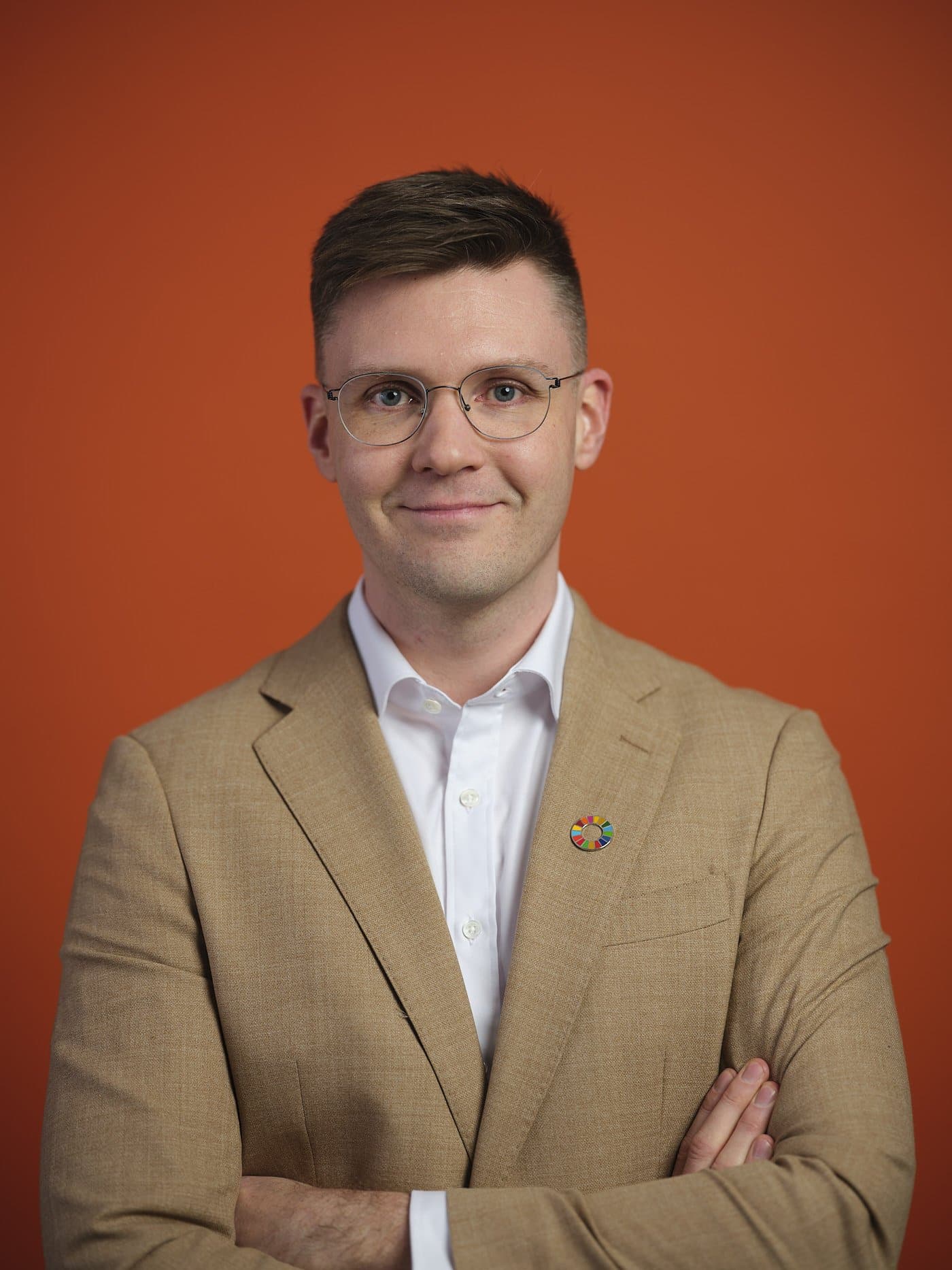
115. Elias Luhtaniemi (@Elias_L )

Despite his young age, Elias has managed to achieve so much, and on top of that, he comes across as a very smart and analytical investor with what I consider to be an accurate, systematically logical approach to analyzing companies. As a young parent and soon-to-graduate master’s student, he still manages to do so much beyond investing… it’s hard to fathom. Elias seems to value an analytical mindset, facts, and logic, which clearly guide his investment strategy—he is certainly not someone who trades on gut feeling.

His writings/tweet threads offer deep insights into small-cap companies, packed with well-digested information and fresh, well-reasoned perspectives. Elias’s posts are genuinely always a pleasure to read with great interest, whether about lesser-known companies or the most familiar ones. He knows how to highlight the most essential points, both good and bad, and most importantly, with sensible reasoning.

Elias is also a great example of how having the basics firmly down allows you to absorb and process information in a more versatile and independent way, which keeps you from experiencing so much FOMO or messing around in your investing—meaning data and reason lead the way. :slight_smile:

1. Tell us who you are in fifty words.

I am Elias Luhtaniemi, 24 years old, father of two children and husband to one wife. I will graduate next December with a Master of Science in Economics and Business Administration from Aalto University, where I major in accounting. This year, I worked for 8 months as an equity research intern, and this work is one option I could pursue after graduation. We live in Espoo.

2. Tell us three things few people in public know about you.

  • I’ve been half-deaf ever since 2000.
  • My wife is Swedish, but she grew up speaking Finnish at home.
  • Once on a car ride from Tampere down south, my future best man asked me what “activity” I’d wish for on my bachelor party if I could choose anything. I replied that I’d love the chance to talk to some enlightened investor or “investment guru” or something like that—I don’t remember the exact phrasing. My friend then asked Sauli Vilén, and for some strange reason, he agreed. So before the bachelor party, I got the chance, and we chatted on FaceTime for 2 hours about investing. :smiley: Nevöfoget

(ping @Sauli_Vilen, pinging so you see you’ve been mentioned)

3. What interests and hobbies do you have besides investing?

I run with goal-oriented training and play golf. In addition, our family has sailed all our lives, and it’s still a part of our summer vacations.

4. What does an ordinary weekday look like for you?

Now that I’ve been at university this autumn, mornings usually start between 6:30 and 8:30, depending on what time our two-year-old son wakes us up with his morning serenade. I take him to daycare between 8:00 and 10:00, after which I drive to campus or back home to study. I aim to study well enough to keep grades respectable (grade 3 and up, targeting around 3), after which I maximize my “workday” time for researching and thinking about companies, building and developing Excel models, and preparing potential threads. We pick up our son from daycare between 14:00 and 16:00, depending on our duties. Afternoons are spent hanging out with my family, running 2–3 times a week, catching up with friends, my brother and his family, or visiting my parents. Our son goes to sleep around eight, after which I usually don’t do anything productive before going to bed between 22:00 and 23:00.

From January to August, I worked as an equity research intern, which meant jumping straight out of bed onto the train and being at work around 7:00–7:30, grabbing a cup of coffee and breakfast at the office, and then waving my hands around for 8–9 hours.

5. What are you like as an investor?

I have never invested a single euro in OMXH25 companies or funds. (Of course, back when I owned Qt, it rose into the index). I currently hold 10 companies in my portfolio, and that’s roughly what I aim for. I only invest in companies whose balance sheet and cash flow logic I understand, and whose core industry and business dynamics I grasp, which also ties into that balance sheet.

So I don’t have any grand investment philosophy behind what I do, but one rule that holds true is that I invest—and always have invested—in small caps. I conduct thorough analysis so that I know what to expect from the company, giving me that sense of certainty and understanding regarding the company’s operations, future, and valuation.

To me, investing has always been a game where I want to be as good as possible, and I want to make as much return as possible given the risk I take. Investing never started for me from the perspective of building wealth or securing the future, but rather out of genuine curiosity toward companies, business models, and investing as a game. Of course, the chance to find a great investment and earn high returns has always been appealing, but the core mission was never steady wealth accumulation (e.g., index investing).

6. What is your investing history like?

I don’t really know where my interest in investing started. At home, we never talked about investing or funds, etc., but business, business development, company culture, and the like are discussed in our family almost every time we gather. Plus, between my brothers and me, these topics come up almost too often. So we frequently discuss very “operational” matters, but no one else in our family does stock picking.

2014/2015, the seed of investing is planted. In social studies class, there was an investment competition where we had to pick stocks, and the winner was whoever had the juiciest return. I didn’t know any companies, but my older brother was in business school, so I asked him, and he suggested Comptel. I bought Comptel and won. Maybe that’s where the interest in investing began.

2017 My first stock purchase. At 17, after starting work at a K-Supermarket in early winter, I made my first stock investment, which was Silmäasema. I still didn’t know anything about anything, but I wanted to own a stock, and Silmäasema happened to be listing conveniently right around that time.

2018 Inderes comes along. I came across Inderes in the summer of 2018 after returning to Finland from the US, where I spent an exchange year. After that, active study of investing began, mainly by grilling my older brother about valuation multiples and income statement line items. Google was also a big help when I was “studying” valuation multiples. I don’t remember my 2018 stock purchases in detail, because my account was with Nordea back then, and I’m no longer a Nordea customer.

In May 2019, actual investing and stock picking kicked off on Nordnet. The first stock purchase appears to have been Suomen Hoivatilat Oy—this wasn’t my own pick; my dad suggested it, I believe. In 2019, I also bought Incap (this was my older brother’s suggestion, not my own pick), which is my longest-held stock position and one I still own today. In addition, Kamux was added in 2019. I didn’t buy that many stocks, simply for the natural reason that I didn’t have much money.

In November 2019, I started investing the money of my then-girlfriend, now-wife (since I didn’t have much myself), aiming to make long-term, “well-reasoned” stock picks there. During the COVID dip, picks like Kamux, Qt, and Revenio ended up in that portfolio; later in 2021, names like Efecte, Rapala, Sievi Capital, Wulff, Avidly, and Tecnotree were added.

In 2022, I bought HelloFresh, Aallon Group, Harvia, and North Media. I sold Harvia quite quickly at €19 and €21 because I hadn’t done my own analysis on it; I had just followed the crowd buying this popular retail favorite, and I wanted to try being cleverer in this game and find something of my own. :smiley: Regarding the sales shown in the image, it’s worth noting that the sales in Aallon Group, Wulff, HelloFresh, Incap, and North Media weren’t actually sales; I simply transferred all the shares to another portfolio in March 2023.

I only started having the ability to make genuinely reasoned stock picks in H2 2022 or early 2023; before that, everything was more or less foolishness, inexperience, and randomness.

As my stock-picking abilities grew, my current investment style took shape: a concentrated portfolio of around 10 companies, exclusively small caps, whose industries and business opportunities I understand. Investing evolves every day, and this will surely evolve into something different in the future. I believe my focus will always remain in the small-cap space.

7. What does your portfolio look like? If you were forced to hold two stocks in your portfolio for at least five years, which ones would they be and why?

I own 10 companies right now, of which the top 5 make up 72% of the portfolio. 7.7% is in cash, and everything is “thoroughly” analyzed—or at least time has been spent, which doesn’t inherently say anything about quality.

HelloFresh has risen from 15% in July to about 33%, and it’s currently under review as to whether that’s too much.

NoHo Partners accounts for about 12% of the portfolio. I bought it in May and July 2023, and added more now in December. I am closely monitoring debt developments and whether the company transforms into a more opaque investment company. I believe next year could already be quite good for them as interest expenses decline and the company’s financial position clarifies. BBS also holds potential, though I don’t think the market is paying much attention to it yet.

As a third one, I could mention (Incap + Note); I kind of look at them together as one investment, even though they are two separate companies.

Two stocks to HODL?

Maybe I’d still bet on HelloFresh, because I believe the company is of high quality. Emphasis on believe, because in terms of numbers, it hasn’t been over the last 3 years, and just looking on the surface gives no reason to assume it is. Nor am I 100% sure yet that the company isn’t just a discount-dispensing machine that can’t realistically ever achieve very strong margins without substantially declining revenue.

Incap: let’s place a bet that the largest customer doesn’t pull any tricks, Incap makes another good acquisition, and the market starts growing at that 7% annual pace again.

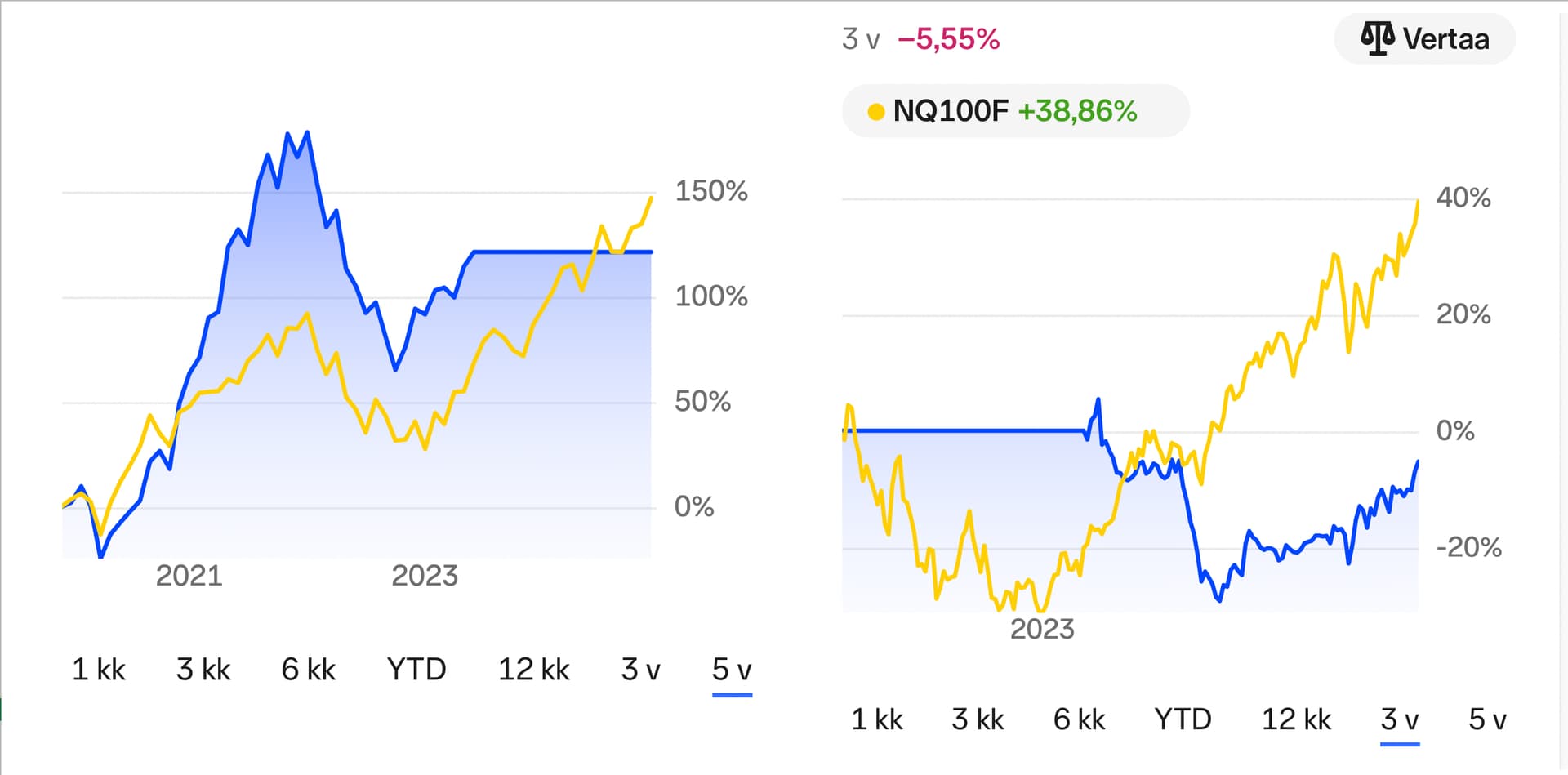
Portfolio performance: Before I moved the portfolio to another account, the return was 121% from 09/2019 to 03/2023, and after the transfer from 03/2023 to 12/2024, the return has been -5.55%. YTD 2024 is 22.3%.
8. What were the last two stocks you sold from your portfolio? Explain your rationale for selling.

Fondia

Fondia in October after Q3—this was supposed to be a company returning to decent growth and thereby recovering profitability to a commendable level, but growth seems to be stuck hard at rock bottom, resulting in weak profitability.

In a way, Fondia was/is “Small Cap Value”, and a very wise person at my work last year said that small cap value is a value trap if they stay small. The trigger I was waiting for (a return to growth) didn’t materialize, so I just lost patience waiting.

Aallon Group—This is also somewhat of a small cap value play that isn’t really growing, preventing the valuation from unlocking. I do like the company and its straightforward, no-frills bolt-on acquisition strategy.

9. What does your stock-picking process normally look like, step by step?

Companies cross my radar constantly or sit right in front of my eyes, and occasionally something sparks my interest, kicking off my research.

I always start by looking at valuation, pondering whether there could be a strong return on offer and whether it’s even worth looking further. I look at EV/Sales and EV/EBIT and reflect these against EBIT margin potential and growth. This gives you a ballpark valuation pretty quickly. I also look at the balance sheet, debt levels, and cash flow profile. The cash flow profile can then be compared to today’s valuation multiples.

Next, I look at history and build a model in Excel, where I compile historical data; I always want to find the reasons behind financial developments in CEO reviews, earnings calls, etc. In a way, I just want to learn to read the company’s communication, management’s “say-to-do” ratio, and its track record, which can then teach you something about the future and potential future growth and profitability.

10. In fifty words, what do you think of each of the following as investment opportunities?

  • Incap

EMS companies occupy a relatively weak position in the value chain, and pricing is more or less dictated to them. Companies must continuously improve efficiency to maintain solid profitability. Incap has a proven recipe for this: outstanding cost discipline and decentralized decision-making down to business units, enabling agile adaptation to customer needs.

  • North Media

The company is interesting to follow even if you never invest. Rarely do you come across a Nordic company whose liquid assets roughly equal its market cap, with a non-cyclical business trading around 2x EBIT alongside solid cash flow. Next year, the SDR integration should be completed, and earnings from that deal should start materializing.

  • Puuilo

Great management and the right culture for this business. No distractions or fluff, keeping all costs firmly in check. A razor-sharp focus on their customer segment with exceptionally strong L4L growth track records. Replicating the concept as long as runway remains, then turning into a dividend machine or identifying new growth drivers. Reflected in the valuation, too.

  • Tokmanni

I don’t really know much about Tokmanni. It was a strong case from 2018 onward, but post-COVID has been bumpier. I don’t really know what Tokmanni wants to be; it’s somewhat of a grocery store, but carries all kinds of general merchandise, too. In my view, it lacks the clear focus of Puuilo.

11. What are your five most important valuation multiples? Justify your choices.

EV/EBIT, EV/Sales, P/E, and in a way EV/FCFF and P/FCFE. EV-based multiples are the ones through which I form my initial read on valuation. In a sense, cash flow multiples matter because while I don’t necessarily calculate them explicitly, I assess normalized cash conversion, balance sheet size and efficiency, and how multiples derived from the income statement reflect against these. The cash flow profile (and growth, of course) justifies or fails to justify certain multiples. Valuation multiples don’t offer much value in isolation, as you must reflect them against the company’s lifecycle stage, market, and industry before judging whether something is cheap or expensive.

12. What has been your single biggest mistake in investing, and what did you learn from it?

There are so many. In this text, I’ve detailed my buys and sells, but those are all from a portfolio based on stock picking and analysis. With my other portfolio, I’ve messed around to my heart’s content, fully aware that I’m making these mistakes now as a broke student to learn on the cheap. You have to make mistakes at some point anyway. I’ll mention perhaps the stupidest and most embarrassing one.

PowerBand Solutions. I bought the company after coming across it on Twitter; I studied its business model and listened to CEO interviews on YouTube. I couldn’t even find a proper balance sheet or cash flow statement for the company, and they had outrageous executive stock-based compensation. I thought, “This is a great penny stock, and it’s going to take off.” I believe the company has since gone bankrupt. That mistake cost around €900.

13. If you could visit only five websites for your investing activities, which would you choose and why? You cannot mention X.

I don’t know if I can even come up with five, but all company IR pages, Inderes, TIKR, and TradingView.

IR pages: Everything is found here, so naturally.

Inderes: Without exaggeration, I’ve visited Inderes’s site practically every day since around 2019. And I still visit Inderes daily among the very first things I do in the morning.

TIKR: This is a great site covering company valuation, earnings, balance sheets, cash flow, and basically everything you need to know when looking at financial performance.

TradingView: I like checking roughly where a stock trades relative to moving averages, etc. I casually check how my holdings look, and when researching a new company, I usually look to see what the technical vibe is like.

14. If you had to choose three forum members and three Inderes employees to manage your portfolio, who would you choose and why?

Verneri, Juha, Olli Koponen; Pohjolan Eka, Timontti, Salkku-Mauri.

Verneri will find all the relevant illiquid Finnish and Swedish small and micro-caps for my portfolio. Verneri seems to stick to his circle of competence without wandering off to buy whatever the crowd is chasing. Juha is an experienced analyst, and I can’t really think of a single reason not to pick him. I believe he sees right through companies, and no silly corporate buzzwords get past him. Someone needs to take opportunistic trades, too, and based on my understanding, Olli knows this craft as well :smiley:

Timontti does very deep analysis and goes far beyond merely researching a company. He knows how to uncover attractive targets across the Nordics. Pohjolan Eka is a realist and will surely find those winning companies that others overlook. Salkku-Mauri also does thorough fundamental analysis, and I trust his ability to spot good cases.

(ping @Verneri_Pulkkinen, @Juha_Kinnunen, @Olli_Koponen, @Pohjolan_Eka, @timontti and @Mauri, pinged you guys because you were mentioned, regards Alokas :slight_smile: )

15. What does the Inderes Forum give you that you can’t get elsewhere?

The forum provides information you simply can’t find anywhere else. Breaking rumors and insights pop up here rapidly because an army of people is constantly tracking what’s happening. On your own, you couldn’t get nearly as much information as quickly as you do through the forum.

16. How do you manage your emotions in investing—for instance, avoiding FOMO? Have you read or studied investor psychology?

I haven’t read or studied it. In my “messing-around” portfolio, I used to occasionally FOMO into leveraged index plays, but I haven’t FOMO’d into anything probably since October 2022, which was the last time I took a trade with Nordnet’s leveraged index products. Today, I am an investor; I don’t give myself permission to make trades because I don’t have time for that, and I didn’t know how to manage my emotions doing it. As an investor, I invest in companies based on fundamental analysis and hold them as long as my thesis holds. If I feel I understand the company and trust it, I don’t bother stressing too much over price drops (e.g., Incap dropped -72% and I did absolutely nothing, didn’t even buy the dip, and it worked out fine this time—which involved plenty of luck).

17. What would today’s Elias say to the Elias who just started investing?

Even though making mistakes while young and broke is fine, there’s no need to make so many of them. For instance, trading leveraged products. Probably wasted several thousand euros on that.

18. Why do you invest? Do you have specific euro-denominated or percentage targets in investing?

Of course, I want to generate the highest possible returns for as long as possible. This is my most important hobby and a game I love playing. That has always been the starting point for investing. It just happens to be one of the most interesting things I could possibly spend my time on. I have no specific euro targets, but I add money to the portfolio—though I don’t neurotically save and invest merely for the sake of saving. I believe wealth growth is a byproduct that emerges through this passion, and there’s certainly no harm in that.

19. How could Alokas learn to better understand company valuation levels so they could genuinely be used in stock picking?

I have about 5–6 years of active investing study behind me, and if that gives me enough merit to be listened to, here are a few thoughts:

Personally, I consider it important to understand a company’s potential profitability level at maturity, along with its growth prospects. Furthermore, you need to recognize—or at least infer—what stage of its lifecycle the company is in right now; that tells you what kind of valuation would be acceptable. Additionally, you must identify what stage of the cycle the market itself is in. Buying growth and profitability driven by a market peak might not be wise, even if the valuation looks lower than peers, etc.

Once you put in the legwork to examine a company’s potential mature-state level, its lifecycle stage, and the market cycle—and how that reflects on the company’s valuation—you can make educated guesses on whether the valuation is high or low.

20. What would you like to thank the Finnish investing community for?

Inderes should probably win some Mental Health Award of the Year. The growth of loneliness is a megatrend across Western societies, and I believe investing—enriched by the Inderes community—can provide a huge sense of meaning and belonging for many individuals. Human animals need community, and the investing community can serve as a wonderful one.


Thank you, Elias, for the fantastic answers!

Elias has done his groundwork thoroughly, continued his studies, and, above all, remained hardworking—he’s also wise in approaching things objectively without unnecessary emotional drama. With fact-based, calm execution, sound self-reflection, and an eager appetite for learning, he can go anywhere—and he has certainly achieved a lot in life already. :slight_smile:

Elias has 952 followers, which is way too few; if you are interested in investing and especially stock picking, Elias is a must-follow:

Thank you, and have a great weekend! :slight_smile:

62 Likes

116. Ilkka6

Ilkka is one of the high-quality contributors on our Forum, making an essential contribution to the most important offering of this board: investment discussion. He is always professional, backs up his points thoroughly, and never resorts to “shallow remarks.” Another big plus is that he is a talented writer who knows how to articulate his thoughts nicely. :slight_smile:

Ilkka has become particularly well-known for his excellent company spotlight series, in which he has showcased dozens of Finnish companies that are not yet listed on the stock exchange. With their high quality and uniqueness, these company overviews have achieved great popularity. Here is a link to the first post in the company spotlight series:

Ilkka is not just a quality writer, but a producer of unique and rich investment content who has brought a wealth of interesting information to our Forum investors—along with plenty of laughs through his memes. :slight_smile:


1. Tell us who you are in fifty words.

I’m Ilkka (the number in my username is random), a nerd and retail investor from Helsinki. Currently, I make a living from investments. Previously, I worked in specialist IT roles; now, I focus on my own projects.

2. Tell us three things about yourself that few people publicly know.

I’m a fan of open-source software and open content. For example, I like Linux, and it has been the sole operating system on my personal computers for over 20 years. I used to be very active in contributing to and maintaining the English Wikipedia—still am, but to a lesser extent. :nerd_face:

As an admirer of Hong Kong, I’ve visited several times. My interest began with Hong Kong kung fu and crime movies, of which I’ve probably watched a three-digit number over the years. The administration’s recent crackdowns on freedom of speech over the past few years have been genuinely saddening. :slightly_frowning_face:

I enjoy a wide range of music, from synthwave to opera and prog rock. Right now, my absolute favorite band is The Midnight. For listening to music—and to the delight of my neighbors—I built two remarkably hefty active subwoofers into my apartment’s living room stereo setup, and I’m currently planning to build new main speakers. :smiley:

3. What interests and hobbies do you have besides investing?

I enjoy video games; for example, a group of friends and I have been playing in the same shared survival multiplayer world in Minecraft for over 11 years. Besides that, I especially like RPGs, adventure games, and action-adventure games, but I also have favorites across many other genres.

The outdoors and nature are also among my favorite things, especially the sea and starry night skies.

Additionally, I like sci-fi and fantasy, cities and architecture/urban planning, as well as history, DIY tinkering, and music.

4. What does an ordinary weekday look like for you?

I used to work in specialist IT roles, but a bit over two years ago I needed a change, so I pivoted to working on my own projects—I might share more about those later. For this reason, I don’t really have typical weekdays or very rigid routines right now. To get things done, I set up “sprints” for myself—essentially to-do lists for a week, a couple of weeks, or a month.

5. What kind of investor are you?

Fundamentally, my style is buy-and-hold, though I make shorter-term trades every now and then.

I think about investment options through various frameworks and themes. One framework, for example, is looking at and categorizing where I spend my own money, and, if possible, trying to find investment targets that correspond to my spending habits. Additionally, I ponder themes and trends: how things will change in the future, as well as how they won’t change. I also try to consider the compounding effects of overlapping developments, because in the best-case scenario, that’s where you find exceptionally powerful compounding dynamics.

However, themes, megatrends, and the like aren’t sufficient reasons on their own to invest in anything: you can correctly forecast a broad development, but if you don’t find the right companies that possess sustainable competitive advantages, the investments will fall flat.

I don’t restrict myself to any single style; my portfolio contains or has contained growth rockets, quality companies, dividend payers, cyclicals, M&A compounders, etc. Some holdings also act as hedges.

6. What is your investment history like?

I’ve been interested in financial matters at least since early adulthood, an interest fostered by coming from an entrepreneurial family. However, I only started investing around the beginning of the last decade, when my income began leaving “spare” cash. I jumped straight into direct stock picking, and my first stock was probably Nordea. Fairly soon, I added international stocks as well. I gradually bumped up my savings rate until it reached quite a high level. A fairly large number of different securities have passed through the portfolio over the years; there have been both successes and flops along the way, but fortunately far more—and far bigger—successes than mistakes, including one 10-bagger.

I view investing as cultivating a continuous tailwind. Even though I aim to invest with a long-term horizon, I’ve never really thought of the goal of investing as lying purely in some distant future. Rather, every invested euro improves my financial situation immediately, even if the potential returns are naturally realized in the future.

7. What is your portfolio like? Which three stocks in your portfolio do you trust the most, and why?

The portfolio is certainly larger than average, though not exceptionally massive considering I live off its returns. It is quite diversified and currently holds 40 companies, though the weightings vary significantly. Various themes are represented in one way or another, such as digitalization, renewable energy, urbanization, food, and finance. The companies are based in Finland, elsewhere in Europe, and North America.

Let’s highlight the three largest:

  1. Accenture is a global consulting and IT services company. Developing information systems is an eternal need, and since “Aksu” counts most of the world’s largest corporations and public organizations as clients, they have outstanding visibility into client demand. This insight allows them to steer their offering in the right direction, meaning the company isn’t reliant on the success of any single technology. Earnings, cash flow, and the balance sheet are all strong, and excess cash is returned to shareholders via growing dividends and share buybacks.

  2. The largest and most profitable part of Alphabet is Google Search. However, I see significantly more untapped potential in YouTube (where I am a paying subscriber), cloud services, AI, quantum computing, and so forth. Beyond the usual risks, regulatory scrutiny is a major consideration, but the valuation looks fairly modest.

  3. I funnel my spare change into Kesko’s cash registers almost daily, so it’s pleasant to own a piece of it too. In grocery retail, Kesko clearly stands out favorably in my view, even though I regularly visit competitors’ stores as well. Building and technical trade are suffering from the economic cycle, but I believe the situation will improve. Over time, I expect growing earnings and distributions.

8. Which two stocks did you buy most recently? What was your rationale for buying them?

Generally, I initiate new positions as quite small stakes and potentially build them up gradually through dollar-cost averaging. Canatu and Kalmar are the most recent additions to the portfolio, but the positions are small, and I haven’t decided yet whether I’ll increase them.

With Canatu, the technology’s potential is obviously intriguing, although the business, competitive landscape, and customer base might prove too difficult to fully grasp. With Kalmar, the electrification of cargo handling machinery presents interesting opportunities, but I still need to study and reflect further—as a stock picker, not everything that seems nice to own is necessarily worth holding if you want to avoid portfolio bloat.

9. What does your typical stock-picking process look like, step by step?

Underpinning everything is continuous research into companies. Currently, my broadest watchlist contains around 2,600 categorized companies worldwide, including private companies. On the one hand, I regularly add more firms to that list; on the other, I filter out smaller groups for closer inspection, and sometimes something interesting emerges. Ideas can pop up from anywhere, really. I also try to see what analysts and other investors think of companies; that often reveals things I might have overlooked myself.

10. What does your typical stock-selling process look like, step by step?

I prefer to hold companies for as long as possible, but if things take a turn for the worse or I change my mind for another reason, I sell. I might also rotate out of an idea that feels weaker into one that looks better. If a single position becomes excessively large, I may trim it.

11. How do you monitor the companies already in your portfolio?

To varying degrees, depending on the nature and situation of the business: for many, I actively track releases, news, and discussions. Furthermore, monitoring many firms naturally involves some “Lynchian” fieldwork—evaluating products and services as an actual customer. However, there are also companies I follow more casually and intermittently.

12. You’ve introduced unlisted Finnish companies to us in the Forum Coffee Room. If you were forced to pick three of them to go public, which would you choose and why?

Let’s pick each for a different reason:

  1. The Helsinki stock exchange could use more tech growth companies, so one of those—say, Aiven.
  2. An exchange listing provides companies with a funding channel for growth and greater brand recognition. Finland’s tourism industry surely holds far more potential than is currently realized, so Lapland Hotels & Safaris.
  3. It’s nice to own a company whose products or services you use yourself, so Fazer.

13. What are your three best traits as an investor? And tell us one area where you would particularly like to improve regarding investing, and why?

I’m curious, and I enjoy learning new things and evaluating both opportunities and threats. I’m also quite calm; I don’t chase excessive risk, and I generally don’t make big decisions rashly.

As for areas to improve—of which there are many—I could at least mention wanting to develop better tools for personal use; for instance, using AI might help speed up researching and screening various qualitative factors.

14. You are very frugal; what are your current monthly expenses? Please share your top three saving tips for forum members, thank you.

I am fairly frugal. My “mandatory” minimum expenses are currently around €400–500 a month, but my real, actual spending is roughly double that because I splurge on all kinds of extra fun. The low baseline is primarily explained by big-picture life circumstances: an apartment with no debt in a housing company that currently charges no maintenance fees, plus not owning a car. Additionally, pinching pennies on other matters is much easier when you have more free time.

Most of the best things in life are free, or at least very cheap—such as spending time with family and friends, computer games, studying, cooking good food yourself, outdoor activities, etc.

If you want to save money, it pays to figure out what you are spending money on and what you actually want to spend it on. Almost every euro spent is a choice. Perhaps my best saving tip is that coming up with ways to save is fun!

I reserve the right for my expenses to change at any moment; who knows, I might suddenly decide to renovate some ancient ruins or build a sailboat.

15. What are your five most important sources of information for stock picking, excluding companies’ own materials and Inderes?

Traditional financial media (including Bloomberg, Financial Times, domestic outlets, etc.) and YouTube, where I’d highlight the Norges Bank Investment Management channel—which features excellent CEO interviews—and valuation professor Aswath Damodaran, whose channel offers practical case studies alongside general lectures (I don’t always agree with Damodaran, but you don’t have to). I also dig up some data from places like Nasdaq’s websites, and I usually track share prices on Google Finance.

16. You have to hand over your portfolio for five years to four forum members and two Inderes team members. Who would you choose and why?

There are plenty of great candidates, but perhaps:

@Laatuohjaus and @Jackwelshh to make sure the portfolio holds quality companies and international diversification

@Osinkoseilaaja to remind everyone that receiving dividends is nice too

@Roope_K to bring more tech/AI perspectives to the table

@Marianne_Palmu for macro perspectives, among other things, plus her recent win in the AP portfolio competition

@Frans-Mikael_Rostedt to keep an eye on Accenture, pitch small-cap ideas, and because his portfolio review interview last week made me consider buying my namesake listed company

I’m picky about investment targets, so I would draft extensive upfront guidelines on everything they are not allowed to invest in.

17. Tell us the three best investment books you’ve read and explain your choices.

I’ve certainly read some investment books, but right now none come to mind that I would wholeheartedly recommend. I’ll have to look for better ones!

18. What kind of goals do you have regarding investing?

Financially, the same as before: maintaining and building on financial security and tailwinds. Furthermore, investing provides a continuous learning process about how the world works, and it’s a discipline where you can always improve.

19. How could Alokas learn to find quality companies for their portfolio that stand the test of time?

Current quality companies can be identified through metrics, for instance, and the forum’s “Global Quality Companies” thread has plenty of discussion and candidates on this. From there, it’s worth considering whether the company that caught your interest continues to develop its operations for the long haul and whether the ingredients for success remain in place going forward—is there room to grow, and are the competitive advantages durable? Quality companies usually always look expensive, but they “grow into their valuations” over time, often surprisingly fast—and then, on the flip side, they continue to look expensive all the time. Dollar-cost averaging can often be beneficial with these as well.

20. What would you like to thank Inderes and the forum members for in particular?

The analysts and community team do a wonderful job for the benefit of investors, and the tech team develops the platform by listening to users. The forum provides interesting insights and information, and the discussion climate is almost always pleasant, friendly, and supportive. The credit belongs primarily to the participants, but the moderators play a vital role as well! :slightly_smiling_face:


Thank you, Ilkka, for the wonderful answers! :pray:

Anyone who wants to can draw a great deal of practical tools and food for thought from these interviews for their own investing journey. :slight_smile:

I have immense appreciation for writers like Ilkka, who bring so much added value to investors and genuinely invest their time and effort for the benefit of forum members. Through his style, he fosters both fruitful, rich discussions and a great atmosphere.

Thank you, and have a wonderful weekend, fellow investors! :slight_smile:

85 Likes

Returning to Ilkka:

Here are the much-discussed company presentations by Ilkka, in order and linked. :slight_smile:

  1. Paulig
  2. KWH-yhtymä
  3. Cityvarasto
  4. Iceye
  5. Luja-yhtiöt
  6. St1
  7. Hostaway
  8. Vitabalans
  9. Algol-konserni
  10. Mantsinen Group
  11. Bluefors
  12. Veho
  13. Avant Tecno
  14. Lindström
  15. LähiTapiola
  16. Forcit
  17. Otava
  18. Vexve
  19. Etola-yhtiöt
  20. Framery
  21. Roschier
  22. Versowood
  23. Aiven
  24. Raumaster
  25. Wihuri
  26. Lapland Hotels & Safaris
  27. Planmeca
  28. GRK
  29. Wiklöf Holding
  30. Fazer
  31. Kumera
  32. Sini-konserni
  33. Kuusakoski
  34. Purso Group
  35. Hereditas
  36. Berner
  37. Snellman
  38. SOL-konserni (emoyhtiö Solemo Oy)
  39. Reaktor
  40. Broman
  41. Elomatic
  42. Woikoski
  43. Veisto
  44. Tapojärvi
  45. Eriksson Capital
  46. Polttimo Group
  47. MSK Group
  48. Rani Plast

Good things are worth “promoting”. :point_up_2:

Have a relaxed Sunday! :slight_smile:

20 Likes

This Friday, I’ll be interviewing a friend who has written for the Forum and been on Inderespod. He has a genuinely diverse CV and a good understanding of investing, so he deserved to be “forced” into an interview with me. :slight_smile:

Have a great start to the week, everyone!

8 Likes

117. Timo Huhtamäki

Timo is a truly well-rounded, accomplished finance and sustainability professional whose vision and expertise span from the circular economy to investing. He combines an analytical mindset, strong presentation skills, and the ability to highlight both the big picture and fine details—qualities readily apparent when reading his Forum posts, among other things. His career is a testament to how strategic thinking and goal-oriented execution can open doors not only in the corporate world, but also in societal advocacy.

Timo’s professional roles range from serving as an EU Climate Pact Ambassador to economic advocacy, yet he is also skilled at diving deep into investing—which is precisely why I invited him for this interview. His posts always offer fresh perspectives and well-reasoned analyses of companies, whether covering a familiar business or an entirely new target. Timo’s approach is calm and evidence-based, reflected in how he makes decisions free from extraneous noise or the fear of missing out.

Listening to Timo and reading his texts, one quickly notices his focus on concrete solutions. This ability to bridge grand visions with practical ideas makes Timo an exceptional guy.


1. Tell us who you are in fifty words.

I’m a 40-year-old entrepreneur and investor. For my day job, I run Emmy Clothing Company, which I co-own—the Nordics’ largest marketplace for pre-owned branded apparel. Previously, I served as CMO at Raisio, Biolan, and Harvia Plc, and in executive management at Tori.fi. Last November, I was named Responsible Influencer of the Year, largely, I’m told, for advocating how economic success and ecological carrying capacity can align through the circular economy. I’m also an EU Commission-appointed Climate Pact Ambassador.

2. Tell us three things few people publicly know about you.

  1. I ghostwrite for several public figures and corporate leaders who want to communicate with strong vision. This started about eight years ago when a listed company CEO discreetly asked for help with his social media posts, feeling too embarrassed to ask his internal comms team. He quickly gained notable social media visibility, which led to a few more assignments. Since then, I’ve also written press releases for those same companies.
  2. My first degree is from the National Defence University, specializing in armored units. It has been intriguing to watch the escalation of hybrid warfare, which has played out strictly by the textbook. Unfortunately, we haven’t seen the whole show yet.
  3. Once retired, I plan to buy an apartment in Berlin. We’ll see if you can take a train there by then.

3. What interests and hobbies do you have besides investing?

I hit the gym three times a week and try to read a lot. I’ve strived to build my career around things I’m genuinely excited about, keeping my intrinsic motivation strong at work. Consequently, I rarely distinguish work or social media engagement from my other interests. Investing is a hobby, but I don’t get excited about conventional investment literature. Instead, my best results have come from investments within my own circle of competence. The foundation for these was built by exploring topics completely outside investment books—such as societal shifts, climate, consumer retail, marketing, or the circular economy.

4. What does a typical weekday look like for you?

I wake up at 6:30 AM and eat oatmeal with berries and nuts. Almost every morning, I draft a social media post over my morning porridge. This ensures that communication capital compounds over time.

A CEO’s day job is fundamentally that of an influencer; beyond recurring weekly meetings, I take part in critical projects and actively drive customer accounts, partnerships, and visibility at Emmy, alongside maintaining proactive investor relations. Two to three evenings a week involve evening meetings or speaking engagements, plus board meetings a couple of times a month—one for Emmy and one for Pispala Clothing Oy.

5. You’ve had—and continue to have—such a diverse and fascinating career. Could you share more about it? 😊

The circular economy has run through my entire career. The spark caught during my childhood in the 1990s recession, when we frequented flea markets. In 2010, I was appointed Marketing Director at Biolan, where I immersed myself in the circular economy as a business, gradually building my profile as an advocate in the field. I see myself with one foot in business and the other in societal impact. I spent nine years as a marketing director, then joined executive leadership at Tori.fi, and stepped into the CEO role at Emmy in 2021.

I consider it invaluable to have executive team experience across two listed companies, a family-owned business, an angel-backed startup, and a private equity-backed portfolio company (CapMan). It opened my eyes to how profoundly owners influence a business. I’ve also been exceptionally lucky with bosses; my supervisors consistently provided room to grow and encouraged bold moves.

5. What kind of investor are you?

Three things come to mind:

  1. My earliest steps in investing taught me just how hard it is to pick winners. Committing to long-term index investing has been one of my best decisions. I go to great lengths to avoid interrupting compound interest. Because my horizon is long, my equity allocation is higher than what the doctor ordered. Among other things, I hold an investment loan against a well-diversified portfolio.
  2. I consider patience and a strong stomach to be my competitive edge. Many investors chase quick gains, creating opportunities for those with well-conditioned patience muscles and the endurance to tolerate the slow, boring compound effect. I believe market psychology will continue to cycle between fear and greed. At least once a decade, something entirely unforeseen hits the world, opening prime buying opportunities.
  3. What has demanded the most thought from me is the impact of climate change. Without profound systemic change, raw materials will fall short for everyone within a few decades. Biodiversity is declining at such a pace that we are inevitably headed for trouble unless the efficacy of mitigation measures improves rapidly. This poses a massive transformation challenge for the current economic system, which must inevitably reflect on equity markets as a globally circulating pool of $140 trillion in assets is forced into climate action. The importance of sustainability is, I believe, far greater than we can currently imagine. We will see many more “green stimulus packages” across every continent once the impacts of climate change fully materialize.

6. What is your investing history like?

I started buying shares through Janakkala’s Osuuspankki cooperative bank back in the day. The “value stocks” pitched by the investment advisor included Stockmann, Finnair, and Nokia, which were supposedly “stable value plays.” I didn’t invest in a single one of those; instead, I first bought OP shares when the cooperative group still had listed units. That taught me that the “value stocks” of any given era rarely stay that way in the future, and picking winners is difficult. Therefore, in my active investing, I focus solely on companies and industries I can truly understand and track, leaving the rest to index funds.

7. What does your portfolio look like? If you had to hold three stocks for ten years, which would you pick and why?

Today, a significant share of my investments is in companies I co-own, the second-largest portion is in a broadly diversified equity portfolio held for decades, and about one-fifth is in selected small-cap stocks where I hold a strong, personal investment thesis.

For a ten-year portfolio, I would pick Investor AB, CapMan, and NoHo Partners.

Investor AB offers global diversification and the Wallenberg network at a discount. It also features roughly one-third unlisted companies and the high-quality private equity firm EQT. Its portfolio companies actively buy back shares, possess solid data and AI capabilities, and benefit from secular growth drivers.

CapMan has shifted its focus away from buyout investments toward more stable, long-term AUM business models, such as real estate, infrastructure, and natural capital investing. Pension insurers and institutional allocations to private assets are growing, and regulatory demands will surely drive industry consolidation toward larger players. CapMan focuses on sustainable investing, and roughly 50% of its current market cap is backed by unlisted investments on its balance sheet, so you gain exposure to an unlisted asset portfolio alongside operating earnings.

NoHo Partners is, I believe, doing what retail did several decades ago. We’ve only seen the beginning of consolidation in the restaurant chain sector, and the M&A potential is vast. As the platform grows, so does the opportunity to centralize raw material sourcing along with OPEX and CAPEX procurement, driving profitable expansion. At its best, NoHo could become Europe’s “Kesko of restaurants,” provided they maintain momentum.

8. What does your typical stock-picking process look like step-by-step?

I monitor stocks within my circle of competence and buy when valuations reach attractive levels. I don’t follow a formal stock-picking process that scans large sets of companies by financial ratios; rather, I track a select group of companies, almost all of which I have personal experience with. All of them also carry a realistic M&A option that could materialize at any moment, and buyout bids have delivered great results for my portfolio. I almost always buy when the broader market pulls back and my favorite stock takes a hit alongside it.

9. What does your fund-selection process look like step-by-step?

For funds, I strictly invest in index funds through small monthly automated contributions. Because investment funds don’t pay dividend taxes on distributions received, this enables optimal compounding over time at minimal costs.

10. How do you account for ESG/sustainability issues in your investing? How can an everyday investor make more responsible investment choices?

There’s no one-size-fits-all solution here; you need to grasp business models that build a more sustainable future. In my view, the core business model itself must be sustainable—the guiding purpose of the company must provide customers with a responsible market alternative. Businesses reliant on ever-increasing material consumption, consumer overconsumption habits, animal-based agriculture, extended freight distances, or margins dependent on cheap labor in the Global South are on my watchlist. I believe these models will eventually run their course. Truly sustainable players are often industry disruptors within these very problem areas, making them worth tracking if you’re interested in responsible investing.

11. What opportunities does the circular economy bring to investors now and in the future? How can people evaluate companies through a circular economy lens today?

The circular economy is a powerful, inevitable secular trend. Corporate readiness varies widely, and the beneficiaries are often indirect. When initiatives like the EU’s Digital Product Passport roll out, the winners will be companies that already make durable, long-lasting, circular-compliant products and have built workable ecosystems to extend product lifecycles. The circular economy also creates new infrastructure, like reverse logistics and specialized ERP systems. Circularity and the data economy are deeply interlinked, meaning data-rich operators hold a distinct head start. That’s why evaluating these capabilities across any company is vital, ensuring the circular transition doesn’t disrupt their entire business model.

12. Could Emmy go public one day? 😊

Right now, that’s not on the table. The secondhand market is transitioning into a services business model, and that journey has barely begun. In apparel especially, this shift is accelerated by ramping regulations and structural changes in consumer behavior, where more buyers start their shopping journey with pre-owned items. The secondhand fashion market represents only about 2% of the overall apparel industry, leaving immense room to grow. Personally, I believe we’ll see ongoing business model transformations around Emmy—one example being our “CircuRetail” innovation, where data guides sorted inventory by size, color, and brand into three Sokos department stores. The era of systemic retail innovation is just getting started. Down the road, an IPO could become an option to finance the next growth leap, but our owners have no such plans at present.

13. In fifty words, what are your thoughts on each of these investment targets below?

- CapMan

See answer above.

- Inderes

I like Inderes because it entered with a fresh, constructive approach to disrupt an industry that had long been conservative and frankly dusty. I appreciate its unique blend of mutually reinforcing business lines, unlike anything else out there. I also like the team and their execution culture. I’ve occasionally wondered whether their growth strategy would create the most shareholder value by scaling these IR products (AGM software, IR-events-as-a-service) internationally. Replicating the Finnish ecosystem abroad may be an uphill battle, but could they acquire European IR event organizers, roll out Inderes software to all of them, and build a pan-European IR services house blending software and service? Could domestic growth deepen into media business, given the finite pool of listed B2B clients—wonder if Alma would sell Arvopaperi magazine to Inderes?

- NoHo

See answer above.

- Ålandsbanken

Ålandsbanken is clearly positioned as a wealth management and relationship bank with a strong impact focus. Their grasp of Nordic equity markets is solid, customer satisfaction appears very high, and staff retention is long-term, signaling a healthy corporate culture. It gets surprisingly little attention as an investment and analysts often skip it, even though ÅB is a notable asset manager with a major share of its wealth and private banking profits stemming from Sweden. I’ve often thought Ålandsbanken has a great opening to grow its wealth management market share in mainland Finland, but it needs to step up its communication and boldly claim its space, especially across social media channels.

14. You hold diverse titles and have extensive experience. Which of your roles or jobs has best “schooled” you as an investor?

Working in a growth company, without question.

15. Looking at the remainder of this decade, which sectors do you find particularly attractive for investors, and why?

Secular trends deliver with the greatest certainty.

16. Shouldn’t Ålandsbanken be covered by Inderes? (You have 56 posts in its thread and have pointed out that Inderes doesn’t cover it!)

I’m positive this would bring ÅB more private banking and wealth management clients if they got to tell their equity story through Inderes. Daily trading volume is currently very thin, so ÅB might not recognize the full value of equity research coverage, but I believe the indirect benefits would be substantial.

17. You seem to possess an exceptionally broad general education for an investor. What role does general knowledge play in your investing?

I believe a significant share of alpha in investing comes from deep knowledge of an industry or structural macro trend.

18. What are your personal goals with investing? How have you concretely benefited from the wealth created through it?

Starting long-term investing in your twenties practically guarantees that by age 40, you reach a point where you can walk away from work whenever you want. Call it “fuck-you money”—it brings peace of mind and lets you work where your intrinsic motivation is highest. Investing has also been deeply educational, particularly while working in strategic planning and corporate finance.

19. How can an everyday investor learn to be more “environmentally friendly”?

An investor can think of the world in terms of materials, energy, and know-how. The answer to material usage is the circular economy; for energy, it’s renewables and energy efficiency; and know-how enables smarter operating models, like the sharing economy. Any company can become ecological by transforming its operations across these pillars to fit within planetary boundaries. That’s why every investment decision should be viewed through an environmental lens, asking whether the company’s business model is actively moving toward a resource-efficient world that stays within Earth’s ecological carrying capacity.

20. What would you like to thank Inderes and its Forum for?

When you want to change something, you must first spark interest and generate conversation. That shifts mindsets, which ultimately turns into action. Inderes and its community members have undoubtedly strengthened people’s relationship with investing and built wealth across Finland.


Thank you for the insightful answers, Timo! :slight_smile:

Many have likely noticed that “Timppa” can be found on the forum as @Timo_Huhtamaki. His posts and replies are always a pleasure to read.

I wholeheartedly agree with this takeaway from Timppa:
When you want to change something, you must first spark interest and generate conversation. That shifts mindsets, which ultimately turns into action. Inderes and its community members have undoubtedly strengthened people’s relationship with investing and built wealth across Finland.

I’ve noticed that more and more company threads are active, welcoming new high-quality contributors to the discussions—truly great to see. I also want to thank all the contributors and readers for the great community spirit and quality discussions on the Forum, even if the markets have served many of us a heavy bag of rotting cod over the past couple of years. :slight_smile:

Thank you, and have a great weekend!

77 Likes

Timo was, by the way, interviewed by @Marianne_Palmu last year. :slight_smile:

11 Likes

This Friday, we’re interviewing a guy especially known from X, who has high-quality investment-related writings and tweets. His writings/tweets often cover companies or specific industries. :slight_smile:

His writing language on X is English, and elsewhere Finnish. :slight_smile:

He has covered well, for example, consumer sector companies, various small caps, and sometimes larger companies too.

I eagerly await his answers.

Have a nice Monday everyone! :slight_smile:

11 Likes

118. Pentti Jokinen

I had the pleasure of interviewing Pentti Jokinen, familiar from Sijoitustieto & X, who is a versatile and passionate investor known especially for his analytical + in-depth investment-related writings. Pentti’s pieces combine well-thought-out analytical rigor with an ability to bring fresh perspectives to light—whether it’s consumer sector companies, small growth companies, or unpacking market sentiment.

His diligence and curiosity are clearly reflected in the way he examines emerging phenomena across both fundamentals and market movements. Pentti’s calm and fact-based approach makes his analyses high-quality and genuinely value-adding for investors. :slight_smile:

Guys like this are exactly the ones whose thoughts you want to read alongside analyst comments. Well-reasoned, fact-based writing offering new angles is truly valuable to investors. That’s why I strongly recommend reading pieces by Pentti and other similar writers, in addition to the “mandatory” Inderes material, of course (not instead of it :wink:).

1. Tell us who you are in fifty words.

I’m a family man just shy of forty, an M.Sc. in Engineering, entrepreneur, and investor from Helsinki. I’ve had and still have all kinds of interests throughout my life. I’m a curious guy with a tendency to dive deep into whatever catches my interest. I dream of big fish.

2. Tell us three things forum members don’t know about you.

If I had to choose just one food to eat for the rest of my life, it would be pistachios. You have to consider both taste and nutritional value, of course.

I’m a recovering gear nerd. I love kit and min-maxing, and I can endlessly compare and research all kinds of gear, mostly related to my hobbies. I usually try to buy used, but I still end up buying and selling too much stuff. Luckily it’s winding down; maybe I’m finally reaching a point where I have enough fly rods and the like to last a lifetime.

And then an investing-related story from last year: Jason Hirschman (@eighttrack180), who is held in high regard among microcap investors and has an insanely long track record, reached out to me regarding Theon. At the time, I was the only one talking about this Greek defense contractor on Twitter, and he wanted to get to know the company better. We chatted about Theon over Zoom for about an hour. He hardly needs to call up random Twitter accounts like mine for the money anymore. But his genuine passion for the craft—digging into companies and analyzing them—shone through in that brief encounter. An inspiring guy.

3. What interests and hobbies do you have? You can’t mention anything related to investing.

My biggest passion and longest-running hobby is fly fishing. Since I was young, it has taken me all over Finland and the world chasing various fishing spots. Even now in the summer, I pull several all-nighters chasing trout in the rapids of Central Finland. And I spend at least a week tent camping in the northern wilderness. Plus chasing pike at sea during the spring ice breakup and autumn storms.

Sports in general have also always been a major part of my life, in many forms. Climbing stands out as a primary sport that I did quite seriously for nearly a decade. As a byproduct of both fly fishing and climbing, I’ve developed a strong bond with nature and the outdoors.

Nowadays, my main sport is Brazilian Jiu-Jitsu.

BJJ is a grappling martial art similar to wrestling. I’ve been training it for about six years now, four times a week. I’ve competed a bit too, so there’s a goal-oriented mindset to some extent. But it still feels like I’m only at the very beginning of the journey of learning grappling.

So there’s something similar to investing: endless paths where, on one hand, you see enough progress all the time to keep your motivation up, but at the same time, you realize how little you actually understand. In any case, BJJ is an addictive sport that is great for both mind and body.

4. Could you describe what kind of investor you are?

If I had to pick one word to describe myself, it would be versatile.

I’m certainly not the best at dissecting accounting details in extreme depth, nor can I trade my ideas with anywhere near the efficiency that many others can.

However, I’m reasonably good at both: understanding a company’s fundamentals and putting them into the context of the broader market. If you roughly divide making money in the market into these two “extremes”:

If you know how to value a company so-called “perfectly,” you can pretty much ignore market movements, growth, sectors, and sentiment, and make money purely by buying companies below your own valuation. Some can do it, but very few.

On the other hand, if you can read and play the market exceptionally well, you don’t even necessarily need to know what the company does, and you can still trade profitably by focusing on technical analysis and other clues regarding market supply/demand balance. Some can do it, but very few.

It’s fascinating how few people even acknowledge the existence of both extremes.

In any case, I clearly focus more on the former: studying fundamentals and determining valuation. That means reading reports, wading through numbers, and finding information about the company and its products.

However, I use a lot of scenario thinking regarding the market in my investment decisions, a bit of technical analysis too, and I generally aim to understand market expectations for the company as accurately as possible. So I use trader tools as well.

Nowadays, I’m more of a contrarian investor; I’m interested in things and markets that are out of favor. I spend my time researching those. But I respect the market enough that I usually only jump to the bid side once the market has given some sort of signal that a turnaround is in sight and we are no longer in a free fall or grinding sideways. So I never buy “new lows”—trends are such a powerful (and irrational) phenomenon in the market. Though I’ve broken this rule too, of course.

I have the stamina to dig into companies day in, day out. That means I screen through a lot of companies on a surface level throughout the year. Inevitably, a fair share of interesting cases pop up at regular intervals.

I try to understand the few key factors essential to the company’s success and focus on those. Whether that’s a strongly growing market, a clear competitive edge, or something else.

I believe that the time spent researching and modeling a single company doesn’t endlessly correlate with investment success, especially when you factor in the opportunity cost—namely, researching other companies. Of course, the analysis needs to be done properly. But, for example, I very rarely build complete DCF models. Occasionally a rough one, just to better understand the company’s business model / unit economics, but hardly ever as part of valuation. If multiples aren’t enough to assess value, I feel you easily drift into the territory of “precision bias.”

Another aspect worth mentioning is that I change my mind often. “Strong opinions, loosely held,” or however the saying goes. So maybe next year I’d answer this interview completely differently. I guess it’s a strength in some sense that I haven’t locked myself into any fixed identity or dogma. But on the flip side, no crystal-clear investment identity or focus has formed over a long investing career.

5. Could you share your investing history?

Investing entered the picture to some extent at a very young age, as my father was an avid investor, so I was exposed to the topic at home. He also saved small amounts in my name, mostly in funds, but with a few stock picks too.

When I reached adulthood and started managing my own savings, I remember wondering for a long time how on earth this Kesko stock had cost so little back in the day (in the 90s) and so much now. I don’t recall the exact prices, and markkas turned into euros in between. But it was a clear multibagger, and that’s probably where the spark came from. As studies show, our first strong investing experiences heavily color our future attitudes toward investing.

I spent some time on the Kauppalehti forum back then, and around age twenty, I read Seppo Saario’s books and others for the first time. My interest picked up in the aftermath of the financial crisis, so by sheer luck, it was great timing. Especially considering that my focus was already outside Finland back then, mainly on the United States.

This definitely wasn’t based on any deep macroeconomic analysis or anything else rational—it just felt more tangible to invest in familiar brands like Apple and Nike, whose products I used and admired. Compared to something like Metso, which I didn’t understand at all on an intuitive level. It was definitely more luck than skill.

As a prime example of luck: I bought a reasonably significant position in Tesla (relative to my portfolio) in 2012–2013. And I sold during the 2018 “going private” episode. By the time I sold, I was starting to understand valuation better. So, in my great wisdom, I naturally deduced that it was insanely expensive. Well, “little did he know” and so on; I haven’t bothered calculating what that position would be worth today.

Of course, there have been plenty of genuinely bad investments along the way. I’ve also practiced trading a lot over the years, with rather modest results. Never day trading per se, but rather longer swing trades. Of course, I learned from that too, and I still follow some of those strategies today.

For some reason, it has always felt natural for me to cut ties with failing investments fairly quickly, so I haven’t suffered any massive individual blowups. On the other hand, this “caution” has led to unnecessary churn and caused those cases where I sold way too early. I could afford to take more risk when my conviction is strong.

Like many others, my investing journey kicked into another gear during the COVID era. Around the same time, I went through a career change, and I decided to take investing more seriously—both in terms of learning and, of course, with financial goals in mind, as I had accumulated a portfolio of decent size by then.

In recent years, the contrarian in me has distinctly come to the fore, and my focus has gradually shifted more toward smaller companies. For one thing, analyzing them feels considerably easier for a retail investor operating with limited resources. And on the other hand, competition in that space currently feels quite scarce. Most people’s focus is somewhere entirely different.

Looking at the numbers, my track record has been quite successful, having beaten the index (S&P 500) over my entire career. That includes last year; even though my weight was primarily in small European companies, 2024 was a solid year performance-wise.

Then again, depending on how you value the time spent, pure index investing would certainly have been more efficient. But regardless of where this “investing career” ultimately leads, it has provided a wealth of lessons and will certainly continue to bring meaning to life.

6. What does your stock-picking process look like, step by step?

1. Idea filtering is a big and vital part of the process for me.

By this, I mean the phase of the process where, for various reasons, I end up adding a stock to my watchlists. I rarely use any traditional screening, as I haven’t found good stocks that way. But through X, news, or interesting industries, I come across new, somewhat intriguing stocks practically every day and add them to my lists. The Twitter community is particularly important for this; new and interesting names surface there constantly.

I think my TradingView watchlists currently hold around two thousand tickers (with nearly two hundred distinct lists). That adds up to a solid database of names that have caught my interest at some point, or lists of names categorized by industry / country / theme, etc.

I go through these lists to some extent every day. If I read an interesting news item, for example, I check my lists to see if there are companies tied to it.

On the flip side, I read the news daily for companies under closer tracking, especially if the share price gives any indication that something is going on.

2. Quick analysis of ideas.

If I don’t have a clear preconception of the company, my first step is very brief. I glance at the basic profile, core financials from recent years, a bit of analyst consensus, and valuation multiples. I personally use TIKR.com for this, though there’s a whole stack of services where you can look these up quickly. I always look at the chart too, to get a sense of how things have played out recently relative to market expectations. This takes maybe 1–2 minutes in total.

This quick look is enough for roughly 99% of the companies I review. That is, it doesn’t trigger “that certain feeling.” It’s hard to pin down exactly what sparks that feeling. A sense that something might be mispriced. Or that there might be growth potential here that hasn’t been noticed yet.

Occasionally, of course, someone pitches an idea so well that I immediately want to dig deeper.

3. In-depth analysis of the idea. If the company passes the initial quick-screen filter, the deeper analytical work begins.

This usually takes time and involves reading company materials, building simple Excel models of the numbers, and writing. A great way to learn about a company is to write about it on X—it forces you to distill the essentials. Or writing longer pieces, for example on Sijoitustieto, where you can unpack your thesis in much broader detail. But even if you never publish anything, writing just for yourself helps clarify your thinking.

It’s very case-by-case how long this process takes before I decide to buy. Sometimes a year, sometimes an hour. It depends heavily on the setup and when the market happens to present a buying opportunity. It usually requires monitoring the stock for a while to understand, for instance, what the market is already pricing in. That’s not always obvious and often requires observing an earnings reaction or similar event.

And of course, I always have multiple names undergoing detailed analysis in parallel, which I work on bit by bit.

7. What are the three most important pieces of primary company materials (e.g., releases, annual reports, etc.) when picking stocks? Justify your choices.

Lately, I’ve been researching a lot of recent IPOs from the past few years, and for these newer companies, my absolute favorite document is the prospectus. It’s a fantastic document where companies typically break down everything from the competitive landscape to market dynamics. It contains deep insights into both the company’s operations and financial statements—often much better than quarterly reports or even annual reports.

For companies that have been listed longer, the prospectus is no longer relevant, of course, so standard quarterly reports and annual reports become the most essential. For companies in my portfolio, I naturally read practically everything, starting with press releases. I subscribe to email alerts on the company’s IR page so I don’t miss anything.

8. How do you track different industries for your investing? If you find an interesting company, how do you go about researching its industry, and how important do you think it is to understand the sector?

These new AI tools provide great access to different industries. You can just ask Perplexity or ChatGPT to break down the industry and the competitive landscape.

Understanding the industry as a whole is, of course, extremely important and relevant to investing. Many industries move largely in tandem, at least over the medium term. So it’s crucial to understand whether your company’s industry is facing tailwinds or headwinds.

And as I mentioned, I keep lists in TradingView categorized by industry, from which I read the news flow for the sectors I follow.

9. What are your most important sources of information when researching foreign companies, setting aside standard corporate filings?

For consumer companies, various social media platforms, Reddit, Google Trends, etc., are essential; you can usually dig up a lot of information about companies and their products there.

And as mentioned above, nowadays I also make heavy use of “AI”—meaning these new services that handle search-and-retrieval tasks better than Google.

Another tool I use frequently is NotebookLM, Google’s tool for parsing documents. When you drop a several-hundred-page prospectus into it and ask it to summarize key points or ask specific questions, your review process becomes substantially more efficient.

10. Share your thoughts on each of these companies in fifty words:

- Amer Sports

You can find a relatively fresh write-up of mine on Amer over at Sijoitustieto. The portfolio features two exceptionally strong brands (Arc’teryx and Salomon) driving strong business momentum with solid outlooks. The stock has surged recently, so it’s no longer particularly cheap, unlike right after the IPO. Amer Sports is backed by Chinese owners and management, and growth has been strongest in China, so there is “China risk.” On the other hand, the brands are managed locally, so I don’t consider it a purely Chinese company.

- Lululemon

A strong brand that built a massive market out of a small niche (yoga pants). High-quality numbers and a solid business all around. The stock traded at a premium for a long time, and a couple of relevant competitors have emerged recently, causing the price to chop around over the last few years. Despite the competition, performance hasn’t fallen off a cliff, even if the market seemed to price that in. Not particularly cheap right now after bouncing hard from the previous trough.

- LVMH

A well-run, top-tier company in every respect. In consumer goods, brand is everything, and LVMH’s vast portfolio houses a wide variety of brands, which makes analyzing it tricky.

Fairly valued at the moment. I completely understand the appeal of luxury brands as investments—superb pricing power and market dominance across many segments. However, near-term growth visibility is soft enough that I’ve been cautious on luxury lately. A huge chunk of recent growth came from China, where most expectations were pinned. The situation could improve if stimulus takes hold in China. Or maybe India fills that gap down the road—possibly, but the market will surely be tougher in the coming years than it was over the past decade. Low multiples can be deceptive here.

- Zalando

A pioneer in fast-fashion e-commerce. It ran hot during the COVID boom when online retail surged, and came down even harder in the post-pandemic hangover. It got hit simultaneously by cooling broader demand and fierce competition from the likes of Shein and Temu—ultra-cheap, ultra-fast Chinese fast-fashion platforms.

On the flip side, the European landscape has consolidated in recent years. Still, cheap e-commerce apparel is a tough business. I would be cautious about relying on simple multiples to value Zalando given how volatile the numbers have been lately.

It feels like a turnaround play: fairly cheap if they get execution back on track. Long-term growth visibility is very difficult for me to gauge; it hinges on execution, and I don’t know the company well enough to evaluate it precisely.

11. How do you incorporate macroeconomic news and data into your investing? Or do you use it at all?

I follow macro eagerly—it’s at least a hobby of mine. I rarely make actual investment decisions purely based on a macro view, though I have done that too. Rather, the macroeconomic backdrop and, above all, market sentiment define the framework within which I invest. In principle, it’s essential to track, but you shouldn’t get caught up in dogmatic extremes, and trading the outcome of Fed meetings is rarely worthwhile.

Right now, for instance, I find it much more rewarding to look at small European companies rather than mega-cap US names. The consensus is so overwhelmingly convinced that Europe is hopeless, the US is untouchable, and the Mag 7 will dominate forever. Everyone’s attention is fixated on the US and AI.

Yet the market is inherently cyclical and manic-depressive, repeatedly pushing even correct narratives way too far.

In Europe, you can find small, high-quality companies at very reasonable valuations. And as a stock picker, you only need to be right about that single company.

12. What would today’s Pentti say to a young Pentti who was just starting out in investing?

Probably something silly like: go find obscure microcaps in Italy and don’t buy Apple, which everyone already knows. And that would have backfired completely.

Jokes aside, I’d probably emphasize the psychological side, like having confidence in yourself. When you’re young, you have the runway and time to take more risk; my default nature has always been rather cautious when it comes to investing.

The other piece of advice would be: start writing on Twitter / a blog immediately. I only started publishing my investment thoughts properly around 2019, and I’ve found it to be hands-down the best tool for learning. It forces you to structure your thinking and drill into matters with the depth required. On the flip side, it has also been an exceptional way to connect with like-minded investors, from whom I’ve learned a tremendous amount.

13. If you had to choose five people to manage your portfolio for five years, who would you pick and why?

From Finland, I’d pick two familiar superstars from our “FinTwit” community: Mikko Mäkinen and Heikki Keskiväli. Slightly different investing styles and angles, but both are exceptionally competent investors.

From the international arena to back them up, I’d go with Stanley Druckenmiller, who would bring macro perspectives and that seasoned risk appetite born of decades of experience. And maybe Edward Thorp to look after portfolio management and the quantitative side—he strikes me as quite a formidable operator anyway.

And as a wild card, the Swedish trader Kristjan Kullamägi, who openly traded massive sums of money on YouTube a few years ago. His job would be to extract returns from bubbles and other market irrationalities. He clearly knows how to do that. And I suspect bubbles and other “irrational frenzies” will remain a persistent feature in this age of social media and information overload—with significantly shorter and more violent cycles than before, as we’ve seen in recent years.

(ping @Heikki_Keskivali and @Mikko_Makinen, pinging you so you see this – Alokas)

14. How do you manage your emotions in investing so you don’t succumb to FOMO, for instance?

Emotional control is easily one of the hardest parts of investing.

Emotionally, I handle losses well—taking a loss and selling doesn’t bother me much. I generally don’t dwell on losses.

Where I struggle is precisely with things like FOMO. It’s sometimes hard to stick to my own strategy, leading to impulsive decisions that often end up being “ideas” outside my core playbook. Rarely do those turn out well.

Hasty decisions usually go off the rails because there’s typically something “dramatic” unfolding, and you end up deciding on emotion. Rules help. Having concrete plans for what I intend to do and why.

However, sports remain my primary outlet for blowing off steam and keeping my mind in check. Even if trades go sideways or the market throws an unexpected curveball and the emotional storm is raging, a couple of hours on the mats and I’m a completely different person.

15. What kind of goals do you have in investing? How have you enjoyed the wealth generated by investing?

The goal is to turn investing, in one way or another, into a career and a lifelong learning journey. No explicit financial milestone targets.

I’ve accumulated some wealth, of course, but nothing so massive that living lavishly is on the radar. Naturally, capital provides security and you don’t have to stress about the basics, but I try to live reasonably frugally and keep my baseline standard of living modest, regardless of how my net worth develops.

16. How could Alokas learn to better track the industries of the companies he owns?

First of all, this whole “Alokas interviews” concept is brilliant. Everything else you do publicly is an outstanding example of how one should approach learning to invest: through active doing and sharing. So I have zero doubt that you will develop rapidly as an investor.

In my view, tracking industries is best done through the companies themselves. Build watchlists containing a handful of essential and interesting companies within a given sector, and follow their news flow. That’s where the signals and core information emerge. Perplexity and other AI tools are great resources for asking who the key players are in any given space.

Financial news, macro data, and “expert” commentary can certainly be entertaining, but they are mostly “noise.” That is, they rarely contain any genuine signal value.

Even expert forecasts have minimal accuracy, and you always have to remember to calibrate them against the expectations already priced into the market.

17. What would you like to thank the Finnish investing community for?

The best part is that so many people selflessly take the time to share their thoughts and ideas. And help the less experienced—immersing yourself in the investment community is an extraordinary way to learn the craft. So a huge thank-you to many people for that!


Thanks to Pentti! :slight_smile:

Inderes material should be mandatory for all Finnish stock pickers in my opinion, but I also highly recommend reading pieces by Pentti and many other quality investing writers. There’s a lot of crazy stuff on X, especially lately (hate, China-Russia-and-friends propaganda, violence, etc.) and it’s best to bypass the political noise there, but there is great, practical investing content to be found. Make sure to give Pentti a follow:

Pentti has written excellent posts on Sijoitustieto, but thankfully he is active on X as well. You won’t find political rants on his feed—just absolute gems on investing.

Pentti has a wonderful goal :slight_smile:
“The goal is to turn investing, in one way or another, into a career and a lifelong learning journey. No explicit financial milestone targets.”

Thank you and have a great weekend!

58 Likes

By the way, you can find Pentti’s articles via this link. :slight_smile:

The year 2025 has started in the usual way, at least for me.

2018, 2019, 2020, 2021, 2022, 2023, 2024… let’s see if 2025 would be the year I could get into the green for my entire investment history. :sunglasses:

Have a nice weekend everyone!

8 Likes

Next week, we will be interviewing a guy who specifically targets small companies, and who is analytical and rational. I think he seems like an exceptionally precise and careful investor who doesn’t rely on gut feelings or emotions – at least not in investing. We can certainly expect high-quality answers. :slight_smile:

Wishing everyone a good investing week! :slight_smile:

10 Likes

119. Johannes Kuusisto

I had the pleasure of interviewing Johannes Kuusisto, a deeply reflective investor well known as an avid stock picker with deep expertise in Helsinki small-cap companies. Johannes’s approach to investing is meticulous, thorough, and long-term—he focuses on businesses that create genuine, tangible value through their own operations.

Johannes’s writings and interviews convey a passion for gaining an in-depth understanding of corporate strategies, competitive advantages, and the quality of growth. His analyses combine a rigorous factual foundation with sharp, forward-looking strategic thinking. Whether discussing the growth stories of Finnish small caps or the psychological aspects of investing, Johannes consistently offers his readers valuable knowledge and fresh insights.

Visionary, unique investors like him are a valuable addition to the discussion, and by following their thoughts, each of us can view things with a broader and longer-term perspective. :slight_smile:

1. Tell us who you are in fifty words.

I am a father of two young boys from Turku, working in sales at a 127-year-old family business. Almost all my time is spent with family and children. In my free time, I sift through Helsinki small caps, hang out on social media, and read books. Currently, my primary interest lies in books on strategy and psychology. Every investor/businessperson should study Napoleon Bonaparte.

2. Tell us three things forum members don’t know about you.

Many know that I enjoy reading books nowadays, mostly related to investing and business, but for most of my life, I despised books and reading. I have dyslexia, which, at least during my childhood, made reading laborious. I only learned to enjoy books as a young adult.

I love fast food. If I could have one superpower, it would be the ability to eat junk food without adverse health effects. In 2021, I ate 750 chicken wings.

I have squatted 205 kg in a junior powerlifting competition. Strength training is fun, but dangerous. Nowadays, I cannot do any exercise other than cycling, swimming, and walking. Be careful at the gym.

3. What are your interests and hobbies? You are not allowed to mention anything related to investing.

I am a pretty binary person, meaning my life doesn’t involve much beyond family and work. I don’t really have many other hobbies. However, I am hooked on YouTube Shorts featuring people tasting and cooking different foods (mostly BBQ, Mexican, and other fast food). I also enjoy traveling, particularly in the US. Americans are strange people in a good way. I dream of living in Florida for a six-month stretch someday. Hands down, my favorite way to relax is ice swimming.

4. What does a typical weekday look like for you?

I wake up at 07:15. I brush my teeth and drink three raw eggs. I don’t like breakfast. Eggs are the fastest and most nutritious morning meal. At 08:00, I arrive at the office, brew a pot of coffee, and drink it by lunchtime. Modern sales work is increasingly becoming a form of consulting for the client. I assist with assortment planning, pricing, and visual merchandising, and I spend more and more time managing product data concerning issues such as sustainability. Mostly, I work with Excel. I always do the heaviest and most demanding Excel workouts in the morning. In the afternoon, I try to advance various development projects related to productization or pricing, for example, or prepare for upcoming client meetings. I get home around 16:30–17:00, after which I take part in feeding the kids and taking them outside. Kids go to sleep at 20:30. An hour of personal time follows, when I read or do investment-related things. At 21:30, time with my wife, and to bed at 22:30.

5. How would you describe yourself as an investor?

Charlie Munger noted that the best way to get what you want is to deserve it. So, how do I earn excess returns? By very patiently holding companies that do good through their own operations and deserve to become larger and more valuable. I consider my role to be merely a capital allocator; the real value creation takes place within the company itself. I strive to minimize my role in value creation, unlike many other investors who consider themselves entirely central to the process. I also know I am not the smartest guy in the market, so I avoid anything complex or difficult. I focus on small Finnish companies because I see the least competition among investors there. When I find a simple business at a reasonable valuation, I hop on board. Unlike many other investors, I don’t care if a stock becomes overpriced or if its portfolio weighting climbs as high as 30 percent. I don’t think in terms of overweight or underweight. Nor am I eager to sell, even if the near-term future of a portfolio company doesn’t look rosy. Constantly churning holdings is not in an owner’s playbook. Based on my family background, I have seen what patient ownership can achieve over the long haul.

6. Could you walk us through your investing history?

It all started on the terrace of a summer cottage when I was around 11 years old. My dad showed me the stock tables in Kauppalehti and said, “Here are stocks; you can buy and sell them. You buy today, and in a couple of months, you can sell them for a profit.” At the time, I was working a summer job at a sawmill as a cleaner, earning 6 euros an hour. Working 40 hours a week netted me €240, and now I heard you could make money without backbreaking labor. I was sold. For years, I just bought and sold stocks completely at random. Back then, investing resembled the lottery more than anything else.

At some point, I had read all the general investing books available at the Rauma library. There weren’t
many. They all had the same problem: they offered tips, but lacked an overarching thesis or framework on which to build long-term success. In 2014, I read Mika Hyttinen’s excellent book, Vaurastu kuin Buffett (“Get Rich Like Buffett”), and I was hooked all over again. I began building my own philosophy and process on the principles in that book.
In 2020, I launched a small-cap strategy focused on small Finnish companies. The first strategy period came to an end around Christmas 2024, and the strategy’s return during that time was 5.5% annualized. Now, I am considering how to refine that strategy further.

7. What does your portfolio look like? What are the three largest holdings in your portfolio, and why are they there?

The portfolio contains eight small Finnish companies: Harvia at a 24% weighting, Relais Group at 23%, and Inderes at 13%. The heavy weightings of Harvia and Relais are explained by letting winners run. All three deserve to become much larger and more valuable. Inderes and Harvia are not only obscenely profitable; I also like the idea of partnering alongside Mikael Rautanen, Matias Järnefelt, and Arni Ekholm on the road to success.

ping @Mikael_Rautanen, pinging you so you notice you’ve been mentioned, best regards Alokas

8. What does your stock-picking process look like step by step?

Whenever a simple and low-risk business catches my eye or crosses my radar, I quickly do three things. First, I check the company’s returns on capital on Inderes; if historical ROIC and ROE are low, I pass immediately. Next, I look at leverage; I don’t begin an analysis if the balance sheet isn’t in order.

Once those are checked off, I look at the share price trend. If the stock trades or has just collapsed below its 200-day moving average, I pass. This sequence is not optimal, but I have very little free time during the day, so I have to be extremely selective. Some might wonder how technical analysis fits into such a fundamentally driven strategy; the answer is clear. I don’t want to spend time analyzing turnaround candidates or other troubled cases. Price action reveals most rapidly whether a company is healthy. A healthy share price trend = a healthy company.

Once a stock clears these hurdles, the actual analysis phase relies on a checklist methodology. The checklist contains dozens of questions/statements covering the industry, the nature of competitive advantages, the sound logic of the company’s strategy, management, and the structure of profitability and growth. For each item, I award the company either 1 point or 0 points. I don’t have a rigid cutoff score that a company must meet, but there are certain critical criteria where a low score will trigger an outright rejection of the investment thesis.

Breaking down the checklist a bit: the foundation of industry analysis is Porter’s Five Forces. I place great weight on industry analysis and frequently pass on a company if its industry looks too difficult from a value-creation perspective.

If customers possess significant bargaining power or barriers to entry are low, the company is often rejected. If the industry evolves rapidly or growth requires heavy capital expenditures, I usually don’t proceed with the analysis. I also look up the industry’s general ROIC and how stable those returns have remained over time. McKinsey provides good data and research on industry-specific returns on capital.

When examining competitive advantages, one must determine whether the edge stems from the product, from scale, or ideally from both—as is the case with Harvia and Inderes. That combination is, of course, the Holy Grail: combining industry-leading margins with superior operational efficiency drives returns on capital through the roof.

When evaluating corporate strategy, individual initiatives matter less than the big picture: is the strategy aggressive or conservative? Does it prioritize growth or profitability? And what kind of profitability—profit margins, absolute profit, or returns on capital? Nowadays, having learned from my mistakes, I no longer invest in companies pursuing overly aggressive strategies. Having learned my lesson the hard way with Duell—in hindsight, their strategy was hyper-aggressive, practically reckless. I lost 95% of my invested capital in Duell.

Analyzing management and major shareholders rarely leads to an immediate rejection on its own, but it is critical to an investment’s ultimate success. Few can hold a company for years if the core leadership’s rhetoric rubs them the wrong way. I want to back companies whose CEO I would gladly be stranded on a desert island with. I look for signs in leadership of whether they speak the language of owners or are merely polishing their own resumes. Furthermore, I inspect the anchor owners. For instance, I get zero excitement and cannot invest in businesses that have been passed around like hot potatoes from one private equity owner to another.

Finally, I evaluate the quality of growth. As a rule of thumb, if growth comes at the expense of competitors, it is low-quality growth. The less competitors react to growth, the better. In those cases, a smart buy-and-build M&A strategy can be a very effective playbook, as Aallon Group and Relais have proven. Or take Inderes, which creates an entirely new market from scratch. On the other hand, Kamux’s growth comes almost entirely at the expense of competitors, which has inevitably shown up as intensified competition and compressed margins. For valuation, I favor scenario-based DCF models, residual income models, or even traditional valuation multiples. The exact valuation method doesn’t matter, as long as I have a rough gauge of what kind of growth and returns on capital to expect from the business.

I gather data and information from every possible source. But IPO prospectuses are a truly underutilized treasure trove of information. Highly recommended.

9. How do you monitor companies already in your portfolio? And do you have predefined plans for when to trim, sell, or add to your positions?

I have no strict maximum position sizing. I don’t trim or rebalance the portfolio in any mechanical way. Nor do I maintain any specific cash target. The ideal scenario is having all capital intelligently put to work across portfolio companies. I track business progress via interim reports and webcasts. I must admit I don’t read annual reports, due to their ruthlessly dry and numbing content. For me, the figures and concise analyst reports suffice.

10. You invest through your own investment company, BSIPartners. What is it like investing through a holding company? Does it differ significantly from investing as an individual? Could you tell us a bit more about this company in general?

Investing through a limited liability company doesn’t, in my view, differ fundamentally from investing as a private individual. Tax treatments differ, but back when I founded the company, I wanted to introduce more discipline into my investing, and the corporate entity structure provides a helpful mental framework. It keeps me slightly more rational when I think of it as building an operating enterprise. Or perhaps it simply stems from a subconscious desire to stroke my own ego.

11. In fifty words per company, tell us your thoughts on these stocks:

- Aallon Group

An exceptionally low-risk business run with conservative, human-centric management. The share price is remarkably cheap. Offers one of the best risk/reward profiles in my entire portfolio. The M&A strategy works like clockwork. The stock will re-rate the moment institutional investors realize Aallon Group is the winner in the accounting space, not Talenom or Administer. It might take time.

- Harvia

Americans understand fast food and soda; Finns understand saunas. One of the few Finnish companies with a legitimate shot at dominating its industry globally. The stock is expensive. I wouldn’t buy here, but I’m not selling either. Truly great businesses have a knack for surprising to the upside.

- Inderes

The Tinder connecting retail investors and listed companies. The success of Inderes and us shareholders hinges on Sweden. Inderes is a platform business; if it succeeds in Sweden, it has the opportunity to capture an equivalent quasi-monopolistic position. The stock is ridiculously cheap.

- Relais

A high-quality compounder flying under the radar. The business is not extraordinarily profitable, but it is able to reinvest nearly all of its free cash flow back into the business at moderate risk. The company has an ambitious EBITA target: €50M by 2026. They may conduct a share issue to finance expansion, which could temporarily weigh on valuation multiples.

12. The Baltic markets are quite unfamiliar to me, as they likely are to many other Finnish investors. You seem to be familiar with them; how would you recommend a Finnish investor get started exploring those markets, and what should one keep in mind when investing in those countries?

The Baltic market is the Wild West. The vast majority of companies are low quality, but their reporting is surprisingly decent, even impressively transparent. Reports for all listed companies can be accessed on the Nasdaq Baltic website. Keep in mind, however, that you must take reported figures with a grain of salt, as corporate governance lapses and irregularities can occur. Additionally, comprehensive Morningstar datasheets are available for almost all listed firms. These can also be found directly on the Nasdaq Baltic website.

13. If you had to recommend five investing books, which ones would you recommend and why? At least two must be available in Finnish.

Vaurastu kuin Buffett, Mika Hyttinen. – The ultimate gateway into Buffett-style value investing.

Poor Charlie’s Almanack, Peter D. Kaufman. – Not just investing wisdom, but a guide and philosophy for living a better life.

The 33 Strategies of War, Robert Greene. – Opens an investor’s eyes to strategic thinking.

Alustatalous ja uudet liiketoimintamallit, Johannes Koponen. – Platform-based business models are taking over the world. A very accessible book for understanding them.

Trend Watching, Ron Insana. – Far too many fundamental investors leave the invaluable signal of market price action on the table.

Valuation: Measuring and Managing the Value of Companies, McKinsey & Co. – The bible of company valuation. Contains an immense volume of fascinating insights into management and markets.

14. Why not just put your money into low-cost index funds and ETFs? They generate solid returns, beat roughly 95% of retail investors, and require zero effort with negligible fees.

In his book Principles, Ray Dalio writes roughly that all human beings need struggles and problems. Dalio is right: life without problems is boring and mind-numbing. Naturally, I wish everyone could choose their problems, and that nobody had to struggle to meet basic survival needs. But solving hard problems is deeply rewarding, and ultimately the only way to uncover one’s true potential. So, a hundred times out of a hundred, I will choose the rougher, stonier path to building wealth. At the same time, I wholeheartedly recommend strictly index investing to practically everyone else.

15. You are barred from managing your portfolio for five years and must assign six people to manage it for you. Who would you pick and why?

Janne Kujala (Evli Asset Management) – A long, proven track record in active portfolio management.
Kyösti Kakkonen – Dares to take high-conviction views. Genuinely understands long-term ownership.
Sauli Vilén – One of the sharpest equity analysts in Finland.
Mohnish Pabrai – The universe’s most devoted Buffett/Munger disciple. Stellar track record.

@Sauli_Vilen, pinging you so you see you’ve been pinged.

16. What kind of goals do you have for your investing? Do you have thoughts on how, for example, you might use your accumulated wealth down the road for your family?

I hope that by setting an example, I can strengthen people’s faith in business ownership and its compounding benefits. Churning positions constantly leads only to mediocrity; at the end of the day, patient long-term ownership delivers the best results.

My personal goal is to provide 1,000,000 meals to the world’s poorest children. One meal costs €0.70. Over the past couple of years, I have provided around 2,600 meals, so there is still a long way to go, and my investment operations need to succeed for me to reach that milestone.

17. How do you manage your emotions in investing? Do you have any tips for us emotional retail investors?

I manage my emotions poorly. I am not nearly as rational as I might seem. If you want to marginally improve your rationality, you first must accept that humans are anything but rational. In fact, people who consider themselves hyper-rational are often the least rational of all. So: accept your irrationality. Financial modeling or DCF analyses won’t make anyone rational. You cannot control emotions through sheer willpower; you control emotions by controlling the external conditions and environment that act as stimuli to your brain.

In short: take care of the fundamentals—exercise, sleep, and eat well. Spend time with friends. Another effective tool is reflection. By reflection, I mean taking the temperature of your own mental climate. When you are reasonably conscious of your internal mental state, you can assess where your biases are leaning. If recent experience is littered with disappointments, your perspective will tilt negative, and so forth.

18. Should Alokas consider investing through a private holding company? For context: investment assets stand at roughly €150,000, and Alokas works continuously, maintains a high savings rate, and allocates significant capital to investing.

It’s not worth it. Costs and administrative overhead will simply increase. If I were starting out investing today, I would do it as a private individual.

19. What would you particularly like to thank the Finnish investing community for?

For the unbelievably comprehensive, high-quality, and completely free content that people tirelessly create for one another. If any country is in desperate need of a thriving investment community, it is capital-poor Finland.


Thank you, Johannes! :slight_smile:

I appreciate many things about Johannes, but especially the fresh and distinct perspective he brings to so many topics. As an investor, he knows how to stick to the basics the right way, without becoming dogmatically trapped by fundamental theses.

Johannes is patient in an exemplary way, which is perfectly suited to this marathon discipline. :slight_smile:

Make sure to follow him:

Thank you, and have a great weekend!

60 Likes

This week’s Friday, i.e., tomorrow, we will be interviewing a person who has a quality blog and an X (Twitter) account. His/Her goals include teaching financial thinking and helping others take control of their finances. He/She also has an ambitious goal for accumulating wealth, but I believe this smart person will achieve these impressive goals. :slight_smile:

Happy continuation of the earnings season to all!

6 Likes

120. Taloudellinen Ajattelu (Financial Thinking)

Behind the moniker “Taloudellinen Ajattelu” writes a guy dedicated to the world of personal financial management and self-improvement. He is a goal-oriented and sensible person blessed with the right kind of perseverance—which is precisely what is usually required of investors.

In his writings and interviews, he candidly and genuinely brings forth the lessons, mistakes, and successes of his own investment journey and life. His approach combines practicality with strategic insight—whether it’s about saving, investment strategies, or the psychological dimensions of financial thinking.

In an inspiring way, he reminds readers that taking control of one’s finances doesn’t require complex systems, but rather clear goals and systematic decisions. His story is an inspiring example of how patience and focus can change the direction of an entire life and create meaningful positive change. :slight_smile:

1. Tell us who you are in fifty words.

I am a 36-year-old man and hold a Master of Science in Engineering. I am interested in self-improvement, especially from a financial perspective. I write a personal finance blog at taloudellinenajattelu.fi, where I document my personal journey to becoming a millionaire and everything I experience and realize along the way. My goal is to be a millionaire before turning 40, and I have set up my life to make this goal possible.

2. Tell us three things few people in public know about you.

I write my blog under a pseudonym, so naturally, there are many things few people know about me. Here are a few things I opened up about when I started the blog years ago. When I finished my university studies, I was completely penniless. I was able to buy my first car for work because my father financed it with a grand. A few months down the road, I had already opened an investment portfolio and started an exciting new hobby called stock picking. Naturally, my first investments were Nokia and Nordea. The annual return of my first investment years was gruesome.

3. What interests and hobbies do you have besides investing?

I’m pretty lazy when it comes to hobbies, and I try to avoid committing to extra routines that aren’t somehow tied to my goal of becoming a millionaire. For this reason, my hobbies are things that can be done casually without feeling guilty if there’s a long break at some point. Right now, most of my time is spent on a busy job and with a 5-month-old child, and the few spare hours here and there have been spent on the PlayStation. I’ve played (Japanese) role-playing games on various consoles all my life, and that hobby is still going strong.

4. What is a regular weekday like for you?

I wake up an hour or an hour and a half before my first commitment, which is usually a work meeting, but sometimes a commute. I like to eat breakfast in peace while scrolling through X and the news. Workdays normally consist of meetings from nine to five and can easily stretch until six. After that, family life and everyday chores begin, such as cooking or shoveling snow. In the evening, depending on the situation, an hour might open up for my own hobbies, like reading a book or playing PlayStation. Then it’s time for bed.

5. What kind of investor are you?

I used to be an active stock picker, but I’ve realized I’m pretty average at it, and the time spent on stock picking has therefore been hard to justify. Now I focus more on earning more and investing patiently in funds. I use the time freed up from stock research on family life and other hobbies. I am giving up potential excess returns, but at the same time, the risk level of my investing has decreased. I don’t necessarily shun volatility, but I’ve also noticed that a relatively steady rise in investments suits me better than wild swings.

6. What does your investment history look like?

I started with stock picking in Finnish blue-chip “people’s stocks” and, naturally, bought into the talk about dividends being essential. So, I mainly invested in Finnish dividend companies. As I studied investing deeper, I realized I needed to focus even more on return on capital and long-term growth prospects. This kicked off a shift toward picking high-quality small caps. My stock picks still reflect this background and were chosen with the idea that time is the investor’s friend as the companies I own gradually grow their revenue and, consequently, their earnings. About five years ago, I decided to diversify my investment risks by starting fund savings, and now I have pretty much transitioned to being a fund investor regarding new capital allocation. I have also been hodling Bitcoin since 2018, when I looked into it more closely. Considering the timeframe, my returns from Bitcoin are very modest, but still well in the green. The best result would have come from not making any moves and simply holding the positions.

7. What does your stock and fund portfolio look like, and what are its largest holdings?

The daily figure fluctuates, but right now my portfolio is worth about 280,000 euros, of which 45% is in ETFs (USA, World, Emerging Markets, Europe) and the rest in direct stock picks. The largest stock holding is Harvia, with Qt as a close second. In addition, I entered the Sifter Fund with a weight of 50,000 euros, which focuses on quality stock picking. I got excited about this actively managed fund because they do exactly what I should be doing as a stock picker, but I simply lack the time, resources, and energy.

8. What does your stock-picking process normally look like, step by step?

Lately, I’ve mostly been doing fund investing, but generally, if I make direct picks, I want to buy companies that have plenty of runway to grow profitably and where the return on capital is high. In addition, the valuation must be at an attractive level relative to potential, and both management and the board of directors must be convincing. I review the ownership structure just enough to ensure there are no significant risks, such as state ownership. So, I don’t build any complicated Excel models or massive comparative tables of different metrics. Perhaps this is also why my returns have been mediocre; the process hasn’t been rigorous enough.

9. What does your fund selection process normally look like, step by step?

I have automated all my fund investing. A chosen sum leaves my bank account on a specific date to the investment account, from where it automatically goes into funds on a certain day of the month. For funds, I have selected broad geographical coverage, but the main focus is on the USA. I believe in the continued success of the US as an economic region, as it is home to most of the successful tech companies and its political process has demonstrated the ability to regenerate, as the recent election of Trump as president shows. Over the long term, this provides resilience to absorb changes in the world.

10. What does your wealth consist of, and how is it distributed? (e.g., apartment 30 percent, stocks 20 percent, etc.)

My net worth is divided into stock market investments, funds, an investment property, Bitcoin, my own home, a car, and a small amount of other miscellaneous assets. Around 280,000 euros is in the stock market, 50,000 euros in funds, the debt-free portion of the investment property is about 50,000 euros, around 40,000 euros in Bitcoin, 50,000 euros in my own home, 45,000 euros in the car, and other stuff around 35,000 euros. So, over half a million euros in total. A precise breakdown and the daily figure can be found on my blog, which I update regularly once a month.

11. What do you currently think of Bitcoin as an investment?

Bitcoin is a good diversifier for an investment portfolio, but the wild days are in the past. So one shouldn’t expect historical returns to repeat. In terms of risk, I do see scenarios where Bitcoin could very well go to zero or crash, but I can’t say how that risk would trigger in practice. Similarly, it’s very difficult to estimate how much upside potential there is in the price. Historically, crashes have been good opportunities to buy more. Perhaps the next crash will be another good accumulation opportunity.

12. What are your most important sources of information in investing? Mention at least five and explain your choices.

I’ve settled on a few go-to sources that I mainly follow. On X, I follow a wide range of investors and macroeconomists, and it’s an excellent source for news and analysis. On YouTube, Traders’ Club provides a great overview of the macro outlook. Inderes is an outstanding source for company-specific news and analysis, and they also host company quarterly reports, which I actively follow. Working as a CFO myself, it’s interesting to listen to how colleagues handle topics in webcasts. I also enjoy watching the dynamic between the CEO and the CFO in those broadcasts and imagining myself in the CFO’s shoes.

13. How do you control your emotions in investing and in your personal finances overall? Often, emotional reasons (e.g., FOMO) lead to major financial misjudgments.

I’m by no means immune to emotions in investing and personal finances, but I have consciously worked on managing this aspect. In investing, for example, during the bubble euphoria of 2021, I bought Tecnotree, which turned out to be an extremely poor investment. One could also argue that purchasing my Tesla was at least partially emotionally driven, and a decent car could be had for less. Additionally, we live in a house that is too big for our needs, which we fell in love with at first sight. It is very hard to completely remove emotions from the equation when dealing with money. I try to manage my spending by making an annual budget, during which I consider what I truly need and what is essential. This helps eliminate unnecessary purchases, but I still find myself buying things every year that weren’t budgeted. When it comes to investing, I’ve shifted more and more toward monthly savings, which helps significantly with emotions since the saving process is fully automated. Somewhat ironically, the less time and energy I spend thinking about money and investing, the fewer opportunities I give for emotions to interfere.

14. You have a goal of reaching a net worth of one million euros before you turn 40. Could you tell us about that?

Years ago, I decided that I wanted to be a millionaire. It sounded and felt exciting. I listened to my feelings and concluded that this is what I want. I thought it would be great to be a millionaire before turning 40 because then I’d still have time to enjoy my wealth. The timeframe also felt suitably challenging, yet long enough that I could influence the outcome through my own actions. That’s how it all started. After the beginning, I noticed that things weren’t progressing the way I wanted, and I figured that maybe by writing out my thoughts for everyone to read, I could gain clarity and get things on the right track. Writing worked better than I could have imagined. I organized my thoughts and sharpened my focus. I made better investments, and especially better moves in my career. I kept expenses in check. I gained followers and peer bloggers to discuss the goal with. The goal has changed my entire life, because reaching a million within such a tight timeframe is so demanding that your whole life has to be fine-tuned around it. The changes have been purely positive; nowadays, I wake up every morning excited and full of energy, and I enjoy life. When challenges arise in life, I now try to resolve them quickly and permanently so they don’t disrupt my positive energy.

15. You have achieved financial balance and are now able to invest regularly. How have the scarcity and carelessness with money from your student days shaped your relationship with money and investing today?

During my student years, money was really tight. Every euro spent had to be considered carefully. When transitioning into working life, this left me with an acute awareness of expenses. As my income rose, I didn’t increase my spending; instead, I invested the extra income, thinking I would buy all the extra fun things with the returns on my investments later. I still have this mentality, albeit in a slightly different form. My expenses have indeed grown significantly over the years, but instead of the absolute spending level, I monitor my savings rate, which I want to keep above 50%. Nowadays, I no longer think that I want to live off my investment returns alone, because I genuinely enjoy work life and aim to focus on continuing to enjoy it in the future. In practice, this means my job needs to be sufficiently challenging and work needs to be fun. If I can’t laugh and smile at work, sooner or later I’ll likely vote with my feet.

16. In your blog, you emphasize the importance of financial thinking. What do you consider the biggest obstacle preventing people from developing their financial mindset, and how do you believe you can influence this through your writings?

The more I’ve thought about it, the more I’ve reached the conclusion that the only obstacle is our habits. If you are used to doing things a certain way, changing that can be really difficult, and for some, even impossible. If you are used to spending your entire paycheck month after month, saving can feel like an impossible idea. If you’re used to saving but not investing, investing can feel like an impossible idea. If you are used to controlling spending, saving, and investing regularly, spending your entire paycheck month after month can feel like an impossible idea. I hope that through my writing, I can guide my readers to save and invest more and give them a living example that this is another way to live and operate.

17. In under two hundred words, how would you advise an employed person to start saving and managing their finances when they currently have no money left over because cash is flying left and right?

Saving and investing is not technically difficult and doesn’t require any special expertise. By far the most important thing is what happens inside your own head. If you decide that you want to save, want to invest, and want to build wealth, the actions will follow. Without that will, nothing will happen. So, decide that you want to take control of your finances and do something about it. What is that “something”? Start by mapping out your monthly expenses. Where does the money go? This information is essential to understand what trade-offs you must make to build up savings. It also reveals opportunities to cut costs without impacting your lifestyle at all. Maybe a forgotten subscription is still running? Maybe you can shop around for better insurance rates? Maybe you can choose a cheaper alternative? Expense management is key. The next most important step is increasing income without letting spending rise alongside it. All additional earnings go straight into savings. This is a painless way to boost your savings rate because you don’t have to give up anything. Just make sure not to inflate your lifestyle. At its core, the fundamentals are no more complex than that. After that, if the goal is truly to build wealth, it pays to study investing more broadly. The hours spent studying will pay for themselves many times over. Keep investing simple, because in investing, complexity doesn’t increase returns. Personally, I favor monthly saving into low-cost, broadly diversified funds.

18. How have you already enjoyed the wealth brought by investing in concrete ways?

I enjoy it every day. We live in a large stone house by a lake, and I drive a Tesla bought with cash. Neither would have been an option if we had to max out our finances with leverage. In addition, the peace of mind and the range of possibilities brought by wealth are things that are hard to put a price tag on. Quite simply, it just feels good and makes life brighter. I feel I am a kinder person to those around me as well, because I strive to project unconditional positivity. Why wouldn’t I? I am lucky, in a good position, and it costs nothing.

19. Do you have any ideas for Alokas on how to start building a concrete plan and goal toward one million euros?

First, consider how quickly you want to reach that goal. Over a longer timeframe, compound interest has more time to exert a stronger effect. Over a shorter timeframe, you’ll have to focus more heavily on expense control and income growth. Think about what you’re willing to commit to and adapt your life accordingly. If you want to become a millionaire quickly, be prepared to restructure your entire life around that goal. If you choose a longer timeframe, focus on establishing a strict routine with a monthly savings program and choose low-risk investments that still have a solid expected return. Doing the basics right with consistency and patience will take you very far.

20. What would you like to thank the Finnish investment community for?

The Finnish investment community is fantastic. Investing unites forward-looking, sharp, and ambitious citizens. This makes for an inspiring and supportive peer group for anyone dreaming of building wealth. I am a product of this community myself. When I finished my studies at university, I was broke and had no direction in life. The Finnish investment community pulled me in and set me on the path to building wealth. Thank you all for that!


Thank you so much for the answers! :blush:

Pretty impressive results can often be achieved by working hard, and as Taloudellinen Ajattelu put it: “Doing the basics right with consistency and patience will take you very far.”

I recommend giving him a follow on X:

I recommend at least as much checking out his blog and website:

Thank you everyone, and have a great weekend! :slight_smile:

EDIT: Well look at that, he is on the Forum too: @Taloudellinen_Ajatte

63 Likes

This Friday, I will not publish the investor interview. :slight_smile:

Of course, if by chance I receive the answers today or tomorrow, I will publish it then.

Next Friday at the latest, I will publish the interview. :slight_smile:

Thank you and happy reading and discussion moments to everyone interested in investment topics!


EDIT:

I am bringing up this interview due to today’s biggest news:

https://keskustelut.inderes.fi/t/alokas-haastattelee/35425/146?u=sijoittaja-alokas

12 Likes

Next Friday, I’ll be interviewing a guy who, in my opinion, produces extremely high-quality and excellent investment and financial material… a level that commands respect. Perhaps his writings could be shared more here on the Forum… :thinking: I’m looking forward with great interest to how he answers my questions.
And also coming, among others, is a representative of an OMX25 company. :slight_smile:

Have pleasant and peaceful reading and discussion moments with investment topics!

10 Likes

In the near future, there will also be an interview with a representative of another OMX25 company. :slight_smile: Questions have also been sent to others, such as an analyst and a few investors.

Oh, and this Friday’s interview will, as usual, be released around lunchtime.

Have a pleasantly peaceful day everyone and thanks to the diligent writers of investment content! :pray: :slightly_smiling_face:

4 Likes

121. Markku Kurtti

Markku Kurtti is an investor equipped with an engineer’s precision and an understanding of finance, combining data-driven analysis with strategic investing. His investment journey has spanned from the dot-com bubble’s boom-and-bust frenzy to building a systematically structured, relatively diversified portfolio.

Markku is quite an analytical and thorough guy who brings genuine knowledge, solid arguments, and real research to everything he writes. His views are grounded in deep research, and he shares his insights on his investment blog, Outcast Beta. This very high-quality and sophisticated blog offers data-backed perspectives that challenge traditional investing dogmas to some degree.

As an investor, he is realistic and analytically consistent in his risk awareness—an investor shaped through hard-earned lessons, striving to understand the deep structures of investing and their impact on long-term returns.

We could definitely use more level-headed people like Markku in this scene. :slight_smile:

1. Tell us who you are in fifty words.

I am an electrical engineer with an M.Sc. (Tech.) who has spent his career developing cellular data communication chips, witnessing both Nokia’s incredible rise to the top and its fall back among mere mortals. I am also a father of two elementary school-aged children. Ever since childhood, I have enjoyed making sense of the world through mathematics, which led me first toward engineering studies and later toward the investment world.

2. Tell us three things few people in public know about you.

I have managed to ride my stock portfolio through an over 90% drawdown in the aftermath of the dot-com bubble, I have significantly underweighted high-valuation US equities relative to the rest of the world over the past 10-year period, and I directly own shares in only one company: Berkshire Hathaway Inc.

3. What interests and hobbies do you have besides investing?
In my youth, I played volleyball actively, which I have now picked up again later in life. I enjoy downhill skiing, try to hit the gym with varying degrees of success, and participate in my kids’ activities as a chauffeur and assistant coach.

4. What does a typical weekday look like for you?

In the morning, wake up and feed the kids, then head off to work. The commute is just over a kilometer, so it’s a pleasant bike ride in the summer and a walk in the winter. After work, the agenda usually includes cooking and mostly the children’s hobbies. In the evenings, whenever possible, I try to make progress on my current research project for my Outcast Beta investment blog. Following investing-related discussions on X is also part of my daily routine.

5. What kind of an investor are you?

As an investor, I am fairly risk-averse. For example, I have never been 100% in equities, but typically somewhere between 60% and 90%. I don’t have so-called alpha—that is, outperformance driven by skill that deviates from market returns or other known sources of return. Consequently, I strive to exploit known sources of return, or so-called betas. The most important beta is diversified market return. The fact that I don’t possess alpha also means I don’t have stock-picking skill. Therefore, I don’t pick individual stocks either, but invest practically solely through ETFs and mutual funds.

6. What is your investment history like?

I made my first stock investments as a student during the tech frenzy of 1998 and 1999. I understood nothing about stocks other than that they could only go up. And up they went, rapidly. The key was to participate in every IPO and scrape together every penny possible on a student budget. Fortunately, it was possible to take out student loans. On Fridays, we drank fancy imported beers on virtual profits and debated whether it would take weeks or an entire year for Stonesoft to multiply. Great times; we were on top of the world and felt invincible. Then happened what wasn’t in our scenario analysis: stocks began to go down. At first, every dip was a buying opportunity, but eventually, it wasn’t anymore. Tech stocks were battered into the ground, and I humbly sold, likely right at the bottom of the bear market. I don’t know the exact number, but it was around -90%.

A hangover followed the party, and I lost my appetite for stocks for a long time. It was precisely this hangover that was the worst part of the episode: In the end, I didn’t lose a massive amount of absolute markkas or euros in the tech crash, even though the percentages were ugly, but I lost a lot of future returns because, hungover, I couldn’t bring myself to buy cheap stocks during the bear market, even though I was already working and earning new money.

However, I managed to buy my first home, so my capital wasn’t sitting completely idle in a bank account. A few years later, I started getting interested in stocks again, but this time I decided to study the subject before placing orders. I read a few classic books in the field, such as Burton Malkiel’s “A Random Walk Down Wall Street.” I had bought a few single stocks, but decided to transition entirely to index investing in 2008, right before the financial crisis. During the financial crisis, I learned that even index investing is not risk-free, as globally diversified indexes all plummeted down hand in hand.

I became fascinated by investing and the theory behind it, eventually ending up investing in factor-tilted products, such as value-weighted ETFs. This didn’t play out like the textbooks taught, either. The value factor has underperformed growth practically throughout the post-financial crisis era. Still, I became so interested in investment theory that I took a 21-month study leave and completed a Master’s degree in Finance.

7. What is your portfolio like? How have you approached its allocation, e.g., diversification?

My portfolio consists almost entirely of ETFs and index funds acquired over the years. So the portfolio is well-diversified geographically (though the US is still underweighted). However, ETF investing doesn’t necessarily mean purely passive investing. The portfolio deviates from the global market portfolio in terms of both geographic weighting and factor tilts, including, for instance, small caps as well as value and momentum-style equities. And then there’s that one single stock, Berkshire Hathaway, which can also be thought of as a zero-fee, leveraged, actively managed US fund. I fear inflation, so I have overweighted energy and mining companies, real estate (REITs), and gold miners. Over the long term (5–10 years), the correlation of all of these to the broader stock market approaches or even falls below zero, meaning they are also excellent diversifiers. I have also invested in US Treasury Inflation-Protected Securities (TIPS ETFs). And I do hold one genuinely active fund: PYN Elite, which invests in Vietnam. As a frontier market, Vietnam’s correlation with Western markets is far from perfect, once again offering diversification benefits, plus its valuation seems attractive.

8. Which company’s stock did you last buy for your portfolio, and what was your investment thesis?

As mentioned, I only own one single stock, BRK-B, which I bought, if I recall correctly, in early 2016. Back then, being underweighted in the US started making me nervous, and hopping on Warren’s train at the then-low P/B multiple felt psychologically easier than buying the broad US index. If we look at what I’ve added to my portfolio in ETF form over the past year or two, it has mainly been small-cap value companies and also real estate funds, i.e., REIT ETFs. The low relative valuation of small value stocks in both Europe and the US has made them attractive buys. I bought REIT ETFs when valuations came down following interest rate hikes and I wanted more diversification in my portfolio. In the short term, REIT ETFs tend to behave like equities, but in the long run, like direct real estate holdings. So, as a long-term investor, I view it as investing in globally diversified real estate without the dread of a tenant calling me on a Saturday night.

9. What does your stock-picking process normally look like, step by step?

I don’t pick individual stocks, but my ETF selection process always starts with the question: what would best complement my current portfolio by offering either additional diversification or an attractive expected return? Ideally, both. Additionally, I try to reflect, study, and model how different asset classes provide diversification over the long term rather than the short term, and how they have historically protected against the worst risks, such as inflation.

10. You are an engineer and hold a Master’s degree in Finance. Have you been able to leverage your engineering background in your investing? Does a finance degree provide a significant edge in investing?

In my work as an engineer, I am used to designing various tests that yield large amounts of statistical data. Data analysis has developed a certain intuition in me that helps spot phenomena behind the numbers and smell out when something is off. This is also useful in investing and in understanding markets. Studying finance helps you understand how the market and asset pricing work. Most importantly, it has helped me run various tests on empirical data and helped me understand risk. However, neither degree has granted the ability to generate true alpha. I believe that true outperformance stems more from innate talent, coupled with the commitment and sheer work ethic fueled by passion, rather than from earning degrees.

11. What are the four most important valuation metrics for you? Justify your choices.

I don’t pick stocks, so I haven’t developed a large toolkit of valuation multiples that I use. Because I view my investments top-down, typically at the ETF level, I prefer to think of valuation multiples in generalized terms. I don’t care too much which specific metric a value ETF uses, but I believe it is better to use multiple valuation metrics. Diversification is a good thing for signals (like valuation multiples) too. Relying on a single valuation multiple that performed best historically can lead to overemphasizing historical randomness in stock selection. Using multiple valuation metrics reduces this risk.

In the big picture, all decisions made based on valuation multiples lead to exposure to the value factor. More essential than an individual metric may be considering other factors simultaneously—such as sector alongside valuation—making valuation multiples more comparable across stocks. I like simple metrics, although even they can exhibit significant differences, like the commonly used P/B and P/E multiples. P/B, or rather B/P, can be thought of as a “pure” value metric, whereas P/E, or earnings yield E/P, is a kind of hybrid measure of the value factor and the profitability factor (“profitability at a reasonable price”): E/P = B/P x E/B.

12. What are your five most important sources of information in investing? Justify your choices.

I like to test how different asset classes or strategies have performed historically. That’s why my most important sources are data repositories such as Kenneth French’s Data Library and Robert Shiller’s Data. I also enjoy reading quantitative investing papers, for example from AQR, along with the accessible and often witty writings of its founder Cliff Asness. Furthermore, I discover many interesting finance professionals, discussions, and articles on X, or so-called FinTwit.

13. You run the website: https://outcastbeta.com/ Could you tell us about it? Why did you start it, and what added value can an investor gain from it for their own investing?

For years, I have conducted various data-driven studies related to stock investing. A few years ago, I began writing threads about my research on Twitter. That worked for a while, but Twitter threads proved too restrictive a format, and effectively the posts disappeared into the digital ether a few days after publication. I wanted to start documenting my research more thoroughly, which is why I founded the blog. The posts on my blog are quite theoretical, which limits their appeal to a broader audience. But the conclusions (if one believes in them) can, in my view, be useful even to an ordinary investor. Many of the articles I have written revolve around portfolio diversification and how diversification is, in practice, even more important and beneficial than is commonly thought.

14. How do you view exploiting systematic risks and behavioral factors in practice when building an investment strategy, and what tools would you recommend for assessing them?

You are likely referring to utilizing different factor premiums in investing. Factor returns can indeed be explained either by systematic risk associated with the factor (which leads to a risk premium) or alternatively by behavioral biases of the investing masses (for example, people’s tendency to extrapolate recent earnings growth far into the future, leading to overpaying for growth stocks). The most common factors utilized are size (small vs. large), value (cheap vs. expensive), momentum (past winners vs. past losers), or profitability (robust vs. weak profitability). There are many factors, but most of them are variants of these fundamental ones. The basic idea is that these factors are uncorrelated with overall market returns, so adding them to a portfolio improves diversification.

However, factor investing involves practical hurdles. Academic studies use so-called Long-Short (L/S) portfolios—meaning, for instance, the value factor is captured by going long cheap stocks and shorting (borrowing and selling) expensive stocks. The goal is to make factor returns independent of market direction, capturing the spread between cheap and expensive stocks net of costs. Yet regular investors typically don’t short; they only buy cheap stocks, leaving them with only roughly half of the factor premium. Furthermore, this so-called long-only factor investing does not offer the same diversification benefits as long-short strategies. In practice, almost all factor ETFs are implemented in a long-only fashion. Thus, retail factor investing is very different from that of institutional investors (e.g., hedge funds) and academic studies. Personally, I prefer allocating only to a select few prominent factors and doing so through ETFs, which isn’t the most optimal way, but certainly the easiest. And of course, it’s entirely possible that not all factors will perform in the future as they have in the past. The best example of this is value investing post-financial crisis.

15. Do you think geometric returns are underestimated among investors, and how would you recommend utilizing them in long-term investment strategies?

I have indeed written a lot about geometric returns and how using them in analysis can change conclusions regarding things like the benefits of diversification. In itself, I don’t think geometric returns are underappreciated by investors, because virtually all investors measure their success through compound annual growth rates (CAGR). The issue I often highlight relates more to the discrepancy between academia and practical investors. In academic research, returns are almost without exception measured using arithmetic returns (simple averages), which is often appropriate and justified, but can sometimes lead to conclusions that clash with practical reality.

For example, if a portfolio returns -50% in year one and +50% in year two, the arithmetic average return is 0%. But measured by a real-world investor, the geometric return is 0.5 * 1.5 = 0.75, resulting in an annualized return of -13.4%. In practice, the geometric mean (the metric used by real investors) is always lower than the arithmetic mean (the metric used by academics). This drag is due to the so-called volatility drag (portfolio volatility reduces compound growth, i.e., the geometric return). The widely known benefits of diversification originate from academic research and are therefore based on arithmetic returns. If we run those same analyses using geometric returns, we reach the conclusion that diversification doesn’t merely reduce risk; it also increases compound returns. Diversification is therefore far more beneficial than is generally believed and taught.

By the way, you often hear that risk isn’t volatility, but the permanent loss of capital. Well, in the world of compounding returns, volatility leads (in the form of volatility drag), in expectation over the long term, to the permanent loss of capital.

16. You truly write a lot of high-quality investing content. How useful do you find writing things down for your own investing and learning process?

Personally, I’ve noticed that writing blog posts helps my learning tremendously. A large portion of my blog posts cover topics I didn’t know much about when I started writing, but I studied the matter and simultaneously documented the learning process and findings on the blog. When you write something down for others to read, you are forced to aim for a much deeper understanding than you might otherwise bother to pursue. Almost every time, once I start writing, I realize I don’t actually understand the subject after all. That’s when you have to go back to the drawing board and research further. Primarily, my writings serve as tools for my own learning. That’s also why they might be overly detailed for a large share of readers.

17. How do you manage your emotions in investing, for instance, to avoid falling victim to FOMO and the like?

I feel that accumulating experience and knowledge helps in managing emotions when investing. Due to my temperament, I think I’m able to keep my emotions in check better than many other investors, but I’m certainly not immune to them. I definitely remember a few sleepless nights during the financial crisis, and FOMO has crept into my mind on occasion as well. Nowadays, I strive to make investment decisions based on data I have reviewed and my own quantitative tests. That helps combat things like FOMO. Having your own framework to lean on—such as valuations and what the empirical data indicates—makes it easier to avoid falling into emotion-driven traps.

18. Why do you invest? Do you have specific euro-denominated or percentage targets for your investing?

I don’t have any strict euro-denominated or percentage targets. I invest for both rainy days and sunny days. I don’t have a goal to retire at a specific age, but more broadly, I pursue the freedom and optionality that wealth brings—the ability to choose what to do with one’s life. I’ve already exercised that freedom, for example, by taking 21 months of study leave. Making a decision like that is much easier when you aren’t completely dependent on a paycheck. By default, I don’t aim for total financial independence, but increasing independence and freedom, absolutely.

19. If you had to pick two articles from your site for the Rookie to utilize in their investing journey and/or mindset, which would you choose and why?

I would choose the articles A voting machine or a weighing machine? and How much skill a concentrated stock picker needs to beat a diversified benchmark?

The point of the first article is to demonstrate how the stock market’s ‘voting machine’ nature remains dominant even over very long investment horizons. Valuation swings account for the overwhelming majority of return variance even across periods spanning a decade or decades. This doesn’t mean fundamentals don’t matter. Fundamentals are vital because they determine the expected return, but the influence of randomness does not vanish no matter how much we extend the investment horizon.

The second article aims to show how volatility drag eats away at the geometric expected return of an under-diversified portfolio, and how returns across different investment styles have diverged historically. This implies that through diversification, one can achieve higher returns. An investor who fails to diversify properly starts at a disadvantage compared to a broad index and requires skill or luck just to break even. It is also entirely possible to possess genuine stock-picking skill (alpha) and still lose out to the benchmark return with a concentrated portfolio, because volatility drag erodes your returns or because your chosen investment style lags the broader market.

20. What would you like to thank the Finnish investing community for?

Finland has a wealth of interesting and useful investing content and discussion. Just as globally, Finland has a knowledgeable FinTwit. I’ve followed discussion boards since the dot-com bubble era and the legendary AP arena. Nowadays, the torch is carried by platforms like Inderes and Sijoitustieto. In particular, investing-related YouTube and podcast offerings provide plenty of high-quality Finnish-language material. My thanks go to everyone who takes part in the conversation and creates content for us investors. Thank you also to Investor Rookie for this interview.


Thank you for the excellent answers, Markku!

This was truly a refreshingly unique interviewee whose blog is well worth following:

Genuinely top-tier material.

And of course, Markku is well worth following on X too:

In my view, Markku Kurtti is a must-follow because he delivers different, deeply useful insights in such a high-quality and content-rich manner. :slight_smile:

Have a great weekend!

64 Likes

Thanks for this interview to Recruit, it was about time to get Markku into the thread :smile:

8 Likes

Thanks! :slight_smile:

It was already a sure thing that I would ask Markku for an interview sometime. He produces great writings that contain information that will surely bring a lot of joy and benefit to those interested in investment economics, and even if some of the topics seem difficult, it’s worth reading them, because even an ordinary person like me can get good information and food for thought from them. :slight_smile:

Markku’s writings have been shared here on the Forum, and if you tag him and ask something, he will answer. :slight_smile: Hopefully, we’ll run into Markku, even if sometimes in some podcast or other format, and in Finnish, because English is really challenging for me, but luckily, when needed (=very often), various translators help.


In the coming weeks, we’ll have representatives of listed companies, a lyricist, and even a trader. :slight_smile:

Have a great time with investment matters and a nice weekend everyone! :slight_smile:

P.S. Thanks to earnings season 2024/Q4:
image

Lindex -5.5 at the moment. The second most positive earnings announcer so far in terms of share price reaction. :cowboy_hat_face:

9 Likes

This Friday, it’s the turn of a guy who knows how to bet (successfully), invest, and also analyze companies. :slight_smile:

I watched an interview/podcast where he was a guest and became even more convinced of his abilities. I had already admired his analyses before, which pack a lot of information into an interesting and concise format. :blush:

Have a great rest of the week, everyone! :slight_smile:

P.S.

Thanks Q4! :point_down:

image

12 Likes