197. Verneri answers Alokas’s questions regarding the much-maligned First North
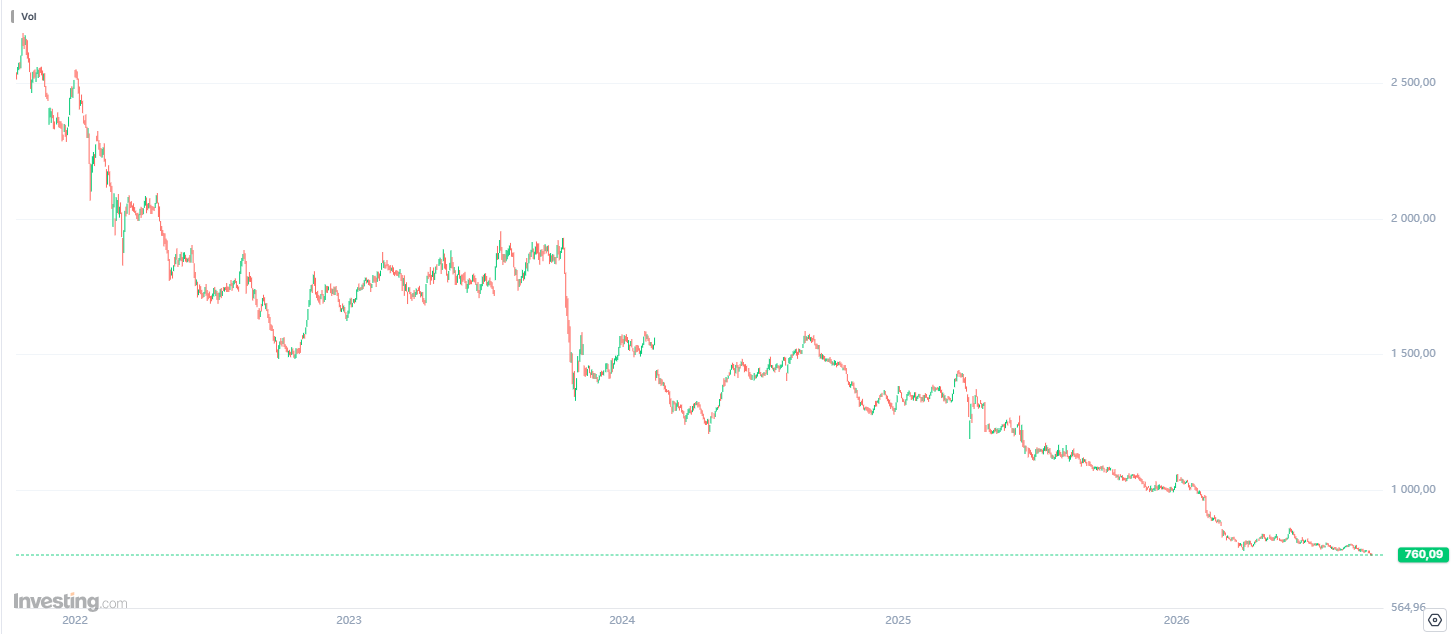
No, this is not the return curve of Alokas’s portfolio, but First North’s return graph. 
The First North list and its companies have received plenty of criticism and ridicule. Many of the companies on this list have caused the Forum’s stock brothers a lot of heavy losses and pain. So I decided to take action… and sent questions regarding “Eka Pohjola” (First North) to NVIDIA analyst, Bitcoin strategist, gold expert, community builder, and chairman of the Buybacks Party, Verneri Pulkkinen.

1. First North’s five-year “return” is down by nearly 70 percent. What is causing such a steep decline?
The First North list consists of growth-seeking small caps, many of which are quite risky investment targets. Over the past five years, the stock market has seen a decline instead of growth, and in the case of several companies, the risks have materialized. A few successes, such as the maintenance company Viafin, whose stock has tripled since its 2018 listing, are not enough to drag the overall performance into the green.
The First North index is market-cap-weighted, meaning larger companies move the index more. The stock of “Lahti’s Tesla”, i.e., electric vehicle charger manufacturer Kempower, skyrocketed so much that the company’s market cap at its peak was several billion. Then it crashed within the First North index, until it jumped to the main list in 2024 (where it has declined further). The market caps of many First North companies hover in the tens of millions, so a single multi-billion-dollar elephant causes a lot of damage in a china shop. But the crash isn’t Kempower’s fault: the mice have dropped the china that the elephant didn’t touch.
The stock market is always a market of stocks. Let’s therefore look beneath the red surface of the index. A quick glance at the First North company list tells a grim tale: stocks were in a bubble in 2021 and expectations unrealistically high, companies have either messed up their strategies themselves, a difficult economic downturn has punished them disproportionately, and/or a combination of these has caused the stock to collapse.
Many companies have (or had) ambitious plans that haven’t gone as envisioned during the IPO. Solar Food’s protein is a brilliant invention, but scaling production to a massive level would require staggering amounts of capital. Aiforia’s AI solutions are securing contracts in Europe, but they aren’t converting into revenue. For several drug development companies, such as Faron, the pipelines haven’t developed favorably (which is, of course, the most expected outcome for a small drug development company). Duell and many others drove themselves into a ditch with massive financial leverage by acquiring companies left and right. Fodelia is still picking itself up from its previous kebab empire building.
The difficult economic environment has weighed on companies. For example, Lapwall, which has indeed risen +50% since its 2022 listing, or Ecoup, which has crashed on the stock exchange, are suffering from a weak construction cycle. Software company Admicom’s growth has also slowed significantly in the construction slump, compounded by AI concerns. The stock also experienced a total bubble in 2021, from which steam has been let out up to the present day. Asset manager Titanium enjoyed a real estate bubble fueled by zero interest rates with its care properties on the way up, as well as the long downward slide of the interest rate hangover.
Then there is its own group of patched-together fixes, such as Summa, which opportunistically exploited investors’ defense fervor with “is the drone factory in the room with us” (the stock has essentially lost its value). Or Pallas Air (-99%), which marketed a bizarre air purifier hanging around the neck.
The list could go on, but let’s spare the reader’s tear ducts. As a consolation, it’s worth mentioning that Sweden’s First North has also crashed 65% from its peaks. It happens in the best of circles. I don’t want to create false impressions about the quality of First North companies, but many companies considered unbeatable today, such as Amazon and NVIDIA, have dropped by some 90% at times in their history. Amazon was halved just a few years ago. They are completely exceptional companies, and even they have experienced that! First North’s 70% drop is still “rookie numbers.”
2. Is it even worth eyeing such a loss-making market when the negatives are huge and almost everything looks red? Just the thought of finding forgotten gems in the trash can isn’t very convincing when nowadays almost all companies are already covered by Inderes.
Someone following stock lists might not necessarily distinguish whether a particular company is listed on the main list or First North. I would look at all companies as individuals. First North’s reporting obligations are lighter, and one must always be critical regarding new listings, which is naturally worth keeping in mind.
Someone could argue that it’s not worth investing in the world’s largest companies because everyone follows them. However, the world’s largest companies have broken the “old formula” over the last 10 years and beaten the indices time and time again. This may not continue forever, but it’s a good reminder of how gems can be found right where everyone is already looking. But looking is not enough; one must also seize the opportunity.
The European banking sector was the most hated sector in the world for years after the euro crisis. For the past five years, it has been one of the best-performing sectors in the world, even better than technology. Tech stocks were out of favor and cheap for a long time after the dot-com bubble burst. The idea that one should pay a lot for them is a phenomenon built over the last ~10 years. The beloved can turn into the hated, the rocket into a stagner, and a stagner into a rocket. It’s always good to keep an open mind.
**3. Sifting through First North companies feels almost like a job for a professional. Many companies operate in difficult fields and otherwise seem very risky… well, let’s admit there are some “more ordinary” companies mixed in as well. What kind of investor is First North actually suitable for? Does the investor need to be a bit startup-minded and ready to accept truly high risk?**There are admittedly many early-stage technology companies that are difficult to evaluate even for a professional. Generally speaking, I would point out that it is worth keeping “base rates” in mind (which I talked about earlier in Verneri’s Vartti). For example, for an early-stage pharmaceutical company whose drug is already in the clinical phase, meaning patient trials are being conducted, the probability of the drug ever making it to the pharmacy shelf is roughly ten percent. Early-stage world-changing tech companies and new technological inventions, such as Canatu, Modulight, Betolar, or Spinnova on First North… There is no exact figure for this, but it is relatively clear that few will succeed. Maybe a couple of percent, if you look at startup statistics in America, for example. Of course, these companies have already made it to the list, so they are not entirely comparable to startups.
The hook (or punch to the face) of First North comes from its lottery-like nature: with good luck, one of those will win big someday. In recent years, this hasn’t really happened. Although, for example, Nexstim’s stock nearly multiplied by seven from its bottoms in past years, even though the entire return history is a dismal -98%. Once again, it’s a market of stocks, not a stock market!
But there are also plenty of sensibly managed, even a bit boring and easily understandable businesses on the list, such as Viafin (an investor can sleep through the year and just glance at the financial statements) and Lapwall (the CEO is a phenomenal presenter). Or the financing platform Springvest, which is a quirky case. The investor gets exposure to very early-stage startups. Springvest wins either way as it collects fees when companies raise money through it. At the same time, it gets a small ownership stake from the fundraisers.
So First North offers all kinds of exposure; one shouldn’t categorize too much.
4. What does the future of First North look like? Can the market still rise to a more significant position in Finland?
I chatted about this with our CEO Mikael, as he has a better picture of First North as an institution. It certainly has its place in the sun, because the main list is too heavy for many small companies. It’s great that there is a marketplace where you can list with low costs (if you know how to keep them low, there are takers) and, on the other hand, retail investors can get their hands on the stock before larger investors. Once, if, and when things go better for small companies (cycles change!) and money is needed for ideas, First North will surely liven up as well.
Thanks Verneri for the great, content-rich answers! 
For some reason, First North made me think of a “bro stock” (veliosake). I asked AI what a bro stock is, and here is the answer 

Click here to open the AI's answer
“Bro stock” (veliosake) is not an official investment term, but a colloquial expression used by investors. It generally refers to a stock that is recommended or bought more because of “tips from the bros”, forum hype, or peer pressure rather than thorough analysis. \[forum.inderes.com\], \[forum.inderes.com\]
The term comes from the same idea as the English broscience, where beliefs are based on the experiences of a friend group rather than strong evidence. In investment discussions, a bro stock can refer, for example, to a stock that many investors praise even though the company’s fundamentals might not support the enthusiasm. \[forum.inderes.com\]
Example:
“This stock is such a bro stock, everyone on the forum is buying it, but few can justify why.”
The word is usually slightly humorous or dismissive and does not refer to any specific company.
Perhaps there is reason to be optimistic going forward 
Once, if, and when things go better for small companies (cycles change!) and money is needed for ideas, First North will surely liven up as well.
Thanks and have a relaxing weekend!