24. TEEMU HINKULA
Teemu definitely stands out from the crowd, and in a genuinely great way; he’s a funny, creative, and smart guy who also writes exceptionally well. In my opinion, he knows how to get a lot out of different investment cases, for instance by doing “Lynch-style” fieldwork or boldly asking around from different sources. Inherently, many of his ways of researching and digging into things are simple, but they require courage and effort.
Personally, I think and believe that Teemu will succeed as an investor even in the long run because of the aforementioned points and many other reasons. Most investors probably end up researching investment targets in pretty much the same way—looking at similar things, reading the same material, with some simply dedicating more hours than others. But while Teemu certainly covers about the same bases as everyone else, on top of that, he genuinely gets to know companies in ways that most wouldn’t think of or bother to do.
Teemu puts in more effort than most, but he also views and examines things differently than the investing crowd… maybe these are the exact ways one can beat the index? In addition to all these qualities, Hinkula’s strength lies in the multiple perspectives from which he can examine things, and the fact that he clearly recognizes his areas for improvement and definitely knows how to account for them in his investing activities.
This interview is definitely worth reading, as it offers great practical tips. 
First off, a big thank you to Alokas for this thread. It is thoroughly interesting and an educational innovation. It’s truly humbling to be included when looking at that roster of names.
@Harri_Sieppi suggested adding a so-called “three pictures” section to the series. I didn’t go for that, but there is one picture, a podcast, and a video.
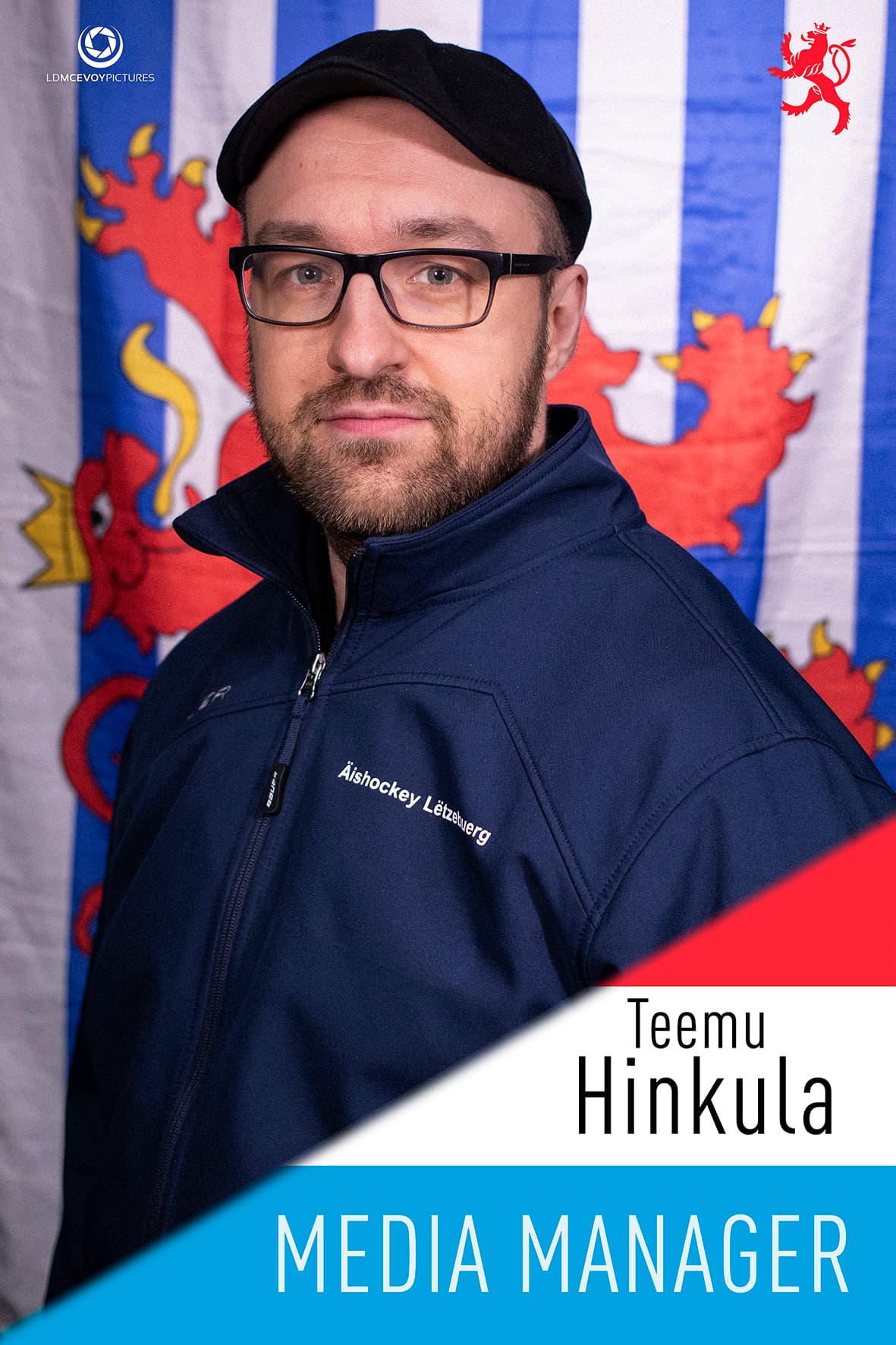
1. Tell us who you are in thirty words.
I’m a teacher originally from near Oulu, currently living in Germany but operating in Luxembourg. I belong to this series’ familiar club of guys pushing forty. Except, unlike the previous ones, I haven’t started a family.
2. Tell us three things the forum members don’t know about you.
There have been a lot of funny and versatile answers to this section from previous interviewees. I decided to pick a few milestones from along my path that I’m particularly proud of.
i) At least in my own opinion, I’m the father of Inderes’s live earnings stream idea. That tradition started in the Facebook group Osakesijoittaminen around Nokia’s Q1 2018, and I believe with this exact post.
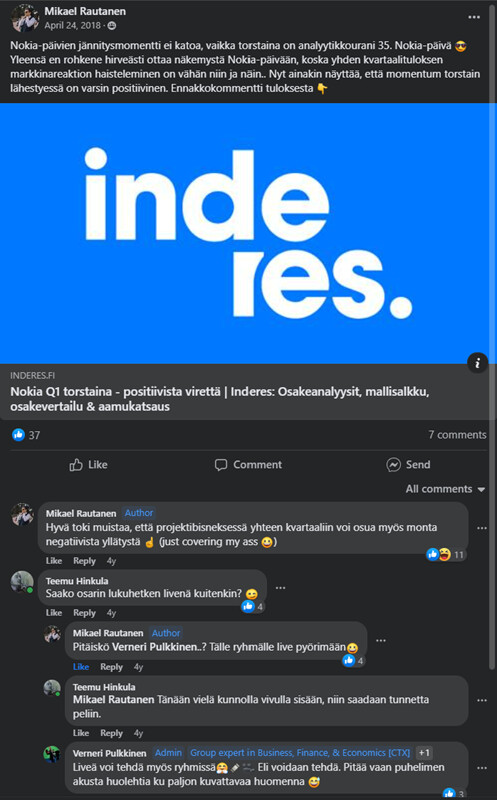
At the after-party of last year’s AGM, I managed to bum an Inderes shirt off Mikael as a reward for this. I’ve worn it proudly on various occasions ever since. Especially while doing Lynch-style fieldwork.
ii) I have served as the team manager for Luxembourg’s national ice hockey team in the Division III World Championship tournaments and Olympic qualifiers.
iii) Despite having lived abroad for over 10 years of my adult life, my childhood friends and I have gone on a summer fishing trip to the exact same spots for 23 years. We only missed the COVID year and one other summer, but those were compensated for with ice-fishing trips.
3. What are your interests and hobbies? You’re not allowed to mention anything related to investing.
Learning new things and self-improvement have always been passions of mine. My interests have varied a bit over different eras, but they’ve involved sports, philosophy, studying the universe, and lately more and more of the kinds of things I’m not allowed to mention in this question.
By the way, I know the meaning of life. It is to observe. I actually prefer the English term “to observe” over the Finnish one because it sounds more active. I haven’t yet come across an argument that would make me change my mind.
My hobbies include ice hockey in particular, but also other sports. In addition, I enjoy traveling and roaming in nature. I live close to some sweet forest trails here and during summers I try to do a solo trip somewhere into the wilderness of Lapland. I also like enjoying good food and drinks. The former could be practiced more, the latter less.
I’d love to talk more about local hockey because it has provided unique experiences. Let’s save character count though and not deviate too much from the topic. If anyone happens to be interested, at the end of this podcast (around the 50-minute mark) I talk more about it.
I do want to brag just enough to mention that I’ve fulfilled every Finnish boy’s dream of scoring a goal wearing the Lion jersey. Granted, it was Luxembourg’s Red Lion against Belgium, but let’s not get bogged down in details. Hopefully, stock picking opportunities fall onto my lap just as cleanly as that rebound did.
https://twitter.com/LehtoriHinkula/status/1112828539211079680?s=20
4. What does a typical weekday look like for you?
I wake up around 6–7 AM depending on what time my first class starts. Then my morning routine usually plays out with a podcast or something like Vernerin Vartti running in the background.
While driving to work, I listen to another investing-related podcast or an audiobook. At work, I spend my time acting smart around students and colleagues or sulking in my office. Then I drive home to the rhythm of podcasts, usually around 4–5 PM unless something unusual comes up. After that, food, a power nap, and in the evening work, investing stuff, or hockey/other sports. Then off to bed, hopefully before midnight.
5. Could you briefly describe what kind of investor you are and what your investing history looks like?
Despite the request for brevity, I decided to describe it at length. I’ll also rebel a bit by combining three questions from the original list here.
I’ve always been interested in economics and investing. I remember reading stock quotes in newspapers and on teletext as a kid, alongside NHL scores. I even set up some play portfolios based on penny stocks. After upper secondary school, I applied to study economics, but my motivation to study for the entrance exams took a hit when I unexpectedly found out that my high school grades gave me direct admission to study mathematics. I decided to allocate my time toward short-term financial gains instead and went to build scaffolding on construction sites rather than studying for entrance exams.
My background is such that there was never any major capital around during my childhood or youth, so investing was never discussed other than in the form of homeownership. I was always interested in investing on some level, but brokerage fees always felt painfully high relative to the investable capital. Back then, I didn’t know about ETFs yet, but during my student years, I put some summer job money into bank mutual funds. I cashed them out quite casually whenever the urge to enjoy life came up. The same pattern continued at the start of my working career, where any extra income was directed into lifestyle inflation—in other words, having fun.
I did manage to pull together enough to buy an apartment in the Helsinki metropolitan area right after graduating and finishing a one-year work stint in Brussels. Back then, in 2010, you could get one without a down payment or personal guarantor; instead, you used some likely expensive vehicle offered by the bank or insurance company. I found it quite baffling since I only had a one-year contract and had only been at that job for three months. The bank never asked to see any employment contract or anything similar. They just said I had been a reliable customer and my salary had been coming regularly into the account. Apparently, three months was enough for “regularity”—before that, the salary had been deposited into a Belgian account…
A couple of years later, I moved here to Lux for work. I rented out the apartment, so at that point, I guess I became a real real estate investor. Later on, I sold that place and bought two other investment apartments. Here in Lux, money started piling up in the account. After living the high life for a while, buying an old Mercedes, and building a certain cash buffer, I started thinking that the money could actually be put to work. After googling around for a bit, I stumbled upon the Laiska Sijoittaja (Lazy Investor) blog, whose core premise resonated strongly with me. Around the same time, Rahapodi was taking off, where Martin Paasi preached about passive index investing. From there, I opened a Nordnet account, fired up monthly savings, and started experimenting with small stock picks. The first ones were probably Orava and a 2x bull crude oil certificate. Enough said about those.
A couple of years later, I also bought an apartment in Lux. I had been renting it for a couple of years until my landlord notified me that it was time for me to move out due to personal reasons. I asked whether the reason might be that she was selling the place, and indeed it was. I asked for the price, and even though Lux isn’t the cheapest place around and apartment prices had been skyrocketing for twenty years, the price felt like a complete no-brainer. I said on the spot that I’d buy it without consulting the bank first. Fortunately, the bank came around, though not on cheap terms. Still, I had calculated that even in the worst-case scenario, I couldn’t lose that much compared to renting.
At that point, my work contract was temporary, though there were still 4 years left on it, but I had zero visibility regarding my location or income level afterward. For that reason, a large part of my stock investments went into ETFs, as I wanted to play it safe so I wouldn’t have to return home from this journey empty-handed. At some point, the ETFs shifted to ones with an ESG screen. At the same time, I was dabbling in small stock picks with varying strategies, trying to learn the craft. Through Nordnet, I had gotten acquainted with Inderes’s morning reports, read blogs, and investing groups started popping up on social media. The field sucked me in, and the desire to learn was strong. Inderes’s mantra regarding small Finnish companies caught on with me too, and it began forming the cornerstone of my investing philosophy. Let the big companies stay in those ETFs.
The growing interest wasn’t hurt by the fact that in Luxembourg, it’s easier to bump into people well-versed in investing—say, in an ice hockey team—than in the suburbs of Vantaa or the rural municipalities around Oulu. Sure, they exist there too, but maybe not in the same numbers. Furthermore, in Finland, these things weren’t talked about much, at least not within my bubble, even if someone engaged in it. Over here, on the other hand, you can easily find plenty of investors of various calibers.
A big shift in my investing journey arrived with COVID in 2020. As a classic bull-market momentum investor, I felt invincible. Around this time, I also discovered the Inderes forum. Changes occurred in other areas of life as well. The temporary EU job turned into a permanent civil servant position with the state of Luxembourg, which prompted an update to my living situation. The Lux housing market had continued to heat up, and I managed to sell my apartment for quite a good price. Because my new workplace was no longer in central Lux, I decided to buy the next home on the German side, where prices are maybe about a third of those in Lux. So at this point, the opportunity arose to allocate a larger share of wealth to the stock market as well. This also forced me to take stock investing more seriously. As a side note: living in Lux would have been smarter tax-wise, since you don’t pay capital gains tax on a stock if you’ve held it for over 6 months and your ownership stake in the company is under 10%. (From memory).
In any case, the change in portfolio size meant that while it had previously been possible to fix mistakes with additional purchases funded by earned income, that was no longer so easy. This further fueled my motivation to hone my skills as an investor. I continued with an index-heavy approach, but at some point, the thought began to emerge that since I don’t have a family, I’m not really accountable to anyone for my actions, and having a steady, good job to boot, why wouldn’t I start taking on more risk?
I had bumped into Arimatti Alhanko in Lux, and during a Lynch-style fieldwork trip with him, as well as chatting with him in general, I realized just how green I was as a stock investor. Truly researching companies requires much deeper due diligence than I had done up to that point. Additionally, I realized that as a part-time investor, I don’t have the resources to genuinely follow a large universe of companies.
So lately, I’ve tried to look into companies more deeply and approach them more critically. As a result, the number of holdings in my portfolio has dropped from maybe 15 to about 5, but the capital allocated to them has grown correspondingly. The index weight is still significant, up to 2/3 of the portfolio. I mainly aim to own companies where I see clear potential to beat the index. Who wouldn’t do that? My portfolio can be found on Shareville if anyone wants to stalk it.
That turned into quite a long answer, and we’re only on question #5.
6. Which three stocks in your portfolio do you trust the most, and why?
I thought about this for a long time and even wrote something down, but in the end, I realized that I don’t trust a single stock in my portfolio! After all, the idea behind individual stock picks has been to take on risk. I’m prepared to stay aboard for a long ride, but also to jump ship if the thesis falls apart or I realize I’ve made a mistake.
That said, Efecte has done pretty well delivering on what it promised.
7. What are your three most recent stock sales and why did you sell them?
Last year, I got quite a bit of practice with this skill. Here are the three most recent ones:
- Nasdaq ETF: I had bought it for portfolio diversification with starry-eyed super-conviction and maybe to practice a bit of trading, but I came up with what I thought was a better investment idea that I wanted to allocate capital to. (By the way, it’s ridiculous that on Nordnet, an ETF containing hundreds of companies is counted as a single stock for diversification purposes).
- Kamux: I’ve followed Kamux over time—sometimes aboard, sometimes from the sidelines. Usually, the latter proved sensible, except this time. I sold my last small position around the time Tesla announced price cuts, so pretty much at the bottom. Generally, I’ve been a bit worried about Kamux’s ability to defend its market share despite being a major player. Moreover, I’ve been slightly baffled by Kamux’s issues with sales mixes, considering I thought data utilization was supposed to be the company’s core strength. At the time of writing, this looks like quite an idiotic move. I have to hope that the target I reallocated that money to brings returns.
- Stockmann: I had consciously taken a slightly stronger conviction here, but ended up trimming its weight in the portfolio toward the end of the year when it started looking like the sum-of-the-parts wouldn’t unlock the way I had initially envisioned. My bad. This money also ended up going toward something more interesting.
That list doesn’t sound very flattering, but why would you sell the stocks you’re happy with? Not that the remaining portfolio consists purely of winners either.
8. What does your stock-picking process look like, from start to buy order?
This is an area I’ve continually sought to develop. Who hasn’t? An obvious area for improvement is screening for new buy targets. I don’t really have a clear method for that. Usually, I hear an idea about a company from an acquaintance or read about it on the forum and start looking into it. Usually too late.
Lately, the process has roughly gone so that I review the company’s fundamental figures and then dive into the business model—for example, by reading the company’s thread on the forum, an analysis report, or the company’s own reports, and watching CEO interviews. If I feel I understand what the company does and its business model seems interesting, I dig a bit deeper into the industry and the company’s position within it. If it still looks good, I start typing numbers into Excel. That usually solidifies my own understanding of the business and allows me to crunch the numbers. I usually record the quarterly income statement numbers for at least two or three years back. Meanwhile, I read financial statements and interim reports. If it still looks good at this stage, I might open a so-called tracking position.
After this, I try to learn more about the industry. This always depends on the company, but it can happen by reading other publications and researching competitors. I might look for specific data points that I believe impact the company’s operations. I add those to Excel as well. For key observations, I also maintain a text-based news flow tracker, which I update as information comes in.
If I feel that I can’t find certain information, don’t understand something, or just want to bounce ideas around, I might message an analyst, a forum member well-versed in the company or industry, or an acquaintance. If the company is small enough, I might reach out directly to management. If the case still feels solid at this point, I usually buy up to my target position relatively quickly. A good case could involve a growing industry, a company taking market share within it, and naturally a sensible valuation. I don’t claim that every single holding of mine checks those boxes perfectly.
In general, I’d like to be more systematic and disciplined in these processes. Sometimes I jot down scattered thoughts about different companies. Reading them in hindsight illustrates quite well what a weather vane one can be mentally. I should do that more often. I would especially like to make the buying process more structured, which could include something like a checklist that I rigorously go through before every order. In addition, I want to further develop my financial statement analysis, especially regarding the balance sheet and cash flow statements.
9. You’re a teacher and teach at least mathematics and ICT subjects; does your field/job provide any help in your investing activities?
Teaching math and ICT currently makes up about half of my job description. In addition, I do study counseling, and on the administrative side, I try to establish structures at the school so that our developing upper secondary school could run smoothly someday. In a way, I’m trying to make myself obsolete in those respects.
It’s really hard to say what helps and what hurts. I suppose I can crunch numbers and handle technology. I understand people to some extent; maybe I can approach things with empathy when needed (many might strongly disagree on that) but also objectively. At work, I meet a wide range of people: young and old, humanists and natural scientists. There are dozens of nationalities in our community. A single classroom might have over a dozen different nationalities. The work feels quite meaningful. But at times, the worry over students is quite heavy.
I’m probably not exceptionally good at anything, but perhaps I can reflect on things from multiple angles. Generally, I feel that work takes time away from investing and doesn’t really provide much concrete added value in that regard. Fortunately, we have plenty of vacations, which gives me time to dive deeper.
10. As an investor, you’ve visited the Batibouw fair with Harvia in mind and toured Europe with Arimatti Alhanko doing Lynch-style fieldwork in the spirit of Kamux; what have these trips given you other than good entertainment? Will you continue doing more trips like these in the future?
At least it hasn’t shown up positively in my returns! But I do believe those trips have reinforced my understanding of the companies and their industries. For example, when visiting a used car dealership in Canada, it was interesting to compare the similarities and differences of the industry across continents. Maybe the experiences at Batibouw influenced my Harvia exit, when I thought I noticed that dealers’ inventories were already full after Q1, signaling slower sales for Harvia in Q2 and Q3. Granted, that exit could have been executed much earlier.
Fieldwork in general is quite a fun addition to traveling! I have a very interesting field trip planned for next week, but maybe more on that later. In addition, Kamux is opening a new store in Düren, which isn’t ridiculously far from where I live. Maybe I could swing by there one weekend once the store opens.
11. What are your most important sources of information in investing, excluding Inderes and its Forum? Please elaborate.
Naturally the traditional ones: Twitter, Redeye, podcasts, company materials, occasional blogs, and acquaintances along with analyses read over their shoulders. Some acquaintances follow similar companies to the ones I do, so we bounce ideas off each other. With others, the discussions lean more toward the psychology of investing, macro, etc. You can never have too many investing friends like that.
Then there are company-specific things. Sometimes I check discussion forums related to the industry, join a social media group, or just follow the company and its competitors on social media. Sometimes I message acquaintances if I know they work in the industry. Digging up this kind of information is quite fun, in my opinion.
12. How do you follow macroeconomic trends, and do you try to time the market?
I follow the standard news flow, chat with acquaintances, and catch whatever pops up in various podcasts. And, of course, I read the “Direction of the Markets” thread. Macro in general feels so complex that it’s hard to imagine gaining an edge as a retail investor. As far as I understand, not even central bank heads have been able to predict macro. Though many forum members seem to have a pretty good grip on it. I envy and admire them greatly.
Of course, macro has an impact when researching companies and industries. I’d like to say that I don’t time the market, but you probably inevitably do so—at least subconsciously—with every buy and sell. What I do know for sure is that I’m terrible at timing. Somehow, I need to try to improve on this as well.
13. Analyze these three Inderes figures in 30 words per person.
I admire Mikael’s open-minded, blank-slate approach to matters, which enables innovative solutions. His weakness is a lack of appreciation for pineapple on pizza. Diavola with pineapple + a full-bodied red = chef’s kiss!
An articulate professional who cuts straight to the core of matters objectively and comprehensively. The Finnish investor community would be far lighter and less efficient without this gentleman. Verneri largely deserves credit for what the Inderes community offering is today.
If every person in the world were as positive as Yu, and if every company had a few employees as active and cheerful as Yu, we would have no wars, no famine, and no recessions.
14. Why do you visit the Inderes Forum, and what does the Forum offer that can’t be found elsewhere?
The forum has certainly become a very efficient way to follow company news flow. News surfaces quickly (thanks @KuHa), and you usually get knowledgeable commentary very fast. The quality of the discussion is high, and thanks to the analysts and active corporate representatives, the forum brings you closer to the companies. Additionally, the forum features threads on other investing-related topics. I’m not interested in political debates, but it takes nothing away from me if someone wants to spend their time in those threads.
I’ve actually started wondering: has the forum made the Finnish small-cap market too efficient!?
15. You have to hand your portfolio over to three forum members to manage for 5 years. Who would you pick?
50% allocated to @Wallet_Nahlroos. Based on the fact that he seems to be the most active poster in the index and ETF threads.
45% allocated to @Arimatti_Alhanko, because he looks into similar companies to me. Naturally executed with deeper analysis and wisdom.
5% goes to @Sijoittaja-alokas. His mission is to find some million-bagger hype rocket. Reporting will be handled via memes. This is also close to my own strategy.
16. Do you consider investing psychology in your own investing, and have you “studied” investing psychology in any way; if so, how?
I haven’t studied investing psychology per se, but I have read about decision-making philosophy, human cognition, learning, etc. You continuously try to reflect on your own actions and improve through that. For instance, posting under my real name on this forum was a deliberate choice. Its purpose was to instill seriousness into my thinking, for example by taking greater ownership of what I post here. As @Mauri has noted, writing publicly brings a lot of structure to one’s own thoughts. Whether I’ve succeeded in that, I don’t know.
17. Putting aside the entertainment and excitement of investing as a hobby, why and what are you investing for?
Building wealth and the freedom that comes with it naturally appeal to me. Someday, I’d like to try living a life where I could focus purely and exclusively on investing.
I could mention continuous learning and understanding the world, but I suppose those were meant to be left out of this question.
18. You have five minutes to think: what investing-related lesson would you like to instill in the minds of forum members?
In criticism lies the seed of growth. Someone else’s differing view can provide a learning opportunity as well as a buying or selling opportunity.
19. As a teacher, could you give a couple of tips that would help Alokas become a better investor?
With my level of competence, I probably shouldn’t hand out too many tips on investing itself, but I could share the same advice I often give my students when they ponder life’s big decisions.
I believe one should explore the world and oneself through one’s own passions and interests. That sustains motivation, which is when you learn best. The world will present opportunities that are worth seizing when they align. So, back to the meaning of life.
20. What would you like to thank the forum members for in particular?
For making me feel stupid every single day when reading the forum. It motivates me to keep learning, endlessly.
Just recently, I had a discussion with local finance professionals about a topic that sparked heavy debate on the forum. They laughed off the forum, but in my view, the arguments I read there (not all of them, of course, but the highest-quality ones) easily outclassed those of these professionals.
Time will tell who was right.
…
A big thank you again to Alokas for the invitation to participate in this series. I’m truly honored. It’s fascinating to think that a regular schoolteacher gets to write about his investing. This perhaps turned out to be more of a personal investor’s journey than an investing case study. Nevertheless, even on a personal level, it was a genuinely interesting expedition inside my own head.
See you on the forum, on Lynchian field trips, or at physical dividend gatherings!
Thank you for the interview, Teemu!
Even less experienced investors can take a page out of Teemu’s book, because many of his ways of thinking and researching aren’t necessarily so difficult in the end, though they certainly take time and require courage.
I might be biased, but the answers from these interviewees offer a ton of excellent help for one’s own investing activities that you might not get anywhere else.
Have a wonderful weekend, everyone!