185. Frans-Mikael Rostedt answers Alokas’s questions about the IT services sector
Not just two words, nor even one; Frans-Mikael Rostedt and @Joni_Gronqvist produce a commendable amount of material on IT service sector companies and the overall industry outlook. Everything from extensive reports to company updates and excellent videos is available – huge thanks to the guys for these! However, I would still like to ask a few targeted questions on topics that interest me regarding this sector, even though they have certainly been touched upon at least partially in their previous content.
My questions may be what they are, but the interviewee’s answers were very rewarding this time as well. 


1. A few years ago, the IT services sector appeared to many investors as a broad field where returns were easily accessible. General macro challenges have certainly weighed on companies in the industry, but technology development and the growing role of AI in particular have created a sense that the industry might be stagnating and power is shifting increasingly to large pioneers. On the other hand, it’s unlikely these “winners” would have massive margins to skim and growth ahead, even if such “concentration” occurred. Is this interpretation unnecessary dramatization, or in what direction do you see these things moving?
The industry was a true gold rush in the 2010s and expanded tremendously during the hot years. To put it crudely, between 2015-2022, success meant simply being able to recruit good talent. We even have many incredible growth stories on the stock exchange. For example, Gofore and Witted.

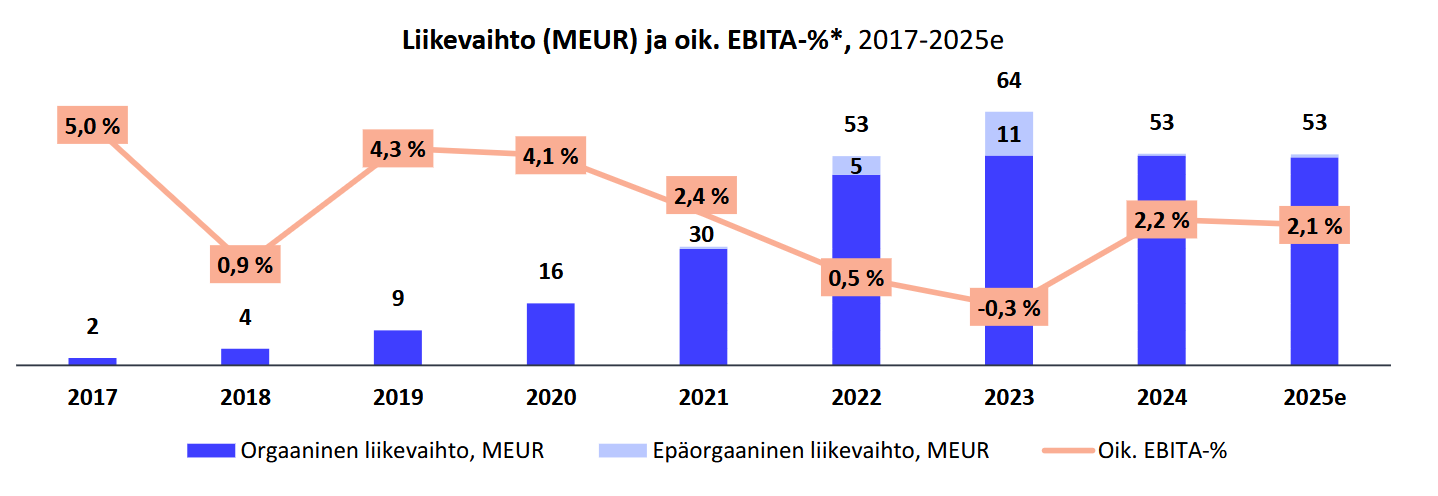
Now, in my opinion, we have moved into a phase where development is more efficient and companies are much more focused on profitability than during the boom era. This in itself, even without AI, has made the industry much more “mature” and has clearly tightened the competitive landscape.
Now AI brings its own flavor to the mix and streamlines development very significantly. I believe that in the broad context of the entire industry, the years of hot growth are behind us. At the same time, there will be new success stories in the industry, as Data and AI consulting, for instance, is currently experiencing strong growth.
I think it’s normal that in the IT services sector, there are always areas that rise and fall. Even 10 years ago, one couldn’t imagine the extent to which development resources are needed for everything today. Now AI potentially accelerates this change 10x, and the challenge is that some sub-sectors will decline very sharply. New competition will certainly emerge, but it is vital for companies to gain access to emerging fields. I believe the fundamental principles of consulting will not change. That is, you sell people to solve a problem. Now, people can be supported by a “code factory,” while the experts themselves focus on communicating with people and managing that “code factory.”
Rapid changes are, of course, difficult. Especially when the business is based on hourly billing of people. There may be a mismatch in expert profiles regarding what customers want to buy now. This will divide the market into winners and losers, and I personally follow business trends in companies closely. If revenues are on a continuous downward trend, the price paid for the company will also be very low.
2. What should an investor follow in IT service companies if we set aside familiar valuation multiples and key figures for a moment, even though they are very important—for example, are NPS scores and employee turnover still relevant metrics for these companies? And is it possible to monitor how well companies in the industry are utilizing AI in their own operations?
NPS scores are, in my opinion, very relevant. I believe that in the future, the bar for the quality of experts sold by IT service companies will rise (it already has), and this naturally requires companies to be able to recruit top talent.
Change negotiations naturally lower employee satisfaction levels, but unfortunately, they have been necessary for many, as business grew significantly in past years, but now operation volumes have clearly decreased for many. However, it is more important than streamlining to get revenue back on a growth path / stabilize the decline. This has required investments in sales from almost all companies. In this kind of business, the sky won’t brighten through streamlining if revenue just continues to decline. Or then one must accept the new situation and transform into a company whose core activity is the constant honing of profitability by continuously streamlining various operations. This is, however, very difficult in an expert business like the IT services sector, where one of the key factors differentiating companies is their ability to attract top talent.
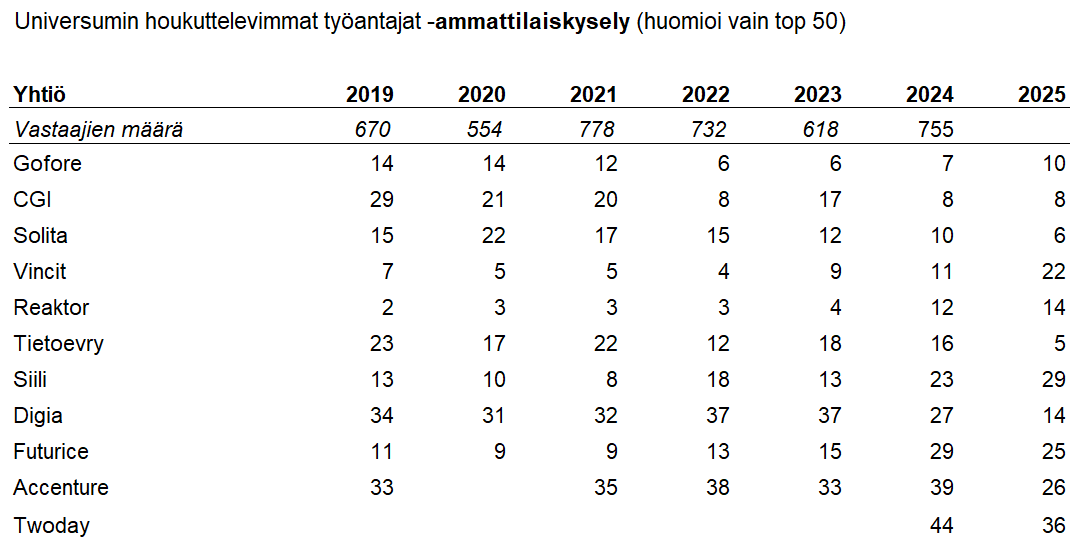
I personally have followed Universum’s Most Attractive Employers statistics, which I find to be a quite good metric. It is difficult for smaller companies to get on this list, but I think the trend in the statistics speaks well of a company’s development in this area. Of course, such surveys have their own challenges. In a difficult cycle, “steadier” companies and those whose business is going relatively well have—surprise, surprise—emerged as winners.
Other key metrics that are good to follow, but difficult to access, are: fixed costs relative to revenue and gross margins. Companies must be able to operate with a sufficiently light cost structure, or else inevitable project fluctuations will hit profitability hard.
As for utilizing AI, it is unfortunately impossible to monitor in practice in any reliable way, at least in my opinion. Some companies globally report AI-related business, which improves visibility slightly in this area, but these classifications always involve a lot of uncertainty regarding what is actually counted as AI business.
Many thanks to Frans for the great answers! 
Even though the duo has covered the industry and companies excellently, as an investor, I needed a bit more “grip” and deeper thoughts on these aforementioned themes. And while reading these answers, it occurred to me that things are often looked at far too one-dimensionally. Frans’s reflections will surely help broaden the perspective for both myself and probably others, so that in the future we might be able to think about and examine this sector more diversely and in a less black-and-white manner.
Have a nice weekend everyone!