154. Roope K
Roope K writes valuable posts on the Forum, especially regarding companies in somewhat challenging industries. He has a knack for clarifying even complex topics in a way that makes them understandable and relevant from an investor’s perspective.
He often brings new information to the discussion that an average investor wouldn’t know how to bring up, and does so in a way that even those unfamiliar with the industry can understand. Especially valuable is his ability to combine a deep understanding of technology sectors with investing—a perspective you don’t get from very many others on the forum.
Roope K’s writing style is indeed reader-friendly and fosters fruitful discussions, avoiding pointless bickering among investors that unfortunately often overshadows quality investment discourse. His contribution to the discussion raises the level of the forum and offers other investors the very added value that brings people here—a different style, especially regarding other themes, takes things in a negative direction in every way. Roope and writers like him are uniquely important contributors to our Forum.

1. In fifty words, tell us who you are.
I am a husband, a former athlete and current fitness enthusiast, a dabbling programmer, a part-time equity saver and investor, a brewer, an eternal student, and a management consultant. This is the order according to my identity and interests—unfortunately, my time allocation often goes in the reverse order.
2. Tell us three things that few people know about you.
I have a Dutch championship in my trophy cabinet, I can speak and write (cautiously) in Persian, and I can solve a Rubik’s cube almost as fast as Markku Uusipaavalniemi (25 sec).
3. What interests and hobbies do you have besides investing?
I actually competed in sports quite seriously until adulthood, and the NFL season from September to February completely messes up my sleep schedule. Gym workouts have continued even after my athletic career. I tinker with all kinds of programming projects for my own and my family’s needs.
4. What is a normal weekday like for you?
To work by eight, lunch on the fly, and around six I might have the opportunity to spend my free evening, which then goes into working out, studying, or other basic chores. In practice, my waking hours are spent doing something fairly productive every day.
5. What are you like as an investor?
I am primarily a long-term ETF saver rather than a stock picker. Ultimately, only a small portion of my new savings is allocated to individual companies, where I then seek practically unlimited upside with high risk. Investing and portfolio composition must be such that you can step away from the playing field even for day trading if necessary and still trust that massive destruction won’t occur.
In general, “saver” is the best term to describe me. I look very closely at where I spend my money and allocate practically everything left over from basic consumption immediately into the stock market to generate returns. In this regard, I operate completely systematically without glancing even a bit at what is happening in the market. When it comes to using leverage and small company ownership stakes, my actions are more based on discretionary analysis.
6. What is your investment history?
It’s been about 14 years since my first purchase (was it WMT?). I’ve had a written strategy from the very beginning—too bad the strategies were completely bonkers for the first ten years or so, and my discipline in following them was questionable at times (which might have been a good thing in the end). At times I was a home-market dividend investor. At other times, I dug through the balance sheets for “undervalued” stocks whose undervaluation the market never noticed. For the past 5-6 years, my investment history has followed my current “approx. 80% blindfolded into ETFs and approx. 20% potential tech moonshots” strategy, which, largely thanks to Nvidia’s bullseye, has yielded excellent results.
7. What kind of portfolio do you have? If one of the stocks in your portfolio were to rise by hundreds of percent in the coming years, which one would it be and why?
As mentioned, I mainly have tech-heavy ETFs tied to US indices (perhaps 75-80% of the portfolio’s current market value), to which I seek additional return with a small amount of leverage. The rest is in a few direct tech sector stocks with the aim of hitting solid moonshots with high risk. My only direct holdings right now are Nvidia and IonQ, and of these, the latter definitely has more fuel for a flight if quantum computing breaks through strongly in the near future.
8. What is your step-by-step stock picking process?
Company discoveries stem almost 100% from exposure to tech sector firms in my day job and at the university. In addition, there are a few portfolio managers (e.g., managers of Asilo Argon and I/O Fund) from whom I pick ideas and whose views I validate against my own. I have a systematic way of finding out at least at a rough level about all new tech company acquaintances that cross my path—what kind of product or service the company offers, because it also helps professionally. For the most interesting companies, the investment process then moves on to evaluating sales growth mostly over the next 2-5 years (target holding period), which is pretty much the only metric I consider as a growth investor during the selection phase. Companies with suitable growth potential end up in the sieve perhaps every 1-2 years, and for these, depending on the situation, product, or service, I do checks on e.g., cash sufficiency, management’s domain expertise, patents, production and demand scaling opportunities, etc. In a good year, I might find one target to buy that I truly believe in—it has now been closer to two years since my last new company pick.
9. How do you monitor the stocks already in your portfolio?
I check stock prices perhaps daily. Fluctuations of around 15–20% are pretty normal for the companies in my own portfolio, so I certainly don’t analyze every single blip. I try to find time to check the news flow more broadly perhaps once or twice a week, just in case there is something interesting from a big-picture perspective. Usually, that covers a broader sample of, say, the supply chain or key customers—not just the company I own. Otherwise, general monitoring of the tech industry gets handled pretty much as part of my other daily chores (client work, research papers, podcasts, and news media), and data points related to my holdings often turn up there as well. Of course, I closely follow quarterly reports and other key forums where the companies I own talk about their products and other outlooks.
10. What valuation multiples do you use the most with growth companies and other future prospects? Mention at least four and justify your choices.
At the picking stage, I really only look at revenue, and even then, not on a valuation multiple basis. I try to hit on companies long before valuation multiples have much utility.
At the holding stage, monitoring depends enormously on the target. If revenue develops according to assumptions, the next thing I generally follow in my holdings is whether EPS is turning positive within some timeframe or if the cash runs out first. If, on the other hand, EPS is positive, I usually monitor the net margin—meaning, in practice, how well sales scale without an increase in fixed costs.
Much more than valuation multiples, I track real indicators such as demand drivers for companies’ products and services, mentions in research papers, patent applications, product roadmaps and launches, etc.
11. Analyze these companies in 50 words:
- Gofore
When the business logic is to sell either resources or information arbitrage, it’s hard to see how AI won’t disrupt the whole industry in the long run. In the short term, Finland’s anaemic demand for consulting has brought fierce competition and predatory pricing. The company is really tough if it turns both of these challenges into opportunities.
- IonQ
The best-capitalized pure-play quantum company, employing some of the industry’s most distinguished researchers. A risky investment whose success depends heavily on the success of ion trap qubit technology and, for example, on someone inventing highly usable algorithms elsewhere that IonQ’s hardware can run sometime in the future. Roadmap execution and general breakthroughs in the quantum field will determine the direction of the stock price.
- Kempower
The company is presumably still guiding for €750m in revenue and a 10–15% EBIT margin by 2026–2028. Is it perhaps time to revise these downwards? Otherwise, I haven’t really followed the company or even the industry, and I don’t dare take much of a view. I just wish them great success—Finland is in dire need of high-value-add export companies.
- Nvidia
Over the next five years, $4T in data center investments are on the horizon, a large share of which will likely flow to Nvidia. But these roughly cover the current market cap, and AI has to break through even more massively for there to be drivers for growth in the future as well. It’s not impossible that Nvidia will someday be a $10T company, but before that, it could easily drop below a $2T company in between.
12. You have written a bit about companies related to quantum computing and the industry in general. How do you see the future of quantum business from an investment perspective, and how do you monitor this industry yourself?
Quantum business certainly has a pretty bullish future, if only because in a couple of years, company roadmaps feature machines whose performance can never even theoretically be built with ordinary classical computers, because the universe would run out of atoms. The second major signal is how much public and private money is flowing into various quantum ventures—the probability of something good coming out of it keeps growing all the time. Especially the hardware side has stepped up hard over the last 3–4 years, but then again, on the side of usable algorithms, it has been a bit quieter. As a semi-layman, I follow quantum technology largely based on the views of people much more distinguished than myself. However, I’ve spent a good year or so learning the finer points of quantum computing on an academic path.
13. You are also into a lot of things related to AI. How do you think one should monitor AI companies, and how AI is changing various industries from an investor’s perspective?
AI is still in a phase where infrastructure is being built first, and maybe only sometime later will someone start making bigger money with end-user applications. Infrastructure-building beneficiary companies are pretty easy to follow: on the supply side, it’s enough to follow ASML’s and TSMC’s outlooks, and on the demand side, the capex investments of hyperscalers and a few larger neo-clouds.
If and when beneficiaries eventually start showing up closer to the end user in the value chain, monitoring can become quite a bit more difficult. I would draw an analogy here to the breakthrough of the internet, where companies building winning end-user services and applications only started to emerge 15–20 years after the infrastructure-building phase—and continue to emerge. I don’t dare guess at all how and where AI will disrupt things the most—and it’s quite possible that the winning companies haven’t even been founded yet. The only certain thing is that disruption will happen—just like in the case of the internet.
**14. Inderes’ analyses are easy to read when you know the analysts and the “basics” of their analyses, etc. But how do I know how to read, for example, American analyses of foreign companies and relate to them correctly, when they are on average a bit too bullish and positive and a bit different in other ways too?**To be honest, I hardly read analysts’ investment views, apart from the few exceptional portfolio managers mentioned above. What makes even those portfolio managers exceptional in my eyes is their astonishing ability to understand the tech domain and see the business implications of innovations – rather than their ability to value companies.
Instead, I listen to and read a lot more of that kind of deep tech analysis, where they don’t really talk about Euros or valuation multiples, but are closer to the metal and the code. Based on those, I then try to figure out for myself how bullish a view is warranted for each company.
15. You have to choose three forum members to manage your portfolio for ten years. Who would you choose and why?
Karhulalainen seems to have a magical ability based on their thread openings to find precisely those tech-sector moonshots that I screen for myself.
Based on his track record, Jarnis could also manage a tech semiconductor portfolio for me.
I don’t know if it’s fair to choose Jukka Lepikkö, but I’ve had many good debates with him on the tech-side outlooks, and the portfolio would certainly be in tender care, even if our views don’t always quite align.
(@karhulalainen, @Jarnis and @anon34312866 - I pinged you so you would notice. -Alokas)
16. What would today’s Roope say to the young Roope who has just started investing?
There are two pieces of wisdom that I should have followed from the start: 1) “Far more money has been lost by investors preparing for corrections, or trying to anticipate corrections, than has been lost in the corrections themselves” (Peter Lynch) 2) economic growth in developed markets is largely built on technological development.
I learned both pieces of wisdom probably five years before my investing career started, and if I had followed them from the beginning, my wealth would certainly be at least 4-5 times what it is now. Compared to ignoring these, a few stray excursions into Helsinki stock exchange dividend crawlers are minor rounding errors.
17. Do you have monetary targets for investing? Or any other concrete goals in investing, or things you try to achieve by getting wealthier?
My secret dream is to be wealthy enough to act as an angel investor with a sufficiently diversified portfolio without the risk profile of my holdings turning into a house of cards. Another key goal is that I could shift the time spent in question 1 more towards my interests well before retirement age.
18. How do you manage your emotions in investing so that you don’t make hasty decisions, for example?
When it comes to purchasing decisions, it’s easy when you are committed to following the screening process described above. It is much harder to let go of holdings when the thesis has played out. The portfolio would be many times fatter if I had been suitably hasty, and big returns have been lost by selling too late.
19. How would Alokas find multi-baggers in the US (or elsewhere) instead of digging up the ones from the dumpster that should be left there?
My own dumpster finds have been made by investing in companies that are totally outside my comfort zone. Therefore, I recommend digging up ideas from places that you actually understand as well as possible. How on earth could you otherwise make any informed estimates about what a company’s future value is?
20. Who do you especially want to thank for the forum members and Inderes?
The summer terrace meetup was a particularly great event, and thanks for that go to @JHeiskanen! 
In general, the discussion on the platform is at times quite breathtakingly knowledgeable, and I’ve learned a lot myself about all kinds of tech niches over the years.
Thanks again for the truly insightful answers, Roope!
Roope Koo and forum members like him, as an example @karhulalainen, are particularly valuable forum members because they often bring good and high-quality information about companies + industries that few know how to bring, and furthermore, their writing style fosters good team spirit and high-quality discussion.
I remind you that it’s worth liking posts especially from guys who write this kind of high-quality investment-related posts and spend time on their brilliant posts, so that these people know they are wanted and more are expected.
Thanks everyone and have a great weekend!
EDIT:
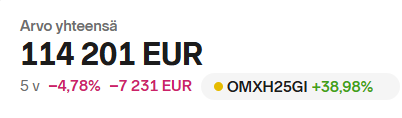
With KH’s profit warning, I had to check my five-year return  , if you think really positively, fortunately the monetary losses haven’t been five-digit (and fortunately not in percentages at least
 )