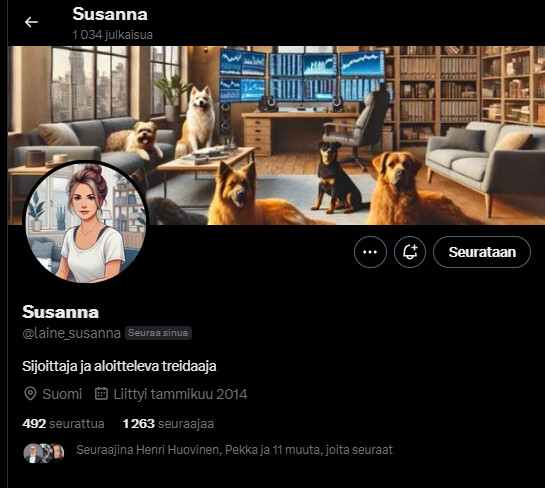
96. Susanna ( Susanna (@laine_susanna) / X )\n\nSusanna is a familiar username to many on X, with a solid following for a good reason; Susanna has an encouraging and positive impact on Finnish Finfluencer Twitter, and besides creating a good atmosphere, she shares her own interesting and well-founded views on various investment-related matters… Most recently, I recall her thread on trading and technical analysis.\n\nI see her strengths as good and genuine self-reflection, which is not a common strength in Finfluencer Twitter or this scene in general. Her posts exude a healthy common sense, which shows in the fact that she doesn’t try to make things as difficult as possible, which sometimes seems to be a (unintentional) habit for us investors.\n\nAt least what I personally like about what she does is how broadly and versatilely she examines things, rather than raging about a target price and recommendation 1.5 minutes after a 50-page comprehensive report. This common-sense-using investor comes across as someone walking her own path in a good way, constantly moving forward.\n\n
\n\n1. Tell us in thirty words who you are.\n\nI am an energetic thirty-something woman interested in investing and trading. I have worked in the metal industry for almost 20 years in various roles as a welder, machinist, robot operator, and foreman.\n\n2. Tell us three things that forum members or X users don’t know about you.\n\n1. I have 5 dogs: 3 Siberian Huskies and 2 East European Shepherds. Besides basic jogging, we do nose-work-style training, some of the dogs like to swim and love playing fetch. 2. I like houseplants and I have about 30-40 indoor plants at home, and in the summers I grow chili peppers. Carnivorous plants are fascinating and I currently have 2 of them. Once I bought a rare cutting from another plant enthusiast for 150€, but I couldn’t get it to root and it died. 3. A few years ago I was doing a kitchen renovation and, being overconfident, decided to do the electrical work myself, which resulted in me cutting the wrong wire and the kitchen being without electricity for the next 2 weeks until an electrician came to fix the situation.\n\n3. What interests and hobbies do you have? You are not allowed to mention anything related to investing.\n\nIn addition to walking with the dogs, I like to fish, and currently, I have self-caught rainbow trout fillets in the freezer. Bird watching is a nice activity, even though I’m not particularly good at identifying them. I also like to go cycling on forest carriage roads, and I have an exercise bike at home.\n\n4. What is your typical weekday like?\n\nI wake up at 6 a.m. and work starts at 7 a.m. At work, I can’t use my phone much, but during breaks, I quickly glance at X’s hottest investment discussions and bookmark them so I can calmly return to read them in the evening. In the afternoon when I get home, I like to take a breather while checking what has happened in the markets. After that, it’s time for chores and hobbies. In the evening, I generally go over the day’s events and markets. My trading mostly takes place in the afternoon/evening. During the workday, I might open a small position and set a ready-made sell order and price alerts for it.\n\n5. Can you describe what kind of investor you are?\n\nPatient, I have ironclad nerves, excellent analytical skills, I am a risk management master, and I control my emotions like a robot. Those are the qualities I would like to have, but they aren’t true. I (usually) take calculated risks, I strive to act consistently (doesn’t always work out), I am curious and want to know what is happening in the markets and why.\n\n6. Could you share what your investment history is like?\n\nI come from a poor family where hard work, diligence, and thrift have always been emphasized. Investing was never talked about, but it has always fascinated me. I decided to find things out and see if I could start investing too. I opened my first equity savings account in 2006 and started by investing in mutual funds. However, it started to feel like it would be more meaningful to pick individual stocks for the portfolio, so I sold the funds and bought stocks. I don’t remember exactly what my first stock purchase was, but I guess it was Tulikivi. In the early 2010s, through a series of coincidences, I sold all my stocks and went without investing at all for a few years. I got interested in trading in 2020, and alongside traditional stock and fund investing, it has become a favorite hobby that I try to learn more about all the time. I started fund investing again a little over a year ago. I wish I had understood its brilliance back in 2006.\n\n7. What kind of portfolio do you currently have? What three stocks did you buy last time, and why?\n\nIn the portfolio, you can find Nordnet funds: Denmark Index, Finland Index, Technology Index, USA Index, and India ETF. The latest stocks:\n* Waste Management, because it has a strong market position, waste management services are essential, and their demand is stable and predictable. Operating profit margin and earnings growth are good.\n* Uniti, because I wanted to learn about REIT companies. I chose Uniti because it has an extensive fiber-optic network in the United States and I believe in the growth of telecommunications infrastructure.\n* Virtune Bitcoin ETP, because I wanted to get into bitcoin.\n\n8. What is your stock-picking process step by step?\n\nI usually choose familiar companies and sectors, but I try to develop myself and also choose unfamiliar sectors for the sake of learning. A lot of companies accumulate on my watchlist, and to make the selection easier, I use AI to analyze companies in the same sector and choose the most interesting ones based on that to start comparing.\n\n9. What are the four most important valuation multiples for you in investing, and why?\n\nThe most important is EV/FCF (Enterprise Value to Free Cash Flow), because it takes into account the company’s debts and makes it easier to compare stocks. I can’t name the four most important metrics, as I still have a lot to learn on the fundamental side. However, I also aim to compare companies based on operating profit margin, debt-to-equity ratio, and earnings growth.
10. You trade to some extent and also use technical analysis. Could you tell us about trading and how you utilize technical analysis?
I am mainly a day trader and make short, a few hours long trades on the DAX and S&P500 indices as well as oil. I also do some swing trading, where trades usually last a few days. I use Nordnet Markets products because I consider Nordnet a good trading platform. I keep TA indicators to a minimum for clarity and usually only use support and resistance levels as well as moving averages. Sometimes I look for confirmation of my view with Fibonacci levels. If my target is in an uptrend, I look for places where it makes a downward correction, and when hitting a support level, I wait to see if the candle closes above the level, taking a bounce off the level. I look at the chart on different timeframes: 15 min, 30 min, 1 h, and if they all give the same signal, the trend is strong.
11. Share your thoughts on these companies in about fifty words, it was agreed with Suski that she can add her TA thoughts as well (moving averages used in TA are 9, 15, 20 and 50):
- Alibaba
Strong market position, China’s leading e-commerce company. Its e-commerce and cloud services are growing, but as I understand it, competition is fierce both inside China and internationally.
Alibaba is, in my opinion, also in a “sideways market” and has been hovering in the 80 and 70 dollar range. However, on the weekly and daily level, the faster moving averages have turned upward and the candles are above them, it will be interesting to see if the stock starts an upward trend. 
- Amazon
Amazon reminds me of robots (since I like operating robots). Amazon bought Kiva Systems in 2012 to automate its warehouse operations. Amazon’s interim report was a disappointment and Q3 revenue guidance was weaker than market expectations. However, I believe in the company’s future.
Amazon is just below all the moving averages, which have turned downward, but a potential support level could be found around 160 dollars.
- Novo Nordisk
I remember the news coverage about the diabetes drug, when the stock started to rise. This is also the largest holding in my Denmark fund. I don’t yet understand the pharmaceutical industry enough from an investment perspective, so I don’t invest directly in these stocks.
I haven’t followed the Novo Nordisk company much, but based on technical analysis, the stock is in a downtrend. Looking at the daily and weekly candles, the stock is below the moving averages I use, but I would see a support level right around this 830 DKK mark. It will be interesting to see if the stock takes a bounce from the level and rises, or continues to fall.
- Pepsi
A stable company, Coca-Cola’s biggest competitor, broader product portfolio than Coca-Cola.
Pepsi is, in my opinion, in a “sideways market” where it has sailed in the 180 and 160 dollar range. On daily and weekly candles, it hits moving averages from which it could get support, but when moving in such a range, I myself cannot take a view on which direction it will move next.
12. What are your three biggest strengths as an investor? What is your biggest area for improvement as an investor?
- I accept it if my view of the market is wrong. Especially a trader must be able to accept being wrong (that will happen every now and then), learn what there is to learn and move on. 2. Tenacity. I refuse to give up even if trades/investments don’t go well. When I was younger, I lost all my savings due to bad investment decisions, but then I started over with a clean slate and learned my lesson. 3. The desire to develop and learn new things. You can always learn something new and I like to read different perspectives and thoughts about investing.
My biggest area for improvement is sticking to the investment plan. It is extremely important, but sometimes I slip from it and that’s usually when the biggest losses happen.
13. What are your most important information sources as an investor, mention at least five and justify your choices.
Investing website. It has an economic calendar with all economic data release times and you can choose whose country’s data you want to view. ChatGPT/google in general for information retrieval, X, Inderes and the Inderes discussion forum (and other forums), where I read other people’s opinions and perspectives, interim reports are an important source of financial information, Tradingview and the Investing website have quite comprehensively free market news.
14. If you were only allowed to follow five investors on X, who would you follow and why?
Jukka Lepikkö, Heikki Keskiväli, Vontuchman, Jarmo Friman, Verneri Pulkkinen. Common justifications for all: interesting content and analysis of the market/companies. If something special happens in the markets or when financial figures are published, I go check first if they have views on the matter.
Ping: @anon34312866, @Heikki_Keskivali and @Verneri_Pulkkinen, I pinged you so you’ll notice regards, Alokas
15. What are the most important materials provided by the companies themselves from a stock-picking perspective? Justify your choices.
Interim reports, because they are the most important source regarding the company’s financial status. Stock exchange releases, because profit warnings affect price development. Insider trades are also of interest, especially if the company’s management sells a significant amount of shares – the question arises why…
**16. You must give three tips to a fresh investor, what would they be?**1. Even if you want to pick individual stocks for your portfolio, still invest a portion of your money in index funds. If you don’t want to invest in funds, look at which stocks have the highest weight in an index fund and research those companies. 2. Study investing and follow the markets. For example, Nordnet’s website has good learning material, Heikki Keskiväli’s “Tähtäimessä osakkeet” online course is, in my experience, excellent for those who want to learn about stock investing, and you should participate in discussions on the Inderes forum and X (formerly Twitter). Ask questions; there are no stupid questions. 3. Practice makes perfect, and no one is born a master. Don’t be afraid of mistakes because you cannot avoid them; however, you can influence how you react to them and what you learn from them. In investing, you are never truly “finished,” but there is always something new to learn, and through experience, you learn to apply new knowledge.
17. How do you manage your emotions in investing? Have you practiced or studied the psychology of investing in any way?
I haven’t studied psychology any further than Warren Buffett’s famous quote: “Be fearful when others are greedy and be greedy when others are fearful.” However, managing emotions is important for an investor and especially a trader, and the best way for me to do this is through a solid investment plan and developing trading skills. Together, those reduce acting under the influence of emotions. If emotions are about to take over, then it’s better to close the computer and do something else to calm down.
18. What goals do you have regarding investing? What concrete good has investing brought into your life?
This is a cliché, but I’ll answer anyway: financial freedom and a summer cabin. Investing has given me financial peace of mind, and I’ve been able to handle unexpected expenses with the returns from my investments. For example, at the time of writing this, I have contractors fixing a tilting outbuilding (I didn’t even try to fix that one myself).
19. How could a beginner like Alokas, who has learned a little bit of technical analysis (TA), utilize TA in their investment activities?
For example, by trying to time a suitable buy/sell point using support/resistance levels and moving averages. Support and resistance level: Draw a horizontal line at the point where the stock price has fallen and from which it has risen multiple times. Draw another horizontal line at the point where the rise has stopped and from which it has turned downward. The upper line is the resistance level and the lower line is the support level. Between these lines is a ‘range’ containing multiple candles touching the same price levels. Moving averages also act as support and resistance levels, and they make it easy to follow whether a stock is in an uptrend or a downtrend. When the fastest moving average is above the slower ones and the candles are above the moving averages, the stock is in an uptrend. The same applies the other way around: if the fastest moving average is below the slower ones and the candles are below the moving averages, the stock is in a downtrend. Support and resistance levels as well as moving averages can also be utilized in risk management to minimize losses when the trend reverses.
20. Who do you especially want to thank in Inderes and the X investor community?
I want to thank everyone for the interesting investment discussions and sharing of information, new perspectives, and the fact that anyone can participate in the discussion with a low threshold, whether they are a beginner or a veteran.
Thank you for the excellent answers, Susanna!
Perhaps in this interview, more so than in others, it came across that it’s worth taking action and you shouldn’t be too afraid of making mistakes. Taking action in this context doesn’t mean you have to do scalping, although you certainly get to execute a lot of orders there  . If you want to achieve something, you also have to try, and if your attitude is right, you learn from mistakes and gain experience.
Here is some food for thought for the weekend:
Thank you and have a great Friday!
Please give Susanna a follow; she now has 1,263 followers: