MAURI’S INTERVIEW PART 2/2
13. What is your strength as an investor? What area would you particularly like to develop, and why?
I don’t know if I really have any specific competence-based strength directly related to investing (e.g., a particular industry, financial statement analysis, behavior). At this stage, I am perhaps still contemplating and developing my potential future strengths. However, I believe that right now I can identify areas from which I could build potential competitive advantages for my future investing years.
But I’ll start by first describing the strengths I already possess, which may perhaps lead me toward above-average investing competence in the future: passion, intrinsic motivation, and a love for investing, as well as curiosity and an interest in learning new things. I also feel I am sufficiently humble before investing, viewing it as something where truly profound mastery requires at least two or three lifetimes.
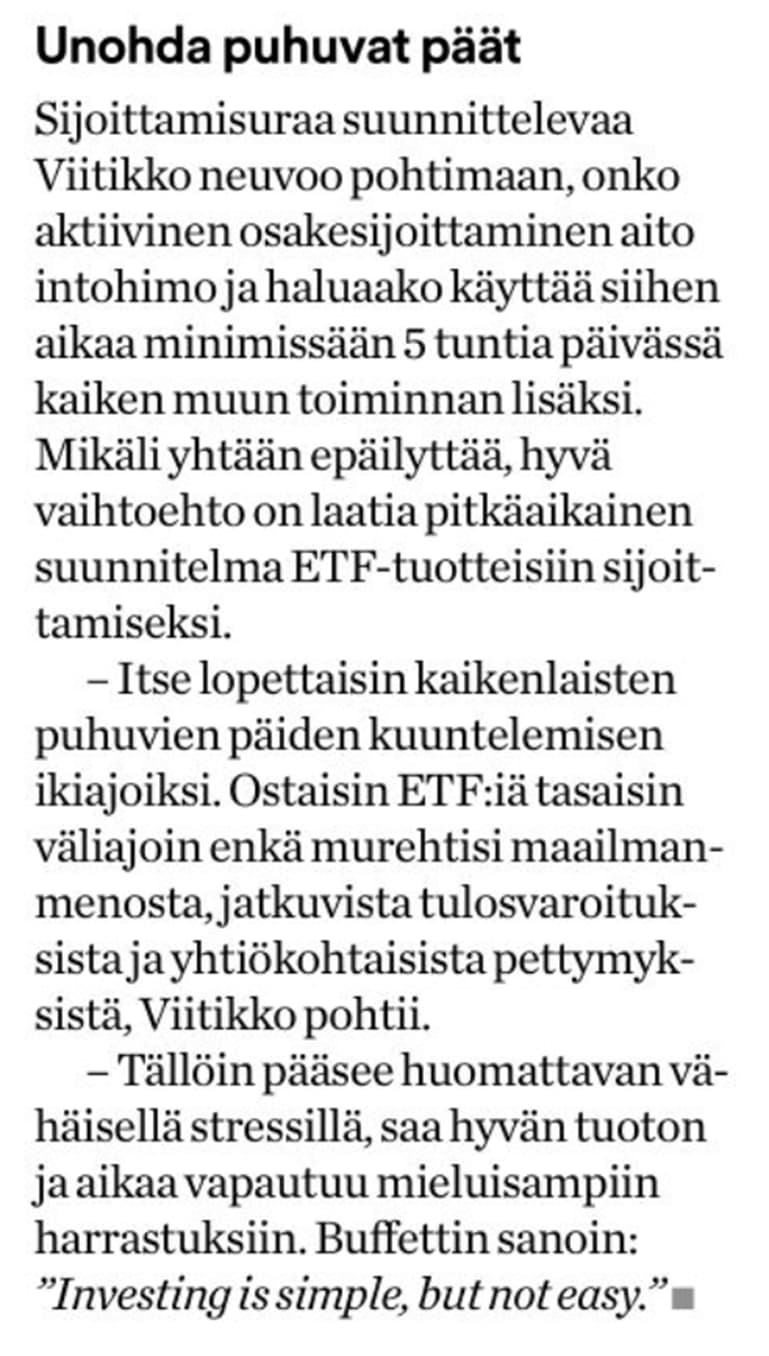
A few months ago, I read an interview with Olli Viitikko in Viisas Raha magazine. At the end, Olli shares a tip: if you aren’t passionately interested in investing, you can just buy ETF units for your portfolio and “free up time for more enjoyable hobbies.” I remember reading that and wondering what on earth he meant by “more enjoyable hobbies.” Personally, I would specifically like to spend more time on investing and everything related to it.
Sometime (this year?) @Arimatti_Alhanko also posted a fantastic piece on the forum about passion for stock investing. I couldn’t find the post right now, but I remember seeing quite a bit of myself in it. If Arimatti, Alokas, or anyone else remembers where that brilliant write-up can be found, feel free to link it here.
Back to the topic.
Now, as I sit here trying to reflect on this while writing, I realize that generally speaking, there are so many different kinds of strengths that categorizing them is quite difficult. If I do a rough breakdown, I might find my future competitive edge in behavior (disciplined commitment, recognizing biases, minimizing emotional influence), fundamental analysis (financial statement analysis, company analysis, scenario work), grasping the big picture (trends, signal vs. noise), and diligence (active work ethic, systematic monitoring, continuous learning).
These are quite high-level things, of course, but on the other hand, I am by nature very much a generalist, and I’ll probably never become a top-tier expert in cash flow statements. It wouldn’t interest me enough to specialize in just that, and I don’t believe that in investing it pays off to pigeonhole oneself too narrowly.
“More art than science.”
I’ve already touched upon many areas that need improvement in the other questions, but to list them concretely here as well: I’d like to develop my skills in financial statement analysis, market analysis, identifying competitive advantages, and macro analysis from very diverse perspectives. Additionally, it would be nice to become better with Excel for investment-related calculations.
Naturally, various systematic methods for analysis, monitoring, and documentation would also be immensely beneficial. It would be good to study those further to save time and effort for what matters most, rather than misplacing well-conducted analysis work across forum threads, grid notebooks, or messy Excel sheets.
14. What goals do you have in investing, and has investing changed your life in ways other than taking up your free time?
To me, investing is inherently rewarding and valuable in itself, so it wouldn’t be a major issue even if I never got to enjoy its financial fruits in a big way—insofar as that means spending the money somehow. Through investing, I have learned a tremendous amount about entrepreneurship, business operations, psychology, politics, cultures, societal matters, and various industries. Furthermore, investing has taught me a lot about writing, studying, spreadsheets, and similar working methods. Honing my patience and long-term perspective certainly hasn’t hurt, either.
Fundamentally, I don’t invest for the money, and I don’t believe money can serve as a sufficient motivator to become a great investor. Think of a soccer player who trains in their youth solely to secure a multi-million contract or win the Ballon d’Or down the line. I would predict a very mediocre future in soccer for such a player, and a rather high probability that, driven by extrinsic motivators, they will eventually lose whatever little passion they had for the game.
I won’t be hypocritical here and pretend that money doesn’t matter, though. Of course the goal is to make money through investing. But not for the sake of the money itself; rather, for what it represents to me. And to me, it doesn’t represent a boat, an expensive phone, or luxury high-life social media posts.
Exactly two years ago, I wrote the following on the forum, and I still stand behind every single point:
People often say that you can’t take money with you to the grave, so you might as well spend it now. Or: what if you fall seriously ill upon retiring, just when you’re supposed to start spending your accumulated investment wealth?
Well, yeah. So what?
In fact, I believe I will leave most of my potential investment wealth untouched before I die anyway. The idea of intergenerational family wealth is extremely appealing. As long as I’ve been able to invest, analyze, and enjoy the community around investing, I’ve already received everything I wanted and aimed for. I gained financial security, flexibility in making choices, courage brought by financial safety, and more free time.
If my goal had been a fancy boat, an apartment in Monaco, or waving stacks of cash around at a high-end club—without ever truly enjoying investing itself—then I suppose it would bother me to leave the money unspent.
In terms of time management, the situation is pretty good. Even though I live the typical daily life of a dad in the rush years, good windows for investing can be found—such as when the kids are in daycare, visiting friends, at hobbies, or asleep. I haven’t had to cut back on time spent together with family and the kids, nor would I be willing to compromise on that very much. I often read books related to investing (among other things) while the kids play beside me. You might recall how children learn by mimicking. In my opinion, this sets a pretty good example for the kids compared to scrolling on a phone. I listen to podcasts to some extent while running, at the gym, and at playgrounds, although fundamentally I don’t consider this kind of “multipasking” a particularly healthy habit.
Otherwise, investing has impacted my daily life in that I have already achieved some of the goals listed above to a certain extent (one never knows, of course, if the market might take it all away from me yet), so I feel my money stress has decreased, my financial security has increased, my options have broadened, and I have learned an immense amount of new things.
15. If you could choose three forum members to give you private tutoring on investing, who would you choose and why, plus what would you want them to teach you?
I’ll approach this based on where I have the most to learn and which lessons would likely benefit me most in the future. There are tons of interesting and highly skilled people hanging around the forum, but these are peers whose competence I also deeply respect:
@Arimatti_Alhanko , covering financial statement analysis, company analysis, company tracking, valuation multiples, and conducting systematic analysis as well as documentation. In my view, Arimatti works tirelessly and inspiringly in investing, which allows him to dig up a lot of information that the average investor misses. He also synthesizes those nuggets of information into great analysis and knows how to turn it into numbers. His passion and drive to learn are exceptionally high. Under Arimatti’s guidance, I could get my analysis and tracking in order and become better at separating the signal from the noise.**
@musa_2 , covering everything that could possibly relate to macro. Musa-possu’s posts, particularly in the “Direction of the Stock Markets” thread, contain so much well-digested information that I often find myself marveling at those insights. They reflect an unbelievable amount of experience and reflection accumulated in investing. Learning from Musa-possu would give me an opportunity to better understand macroeconomic turning points, which would also support my previously mentioned plan to factor macro economics better into my next investment strategy.**
@Kale-possu , covering macroeconomics, just like with Musa-possu, but in addition, Kale would act as my general mentor. There is a lot of intelligence, cleverness, and competence in the world, but decisively less wisdom. Kale-possu’s messages convey an extremely wise attitude not only toward investing, but toward life in general. Beyond possessing knowledge, Kale also knows how to apply it, and recognizes the situations where his understanding still needs improvement. He is always cautiously uncertain rather than 100% idiot-proof certain. A true sign of wisdom. Kale-possu’s broad general knowledge and well-rounded worldview enable deep commentary on everything from the history of chess to the intricacies of US politics. Under his mentorship, we could discuss absolutely anything, and I’d always learn something new.**
16. What is the single biggest benefit you get from the forum?
I honestly can’t name just one. The benefits are simply immense.
I use the forum especially for finding investment ideas, tracking macroeconomics, discussing with analysts and company representatives, drafting and stress-testing my own public notes, and general goofing around (investment memes). It would be really hard to imagine life without the Inderes forum anymore. Even though one occasionally wastes an enormous amount of time browsing aimlessly here, it also saves time when we sift through analyses, interim reports, and other vital investor information together.
17. How have you taught, or how do you plan to teach, your children about financial management and saving?
I don’t really feel like I belong to the crowd that considers talking about money and finances with children to be exceptionally important. To my taste, that tends to have—at least based on the news and social media—a bit too elitist and pretentious an approach. Of course, that perception probably says more about me than about the educators promoting “money talk.”
In my experience, children are terrible at learning by listening, but brilliant at learning by mimicking. I try to lead by example. I trust that if the kids get to grow up in a safe and loving environment overall, financial matters will eventually be learned well enough in our family too. Naturally, if an interest in investing, for instance, appears later on, I’ll be ready and deliver a couple of crisp tape-to-tape passes if needed.
Speaking of mimicking and setting an example: I personally aim to be frugal and spend responsibly. When asking for toys, the kids also learn delayed gratification. Money doesn’t grow on trees; it’s always earned one way or another. Now, at daycare age, they already occasionally pay for their own purchases at the store using money received as birthday gifts. If you buy this, you won’t be able to get that anymore. If I spend the money now, there won’t be any left at the next kiosk. Perhaps that fosters some understanding regarding the use of money.
18. How have you studied investment psychology, and how would you recommend the “average forum member” delve into the subject?
Oh boy. I could write a book about this, but let’s try to keep the answer somewhat concise.
I have a general interest in psychology and at one point even semi-seriously considered studying the field. Consequently, over the years I’ve read many psychology-focused books that, from an average reader’s perspective, don’t have the slightest connection to investing. You know, works by psychologists, neurologists, neuroscientists, and the like. To throw out some names from the more popular end: Jonathan Haidt, Carol Dweck, Brené Brown, Martin Seligman, Sonja Lyubomirsky, Paul Gilbert, etc. At one point, I also read some books belonging to introductory university psychology courses, but I wouldn’t recommend those to just anyone.
From an investing standpoint, it’s probably best to focus primarily on the following:
- Understanding your own thoughts, emotions, and behavior (the aforementioned authors can provide great tools for this, but there are also books by Finnish psychology experts, e.g., Arto Pietikäinen)
- The fundamentals of behavioral economics
I first fell down the behavioral economics rabbit hole around 2012–2013 when I found Kahneman’s Thinking, Fast and Slow at the library. It is a fantastic description of cognitive biases that cause irrational behavior. Most of the book’s examples are applicable to investing as well. I actually liked Thaler’s Misbehaving even more than Kahneman, but Kahneman’s work is somewhat more comprehensive. In general, the publisher Terra Cognita has translated many excellent books on behavioral economics into Finnish.
So, read a book or two on these topics, identify your own irrational behavioral patterns (e.g., FOMO), and try to devise ways to prevent such behavior (e.g., buying into runaway stock prices just because others are) in your investing activities.
There is also a lot of high-quality reading material in the Investment Psychology thread.
19. What should Alokas focus on to avoid constantly messing up?
If I’ve understood correctly, you are quite the heavy consumer of analysis. You seem to read most of the research published by Inderes, so you definitely receive very broad and diverse insights into different companies, sectors, and their current situations. This is a great thing, of course, and certainly keeps you exceptionally well in tune with the market’s pulse.
It is crucial to consider what kind of information you pay attention to, but perhaps even more important is choosing what not to pay attention to. What to leave outside of your consciousness.
By this, I mean that since both our available time and our capacity to process information are very limited, it pays to choose the most useful and motivating way to practice investing. I believe you enjoy reading analysis and investment content a lot, so it comes naturally and feels exciting. However, you could also experiment with a few other approaches and then reflect on whether they offered any new perspectives.
So, here are my two tips tailored for Alokas:
19.1. Reading print books
You mentioned having slight challenges with focus and attention. I don’t know how well long stretches of reading a printed book work for you, but if possible, it could be beneficial not just for investing, but also for reviving your attention span. If you were to practice for, say, twenty minutes daily or a few times a week, maybe by the Christmas holidays you could manage an hour-long reading session straight without interruptions. Phone in airplane mode in another room, remote control out of reach, and read. Surely brothers Sippola or Pulkkinen can hold down the fort on the forum in the meantime. Here are a few relatively accessible ones to start practicing with, which are guaranteed to help with investing.
Narrative-driven:
- Puustinen: Sijoittaja – Mitä Hannes Kulvik oppi ahneudesta ja miten sinäkin voit vaurastua levottomilla osakemarkkinoilla (The Investor – What Hannes Kulvik learned about greed and how you too can build wealth in volatile stock markets)
- Hämäläinen & Oksaharju: Sijoita kuin guru (Invest Like a Guru)
Instructive, easy-to-read stock investing books:
- Keskiväli: Tähtäimessä osakkeet (Targeting Stocks)
- Elo & Saarhelo: Osakesijoittajan maailmanvalloitus (The Stock Investor’s World Conquest)
- Saario: Näin sijoitan pörssiosakkeisiin (How I Invest in Public Equities)
Other related titles:
- Thaler: Misbehaving
- Kallunki: Tilinpäätösanalyysi (Financial Statement Analysis)
I must emphasize that I don’t have the slightest professional qualification regarding actual attention and focus disorders, so Alokas, please take these merely as the meddling of an over-eager reader friend. I don’t want to get sued for quackery. 
19.2. Doing financial statement analysis in Excel
Another tip would be to gather the financial statement data (income statement, balance sheet, cash flow statement, share data) for one or maybe two companies in Excel over a five-year period, for instance. One column per year, entering revenue, all expenses, taxes, asset lines, equity, liability lines, all cash flows, etc., in the order they appear in the financial statements.
Collecting this data is “a bit” tedious and laborious, so if necessary, you can start with just the income statement and shorten the timeframe as needed. The point here isn’t to produce a paid, publication-ready equity research report, but to learn the fundamentals of financial statement analysis.
The end result is rewarding once you learn how to read financial statements and explore them using your own calculations. Even if Inderes’s eternal goal doesn’t materialize and retail research goes extinct, you’ll still be able to make sound stock picks. You’ll also get more out of analyst research when you have a better grasp of what’s being discussed.
Pick up a good investment book—for this exercise, I’d perhaps recommend the ones by Keskiväli, Elo & Saarhelo, or Kallunki. Build simple calculations and charts for metrics like P/S, EV/S, P/E, P/B, EV/EBIT, EBITDA margin %, operating margin %, free cash flow, equity ratio, etc. You are bound to have at least a few “aha!” moments when you see how each multiple or metric is formed, how annual fluctuations in numbers affect the results, and how, for instance, valuation multiples have shifted relative to the share price.
You could also use the Inderes Investor School and other online guides for this, but it’s almost better to have the data in Excel, the instructions in a book, and the ethernet cable hidden away. It’s so easy to get distracted and do completely different things when working on a computer and a calculation temporarily feels too difficult. Raise the friction to quit as high as possible, and reward yourself once you manage to plot, say, one solid P/E chart.
20. What would you especially like to thank the forum members for?
For an immense number of things. First, the Inderes crew for creating this forum and actively participating in the discussions. You have built something truly unique, even on a global scale, as far as I understand. As I said, it’s hard to imagine daily life without Inderes’s services anymore, especially without this forum.
Then, to my fellow investors: thank you for producing content, high-quality analysis, commenting on my posts, and simply fostering an inspiring and educational atmosphere. Beyond learning a great deal, I’ve had countless laughs reading memes and other good-natured banter. And without my fellow investors, I certainly wouldn’t have been this active on the forum or on Twitter, and I would have definitely let myself off easier with my analysis. A little public pressure and social accountability keeps your writing sharp.
I also want to thank the company representatives for coming to the forum to communicate with investors and taking the risk of being exposed to sharp criticism. Without you, many questions would have gone unanswered and many things would have been terribly misunderstood.
Let’s keep the standard high together going forward. 
Thank you Mauri, you put an incredible amount of effort into these answers! 
Mauri is Mauri, and I mean that in the best possible way. His answers held so many important insights for everyone to reflect on. Reading Mauri’s thoughts, you can’t help but realize that doing thorough homework and exploring things broadly will inevitably lead to success in the long run. I’ve also noticed that people like Mauri, who are empathetic and kind, simply enjoy life more and get more out of it.
Wishing everyone a relaxed and wonderful weekend! 