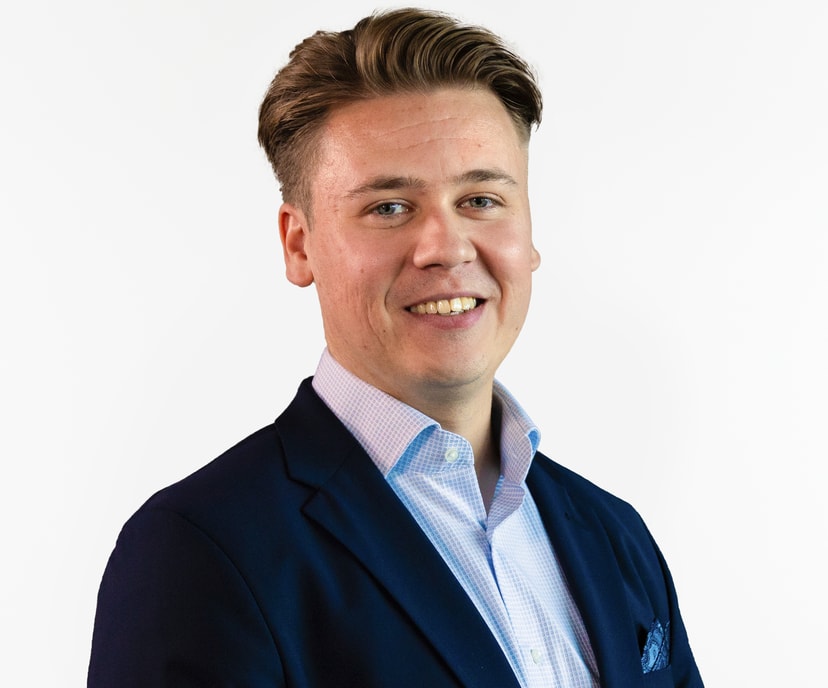
70. Arttu Heikura
Analyst Heikura has an excellent grasp of the companies he follows and a great understanding of the industries in which they operate. He has a knack for noticing the essential things that affect a company, and furthermore, he seems to have a special ability to connect the different pieces together to see the big picture. Seeing the big picture is surprisingly challenging, which I realize when I think about myself and read the thoughts of various investors: we investors tend to focus too much on trivial details and/or just certain specific things.
Analysts generally tend to mostly follow companies that “suit” them, and I think something similar has happened with Arttu. As a sort of Lynchian and down-to-earth person, Arttu is indeed a good fit as an analyst for the retail sector companies he covers.
However, Arttu is a fairly recent analyst at this firm and mostly for that reason he has remained a bit unfamiliar to me, so it was nice to ask him what kind of guy and investor he is.
I couldn’t have chosen a smaller picture. 
1. Tell us in thirty words who you are.
A 29-year-old guy who has studied economics and is interested in stock investing. I’m from the countryside and nowadays live in Helsinki with my wife and two dogs. I spend my free time watching football, with friends and family, and maintaining some level of fitness through casual sports.
2. Tell us three things that forum members don’t know about you.
- We are currently building a detached house, which has significantly increased the amount of grey hair I have.
- In high school, I worked at a Citymarket fish counter for a year and a half. This gave me great insight into the grassroots operations of grocery retail.
- Back in 2019, I was still of the opinion that I would become a Ph.D. in economics. However, this idea has fallen by the wayside with the much more enjoyable and concrete work of an analyst.
3. What interests and hobbies do you have? You are not allowed to mention anything related to investing.
When I was young, I played ice hockey and football. Their influence has continued to this day, and I am quite an active armchair sportsman. In the realm of armchair sports, the success of my favorite teams has been rather dismal in recent years, and I often end up going to sleep “angry” on Sunday evenings. In addition to these, I try to improve myself by reading books and maintaining some sort of fitness through tennis, jogging, and occasional gym workouts. I don’t like cooking everyday food, but I enjoy preparing proper food, e.g., on weekends. On top of these, walking the dogs and messing around with them always takes up part of the day. I try to see my friends and family on weekends.
4. What is a normal weekday like for you?
I wake up in the morning around 7–8 a.m. I take the dogs out and do my morning chores, after which I read the news that came in during the night/morning. If the companies I follow have released press releases, I write a comment about them for the morning report (aamari). After this, I work from home for a while, and then often head to the office. This pattern repeats regardless of the day.
Normal days are spent more or less ramping up on the companies I follow, which in practice means updating comprehensive reports, meeting management, and searching for information. Making a comprehensive report is actually a very good way to get to know a new company. I recommend either reading a comprehensive report or making a similar “report” (e.g., using bullet points) to all investors.
Earnings days are often dedicated to writing comments and dissecting the results.
I often exercise on weekends, so the evenings are filled with everyday chores. I might do some work before going to sleep if there are tasks left unfinished.
5. Could you tell us about your work history?
I started my career at age 13 by painting fences for a week. After that, summer jobs have included mowing lawns, participating in event volunteer work, and working at a Konecranes factory, for example. During high school, I worked for 1.5 years at a Citymarket fish counter, which gave a good picture of the operational everyday life of grocery retail.
During my studies, I did data analysis jobs that required skills in coding and statistics, for example. I moved into equity analysis within Evli in the summer of 2021 and switched to Inderes in the autumn of 2023. Rarely have I used the methods at work that were taught to me in the Faculty of Social Sciences (valtsika), but studying economics has definitely been useful for grasping the big picture of the economy.
6. How would you describe yourself as an investor?
During my student days, very risk-seeking (ignorant), nowadays quite calculating and somewhat conservative. I don’t like turnaround companies and rarely invest in a company that isn’t making a profit. I favor profit-making and growing companies with a proven business model. I usually approach companies quality-first, and in an ideal situation, I time purchases for market disruptions (because quality is rarely cheap). Lately, I have started scouring foreign companies, as these are not subject to commission restrictions for us.
**7. Could you tell us what kind of investment history you have?**My father had once bought me shares of M-real, now known as Metsä Board, from the bottom of the financial crisis, and I got to watch their value formation from the sidelines during my youth. This was probably the spark for my stock investing. During my university years, I taught myself about investing, and the tactic was to invest half of my savings in stocks and half in funds. The first company I bought was probably Nokia, F-Secure, or UPM, of which only one remains in my portfolio. With those volumes, making direct investments was quite expensive, but I feel that learning by doing is the best way. Later, I started studying financial markets and stock investing. The job of an analyst brought a huge step forward in my understanding, but I believe there is still plenty to learn here.
8. What benefits do you get from the work of an analyst regarding your investment activities? And are there any disadvantages from the perspective of investing, given that you are an analyst?
An analyst’s job has brought a lot of additional understanding to the analysis of an investment target. In addition, we have access to data sources that cost several thousand euros a month. This in itself does not bring an informational advantage to a professional, but it makes it easier, for example, to trawl through the investment universe. Management meetings are always useful, but I believe the biggest benefit comes from colleagues and the Inderes community. A colleague almost always knows the company they follow better than I do, and one can ask them for additional information about the company’s situation if necessary. From the community, I get good feedback and also valuable information (e.g., about news that might fly under my radar).
The disadvantage is the trading restrictions, because sometimes, due to short-term weakness, they might prevent buying a high-quality company that has good long-term potential. On the other hand, you can often get such a company cheaper later by placing the order when the restrictions allow it.
9. What does your portfolio look like right now? Which three stocks do you trust the most and why?
My largest holdings include: Qt, Harvia, UPM, Musti, Revenio, Admicom, and Evli. At the bottom, there are then some experiments or lines that turned out to be failures 
Of these, I trust the most:
- Qt: has proven the functionality of its product and business model. Capable management and there seems to be continued demand for the product. Customers include major international companies, which shows that the technology works.
- Evli: I worked at Evli and know the value of the core businesses and the capabilities of the decision-makers there. At Evli, a tremendous amount of work is put in for the clients, which is also reflected in numerous institutional asset management top awards. The house has some of the best portfolio managers in Helsinki and very significant communities and institutions as wealth management clients. Evli is of a scale where the biggest IT reforms have been done and their costs are now scaling with leverage as sales grow.
- I will put Musti here now (even though recent situations have shaken my faith in the company): in my opinion, Musti’s market share growth shows how high-quality a company it is. Musti has a well-functioning concept that is practically tailored as a pet parent’s one-stop-shop service. Pricing of services has succeeded well in my opinion: e.g., clipping a dog’s nails costs around twenty euros, but the threshold for using it is very low when one of the dogs won’t let you clip its nails :D. Food products bring defensiveness and very good margins are obtained from “consumables”.
10. How do you think about your portfolio’s diversification, or do you think about it at all?
I have to admit that I haven’t thought about it overly much; the tactic has been to buy and forget. In recent years, as the weights of certain value-oriented companies have risen quite high, the portfolio’s daily return fluctuations can be quite strong. I think I will consider some kind of rebalancing in the future, which is, however, difficult with current restrictions. Currently, everything is tied up in stocks and index funds, but in the future, I would like to own private equity, e.g., through certain funds.
11. What is your step-by-step stock picking process?
It depends a bit on the company. Often I read either an analysis made by someone else or the latest annual reports/interim reports. If I buy some stable, mature-phase company, I rarely do any modeling of it, but look at the quality-describing key figures at the consensus level, the valuation level, and try to grasp what the future might look like. If I am getting to know a brand new, slightly younger company, then I aim to make a bare-bones model, put consensus forecasts alongside it, and often make a “bear” or more conservative estimate from these. From the bare-bones model, I can then forecast some key figures and qualitative metrics important to me (return on capital, good profitability, scaling potential, continuation of growth, management’s track record, etc.) and at the same time the company’s valuation level. If the valuation seems moderate, I might then open a first position and get to know the company even more deeply after that. Turnaround companies or cheap but low-quality companies rarely end up in my portfolio.
12. Tell us in fifty words per company what you think of these stocks:* Kesko: A high-quality, well-managed company. Although no changes are coming to the strategy, I sense a shift in focus more strongly toward the building and technical trade (RT-kauppa) during Rauhala’s era. The near-term outlook for the grocery trade (PT-kauppa) seems challenging, but if one believes the company’s own words, the new hypermarkets should provide significant help in catching up on lost market share. However, in my opinion, this requires improving the price perception, because with this trend, the S Group’s lead will only grow.
- NoHo: An interesting “holding” company focused on the restaurant market. Management has clear expertise in capital allocation and operational capability (costs vs. sales volume). A winning recipe has also been found in Scandinavia. A significant point of interest and share value driver lies in BBS, as NoHo will divest from this at some point. This boils down to successful acquisitions and scaling concepts in Central Europe (plus F&B in Finland).
- Puuilo: A growth rocket in discount retail and a high-quality company. There is still room for growth in Finland, and I see internationalization as an option. They have succeeded in developing a concept attractive to Finnish consumers that appears to beat the closest competitors. Profitability ranking at the top of the retail sector is thanks to the cost-awareness of management and staff. There is some upside potential in profitability through the successful expansion of the private label selection. The larger the company grows, the more prominent a role cost-awareness assumes.
- Tokmanni: The largest discount retailer in its market area (Finland + Sweden) and a pioneer in Finland. During Rautiainen’s era, they have succeeded in increasing customer loyalty, which is visible in the revitalization of growth and the raising of the profitability level. Internationalization brings a new boost to Tokmanni’s story. Dollarstore seems like a good piece in Tokmanni’s puzzle, and there is likely significant growth potential in Sweden and Denmark. As an essential matter, Tokmanni must succeed in capturing synergies and improving Dollarstore’s profitability profile.
13. How did you end up following precisely these kinds of “retail” sector companies (Kesko, Puuilo, Tokmanni, Verkkis)? If I recall correctly, you have mentioned reading and following Peter Lynch, and you have practiced “Lynching” in your investment activities. How have you practiced this in your work as an analyst?
By coincidence at Evli, I followed Verkkokauppa.com and Marimekko, through which I gained some exposure to the consumer sector. If I understood correctly, this was of some use when applying to Inderes.
The consumer and retail sector is interesting because of its tangibility. Things can be observed and seen with one’s own eyes. The most interesting thing about retail is that products rarely allow one to stand out from others, but sources of competitive advantage must be sought elsewhere, with concepts at the forefront.
In my own investing, the Lynch quote probably applies best to Musti In addition, I often ask for the consumer’s perspective from my wife (just as Lynch did), which helps bring perspective to my own mindset.
My wife shops more often, for example, in grocery stores and Marimekko shops, and is more knowledgeable about the fashion world (which helped during my time at Evli). Today, we often visit discount stores, and I try to pay attention to concepts there and, to some extent, customer activity, though in individual stores, this does not give a realistic picture. Often, you can find Tokmanni, Puuilo, and Rusta right next to each other in the same cluster, which provides good synergy benefits for “Lynching.” I also try to make use of friends/acquaintances who might work in relevant industries.
14. You were at Evli for 5 years, including a few years as an analyst. How do the analyst jobs at Evli and Inderes differ from each other?
Evli is a fantastic company full of professionals. The biggest difference in analysis operations probably comes from scale. Inderes has nearly 200 companies under coverage, while Evli had 20-30. Furthermore, equity analysis is one of Inderes’ core businesses, whereas at Evli, the analysis team was a partial ownership (or non-core business). The analyses themselves do not have major differences, but at Inderes, you deal more with retail investors, whereas at Evli, it was weighted toward institutions.
15. You are forced to hand over your portfolio for five years to two Inderes employees who are not analysts, two analysts, and two forum members. Who would you choose and why?
Verneri and I have chatted about investing a fair bit, mostly in the form of retail companies, and I know Vepu is a very enthusiastic stock investor and economic researcher. Second, I’ll mention Miika Purola, who might bring some completely out-of-the-box thinking to investing with the help of math/AI.
From the analysts, I could choose any of them, but I’ll name Sauli and Rauli now (it rhymes nicely). Both are experienced guys and understand the big picture better than I do.
On the forum, I have come across several usernames, some of which stand out for their activity. I would leave part of the portfolio for JuhaR to manage, and the other half I’ll leave to Alokas. I feel like both know Helsinki Stock Exchange companies well and spend a lot of time on stock investing.
(edit: pings: @JuhaR, @Sauli_Vilen, @Rauli_Juva, @Miika_Purola and @Verneri_Pulkkinen)
16. What help and benefit do you get from the Forum considering your work as an analyst?
The forum provides good ideas, news, and sometimes support for alternative viewpoints. In the discount store threads, Vanerihands and NukkeNukuttaja have been very active. I remember back when I followed Vaisala, reading good technology-related stuff on the forum, e.g., from Contrafun.
(I pinged you so you’d notice: @Contrafun, @Vanerihands and @NukkeNukuttaja regards, alokas)
17. If you could, with the push of a button, teach/internalize one thing related to analyses to the forum members, what would it be and why?
Attempts have been made to make the analyses easy to understand. Hopefully, we have succeeded in that. Of course, reading the analysis requires some familiarity with the company and knowledge of stock investing.
But as for that tip: use the analysis as support for your own investment process and mirror it against your own investment strategy.
18. Do you have concrete investment-related goals, for example, euro-denominated or percentage targets?
I have sometimes thought about something like this when similar things have come up on Twitter. Currently, I don’t have any actual targets, but I might try this in a year. Right now, almost all extra earned income goes into the house project. I save in stocks because I find it fascinating. At the same time, I strive to ensure a reasonable standard of living for my retirement days.
19. How could Alokas become a good “Lyncher”?
If you haven’t read Lynch’s books yet, start with those. If you can try, observe, etc., the products or services of an interesting company, do so. Also, ask for advice from those who know about the company or its products.
Perhaps as less known teachings of Lynch, one could highlight trying out unsexy industries and playing against Wall Street (i.e., institutional investors in Finland). Strike early at small but growing companies, and in a bear market, buy quality companies when institutions are selling them.
20. What would you especially like to thank the forum members for?
A big thank you for the good two-way discussion and sharing of opinions. An active community also maintains the quality of the analysis itself, as we get to hear about questionable views.
Thank you Arttu for the excellent answers! 
Arttu is an active guy on the Forum and he has also brought things to the company threads that certainly benefit investors. I have noticed how the quality of a company thread improves and becomes active in a good way when “lyytikot” (analysts/members) are active in them; in addition, it brings Inderes closer to the community.
At least I myself would need that kind of sensible and comprehensive approach to companies that Arttu has. He knows how to structure the information he has gathered well, accompanied by good comments, and from the materials he produces, I have noticed that he recognizes what is actually significant and what is less significant.
I just need to learn how to keep my emotions in check and examine things more broadly, rather than making things unnecessarily difficult by getting stuck on old minor theses when things change.
I guess that’s about it, have a nice weekend! 