66. Porssi-Petteri, PART 1/2

Porssi-Petteri, or more familiarly Pörssi-Petteri 
Here is a wonderful forum member whose rarely posted messages are carefully written and full of valuable content. Although he doesn’t write particularly often, every single one of his forum posts reflects expertise and dedication. He fosters positive community spirit by offering high quality information, and his example hopefully inspires others to share valuable insights within the investment community.
The community appreciates it when such excellent forum members invest effort into useful information that offers something new that hasn’t been brought up in company threads before. Petteri writes quite a lot specifically in popular company threads where often “everything has already been covered” and it is difficult to bring anything new that adds value to the thread, but he always manages to bring new quality material anyway.
A popular company thread is easily followed by an arena-sized crowd, so whenever a message drops there, within a brief moment even hundreds are clicking the thread… and when it’s his message, that click is certainly not wasted…
NOTE! The interview is in two parts/messages.

Thanks to Alokas for the opportunity to be part of this wonderful interview series. I have been an eager reader of the interviews. It’s nice to finally challenge myself in the form of answering as well. Up to this point, many heavy hitters and top professionals from the investment and corporate worlds have been interviewed. As for forum members, the interviewed have been the hardest household names of the forum, who have had a lot of solid points to write and many interesting stories to share. I want to emphasize at this point already that I am quite an enthusiastic investor, but by no means excellent in my track record. Hopefully, the writings below will be of use to some of the readers or spark new thoughts. Hopefully, no one will copy any of my choices, because there is certainly no guarantee of good returns.
1. Describe who you are in thirty words.
Like almost all the other interviewees: a late-thirty-something or early-forties family man who has fallen for investing. I’m living the peak years of the rush hour of life in the Helsinki Metropolitan Area with my wife and three children. My education is M.Sc. (Tech.). The upcoming answers will reveal more of my personality.
2. Tell three things that forum members don’t know about you.
I have maintained full anonymity and don’t write much about myself, so you really don’t know anything about me. Soon we’ll see if I stay completely anonymous after these.
- I like numbers. As a child, I memorized car prices and technical specifications, later NHL statistics. Nowadays I focus more on investment-related figures.
- I am extremely lazy and comfort-loving. I slouch in an armchair or on the sofa whenever the wife isn’t looking.
- I am not active on social media at all, and the Inderes forum is practically the only social media I write on.
3. What interests and hobbies do you have? You are not allowed to mention anything related to investing.
I am not very athletic, and especially after having children, regular exercising has taken a back seat. It has of course been replaced by indoor playground visits and other scrambling around. I try to move just enough so that I don’t get into terrible shape.
There are plenty of other interests, though. A person must be enthusiastic and interested in things to keep the mind sharp.
Economy: in addition to investing, I am versatilely interested in the economy. I read news on the subject, follow Twitter, and examine data and charts. Related to this, economic policy (why not other politics too) is of interest, but it’s not worth sinking too deep into that swamp for mental health reasons.
Alcohol: I gladly drink high-quality alcohols. Craft beers and single malt whiskies especially appeal to me. It would also be nice to pursue wines more deeply, but you can’t booze beyond a certain limit. I used to brew my own beers; perhaps someday I’ll dig the fermentation tank out of storage again. More unusual beers interested me back in the days when it was hard to find anything other than pale lager in stores.
Watches: This hobby easily carries you away. You just can’t have too many watches, and impulse buys are hard to avoid. You can tell the time from your phone too, but that’s not why you wear a watch. A fine watch is simultaneously a work of art and a display of engineering style. And best of all, you can wear and admire it around the clock. A watch makes the man (or woman).
Classic men’s dress: The golden age of style was the 1920s-1950s, when everyone, regardless of class, dressed wonderfully. Nowadays, things don’t matter in the same way; everything is the same gray mass. To put it a bit extremely, you can leave home even in long underwear without causing any particular disapproval. Morning or evening, everyday life or celebration, at workouts or at work, you wear the same t-shirt. When everything is the same mush, meaning disappears from life.
Almost the only privileged field where you can dress stylishly is the financial sector. Sweatshirts are a wasted opportunity. Verneri certainly knows that today is an important day, today things happen, today I am at my best when he leaves with a tie around his neck to interview Sampo’s CEO.
Spectator sports: I have a diverse background as a couch potato since childhood. Sometimes I followed almost all sports, then especially football and hockey, but nowadays mostly just hockey. NHL, national team games, and especially the U20 championships get watched. A couple of golds celebrated on-site too.
Eating: I like to eat high-quality food, whether it’s fine dining stuff or street food. Sometimes I even get inspired to cook something better myself.There is more, but I won’t go on any longer. Quick mentions of other interests: reading, traveling, cultures, history, architecture, cities, cabin life.
Some of these mentioned things might seem a bit snobbish or elitist. However, in some matters, I’m just as frugal as Alokas. So, I’m just an ordinary guy in my holey socks and boxers. Besides, I don’t buy anything to look like something in the eyes of others, but rather because I enjoy those things myself.
4. What is your typical weekday like?
The kids wake me up around seven, and then we do our and the kids’ morning routines, topped off with a big cup of coffee. I drop the kids off at daycare after eight and continue on to the office. I work in procurement and, from that perspective, I also follow the economy and various markets closely. Unfortunately, however, workdays are mostly spent sitting in meetings and rushing through actual work under time pressure. I get home from work around five and start making food for the kids (sometimes I even arrive at a ready-to-eat table). From five to eight, we clean up messes, change diapers, do laundry, and play with the kids indoors or outdoors. When the opportunity arises, I take out my phone and log onto the forum or browse some other finance/investment-related media. After eight, we get the kids to sleep, after which there’s a moment to zone out in front of the TV, surf the forum more, or listen to podcasts. I go to sleep between 22-23 and usually listen to a podcast in bed until I pass out. At night, I still wake up a couple of times when the kids wake up.
5. Could you describe what kind of an investor you are?
Eager to learn, motivated, versatile, occasionally overly impulsive, and dabbling in many directions. However, I make my impulsive flutters with small stakes. All in all, though, I am long-term, diversifying, and risk-averse. When I invest in higher-risk companies, I prefer to take many small risks rather than a few large individual ones. I’m not looking for any huge one-off gains; instead, I try to make many small good decisions. Thus, I also don’t believe I will ever beat the index by a huge margin. If I beat the index in any given year by more than 10%, I would likely have strayed from my strategy or investment principles. I see that over the long term, even a small outperformance brings a significant advantage. Over 30 years, a 7% return multiplies capital by 7.6, an 8% return by 10, and a 9% return by 13.3. So, alongside an annual 1-2% outperformance, the total capital can multiply 1.5-2 times in the long run vs. the index. That is perhaps what I am aiming for, rather than lottery-like sudden riches. Above all, I don’t want to lose capital (or underperform significantly). An index return would suit me just fine, but it would be a lot more boring.
Howard Marks mentioned somewhere about a portfolio manager who produced mediocre returns for years. He never ended up on the lists of star portfolio managers. Likewise, he never had bad years. Thus, over time, this portfolio manager’s fund actually belonged to the best-performing ones. I’d gladly get my returns with this style.
I mainly invest in Finnish stocks because it’s simply easier to stay on top of how they are doing. I aim to keep a roughly 50/50 split between stable quality companies and small/growth companies. However, this isn’t set in stone and fluctuates a bit along with good cases and valuations. A third segment would be potential turnaround companies or other cigar butts. I try to take on very few of these and only after careful consideration. Of course, it’s quite subjective how to categorize any given company, and companies also change over time. A company stamped as a quality stock in the portfolio soon turns into a turnaround company, and a fantastic growth company hits a wall with zero growth.
The market turbulence of recent years has taught me even more to watch out for buying at overprices and to focus on quality.
A few principles for direct stock purchases that I try to follow:
Small & Growth Companies:
- Industry disruptors, scalable business models
- Industry consolidators
- New winning technologies and Megatrends
- Don’t pay too much, don’t underestimate risks
- The higher the risk, the higher the expected return must be
- For high-risk cases, time diversification for purchases – try to be convinced that the risks have dissipated or the probability of return has improved before making additional purchases
- 3-5 year focus, wait calmly for the compounding effect
Quality/Value:
- Stable operators, long-term value creators
- Low-risk profile, moderate competitive advantages
- Stable, good dividend
- Do not invest against trends, into value traps, or shrinking industries
- 1-5 year focus – buy for long-term holding, react if return expectations change
General Principles:
- Utilize time diversification in purchases and a sufficient margin of safety (~15% return expectation for a 3-5 year period – this is naturally only on paper. Real-life variables then shrink the returns lower)
- Dare to buy into rising prices as well
- When everything feels like it’s going swimmingly, raise your cash weighting
- When there is blood in the streets, be brave. Evaluate the long game.
When a good stock has “gone up too much,” wait a little longer before trimming - Beware of falling knives
- Remember that cheap companies are usually cheap for a reason
- Understand the business of the companies you buy, study them thoroughly
- Utilize information edge in small and mid-sized companies & Finnish stocks
- Spend time reading interim reports and analyses
- Top 3 stocks Max 30%, preferably max 25 stocks (I haven’t managed to stick to this)
Despite all of the above, that famous gut feeling still gets used too.For international diversification and as a hedge against my own lack of skill, I use mutual funds and ETFs. I’d like these to make up 30-40% of my investments. My international diversification has failed to the extent that only about ten percent of my portfolio is in the US. The S&P has just felt so overpriced for the past few years. I also have quite a lot in emerging markets, and they have performed poorly. However, I don’t use funds as very active instruments. In practice, I just buy and hodl. We’ll increase the US weighting when they feel more reasonable again.
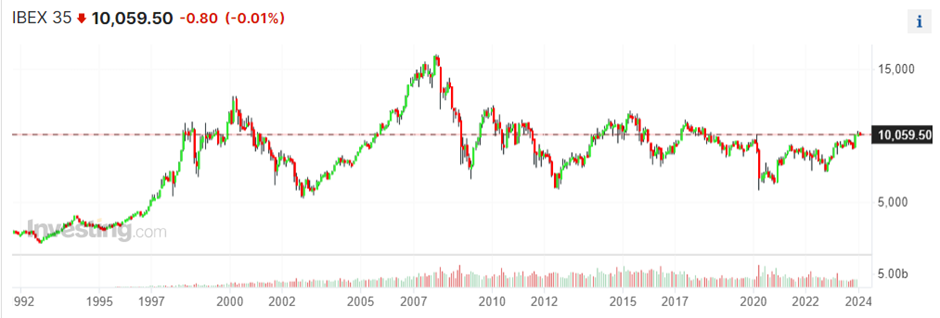
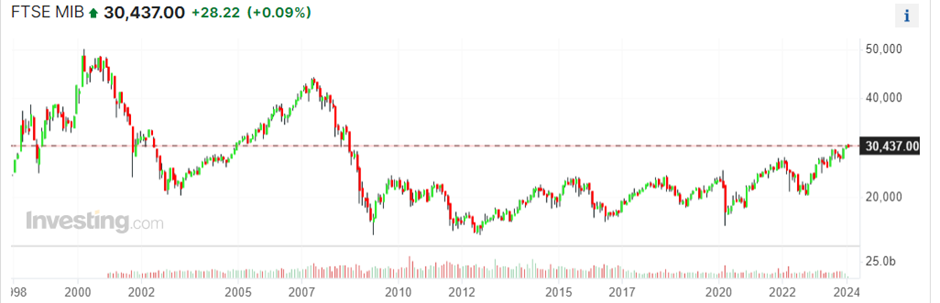
I think having global diversification is also good because I cannot rely for sure on our local Helsinki stock exchange being as good a stock market for the next 30 years as it was for the previous 30 years. What would a 20-year investment career with a 100% weighting in the Spanish or Italian stock markets have felt like? Surely, investors in those countries were also very convinced of their home bias back in the day. You can generate excess returns in that kind of environment too, but it’s hard to squeeze all your returns as outperformance when the index itself yields zero.
The third section of the portfolio is “other investments”. In principle, anything can go here, but I don’t let this section exceed 10% of my total wealth. Right now, I have real estate funds, and I’ve also used fixed-income funds over the past year.
The fourth section is cash. As a cash substitute, very short-term fixed income. I’ve used an overnight swap ETF, which basically works like a short Euribor. Cash weighting -20 to +20%.
I haven’t actually used leverage yet, but it’s within the target range mentioned above in the playbook. As a rule, I keep a cash weighting of 0-10%. I don’t see speculating on market timing as a relevant part of my investments. Of course, if the price level is exceptionally cheap or expensive, I think it’s reasonable to be slightly flexible.
I’m not a huge conviction person. I think a portfolio of under 10 stocks is overly risky. You can be well or poorly on top of the cases, but there are always so many variables that even a well-researched investor cannot understand them all. A pandemic or some other disruptor can always come around the corner and pull the rug out from under your assumptions. I’m still so slow to change my mind that I’m easily left holding the bag. The more you research and the better you know an investment case, the easier it is to fall in love with a stock or fall prey to confirmation biases.
“That if you have conviction, and I hate that word conviction, because conviction goes with arrogance.” – Aswath Damodaran
Secondly, there is an endless number of possible outcomes. Understanding all of them is impossible. The stronger your conviction in your own thesis, the more likely you are to underestimate scenarios that seem improbable, and especially those scenarios you have failed to identify.
“It ain’t what you don’t know that gets you into trouble. It’s what you know for sure that just ain’t so.” – Howard Marks
6. Could you share what kind of investment history you have?
I got my first shares as a christening gift. Those KOP shares later turned into Nordea. They get to stay in the portfolio forever and are not for sale. What a fantastic gift, since every year 50-70 euros land in my account. A gift that keeps on giving.
I made my first self-directed investments 11 years ago. I had been in the workforce for a while and the most important purchases to raise my standard of living had already been made; money was left over in the account from my salary and I had to put it somewhere. I chose 5 familiar companies pretty much at random. Little by little, I also started monthly saving into low-cost index funds and continued stock picking without significant understanding. Over time, I researched more and started to understand P/E ratios and dividend yields, among other things. Probably around 2016, through Nordnet’s morning letter, I started getting to know Inderes and began utilizing Inderes’s analysis more and more. At first, of course, just the recommendations, target price, and top 3 list. Then I started reading the forum, pretty much from the forum’s early days. Back then, it was mostly Aston and Masse chatting, with the G-numbers muddying the waters.
Between 2013-2018, there wasn’t a whole lot of rhyme or reason to what I was doing, and wealth accumulated especially through hard saving and owner-occupied housing. During that time, the return was roughly in line with the index. In 2019, things started to make a bit of sense, even though returns were dragged down by the portfolio’s old bagholders. During the Covid era, returns were strong, but success went to my head, and despite all apparent caution, in the bear market, the valuation levels and earnings performance of small-cap companies couldn’t hold up. As a result, the nice gains melted away, but I was able to beat the index somewhat overall during that period.
I’d like to think that with these experiences, I’m a notch smarter as an investor again and I wouldn’t make all the same mistakes over again. Of course, there are still plenty of unmade mistakes ahead, but hopefully also an increasing number of successes.
7. What kind of portfolio do you currently have? If you had to keep three stocks in your portfolio for five years, which ones would you choose and why?
The portfolio is already a nice size and well diversified. I already broke down the allocation between different classes a lot above. I’ll focus here on direct stock investments. In my excitement, I’ve managed to accumulate a few too many individual stock holdings, a little over 30. Here is a sample of the most significant ones:
Tokmanni, Kamux, Qt, Noho, Harvia, Tieto, Vincit, Fortum, OmaSp, Neste, Terveystalo, Fondia, Talenom, Sampo
I choose the following 3 companies for a 5-year hold: Tokmanni, Noho, Aallon Group
Tokmanni - stable and uneventful. For the next 5 years, we’ll probably get about a 6% dividend + (hopefully) earnings growth in an improving economic cycle + Dollarstore growth + a little room for multiples to stretch. à up to 15% return with low downside.Noho – a bit more risk, but still a more defensive player than its reputation suggests. It is consolidating a highly fragmented market with room to multiply several times over. I wouldn’t be surprised if it delivered even 20% over the next 5 years, but this comes with more risks along the way.
Aallon – the newest addition to the portfolio. Familiarization is still partly ongoing, and it will likely end up on the core list above. A defensive market with plenty of consolidation opportunities. Like Noho, it can leverage multiple arbitrage and buy up small shops piece by piece. Perhaps not as much upside as in Talenom, for example, but it now feels safer due to its Finland focus and moderate valuation.
All 3 are companies whose business model and logic I can grasp, and perhaps that’s why it would be safe to commit for 5 years. A fairly cautious set of holdings that isn’t chasing get-rich-quick returns.
8. What is your stock-picking process step by step?
I try to constantly stay at least somewhat on top of most Finnish companies. I gladly save time and don’t bother familiarizing myself with risk cases like Fifax and Lifa Air.
I continuously monitor the development of figures and valuation levels. When a potential target in my opinion has developed favorably, I step up my monitoring and study it more closely (e.g., company reports, publications, interviews, quarterly calls, company threads). I try to ponder qualitative factors and risks on the side. I like to do some of my own Excel work as well. It always helps to better think through and challenge the figures in the analysis.
When the figures, story, and price/return expectation match and feel appropriate for my investment strategy and suitable for the portfolio, I start buying in relatively small batches. I prefer to stagger purchases over time and possibly seek further confirmation from subsequent reports before taking larger bites.
2023 purchases / new positions:
Aallon – mentioned earlier
Admicom – Good SaaS model, valuation was cheap vs. potential.
Fortum – Nearly 10% dividend yield on purchase prices.
Kone – I only managed to start buying when it rose just a bit too much. I was hoping for prices starting with a 3. – Kone is always Kone. Elevators will continue to be serviced and sold, even if the pace has slowed down now.
Mandatum – of course I already had Sampo, but I also bought more since there is enough capital to distribute and the valuation was attractive considering the earnings level as well.
UPM – Domestically the highest quality forestry company with diverse future potential. I have already trimmed some of my purchases as the price rose. Nice to buy around €28 and trim around €35.
Witted – a small monitoring slice. No joy from this so far. When bought, it seemed very cheap on EV/S, especially if growth had continued. Continuing to monitor in the hope of better times.
In addition, everything already in my portfolio is under the constant threat of being added to. As long as the business progresses in the desired direction and I get further confirmation of good performance. Variables for decisions include cash weight, company analysis, the development of qualitative factors, and as a result of these, a reassessment of the return potential. Often I do a little reallocation, trimming something where I feel the return potential has decreased slightly and adding an equal-sized slice to another where it has improved.
9. What is your stock-selling process step by step?
I am more eager to buy than to sell.
On the other hand, as I mentioned, I trim and add quite actively. However, I don’t mean big moves, less than 10% of the position at a time. For example, Tokmanni has bounced between €11 and €15 for the past 2 years. During that time, I have trimmed 4 times between €14–15 and added 5 times from the €11–13 level. With a company like this, no breakthrough revolution is expected that would catapult fair value to entirely new levels, so I don’t think there is a huge risk of hindsight regret in this kind of activity.
Generally speaking, I prefer to own more of the stocks that have high return expectations and fewer of the stocks whose return expectations diminish as the share price rises. That’s why I trim. However, it’s impossible to always be right about whether the fundamentals have changed to justify the rise, or how long the unjustified rise will continue. That’s why it’s nice to sell a slice at a time. I don’t try to time any peaks; rather, I sell piece by piece and try to achieve a reasonably good outcome. It’s also good to remember that every company is on an inevitable journey toward bankruptcy; dividends and small trimmings are a good way to transfer this timeless risk of an individual company to another company.
The question perhaps specifically concerned actual sales where the entire position is sold. Occasionally, I do sell entire positions. The reasons are usually:
The company’s quality or competitive advantage is not as good as my original investment thesis—meaning quality has deteriorated or the thesis is wrong.
The market/cycle is very harsh, and the assumptions of the original investment thesis are no longer possible.
Company management / strategy / decisions do not support shareholder value creation. I no longer have confidence in the management.
Need for dubious financing solutions / financial position is very weak.
Positions that have become particularly small or shrunk are sold out completely in one go.
Examples of positions that met these criteria in 2023:Rapala – I already had weak feelings about the development anyway, and the hybrid was the final nail in the coffin.
YIT – The market and unsold apartments pumped into the balance sheet at overprices scared me.
Duell – I won’t say anything about this heroic story…
Voxtur – I managed to follow this wild transformation story of the real estate industry for a while. Fortunately, I had trimmed my position when it was at its peak. Management’s say/do-ratio didn’t really match up, and red flags were coming from right and left. Once the discussion moved from the forum to a victimhood channel, I no longer wanted to participate. It was lovely back then to be carried along by this story during the good times. Good luck to everyone staying for the ride. Let’s hope that pot of gold at the end of the rainbow finally arrives. (Hopefully, you have a Plan B as well, though.)
Smart Eye – The can was kicked enough and dilution became too much to bear. Now maybe it looks slightly better? I haven’t followed it much anymore without a stake.
Nokia – A value buy confirmed to be a value trap.
So, all sorts of dead weights had somehow found their way into my portfolio. This refers to the previously mentioned flaw of unnecessary impulsiveness and dabbling in every direction. Fortunately, these were all small positions, and I’ve learned a good deal from each of them. It’s fun to recognize mistakes and try to learn from them.
Of course, total overvaluation also justifies selling even a good company. I prefer to do this gradually in parts rather than all at once.
10. Mention your three biggest strengths as an investor and also state your biggest area for improvement as an investor.
Areas for improvement are much easier to come up with, so I think I’ll cheat and come up with more of those.
Strengths:
Thirst for learning, which only increases the more you learn something new.
Flexible mindset. I strive to look at investing holistically and avoid black-and-white thinking.
Ability to comprehend numbers and graphs. I also like to crunch the numbers myself using Excel and try to create new angles for analysis.
And then for the areas for improvement:
Learn to say no to more cases. You don’t have to swing at every pitch.
Anchoring bias. This is especially apparent in the fact that I find it difficult to buy into rising prices and raise my average cost.
Falling knives. My hands have been bloody, and often. It’s just so hard to fathom how deep and long-lasting market challenges, and especially internal problems, can be. And problems are always followed by new problems. In addition, valuation multiples take a nosedive along with them. There’s no point in me arguing fair value and a normalized earnings level to myself. You might have to wait a few years for those, if they even show up.
11. Analyze these three companies in fifty words per company.
- Kamux
Finland’s number one in used cars, dreaming of European dominance. Finland is the cash cow, with Sweden and Germany as growth initiatives. The market plummeted by 15%, relative to which the company has coped reasonably well. The gas pedal for growth investments has been eased in a weak cycle, and there have been changes in management. Now, with new management and a slowly recovering market, heading toward a new growth mode. If growth in Sweden and Germany is sorted out and profitability scaled close to Finland’s level, the long-term case is juicy.
- NoHo
A Nordic restaurant industry consolidation machine that leverages multiple arbitrage, excellent operational efficiency, and procurement scale synergies. Growth is supported by the trend-like growth of dining out and a highly fragmented competitor market where efficient operators like NoHo are few. The industry is chronically low-profitability, and with bad concepts, EBIT quickly drops to zero. CEO Vikström is very convincing and has steered NoHo through challenging years with honor.
- Tokmanni
A discount retailer approaching saturation in Finland, expanding into Sweden and Denmark through acquisitions. The Dollarstore brand and concept were retained, which reduces the risks of the deal. Discount retail has been a winning concept in a polarizing world and is not yet a victim of e-commerce either. The market itself is unlikely to grow faster than GDP, and competition is fierce. Winners must be efficient in procurement and operations and remain relevant to the customer. Tokmanni is doing well in these respects.
12. What motivates you to share excellent information, for example, in the Kamux thread?
Kamux has such a simple business model that tracking it is nicely straightforward. In addition, market data is readily available. Excel is ready, just plug in the numbers and output the graphs.
Besides, it’s interesting if you can dig up the figures yourself. You learn a lot in the process. For example, I’ve learned that it’s dangerous to start operating with aggregate-level figures. For instance, if Kamux made about 4% EBIT at its peak. It was easy to make an Excel where you started extrapolating a continuous growth trend and assuming that profitability also scales. You could then nicely put 4.2% EBIT → 4.4% EBIT etc. for the coming years in Excel… In reality, the growth came from Sweden and Germany, where they made 0 EBIT. In this case, growth only lowered the overall EBIT percentage. If you had broken down the case properly in Excel, you would have seen the pitfalls of the aforementioned logic.
13. Do you read annual reports and financial statements carefully, why or why not?
I go through the financial statements and interim reports at least for the portfolio’s core companies. I often try to read them through, but at least I skim the most interesting parts and pick numbers into Excel.
After that, I make quite a lot of use of analyst quick comments, CEO interviews, interim report presentations, and analysis.
I have never read an annual report from cover to cover, and they are somewhat underutilized by me. The primary reason is my own laziness and time constraints. The second is that they are often published later than the financial statements. In this case, a large part of the information is not “new information” and has already been published along with the financial statements.
14. What are the most important sources of information for you in investing, if Inderes or the Inderes Forum CANNOT be mentioned?
Twitter, Spotify, YouTube, and StorytelI consume a lot of podcasts. I listen to a lot of them, even if not always very efficiently when I’m multitasking or falling asleep. However, I like the format myself.
On Spotify (and other sources), the following are in active listening, among others:
Howard Marks – The Memo
Invest Like the Best with Patrick O’Shaughnessy
Berkshire Hathaway Annual Meetings
We Study Billionaires
Karon Grilli
Pörssipäivä
Sijoituskästi
Whatever the medium, I try to read and listen when smart people are speaking.
From the global scene: e.g., Buffett & Munger (the greatest idols. I can’t comprehend how amazing these two old guys are / were. RIP Charlie.), Aswath Damodaran, Howard Marks, Stanley Druckenmiller.
From Finland, e.g.: Vesa Puttonen, Mikko Mäkinen, Mika Heikkilä, Björn Wahlroos, Heikki Keskiväli, Esa Juntunen
I listen to and read investment books to some extent. There would be room for more. Let’s say 5+ go per year.
I also visit the Sijoitustieto website from time to time. There you can find, among other things, the blog of a new user named Almanakka. Truly professional analyses so far.
The investing.com app is downloaded on my phone, where you can easily find stocks, indices, futures, interest rates, commodities, and macro events with their charts. Sort of a very poor man’s Bloomberg terminal.
(ping @Heikki_Keskivali, @Karo_Hamalainen, @Kevin, @Mikko_Makinen and @Omavaraisuushaaste, I pinged you because Petteri mentioned you -regards, alokas )
15. Analyze the guys with 30 words per guy
The forum’s most talented writer. Clearly a very versatile and wise person with a great sense of humor and a lot of emotional intelligence. Although he writes less about investing itself, I believe he is also capable in that field. If you ever write a book, I’m going to buy it.
- @musa_2 (former name: Yha_musa_soi)
Came like a prophet to teach timeless wisdom to us heretics blinded by greed. We bubble-dwelling lemmings didn’t take the lesson and deserved our bloody bear market. A very intelligent and experienced investor with the ability to see the forest for the trees. Welcome back to being active on the forum.
Model forum member. Always writes smart and high-quality posts. Seems like a capable investor. People just like SijoitusSeppo make the forum such a great place. An epic news bombshell that Seppo also turned out to be the RäntapåRänta hit artist. A clear multi-talent.
I didn’t get the “which 3 forum members would you choose to manage your portfolio” question. The trio above would certainly manage my portfolio better than I could myself, so it wouldn’t be a bad lineup for that job either.
The heart and soul of the forum along with alokas. Decide for yourselves which is which. Verneri is fast becoming the number one face of Finnish investment media. Vartit (Quarters) are diamond. At the Inderes evening events, I also met him F2F and it was as nice to chat as expected: Contagious laughter and a great company man.