43. ANTTI SILTANEN
I ran into Antti at the office and found him to be a really laid-back and nice guy, just as I had thought and heard. I think Antti is a fantastic analyst because he is able to explain the industry and operations of the challenging companies in the challenging sectors he covers in a way that even an ordinary investor who is unfamiliar with the field can get a lot out of these companies. Furthermore, Antti is an important guy for Inderes because probably fewer people are able to get such a good grasp of the companies he covers, and perhaps more companies like these will also be brought under Inderes’ coverage.
I also appreciate Mr. Siltanen because his background is quite atypical for an analyst, yet he is a very credible analyst (lyytikko). The more I have hung out on “financial investment Twitter”, the better I’ve realized that it’s good if a person has some experience, background, and knowledge of things other than just their own bubble’s matters and opinions… so it’s great to have different guys with different backgrounds among the analysts.
So it’s probably worth reading carefully the thoughts and answers of this in a good way a bit different analyst. 
1. Tell us in thirty words who you are.
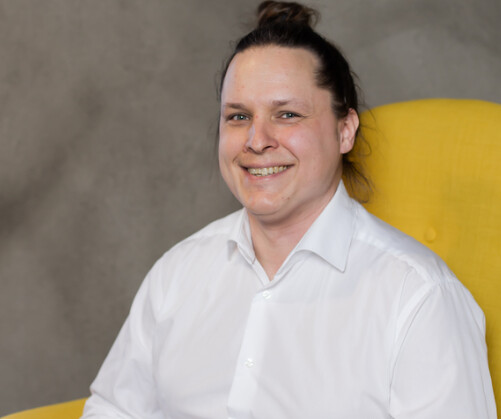
Inderes’ Life Science analyst since 3/2022, meaning I cover life sciences-based companies. I am married and the father of a baby girl. The family also includes a Labrador Retriever named Bea-Birgitta. By educational background, I am a molecular biologist, Ph.D.
2. Tell us three things that forum members don’t know about you.
I ended up at Inderes thanks to the username @TJT. I was checking out Inderes as an investment target and noticed his message on the forum.
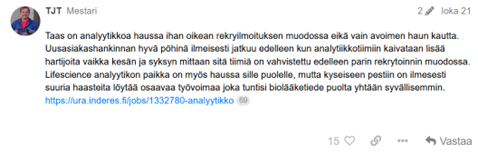
I definitely hadn’t thought of an analyst’s job as a possibility, but when the existence of the open position became clear through this message, I had decided to apply pretty much before I even got the link open.
I have been on Japanese TV. Shinya Yamanaka won the Nobel Prize for the development of so-called induced pluripotent stem cells at the same time I was living and working at Osaka University working with those cells. The country went nuts over the Nobel Prize, and the very next day, the morning TV show “Morning Bird” came from Tokyo to the lab to film. I didn’t have any actual business in the lab at that time, but my boss asked me to show up anyway because apparently it looks better when there are international folks in the pictures  . I am still quite a Japan enthusiast after all the great experiences from that time. That TV incident was mostly an amusing coincidence, but local friends, food culture, and many other things have left an indelible mark and made a deep impression.
Verneri and I grew up on the same street. However, we have enough of an age difference that we only got to know each other at Inderes.
3. What interests and hobbies do you have? Nothing related to investing is allowed.
I play in a band. A friend of mine who has long been active in DIY music stuff asked me a few years ago if I would be interested in the role of a bassist in a band playing cellar blues. I made sure he was aware that I don’t play any instrument. Apparently, that didn’t matter. I figured it’s better to agree right away – another band invitation for someone who can’t play might not come again very soon… I quickly noticed that turning up the volume makes up for the lack of skill with interest.
In the summers, I spend time at the cabin and especially fishing there. Zander jigging and a bit of trolling are the main disciplines. I also enjoy grilling and smoking in the summer kitchen. Motorcycling has been close to my heart, but the bike is currently parked due to lack of time. In winter, fishing changes to downhill skiing. Otherwise, exercise is taken care of by walking the dog and occasional freestyle wrestling training in the garage gym.
Board work for the early-stage Medtech company Epiheart could also be counted as a hobby.
4. What is a typical weekday like for you?
I wake up around 7. Actually waking up takes about half an hour and three cups of coffee, after which I take care of morning chores and reading messages and news while multitasking. The actual workday starts around 8:30, nowadays typically remotely, because we moved outside the capital region at the beginning of the year. Up to this point, a big part of the work has been working on initiation of coverage reports, which often takes the whole day. The end of the workday varies a lot. Sometimes I finish at office hours, but often I take a break in the afternoon and continue working in the evening. Weekday evenings include family time, exercise, and reading.
5. Could you tell us what kind of work history you have?
I had decided to focus on doing research already when considering a place to study. Biology was chosen as a field, on the one hand, because understanding life at the molecular level felt extremely interesting overall, and on the other hand, due to endless application possibilities, for example, through the development of new treatments. Molecular biology later became my major. After my studies, I did my dissertation at the Department of Biomedicine at the University of Helsinki. After the dissertation, I was for a year in Japan at Osaka University and then again at UH (HY) as a postdoctoral researcher. The job included, in addition to research, teaching pharmacology at the medical school. I decided to stop research at the turn of 2016-17 and moved to Biocenter Finland, where my duties included coordinating technology cooperation between Finnish universities in the Life Science field. As side gigs, I coordinated technology cooperation between faculties and independent institutes at UH. I have been a hobbyist investor for a long time, and Inderes then opened up the opportunity to combine my interest in biosciences and investing. It’s a great thing that Inderes found the courage and vision to recruit an analyst with an atypical background.
6. How would you describe yourself as an investor?
I started out with a value-investing style because it felt like the most natural fit for me. Nowadays, my strategy starts with a well-weighed allocation, somewhat in the spirit of the All Weather Portfolio. When it comes to equity investments, the idea is that different types of stocks perform well at different times, so my strategy includes various stock investment styles, meaning some style should in principle always work at any given time. The intention is also to protect the portfolio from my own biases and mistakes, which is why the share of active stock picking is limited. However, actual stock picking keeps things fun and interesting. Long-term, growth-at-a-reasonable-price (GARP) type thinking is emphasized there, especially now that trading is restricted due to Inderes’ rules. Previously, I also picked stocks more diversely on a shorter time horizon. I also emphasize the companies I follow in my choices nowadays.
7. Could you tell us about your investment history?
I originally started at the peak of the tech bubble with mutual funds. The method was technical analysis, with the help of which I determined that IT and biotech (sic) funds, for example, were brilliant investment targets. Naturally, I monitored the fund values daily. The adventure resulted in licking my wounds, and investing wasn’t on the agenda during my university years anyway. Around 2006, I got excited about studying and following economics, which led to my first direct stock investments – this time near the peak of the financial bubble. Getting through the financial crisis with a full equity weight was a good experience. Since then, crises or rigged markets™ haven’t really shaken me. After that, investing has had periods of more activity, such as studying quantitative investing and behavioral finance. At other times, my interest and time have been spent on other things, but I have always returned to the hobby. The corona crisis sparked my interest again after a break, especially in stock picking. I actually feel most at home in bear markets, when it’s easier to find things to buy.
8. What has been the biggest benefit of being an analyst for your investing?
Inderes’ process and the time spent on coverage allow for a deeper and more comprehensive immersion into an investment target than would otherwise be possible. This has brought balance and a versatile perspective both to my own monitoring and to how I view other investment targets. Of course, Inderes also has many highly competent colleagues who are enthusiastic about investing, with whom it’s fun to discuss and bounce ideas around.
9. How do you think about the diversification of your portfolio, or do you think about it at all?
I used to think about it a lot. Nowadays, it’s no longer so necessary, as diversification is largely taken care of by following the investment strategy. First, of course, is the asset class allocation, which is the most central decision. Underneath that, I diversify my equity investments using three different styles: stock picking (mainly in small domestic market companies), indexing, and quantitative investing. For the last one, I built my own model as a hobby project based on literature, research, and backtesting, which I still implement. Within stock picking, I have about 20 lines, which could certainly use some pruning. Thanks to these different styles, the weight of individual companies in the portfolio is quite limited.
10. What does your portfolio look like right now? What are your top three holdings and why?
Paper Gold – relates to the allocation mentioned above, which also includes precious metals and raw materials. BRKB – is in my portfolio as a substitute for fixed-income investments from a time when the risk-return ratio of bonds was exceptionally weak. AFL – this has been in the portfolio for over 10 years. Strong defensive cash flow with very low risk. Nowadays, it serves the same purpose as BRK as a substitute for fixed-income investments.
I suspect your question might have meant stock picking, which the above don’t strictly represent, so the stock picking top 3 are: Harvia – a competitive company that I’ve been invested in since spring 2020. The timing of purchases and sales has roughly hit the right ballpark, so the position has grown into the portfolio’s largest. Bioretec – a recent acquisition. The rationale can be read in the latest update and initiation report. OmaSP – A strong track record, pleasant valuation, and I estimate the company still has some room for growth.
11. Selling stocks is talked about too little in my opinion, so I’ll ask you what your step-by-step stock selling process is like?
Typically, a company ends up being sold if it turns out to be less quality than I estimated, or if the investment otherwise lacks the prerequisites to achieve its goals. The sale is executed right away, at least in principle; I’m not interested in timing it using TA, for example.
12. In thirty words per company, tell me what you think of these stocks:
- Biohit
A moderately valued diagnostics company that flies somewhat under the radar. Success largely depends on Gastropanel and the Chinese market, so risks are quite concentrated. The longer-term outlook is hazy, which will hopefully be clarified in the autumn strategy update.
- Faron Pharmaceuticals
A multi-tasking drug development company that would need a large capital injection to fully implement its plans. The target of the lead asset bexmarimab, Clever-1, is underexplored in cancer biology, which on the one hand creates a niche of its own for Faron, but can also introduce uncertainties into contract negotiations.
- Nexstim
Driven by new NBS6 equipment, licensing revenues—significant for a company of this size—expected to start next year, and a new collaborative clinic network model. Visibility, especially into the latter, is weak. In my view, the TMS market faces structural challenges as competitors pursue revenue growth at the expense of profitability.
- Orion
Nubeqa recently rose to become the company’s largest product, and positive news from that front is expected for years to come. Nubeqa’s cash flow opens up a wealth of opportunities for capital allocation and opening up different types of growth paths.13. You follow several companies (BBS, Biohit, Bioretec, Faron Pharmaceuticals, Modulight, Nexstim, and Orion) that I think are very risky lottery tickets, excluding perhaps Orion. Isn’t investing in many stocks like these quite a bit of a gamble? Somehow, many of these feel like such challenging targets for ordinary investors that at most they could only take a small “fun position” in them.
A good question that would deserve a more thorough answer than is possible here. Personally, I see really only Faron as somewhat of a lottery ticket due to the nature of drug development. Of course, future uncertainty is higher in these companies on average than in the rest of the stock market. Company-specifically, this uncertainty varies a lot and is of a different nature in different companies. However, success is in the companies’ own hands, so I form forecasts and an understanding of the probability of long-term success and competitive factors by evaluating them. Here are a few themes through which I evaluate a company’s probability of success and thereby good stock returns:
The company’s operational activities and management quality. Are the company’s resources and the quality of its execution sufficient to succeed in the market? Companies operate fundamentally in international markets, so the quality of execution must be at a high level to succeed there. Comparing the company’s previously given outlook to what subsequently materialized (talk vs. actions) gives an indication of how likely the currently stated outlook is to materialize in the future. The history of the business is likely to repeat itself for better or worse, unless significant changes have taken place in the company. Evaluating this is probably as easy or difficult for investors less familiar with the industry as it is with other sectors.
Product quality/competitiveness. Products are sold in evidence-based markets, so the product must be better than competitors in terms of efficacy, safety, cost, etc. profile. An example is Orion’s Nubeqa, which is comparable to competitors in efficacy, but better than them in its adverse event profile. Evaluating a product’s competitiveness may be difficult from outside the industry, so hopefully analyses will help with this.
Binary risk. For example, a drug candidate can become worthless if the efficacy or safety profile is not good enough. This thus brings genuine lottery-ticket-like nature. In Medtech or diagnostics companies, this is typically less present.
Financing risk. Is equity financing needed? How many rounds? When? How have previous share issues succeeded? Is there a risk of drifting into a heavily diluting anti-spiral?
Marketing authorizations. Is there a possibility that the marketing authorization will not be granted or will be significantly delayed? What are the consequences of the delay, e.g., regarding financing?
So in summary: I do not see investments as a gamble, but there is certainly future uncertainty. An ordinary investor should probably keep positions modest and remember good diversification.
14. In your opinion, what is the hardest part of an analyst’s job? What do you like most about your work?
I like almost everything, really. Getting to know companies and discussing cases with colleagues, cooperating with company management and employees, modeling and writing, etc.
I am better at slow thinking than fast thinking. Therefore, I think the hardest part is getting all the new information summarized into the model on earnings day, when reading the report, following the webcast, asking questions, interviewing management, and writing the report itself all take up time on the same day. I would gladly spend even more time pondering and digesting new information.
15. You have to hand over your portfolio for three years to two Inderes members who are not analysts and two forum members, who would you choose and why?
Yu Gong. I don’t know what would happen to the portfolio, but at least I would get a good laugh from Yu’s jokes. Antti Järvenpää. I haven’t actually talked about investing with Antti very much, but he is a smart and cultured man to such an extent that I don’t doubt his investment skills for a second. Sijoittaja-Alokas. Even I know that it pays to recruit talent, not skill. I firmly believe that Alokas’s passion for investing will carry far into the future. Mauri similarly seems like an extremely smart and passionate investor who approaches things with an open mind.
(I’m tagging you so you notice: @Yu_Gong, @Antti_Jarvenpaa, and @Mauri regards, Alokas)
16. In your opinion, what is the best thing about our Forum? What are your favorite threads, if the threads of the companies you follow are not counted?
Despite the instruction, I have to mention the Faron thread as top quality thanks to, among others, jerej, Vino_Pino, and Rushimato. Otherwise, I follow the threads of Life Science companies other than those under my coverage and threads concerning Inderes. Following other threads is sporadic due to lack of time. The best part is probably the background work of enthusiastic people and the unearthing of new facts and perspectives.
(I’m tagging you so you notice: @jerej, @Vino_Pino, and @Rushimato regards, Alokas)
17. If you could teach/internalize one thing related to analyses to the forum members at the push of a button, what would it be and why?
The valuation of several companies I follow is imprecise in nature due to future uncertainties. For this reason, a target price condensed into a single exact figure is something that I think should not be taken very literally. The direction of the recommendation is more relevant. I would believe, though, that many have already internalized this.
18. Do you have concrete investment-related goals, for example, euro-denominated or percentage targets?
There are no numerical targets, but through stock picking and quantitative investing, I aim for a better risk-adjusted return than the index.
19. How could Alokas learn to invest in slightly riskier and/or companies in more challenging industries?
In addition to basic work, such as getting to know companies and reading analyses, I would encourage everyone to ask questions actively. I am happy to answer questions and forward them to management through interviews. Questions also help me spar with my own thoughts, which became evident once again with this interview!
20. What would you especially like to thank the forum members for?
For high-quality discussions even during a more bearish market.
Thanks to Antti for the very interesting answers!
At least for my part, I got some food for thought and information from this interview that I can use when researching various companies that I don’t necessarily have the same kind of “touchpoint” with as I do with more common companies.
Antti has a great way of explaining things in an interesting and clear manner, making others interested in things they wouldn’t have been interested in otherwise. Of course, what you say is important, but so is how you say it, simply from the perspective of learning and understanding—that’s (also) why I’m an Inderes fan.
Thanks and have a great weekend everyone! 
P.S. From this Friday afternoon until perhaps Sunday, I will be much less active on the Forum, so I might not be able to react to flags, tags, or private messages. We are spending some quality time with old friends. I will probably drop by the Forum to read a bit and post a couple of messages.