4. MARIANNE PALMU
Who is your favorite economist, and why is it Marianne Palmu? I read a massive amount of news and investing articles for several hours every day, but it’s largely thanks to Marianne that I stay on top of what’s happening in the economy on a big-picture level. There are so many news stories, screaming headlines, confusing tweets, and endless noise… I’d have a very poor grasp of the overall picture without her.
Marianne has been an integral part of Inderes for a very long time, serving as an economist and producing the morning report, among other things. This Turku native is widely appreciated for her ability to condense and summarize even the most complex topics into easily digestible packages. Both novice investors and seasoned veterans gain valuable insights from her writings.
This economist doesn’t preach or claim to offer absolute truths; instead, she educates her readership and provides excellent tools to help them independently learn and understand macroeconomics. In general, teachers and other experts could learn a lot from her when it comes to explaining things clearly and tailoring content so it serves multiple diverse audiences simultaneously.
Economist Palmu is, for good reason, one of the most important figures in the investing world for many of us.
1. Tell us who you are in thirty words.
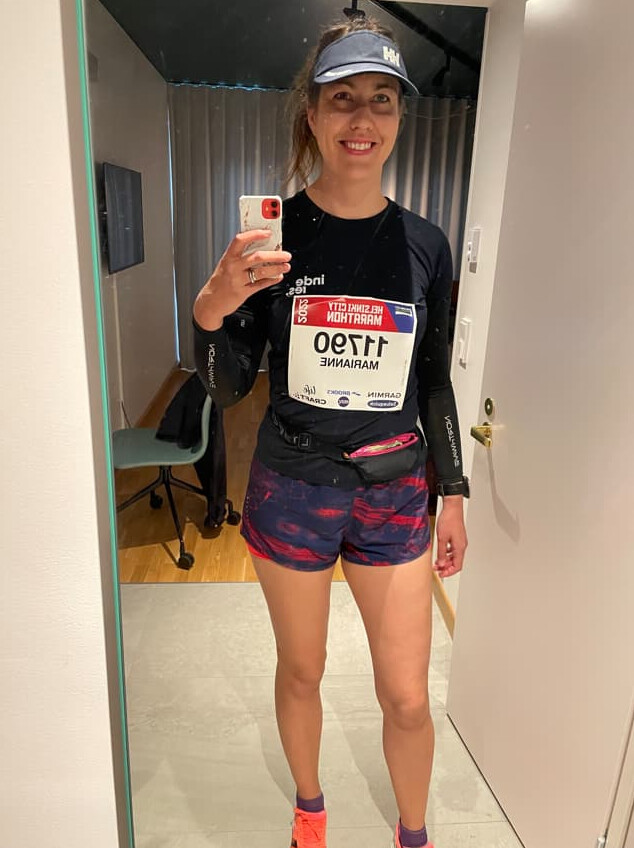
I’ve worked as an economist at Inderes for 12 years—spanning three economic crises (the debt crisis, COVID-19, the war in Ukraine). During the financial crisis, I was still a student. Outside of work, I’m the mother of two active boys and a fitness enthusiast of sorts.
2. Tell us three things the forum members don’t know about you.
- I love old houses. Our family lives in a 100-plus-year-old wooden apartment in the Portsa district of Turku, and we love it. My dream is to someday own a gingerbread-style wooden villa of at least the same vintage somewhere in Finland.
- I also love the Finnish language: writing is the most natural way for me to express myself, and reading is how I learn new things. I also want to advocate for the preservation of Finnish, which is why I dislike Finglish-type expressions.
- I listen to all kinds of music, but rap music has some truly special gems. A Wu-Tang Clan concert is the best live show I’ve ever attended.
3. What are your interests and hobbies? You’re not allowed to mention anything related to investing.
My hobbies have always leaned heavily toward sports. About ten years ago, I got into triathlon and signed up for a middle-distance race with virtually no prior experience. That gave me six months to learn the basics of front crawl swimming. The race came and went, and I crossed the finish line. Out of the three disciplines, running and swimming have remained close to my heart ever since, and I’ve kept them as part of my daily routine. This spring, I ran a marathon for the first time in a long while, and over the years, I’ve participated in a few trail running events, as well as swimrun races—the longest of which involved over 5 km of swimming and 30 km of running. So, I enjoy long distances 
4. What does a typical weekday look like for you?
My job has turned me into an early bird; I wake up at 5:00 a.m. for work. If I have enough energy, I go for an approximately 5-kilometer morning run, during which I plan the outline for the macro review, or otherwise I head straight to the computer screen. I read and publish the material for the morning report along with the daily macro commentary, and I check the Asian markets. Together with the morning report team, we make sure the morning report is published by 9:30 a.m., after which I plan upcoming macro reviews, read articles, and make videos or other content. Lunch is at 11:00 a.m., followed by a bit more work. In the afternoon, I work out and pick up my younger son from daycare. I dedicate the evening to family and go to bed early. Occasionally, I drop by the Helsinki office to say hi to colleagues, but typically I work from home.
5. Could you tell us about your educational and professional background?
Excluding school-age summer jobs like strawberry picking or mowing lawns, my career history has centered around writing. I attended high school at the Turku IB World School, and back then, I wanted to become a journalist. Right after high school, I was admitted to the University of Vaasa to study communication studies. I graduated with a Master of Arts, but while working summer jobs (at Turun Sanomat, Kauppalehti, among others), I realized that economics was “my thing” and wanted to deepen my knowledge. So, overlapping with my studies in Vaasa, I began studying economics at the University of Turku. I earned my master’s degree in 2008, and since not much else was available, I applied for postgraduate studies at the university. There, I got to teach introductory economics courses, which was an amazing experience. Concurrently with my postgraduate studies, I started working part-time at Inderes, mainly producing the morning report. Digging into current affairs pulled me in, and I concluded my postgraduate studies with a Licentiate thesis in 2013. The thesis focused on central bank communications, which I later drew from for two academic articles co-authored with a fellow doctoral candidate friend (one was published in September).
So, before Inderes, my background was predominantly in journalism. Additionally, during my student days, I worked one spring at Handelsbanken, attending various annual general meetings to represent foreign shareholders. That was a fun time (physical dividends being a huge plus), and the colleagues there were also fantastic.
6. How would you briefly describe yourself as an investor, and what is your investing history?
I’m a fairly conservative and long-term investor. I began investing in 2010 when I started working at Inderes. Before that, I hardly knew anything about investing because it wasn’t discussed at home or among my friends. Through my work, I’ve received a substantial amount of education, which has been great
7. How have you performed against the indices over the long run? And do you even compare your portfolio’s returns to an index?
I don’t compare my returns to an index. For my equity savings account (OST), I did check separately, and it has lagged the index.
8. What are your portfolio’s largest holdings, and how many “lines” (positions) do you hold?
Unsurprisingly, Inderes is by far the largest holding in my portfolio. After that, the largest are Neste and Etteplan, along with holdings in index funds (which I invest in monthly).
9. What stock did you buy most recently, and why?
The last stock I bought was Wärtsilä, although that was a few months ago now. I believe the company will benefit from investments in renewable energy.
10. How much do you read equity research and study individual companies? Does an economist build DCF models and crunch numbers in Excel?
An economist doesn’t really build DCF models, nor would I unfortunately have the time for them. So, I leave company analysis to those wiser than me—the equity analysts
11. How and on what grounds do you pick stocks? Do you leverage your “macro expertise” when picking stocks?
Since I produce the morning report, I also read the vast majority of our research reports. Every now and then, interesting companies catch my eye, prompting me to look into them and seek more information. Lately, sustainability (especially environmental responsibility) has also gained weight in my criteria. I use my macro expertise more for the overall balance of my personal finances—such as considering when it’s time to pay down more mortgage principal versus when to allocate more toward investments by increasing the monthly savings amount.
12. What are the main sources of information in your work? Do you have any tips on where an ordinary forum member could find information on the broader market and economic landscape?
After starting my workday, I review the news flow from Reuters and Bloomberg, which are my primary sources. In addition, I follow financial Twitter (FinTwit) and, of course, the forum, as well as some academic publications where I seek out information. On FinTwit, for example, the handle MacroAlf is really worth following; otherwise, it’s wise to read a broad variety of financial news.
13. What are your thoughts on the rest of 2022 and 2023 regarding the economy? Are you exceptionally concerned or… hopeful?
If we focus strictly on the economy, and especially the European economy, the scales definitely tip toward concern. These various crises have caused the euro system to creak at the seams. I strongly doubt that economies with structures as diverse as those in the eurozone can successfully function under a single currency and monetary policy without ongoing rescue measures of some kind.
14. If an investor could only follow four different charts (indices, indicators, currencies, etc.) on a regular basis and you had to pick them, what would you choose and why? I will bookmark them in my browser if they aren’t there already.
The Economic Surprise Index, Purchasing Managers’ Indexes (PMIs), EUR/USD, and central bank interest rate expectations are indicators that take you a long way. They offer a relatively broad, real-time snapshot of the economy.
15. If you could press a button and instill a single, actionable “macro lesson” in all forum members, what would it be?
Perhaps that in macroeconomics, much of the data is incomplete—either subject to later revisions or backward-looking. Therefore, one shouldn’t draw sweeping conclusions based on a single data point, but rather look at the bigger picture.
16. You decide to take a three-month vacation and have to pick three usernames from the Forum to write your macro analysis in your place—who would you choose? Oh, right… yhä_musa_soi is definitely among them, so pick 1+3 forum members.
In addition to yhä_musa_soi, Pohjolan eka, Verneri, and Timontti would definitely put together a great macro review tailored for investors.
17. What has been your greatest success in your investing journey, and what are you especially proud of regarding your career?
Undoubtedly, my greatest success was getting started in the first place, and a huge credit for that goes to my job. Among individual stock purchases, Neste stands out; years ago, I bought it at an average price of around 10 euros. That turned out to be a successful pick.
18. What do you consider the best thing about Inderes Plc? With which colleagues do you have the deepest macro discussions?
The best thing about our company is having the freedom to express ourselves and try new things. Additionally, I greatly value the opportunities for independent work. Most discussions happen with my fellow community team members at the office, but fortunately, I also have a colleague in Turku, Isa, with whom I talk about the economy. I also exchange thoughts with analysts when I hold macro reviews for them at regular intervals.
19. Macro concepts can be tricky for beginners (Alokas); what’s the easiest way for a newcomer to learn the essential basics of this area? There is Analysis School and Investing School—should there be a Macro School?
Actually, macro topics are already included in Investing School, and they are coming to Analysis School as well, so there is plenty of material available
20. What would you especially like to thank the forum members for?
As I mentioned earlier, the forum has become one of my essential sources of information, and that wouldn’t be possible without you, the forum members. A huge thank you for the diverse, high-quality discussion that continually challenges my own thinking!
Thank you, Marianne, for these interesting answers! 
This interview once again showcased your ability to communicate key insights in a reader-friendly format—in the midst of vast information overload and noise, that is an invaluable skill.
Have a great start to the investing week! 
