Isn’t this basically the same as management saying something along the lines of: “On average, we aren’t capable of creating value through acquisitions, so we only attempt them in cases where our own stock is clearly above fair value and we can use it to finance the acquisition” 
If company management could actually genuinely assess the value of their own stock in all situations, this would indeed be the correct way to act opportunistically in capital allocation. Stock is expensive: fire up the printer and use it to buy companies. Stock is cheap: buy back as many shares as the market offers  A classic legend and prime example of this is, of course, Henry Singleton and Teledyne.
Anyway, for the majority of companies—and I believe for Admicom as well—the more important factor is whether acquisitions can in practice systematically create value with a return exceeding the cost of capital, regardless of the approach (synergies or a decentralized operating model, etc.).
Another somewhat peculiar point in the release:
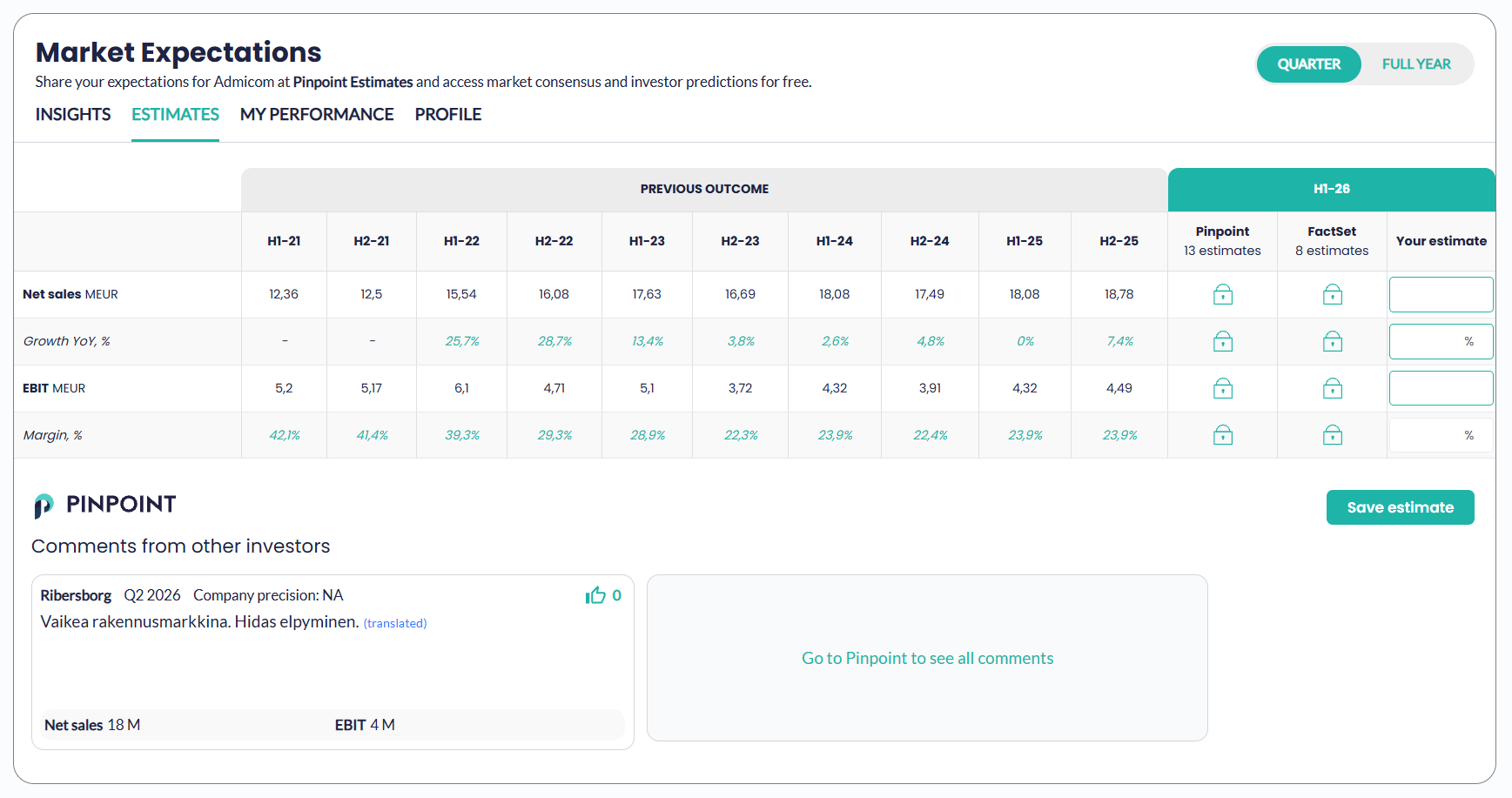
Admicom’s original financial guidance was based on the assumption that reaching the upper end of the growth guidance would require either a faster recovery in the construction market or a small acquisition. Admicom does not rule out the possibility of an acquisition during 2026.
I don’t think it’s a good thing that management includes even these small acquisitions in their growth guidance. There is a risk that, at least subconsciously, they will try to rush a potential deal to completion just to avoid “failing” the given guidance. It would be even worse if this were tied to incentives like absolute revenue or earnings levels, but Admicom doesn’t seem to have those, based on what I tried to find.
Speaking of short-term guidance, it occurred to me: do they actually serve anyone? How much of management’s time is spent calculating what kind of guidance can be given to the market, and in Admicom’s case, even second-guessing the movements of the construction cycle? And then more time is wasted monitoring whether that guidance is being met, and in the worst case, drafting a list of excuses for why it wasn’t This time could be spent on what actually matters for long-term value creation. Of course, it’s good to communicate long-term goals and strategy to investors, but a lot of energy is wasted on this kind of short-term noise by both listed companies and investors.