Some good points there. This year we might be reaching that weak-scenario profitability level, and I personally think that in a weak scenario, that level could actually be lower. The EBIT level for the bull scenario, on the other hand, currently feels utopian when you look at the industry (or the staffing/temp agency sector). Regarding growth, however, I have been thinking that it could be even faster than the levels you’ve projected.
10 Likes
It’s funny that we have the exact opposite thoughts. I’m quite optimistic about the profitability. There is a good momentum in the company, and I consider 8% a completely realistic possibility. Not the most likely one, of course. In my own calculations, I’ve used 5%, and based on that, I invested in Witted at the time.
Regarding revenue, I’m a bit more skeptical. As you said, the industry is going through tough times. Mirroring the company’s history, 10% revenue growth is nothing.
When it comes to profitability, it’s hard to see us going below current levels. The Q1 result also gave me the impression that management was confident that profitability would rise even further from the current level.
But as I said, everyone can use the figures that suit them and make their own calculations.
8 Likes
Interesting reflections from both of you 
My own thesis regarding the company leans more toward @Karhu_Hylje’s position.
These IT firms on the Helsinki Stock Exchange rely so heavily on domestic demand that if and when the recovery of the Finnish economy continues and IT investments return closer to “normal,” we could see strong growth figures on the top lines of the boldest companies quite quickly. Witted has proven historically that it knows how to grow, and when the path clears again, I hope the company prioritizes hitting the gas, even at the expense of profitability, rather than focusing on pleasing investors who only watch the bottom line.
11 Likes
Expectations for Q2
Great reflections, @JHeiskanen.
To start, I am currently following the company from the outside and have access to exactly the same information as everyone else here. I am waiting for August 19th with just as much anticipation as the rest of you.
Nevertheless, I dug into what is already publicly known about Q2 and what Q2 has historically looked like for Witted. The short version: I consider Inderes’s Q2 forecast too conservative regarding both revenue and profitability.
What is already known about Q2
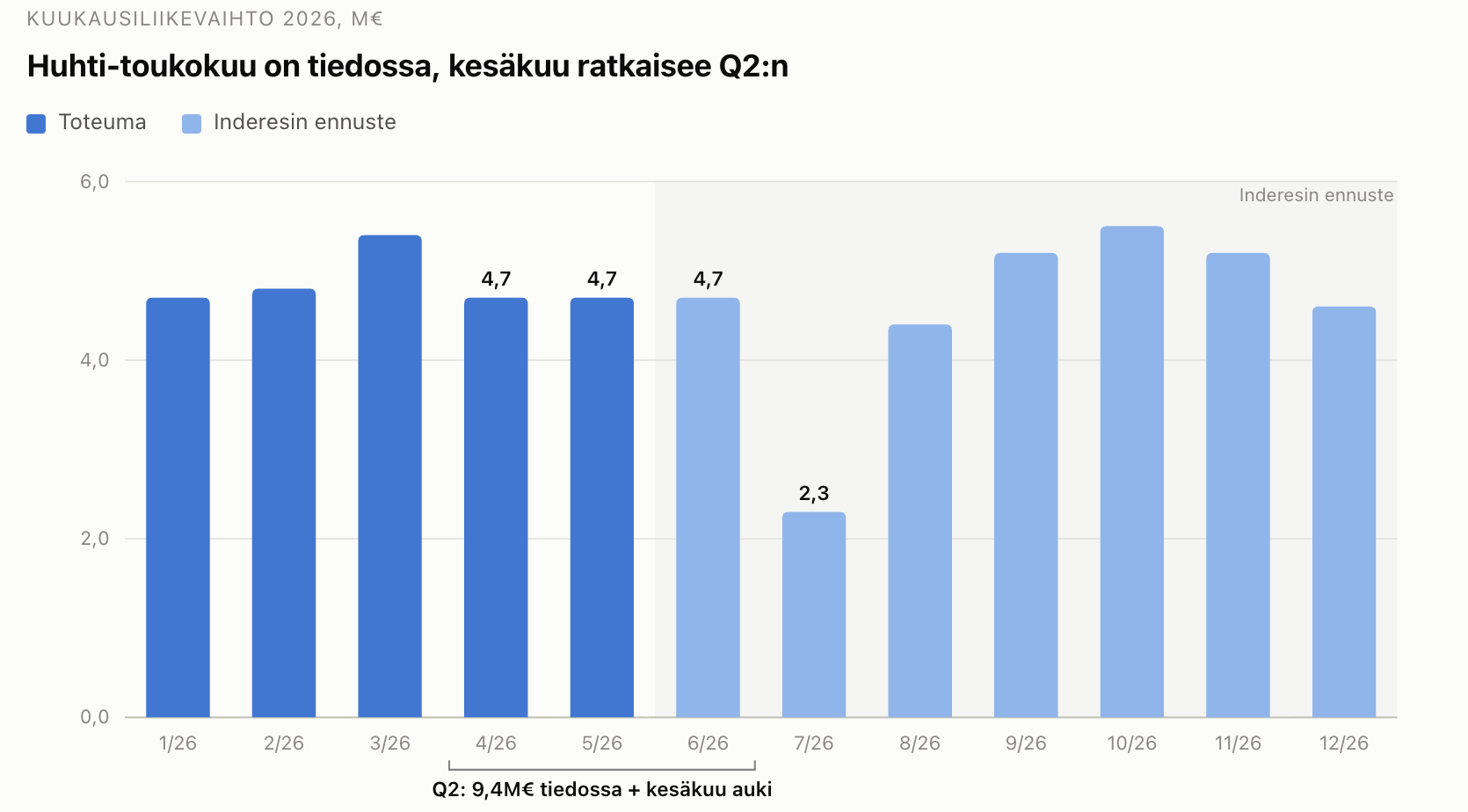
April was €4.7M (+6.6% y/y, organic working day-adjusted +1.9%) and May was €4.7M (+4.0% y/y, organic working day-adjusted +4.9%). A separate report for June is not published, so one-third of the quarter remains in the dark until the report.
The raw monthly figures are misleading because there were 20 working days in April and only 19 in May. Adjusted for working days, April’s growth was 7.0% and May’s was 9.5%. Thus, growth accelerated, it did not stabilize. The average for the two months is approximately 8%.
In terms of levels: April–May produced about €241k per working day, which is roughly the Q1 level (€241k). The rounding margin here is about €238–244k, as the company reports monthly revenue with only one decimal of precision. In the comparison period, the same months were about €220k and €230k.
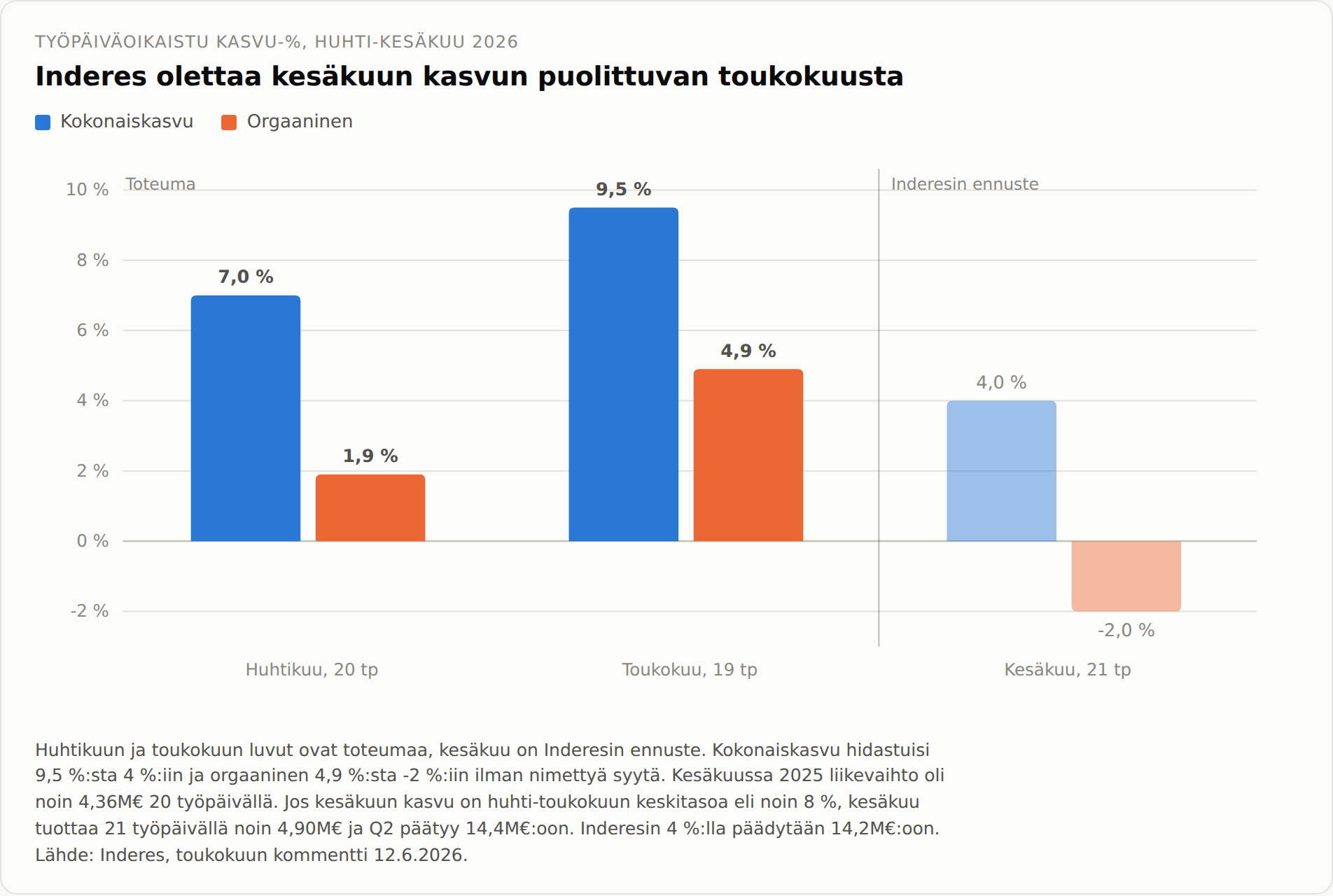
June has 21 working days (2025: 20) and June 2025 revenue was approximately €4.36M. Inderes forecasts 4% working day-adjusted growth and -2% organic growth for June. That would mean growth would be halved from May’s 9.5%, and organic growth would turn negative in one month without a stated reason. I do not find that credible.
With two assumptions, Q2 ends up like this: with Inderes’s 4%, €14.2M (+6.5% y/y); with the actual pace of about 8% from April–May, €14.4M (+7.9%). My own expectation is at the latter end. Neither way leads to the €14.1M that Inderes’s own monthly table gives when its figures are summed up.
One concrete reason to expect the opposite: the Yle contract won in April, with a calculated total value including options of €2.9M, which is intended to be carried out mainly during 2026. It did not appear in the April figures yet, and according to Inderes’s own estimate, it will start on a fast schedule. It should be visible in May–June.
What Q2 has historically looked like
In terms of revenue, Q2 has been lower than Q1 in three out of four years (2023 -10%, 2024 -7%, 2025 -2%), and Inderes now forecasts -4%. However, there is a calendar bias here: Q2 has 60 working days and Q1 has 62, i.e., 3.2% fewer. That explains practically the entire forecast decline.
When the figures are adjusted for working days, the picture turns around. In 2025, daily revenue increased from Q1 to Q2 by 0.9%. Inderes now assumes it will decrease by 0.6%, which is at odds with the April–May performance.
On the profitability side, the reported EBITDA has dipped below Q1 in Q2 in three out of four years. The only exception is 2024.
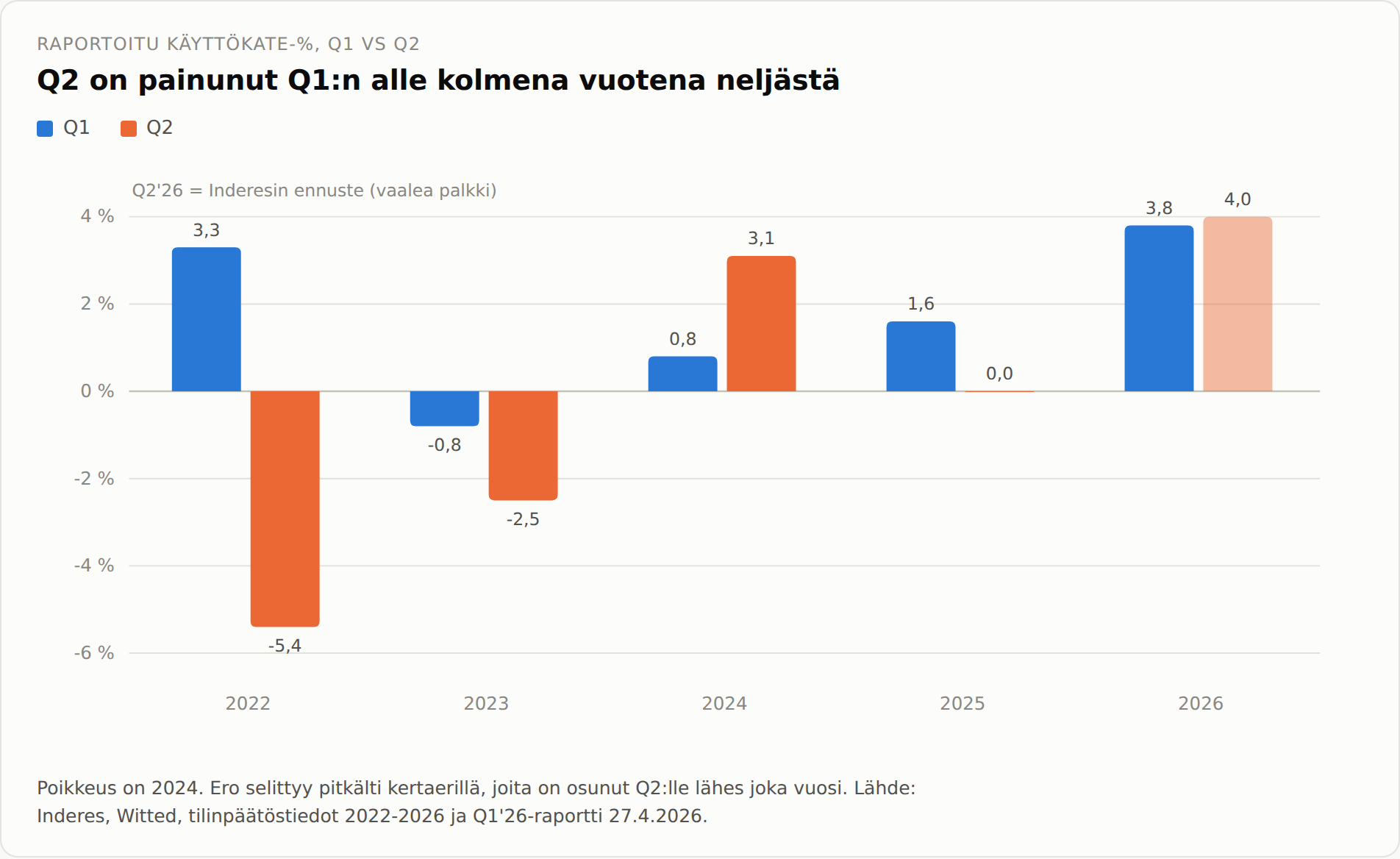
When adjusted, however, the picture changes here as well, and the difference lies in non-recurring items, which have occurred in Q2 almost every year. Last year, these included personnel reductions and the recruitment of the CEO.
Profitability: I expect a new record and a level above 5%
Adjusted EBITA-% has risen from Q1 to Q2 in both years for which the figure is publicly available: 2024 2.6% → 3.5% (+0.9 percentage points) and 2025 1.5% → 1.9% (+0.4 percentage points). The same step from Q1’26’s 4.4% would yield 4.8–5.3%. Inderes, instead, forecasts a decline to 3.8%.
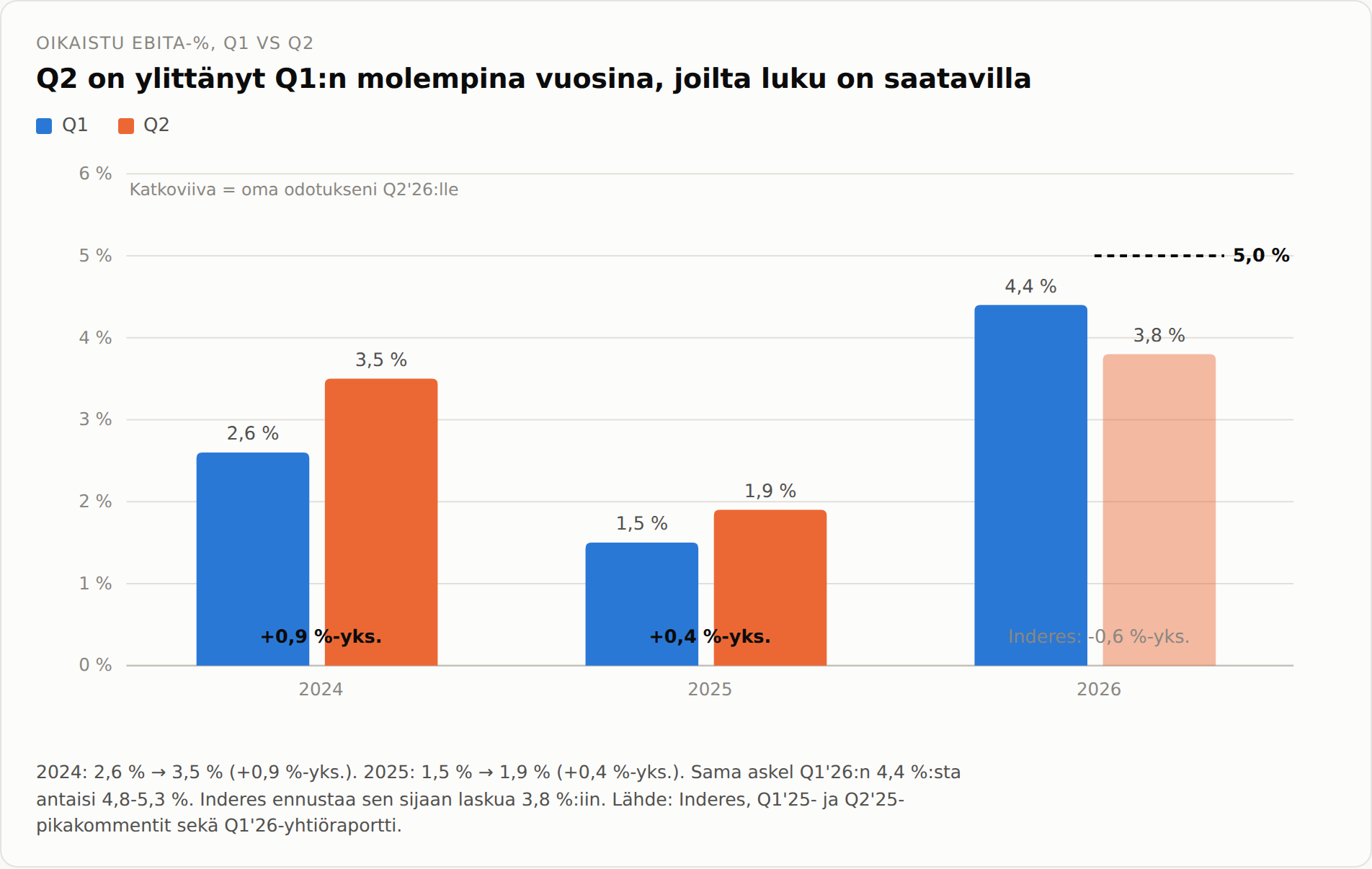
I consider exceeding 5% entirely realistic, and that would be a company record. Three reasons:
- The reversal of Norwegian holiday pay accruals hits in Q2, as holidays are mostly taken only in Q3. Inderes has written this out itself and stated that it strengthens Q2 profitability clearly. Norway is now a fast-growing unit with the highest price level, so the effect should be larger than in previous years.
- The comparison period of Q2’25 was suppressed due to identified reasons. The Finnish adj. EBITA-% dropped to 5.4% at that time due to start-up costs for new businesses and the costs of non-billable roles. Those costs will not recur to the same extent.
- Software Sauna is now fully integrated. Its EBITDA level is about 15%, clearly above the group average.
One thing speaks against this: Q2 has two fewer working days than Q1, which means the fixed cost base is spread over lower billings. However, at Witted, this leverage is weaker than for peers because the share of in-house personnel is only about 26%, and subcontracting costs are flexible in line with billing. I don’t see that as a sufficient reason for profitability to decline from Q1.
Points of tension
Market comments. So far, the companies that have published their results have not managed to convince anyone that the market is doing better. On the contrary, profit warnings have already been seen. On the other hand, Witted’s own organic growth has improved for five quarters in a row and turned positive in Q4’25. There have now been two positive quarters in a row, and with the April–May figures, Q2 would be the third. The IT services sector’s average growth in Q1’26 was about -3%, so the difference to the market is clear.
Number of experts. This is the point where I am genuinely uncertain. 367 at the end of March, 358 at the end of April, 359 at the end of May. Inderes expected 369 and 372 for these months, meaning we are about 13 people behind.
The drop in April has a named reason: at one customer account, several contracts ended at the beginning of the month when the customer changed their procurement strategy. The company did not see a broader trend in this. If the reason was truly one customer account, this is a level shift rather than a trend, and it should have been caught up by this point or at least clearly approached the baseline level. The Yle contract provides a concrete anchor point for that. Therefore, I expect the end-of-June figure to be clearly above 359.
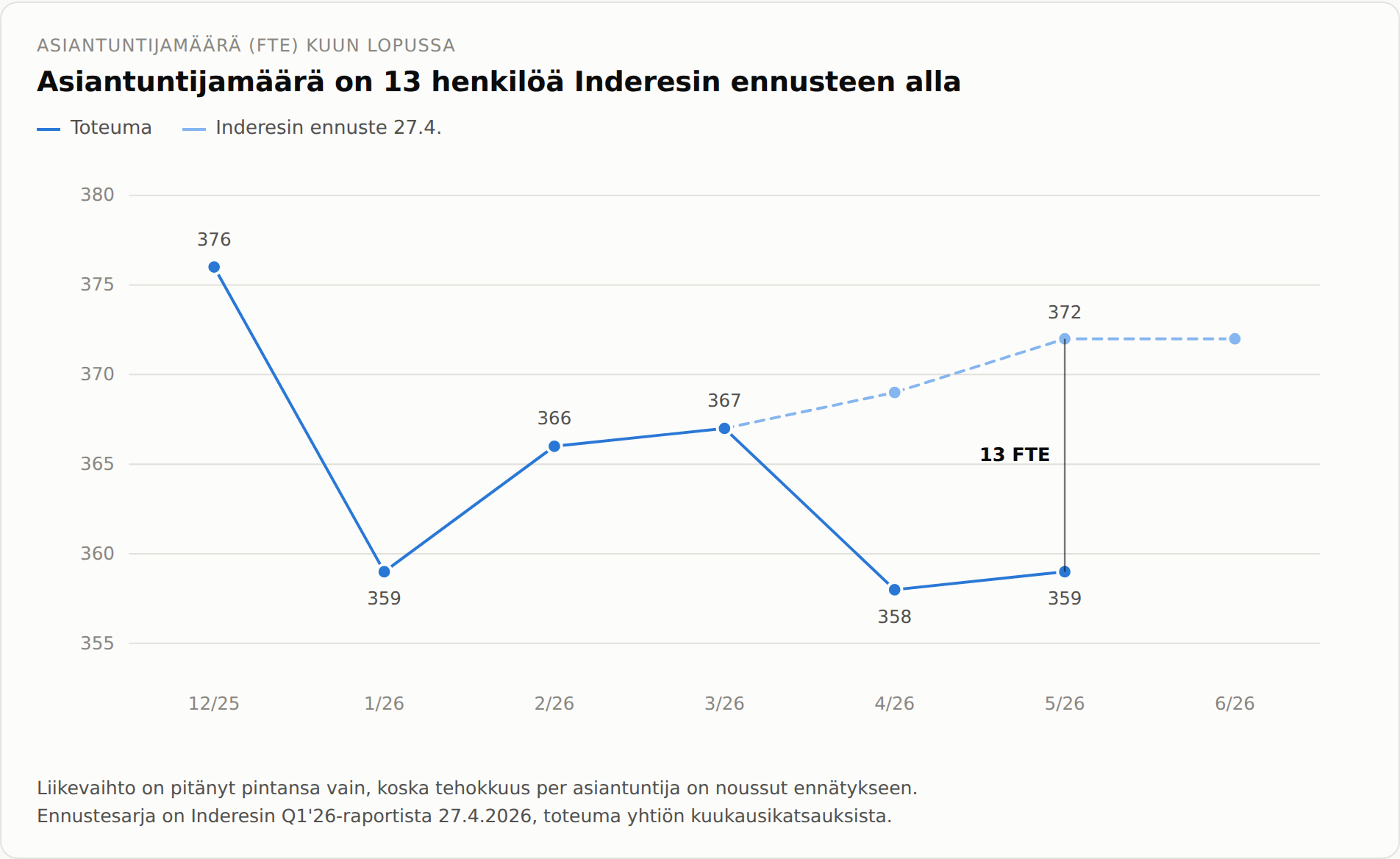
The share of in-house personnel is what makes me worry the most. The number of in-house experts has fallen for three months in a row: 99, 96, 92. In May, in-house -4 and subcontracting +5. The biggest single driver of the Q1 profitability leap was the gross margin, which rose by about 2.5 percentage points, and a large part of that came specifically from the rise in the share of in-house personnel. Now, the mix has been going in the wrong direction for three months. This is the only thing that would make me doubt the profitability expectation above.
Visibility of profitability in general, simply because you get information about the situation so rarely and you have to worry about it every time. Now that AI has been used to significantly improve operations, I would hope the company considers publishing profitability at a monthly level, even with the proviso that figures have to be corrected at the quarterly level due to accruals.
Annoyances
What bothers me now, when I follow the company from the outside, is that it is actually seen and heard very little. Stock exchange releases come regularly, but updates on social media are very rare, at least in my feed. Open projects and tasks are not advertised outside Witted’s own channels. The company is not really visible anywhere.
I do understand that there are certainly many good experts for projects within their own network. But project communication is not just recruitment marketing; it builds an image of the company as a whole and brings in new people. It is a positive and easy way to make one’s voice heard. The silent window has no effect on this. And not just about projects. It would be great to hear from the management regularly with updates and news.
Summary
For Q2, I expect revenue of €14.3–14.4M (+7 to +8% y/y) and an adjusted EBITA-% of 4.8–5.3%, i.e., a company record. Both are above Inderes’s forecast. The single biggest risk to my expectation is the development of the number of experts and especially the share of in-house personnel, which has gone in the wrong direction for three months.
Good luck with the upcoming earnings release!
38 Likes
Valuable analysis @Harri_Sieppi, I hope you continue this now that you don’t have to be so careful with your wording.
Let’s hope you’re right; I have personally noticed a clear positive vibe in the market this year, and I have a gut feeling that things might really take off in the fall.
16 Likes
The importance of expanding abroad has been shouted by investors for years, but companies have either not found a way to implement it or have been unwilling to take the risks associated with international growth. Often, they go to Sweden at most to test if the same recipe works there, get beaten in a tougher and more competitive market, and then return home with their tails between their legs to become dividend machines. The company’s story as an interesting investment prospect usually ends at this point.
However, no massive tailwind can be expected from the Finnish domestic market right now. Massive budget cuts will continue next year, interest rates will remain high, and at least for now, the vast Russian market and tourism potential remain closed to us, so one would think domestic organic demand growth will remain quite mild. The public sector accounts for about half of the Finnish economy.
In the 2027 budget, direct spending cuts will rise to 4.8 billion euros, and new decisions to curb indebtedness will be implemented in the budget to the tune of nearly one billion euros.
In my opinion, Witted’s historical growth rate cannot be used to predict the future, as it took place in a completely different market situation that is unlikely to ever return. I wrote in late 2024 about how the need for highly paid ICT knowledge workers doing manual labor would collapse to a fraction of its former self, just as it has happened to many other skilled trades throughout history as automation has increased. It might be quite interesting reading a couple of years later:
Longer post; click here.
6 months after that post, Claude Code was released. From then on, “vibe coding” by total laypeople began to become mainstream; for twenty bucks a month, anyone can get an agent on their computer to handle high-skill-level tasks, and it is already clear that a significant portion of jobs for which a expensive IT consultant used to be hired has been permanently destroyed.
As Witted flees up the value chain while the demand for academic “bullshit jobs” in the IT sector wanes, the work they do will naturally become more valuable on average, so one would expect the company’s profitability to rise at the same time. The challenge is to find the workers and niches to specialize in within a market where that more valuable revenue can be harvested in the future.
10 Likes
Perhaps so, but maybe some other tasks will take their place. Time will tell. However, one could imagine that this is now separating the wheat from the chaff among IT service companies. The management skills of these companies will be tested by who can actually harness their staff for new roles.
Since the release of Claude Code (2/2025), software developer job postings in the United States have increased by 15% from their low starting level.
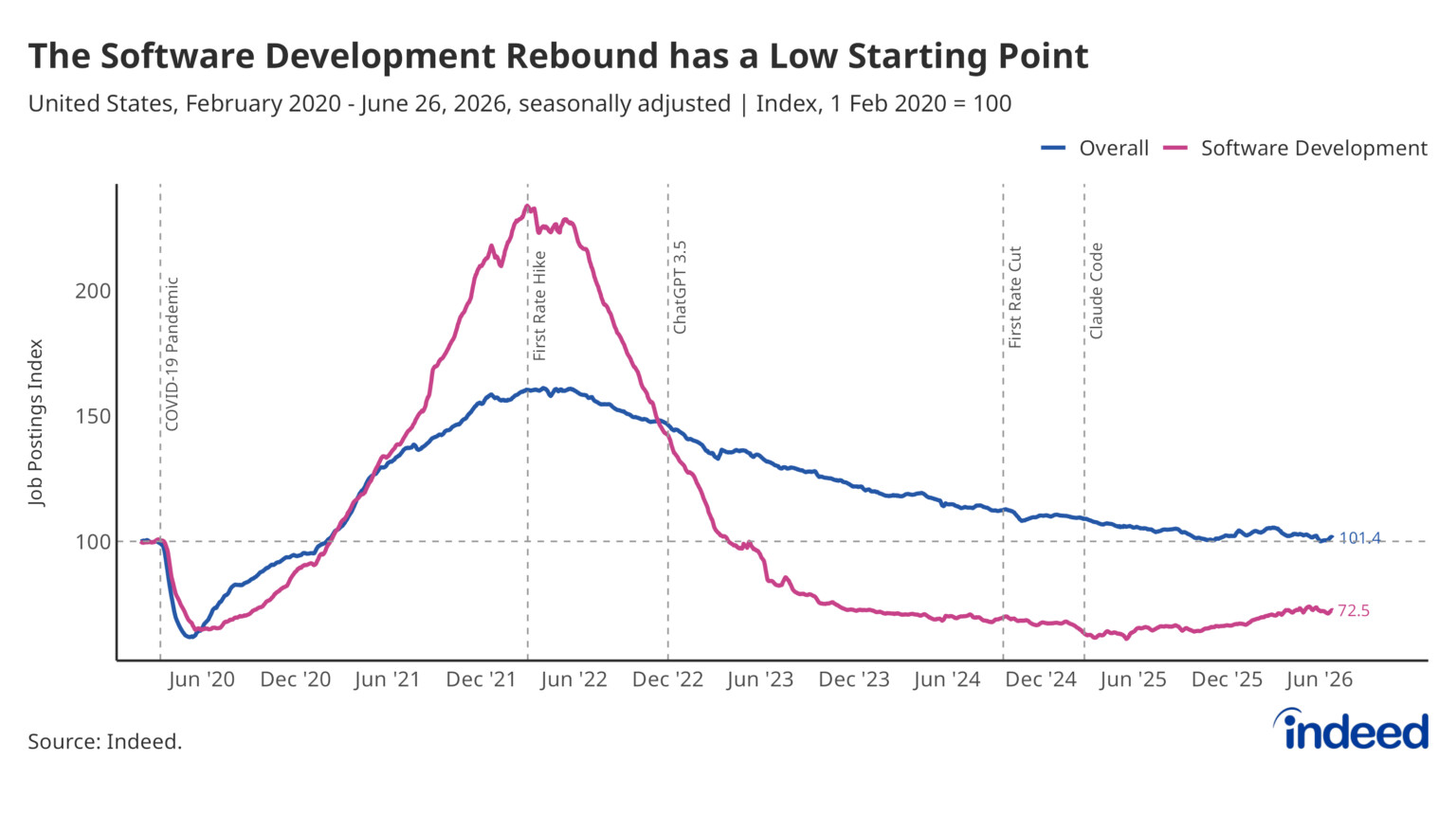
There is a particular demand for senior-level talent and AI experts.
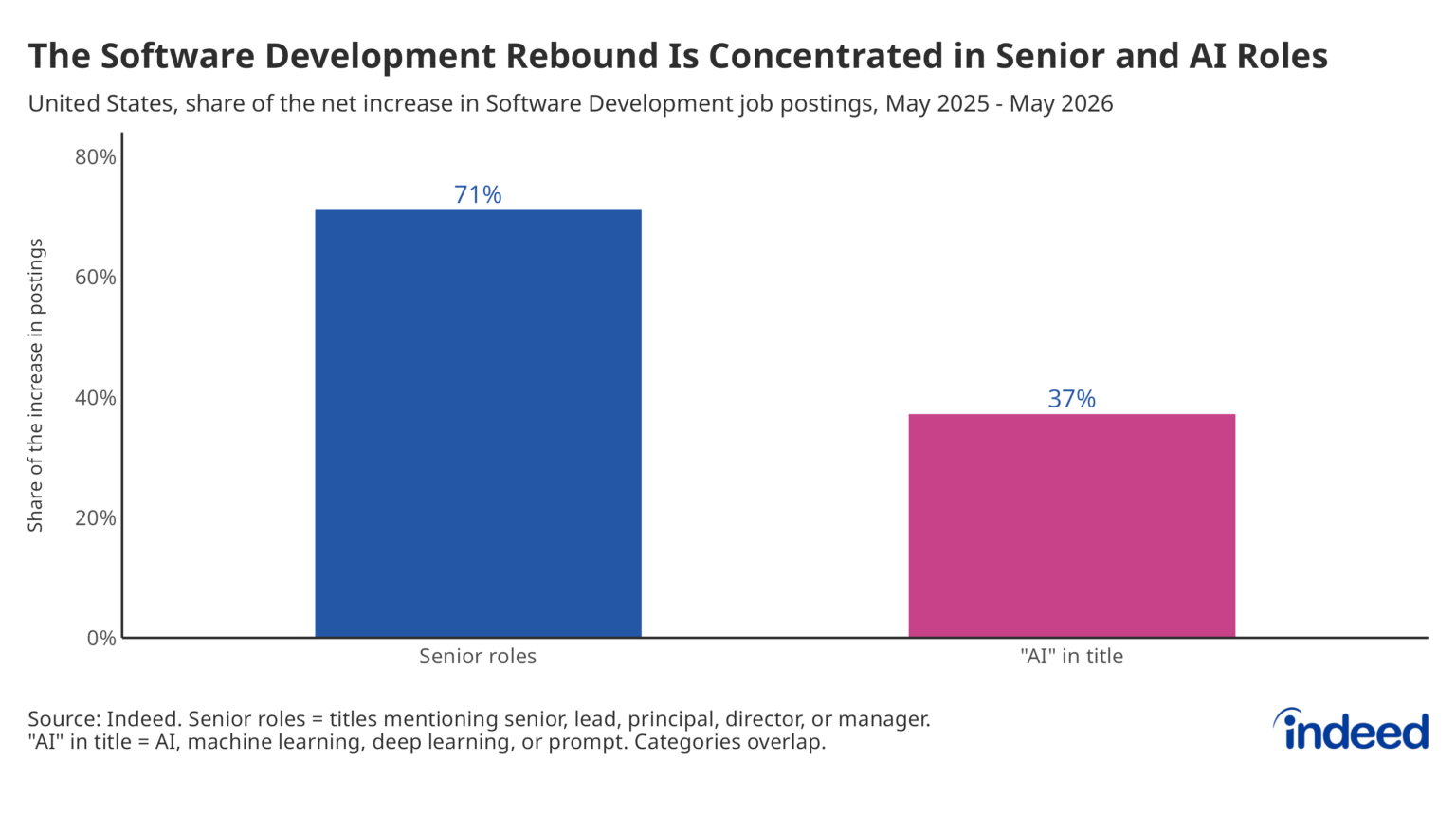
As I understand it, Witted’s experts are on the more senior end of that spectrum.
14 Likes