Witted - Next-generation software development company

Thanks for your activity on the forum! The field is interesting and here are a couple more questions:

  1. How do you see the shortage of skilled workers as a bottleneck for growth?
  2. Where do the skilled workers come from? (Competitors (can you name them?), school benches, abroad…)
  3. Vincit tried to expand into maintenance and infrastructure services, apparently with poor success. How do you see the role/importance and opportunity of solution maintenance in the industry from your perspective?
  4. You compete “head on” with established similar companies like Reaktor and Futurice. What competitive advantage does Witted Group have?
  5. Do you do more private or public sector work, how do you see the future for these?
5 Likes

Yes, anchors usually always have a lock-up (especially on First North). Similarly, anchors usually have a 180-day transfer restriction. Last year there was some offering without one, and it looked bad when one anchor sold their entire position within a month or two. Hopefully, there are no quick-profit anchors involved in this one.

In Nightingale, FIM-fenno, as an anchor investor, immediately started taking losses :smiley: Hats off to Harri for his humble and transparent presence on the forum

7 Likes

Let me clarify further, thanks for the comprehensive answer!

So, for example, a food delivery company comes up with “our phone app needs new features X, Y, and Z. This is difficult to do ourselves, and we don’t really have all the expertise, so let’s ask Harri’s company for help.” Then that food delivery company contacts you and tells you what they want, and you create it custom-made?

Or a small business owner wants to set up an online store, so you implement what the customer sees? Or perhaps also what is not visible on the surface? How would one put it, “the engine of the online store”?

Finally, if needed, you fine-tune things a bit if the wishes become clearer along the way. The client holds the reins and knows what they want? What if the client is a complete novice and doesn’t know what they want? :smile:

Then the project is completed, and the customer pays the invoice. From which follows a further question: are there possibilities for monthly billing operations? If so, do you have such clients? And furthermore, if so, what kind of projects would these typically involve?

I think it was already mentioned above, but what is your competitive advantage?

2 Likes

Hello @Artisti

  1. How do you see the talent shortage as a bottleneck for growth?
    The single most critical bottleneck for the entire industry is the availability of skilled people. It’s the biggest factor limiting or slowing down a company’s growth. The one who acquires talent wins, as demand is so strong for everyone.

Witted has been fortunate to be in a position where growth has been strong year after year, and a lot of new people are joining. We’d gladly hire even faster, so we’re constantly doing everything we can to succeed in recruitment. A big plus is having Talented Growth right alongside us, handling IT recruitment, and being good at it too.

  1. Where do these skilled people come from? (Competitors (can you name them?), recent graduates, abroad…)
    From various sources: competitors, abroad (we have companies in several countries), but rarely directly from school. Joni Grönqvist once somewhat scolded us that we should develop a way to get young people involved, and trust me - we’re working on it :).

  2. Vincit tried expanding into maintenance and infrastructure services, apparently with little success. How do you see the role/importance and opportunity of solution maintenance in the industry, from your perspective?
    Everything is moving to the cloud. There’s high demand for cloud transformation experts and DevOps work. We should build new offerings for this transformation business and cloud service maintenance; the industry needs new impetus and players.

  3. You compete “head on” with established similar firms like Reaktor and Futurice. What competitive advantage does Witted Group have?
    Those companies are, in our eyes, heroes who have brought about a massive change in our industry and have long been pioneers. We like them a lot <3.

We have had:

  1. The ability to adapt to market changes perhaps better than some predecessors (customer’s own expertise increases → purchasing methods change).

  2. We’ve had an exceptionally good employer offering, and compared to predecessors, the assumption: one-size-doesn’t-fit-all. We’ve created specialized (employer) niches that don’t try to be a Great Place to Work for a large group but have dissected this to its core and considered what, for example, an expat moving to Finland or a parent trying to combine work and family life and needing flexibility might want. These are our subsidiaries, operating under their own brands, and they haven’t been merged. (By the way, I thought this was well explained in the podcast).

  3. Do you work more with the private or public sector, and how do you see the future in these areas?
    Private. The private sector is very strongly emphasized for us, and the public sector business is just starting for us. We only started building up the public sector alongside it about a year ago, and we have a two-person team working on this. But the private sector side is very strongly emphasized for us.


By the way, the company prospectus will probably contain a lot of additional information on all these questions :-). It will take a while longer to get it out (it’s not just up to us; Nasdaq (Nasdaq) and partners have to review it at this stage).

17 Likes

Well, let’s hope not :sweat_smile:
Everyone has assured us that we are in it for the long run and there’s no intention to sell after the IPO.

2 Likes

Hi Sami,

We do very few of those really small cases (small business owner wants to set up…), they are quite laborious to sell and riskier than working with larger clients.

Among Witted companies, New Things Company (NTC) does projects for clients where NTC takes the client by the hand and ensures that after the project, the client knows how to steer the boat.

The monthly billing question is multi-faceted: in principle, monthly billing is used in T&M (Time and Materials) projects, where work done monthly is invoiced. In addition, some companies pay service maintenance fees on a monthly billing basis; there are hosting and other expenses. I suspect you are now referring to these smaller clients for whom (small business owner wants to…) some companies sell services and who could benefit from a different purchasing model, and we do not offer such a model. There are many good smaller software houses for that :slight_smile:

7 Likes

The subscription price hasn’t been released yet, has it? But with that offering size and the size of the anchor investors’ share, I’m guessing a massive oversubscription even without knowing the price, so I wouldn’t be worried about whether it gets fully subscribed :sweat_smile:. Unless the remaining part after the anchor investors is kindly offered only to private investors, like Inderes? :smiley:.

What kind of valuation would the forum guess/accept for the offering shares? Considering the growth figures, the stock market valuation could probably be higher or among the highest of other Helsinki IT companies? I saw that Gofore’s P/E 2021 is about 30 and P/S is 3.4. But naturally, there should be some discount in the offering.

2 Likes

Hopefully, the brochure will provide concrete descriptions for the following:

"In the long term, as existing services mature, the aim is to achieve a 10 percent operating profit margin, adjusted for goodwill amortization (EBITA), by 2025."

It’s certainly true that to achieve 10% profitability, one must sell something more valuable than pairs of hands. I am keenly awaiting to see what these more valuable, maturing services are.

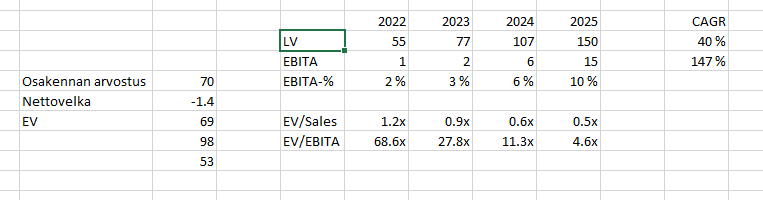
Otherwise, the valuation raises serious questions. Roughly calculated (from the midpoint of the 2022 guidance range, and assuming the %-growth is linear towards the 2025 targets of 150m revenue and 10% EBITA). For the scenario below to materialize, an investor must believe: the 2022 guidance hitting the midpoint, aggressive growth targets in an already highly competitive talent market, and simultaneously a 10% EBITA margin.

The anchor investors are clearly confident; it would be interesting to hear their analysis.

Good luck and success, but I personally remain reserved until further information.

8 Likes

I don’t dare comment on the valuation; that became clear during the Nasdaq training :sweat_smile: The profitability development is detailed in the company prospectus, so if you bear with me for a moment, more fuel for analysis will come. Inderes will also do its own analysis. In our industry, EBITA figures hover around ten percent, and it genuinely isn’t rocket science to achieve market-average profitability, nor should it require product modification – it’s about the smart use of investments and growth efforts.

Now we have businesses that are growing at that doubling pace, and we have instructed businesses to heavily reinvest profits back into growth, to open new countries and cities. Some are performing above expected profitability levels, while others are still in the very early stages and need to stay afloat and move towards the scaling phase. If a business’s growth falls below a 50% annual rate (our playbook’s slow growth), then the playbook should shift towards a combined effect of growth and profitability, more towards an earnings engine.

28 Likes

@Harri_Sieppi What risk scenarios do you see in the company’s business 1) after the listing 2) during the next 5 years?

And thank you to the CEO for the exceptionally visible work! I’m sure I’m not the only one who appreciates such transparent operations.

10 Likes

That was a good, down-to-earth, relaxed, and seemingly honest interview with Harri in Verneri’s hot seat, which further reinforces everything Witted has communicated throughout the listing process.
I quickly skimmed through the morning’s press release, and the company’s strategy also appeals to me, where there’s no rush for dividend distribution, and the business’s cash flows are used where growth is available. Cash flow will only start coming to owners when the three-lane highway begins to turn into a two-lane one.

IT services have never really been in my portfolio, but I have to subscribe to this just because of the CEO’s honest communication and the company’s values.
Good work, and keep up the good work throughout the rest of the listing process! The finish line is already in sight!

34 Likes

@Harri_Sieppi, as I understand it, Witted is a subsidiary of Reaktor. What kind of relationship do you have with the parent company? What kind of cooperation models do you have? For example, I have understood that Reaktor brokers Mavericks’ consultants to its clients.

1 Like

Hey,

First of all, thank you all for the encouragement and support. Thank you also for the tough questions! These have actually been of a much higher caliber than, for example, what was at the stock exchange press conference this morning :joy:… in other words: The real test for the company is the Inderes forum.

Just a heads-up that I’m a single dad this weekend, so I won’t be able to answer at the same pace as during the day, but I’ll do my best!

@Bolse asked: “What risk scenarios do you see in the company’s business 1) after listing 2) during the next 5 years?” The risks are described very comprehensively in the company prospectus, which will be available to everyone shortly. Perhaps on a general level, one could say that in our industry it is important to have a good reputation to succeed in recruitments and sales; on an international level, we are already competing with companies, and the competition won’t get easier; all kinds of new market entries are always risky, but perhaps from my perspective, the biggest risk would be if Megacorp (heheh) became a big and boring company that doesn’t stand out from the gray mass. → It’s worth reading the company prospectus if you want a very detailed list of all the risks we’ve come up with and identified.

@Obelus wrote: “I understand that Witted is a subsidiary of Reaktor. What kind of relationship do you have with the parent company? What kind of cooperation arrangements do you have? For example, I have understood that Reaktor mediates Mavericks consultants to its clients.”

You have old information here; we are no longer a subsidiary of Reaktor, as that arrangement was dissolved to avoid strange situations during this IPO journey. Reaktor retained approximately a 25% stake.

What kind of relationship? Well, a good relationship, of course. Reaktor’s founders and operational management are our friends and will continue to be so. We’ve really dug their journey, and it’s been great that they invested in this back in the day and have helped whenever needed. We’ve done many projects together with Reaktor in Finland and abroad and will certainly continue to do so. Of course, as Witted has grown a lot and even faster than Reaktor, relatively speaking, we have fewer and fewer joint projects. In terms of euros, it has probably always grown and hopefully will continue to grow. They have been good projects – people dig them. Hopefully, we’ll soon surpass them in size – let’s put a little pressure on Pasanen. :wink:

51 Likes

Thanks for the great answers!

This whole expert services scene in Finland is really interesting; I would never have guessed Reaktor was the “seeder” :smiley:

One more question: aren’t low opex costs key to operational competitiveness and profitability in this industry—how does Witted’s ‘group structure’ enable this? I assume the subsidiaries have managers, sales, and other support functions, or are these centralized?

Edit: One more thought out loud… I’ve wondered why Reaktor and Futurice haven’t gone public; you’d think that more senior partner-employees would want the opportunity to gradually realize their shares… This is probably one advantage when attracting talent: ownership stakes are liquid…

4 Likes

T&M business with less than 5% EBIT. Strong revenue growth, but costs grow at the same rate, because T&M. It still makes me wonder why this outfit would even go public? You can’t do many acquisitions with an 8 million euro issue. The mentioned portfolio expansion and expansion into new markets should be possible in the consulting business without significant external financing. Larger, more mature consulting firms are already churning out 10% EBIT, which is still a vague dream for Witted. The relative valuation should be well below less risky comparables such as Gofore, Innofactor, Vincit, etc., for this to be interesting in my books.

6 Likes

@Harri_Sieppi

Thanks Harri for your insightful comments and the interesting Inderes interview!

This isn’t really related to Witted’s offering, but I’ll ask anyway. Since we have such a down-to-earth CEO from whom one dares to ask. What have you learned from founding a company? And what tips would you give for the first few years of a company? What to avoid, what to do, etc.?

4 Likes

Hi @Ausu,

Tips for an entrepreneur? Well, I can try :sweat_smile:
I don’t know what industry you have in mind, but if I can give some general lessons I’ve learned.

For me, this entrepreneurial journey from the idea stage and the corner of the sofa to the present day has been very rewarding. However, it has also been very stressful at times. I made it a bit more challenging for myself by having my first child born in the same year I founded the company. She, my dear daughter, didn’t like to sleep, so sleep was a rare treat for me too. That year caused me to start getting grey hairs and even grey nose hairs (can you imagine), and my hair thinned on top.

It was clear to me from the start that the work wouldn’t get off the ground alone, so my biggest goal was to build a good team. Teme (now the company’s CFO) joined in the early stages, and soon after, we gathered the first handful of people. It was and still is a very good crew. After the first six months, the team was in place. I also took a period of parental leave during the first year. We would always go for a walk with the stroller to the office to say hello to friends, while also visiting museums and such.

I learned the hard way that you have to find a balance where work, leisure, and rest are in order. My model was 8+8+8, and I felt it was very important to be present at home. Eight hours of sleep, eight hours of work, and eight hours of free time with the family. This didn’t always work, and still doesn’t – but under normal circumstances, when there isn’t a “situation going on,” it’s good to aim for that model.

For me, the most crucial things have been:

  • A reasonable balance in life (work is, after all, only a part of it)
  • A good team, people who believe in the same thing as I do. Building that was probably the single biggest thing that created the elements for success.
  • Focus outwards: all companies exist for their customers. (The tendency is for organizations to turn inwards at some point, and that is a huge risk – usually when things go wrong)
  • Remember to have fun :-). We have always had a lot of fun working together. That has also carried us through times when it wasn’t so much fun. As an entrepreneur, if the company grows, your role changes more or less to enabling your colleagues’ success in their work.

Above all, lots of encouragement. Entrepreneurs are indeed superstars, even if not everyone always sees it that way. The journey is demanding – working as an employee is always a bit easier. But I always hugely admire those who overcome the uncertainty associated with starting a company and embark on this journey. Huge respect. The worst thing that can happen is that you end up working somewhere else – and that’s not so bad either. Just go for it :slight_smile:

Nortti didn’t seem to ask questions earlier, but rather presented his own analysis, so I won’t go into a lengthy response. Perhaps just that the T&M (Time and Materials) model is the so-called standard in our industry – that’s how it is now. And it’s perfectly fine, and the model itself doesn’t hinder good profitable growth. We clearly haven’t won you over yet, but we accept the challenge and will do so later :grinning_face_with_smiling_eyes:.

For Ausu:
kuva
<3

66 Likes

Thanks a lot @Harri_Sieppi for the great tips.
And good luck with the IPO! :wink:

4 Likes

Witted has a great story behind it and a promising future ahead, and there isn’t yet an IT service company operating with a similar business model listed on the Helsinki Stock Exchange.

A couple of questions have come to mind, mainly concerning Witted’s place in the IT industry’s value chain and its competitive advantage. Through these, I largely ponder the realism of the stated growth target and profitability improvement. I haven’t been able to form a clear picture of this from interviews or other information. It would be great if @Harri_Sieppi could comment on these, even at a high level.

  • In what proportion of projects/revenue is Witted a direct contracting party with the end customer, and in what proportion does another IT service provider own the contract?

  • The focus on increasing the share of public sector business has been mentioned. Is the goal here to participate directly in tenders or to act as a resource subcontractor for an already strong public sector IT service provider?

  • How would you summarize Witted’s business “moat”? To put it bluntly, smaller freelancer agencies are popping up like mushrooms after rain, and the competitive tool seems to be who can offer the consultant the best combination of base salary and client billing commission percentage.

  • Finally, a slightly broader, and perhaps more difficult, question about the business model level: How has Witted’s business prepared for the risk that the exceptionally strong demand situation in the industry, supported by the megatrend of digitalization, which has continued throughout its operating history, would weaken even temporarily? It has been said in many contexts that sales work is not necessary when strong demand sells itself. Do the customer contract models provide protection in this situation, or is the role in the value chain that of a subcontractor who is first hit by a slowdown? Can the impact be passed on to employees with salary models based on billing?

23 Likes