Virala Acquisition Company VAC

Virala Acquisition Company VAC plans to list on the Helsinki main list
Finland has not yet had SPACs listed, so there should be plenty to dissect

In addition to Virala’s press release, here are a couple of other links below

It would appear that 75-95 MEUR is being raised, with commitments from the Founder Shareholder Ehnrooths’ own Virala (30 MEUR), others (26 MEUR), interests (20 MEUR), targeting one or more companies (EV 50-500 MEUR) within 3 years.

Shares are offered to institutional investors in Finland and internationally, as well as to private individuals and entities in Finland. If the IPO is fully subscribed and the additional share tranche is not offered, VAC is expected to raise preliminary gross proceeds of EUR 75 million from the IPO before IPO-related expenses, and the board also has the right to increase the IPO by an additional share tranche of up to approximately EUR 20 million. In the IPO, VAC is initially offering 7,500,000 new C-series shares of the Company at a subscription price of EUR 10 per share.

The founding shareholder Virala has committed to subscribe for shares worth EUR 30 million. Before the planned IPO, certain anchor investors have, subject to certain conditions, committed to subscribe for shares totaling EUR 26.0 million as follows: Ahlstrom Invest B.V. EUR 9.0 million, Jussi Capital Oy EUR 9.0 million, Oy Julius Tallberg Ab EUR 4.0 million, Oy G.W. Sohlberg Ab EUR 1.5 million, Visio Varainhoito Oy EUR 1.5 million and Oy Hammarén & Co Ab EUR 1.0 million. In addition to this, over 20 investors have verbally informed the Company of their intention to subscribe for shares offered in the IPO in an amount totaling approximately EUR 20 million.

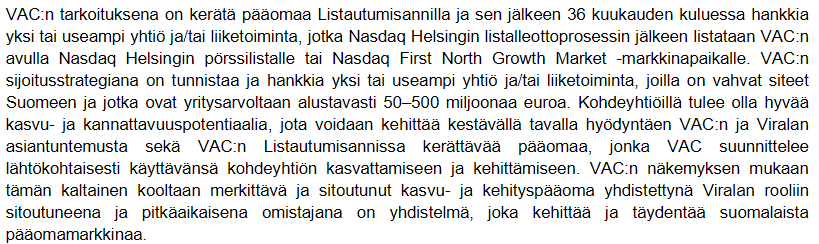
VAC’s purpose is to raise capital through the IPO and then, within 36 months, acquire one or more companies and/or businesses, which, after the Nasdaq Helsinki listing process, will be listed on the Nasdaq Helsinki main list or the Nasdaq First North Growth Market with the help of VAC. VAC’s investment strategy is to identify and acquire one or more companies and/or businesses with strong ties to Finland and an enterprise value of initially EUR 50–500 million. The target companies must have good growth and profitability potential.

https://www.virala.fi/releases/VAC_ITF-tiedote_FI_030621.pdf

17 Likes

This is quite an interesting setup. Of course, I’m a bit concerned about the industry of the target company/companies. I’m joining, at least, purely out of interest, but I do see upside in this from an investment perspective.

Compared to a normal private equity (PE) investment, the upside here is an open time window and, of course, more open financing opportunities. The downside, of course, is whether anything can be acquired and at what price. One would assume that the people behind this already have some kind of plan in place.

It will be interesting to see how much interest there is from private investors and how banks, for example, market this, as it’s not exactly traditional stock investing.

5 Likes

There’s a significant difference between Finnish VACs (SPACs) and their US counterparts:

US SPACs generally have a NAV (Net Asset Value) of around $10, which is “protected” from normal working capital. This fund is distributed to shareholders if a target company isn’t found and the fund is dissolved.

For short-term SPAC speculators, the Finnish model is not suitable, as the number of redeemable shares is limited to ten percent. In practice, this means that, unlike in the United States, nothing prevents the share price from falling below the listing price.

So, according to the article in the opening post, only 10% can be redeemed. Sufficient capital is ensured for the target, but small investors are not protected in the same way. This is contradictory to the operating model and should be confirmed from the listing materials. It could also just be an error in the article.

There are no warrants either, which in part makes it easier to understand the price paid for the shares after a target company is found.

This is usually the capital used in the US market to find a target.

Listing reduces investor risk compared to more traditional private equity investing, as 90 percent of the funds raised are placed in a closed account. They are paid back to investors if a suitable company is not found within 36 months.

Source behind paywall: Uskoisitko rahasi tälle ryhmälle? – Helsingin pörssin ensimmäisessä spac-yhtiössä on paikka auki kokeneiden sijoittajien pöydässä | Kauppalehti

So 90% is held in the fund, meaning the fund’s NAV is 90% of the IPO price. With €10, you get €9 :thinking:
Of course, there’s a potential for profit when a target company is found and its valuation is reasonable. However, many current IPOs have jumped 20-40% right from the start. Here, the potential could be greater - or not.

For my part, I welcome it to the market, but the terms, at least regarding this aspect, don’t seem too attractive initially. I’ll certainly have to study the materials more closely when they’re released. These are just my initial assessments based on pre-written articles.

Edit:
Thanks @Pohjolan_Eka for clarifying the terms in the next post. It was grim reading - No go. I’ll continue researching the US market for these, and domestically, for now, stick to traditional stocks and occasional IPOs.

24 Likes

Well, I’ve been eagerly waiting for these great, but often misunderstood, investment instruments to arrive in Finland. However, I must say that Virala turned out to be a horrible disappointment, and I sincerely hope that the reputation of SPACs here in my home country isn’t ruined because of this.

Let’s take a look at what the VAC press release says:

And it immediately went wrong. The sponsor apparently doesn’t pay the listing costs; instead, for some strange reason, private investors are footing the bill. Additionally, they are offering only shares instead of Units/Warrants (WTF!!!), meaning there are no incentives whatsoever to participate in the listing. This can’t be right, can it?? Can it??? And what on earth is this Series C share? Are there other share classes? Let’s keep reading :worried:

They have managed to gather a good group of anchor investors and are putting their own money in. This is, of course, fundamentally a positive thing! Based on this, I consider it very likely that the IPO will go through. So, it’s easy to predict a large flock of retail investors making a subscription and selling their entire position on the first day, which has been the recent trend in several other listings.

image

90 percent deposited… 90 PERCENT??? In SPACs, the NAV is calculated based on the capital deposited, so VAC’s NAV is €9. This means that those subscribing to the shares are not offered incentives and will lose that 10% to listing costs, management fees, etc. Traditionally, 100% of your capital is secured, which is why SPAC prices hover around the listing price ($10 or €10 here). The VAC share price, however, will instead fall towards €9. A guaranteed loss if you subscribe? :joy:

36 months??? Why? The traditional 24 months should be enough to find an acquisition target and give management a good incentive to work. If you can’t find anything to acquire in two years, you won’t find it in three years either. It’s utterly unreasonable to wait 3 years without warrants to get 90% of your invested capital back. Furthermore, VAC doesn’t disclose the target company’s business sector, meaning it’s completely impossible to know in advance whether it will be a construction company, an IT service firm, or perhaps a development-stage pharmaceutical company. It’s completely irresponsible that they refuse to mention the target sector or sectors!

By my math, 30 million euros for a 75 million issue would make a 40% ownership stake, and 30 million for a 95 million issue would be 31.6%, but okay. A 3-year lock-up period with a 3-year search period is practically the minimum. It would have been better, for example, a year after the merger, although this would restrict them more if they happen to find an acquisition target exceptionally quickly.

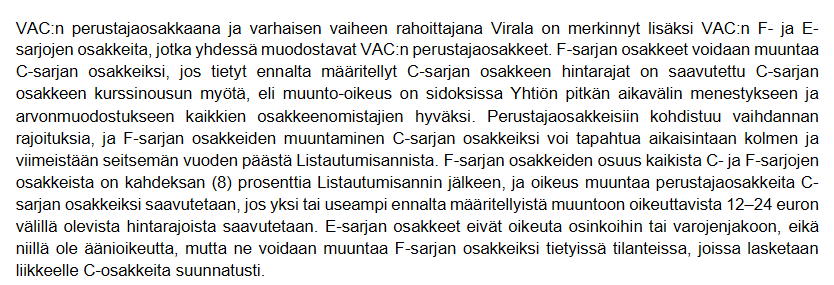
Series F and E shares??? Convertible into Series C shares?? At the latest 7 years from the IPO?? Now it’s clear where the warrants meant for subscribers have disappeared. They have given them to themselves for free :man_facepalming: Series F shares are thus a kind of “warrants” and Series E shares are “warrants for warrants” (convertible into Series F shares). The number of Series E shares isn’t even mentioned here, so we don’t know how many of these are in circulation.

image

Stop the stunt! STOP THE STUNT! You don’t get your own money back if you don’t like the acquisition; the redemption right is limited to 10 percent! So first, 10% is taken from the IPO funds, and 90% is left for investors, after which even this 90% cannot be fully withdrawn. This is an unbelievably brazen condition that ensures the acquisition succeeds and prevents investors from rebelling, regardless of the quality of the acquisition target. In a normal SPAC, you can withdraw all your money (100%) if you don’t like the acquisition target.

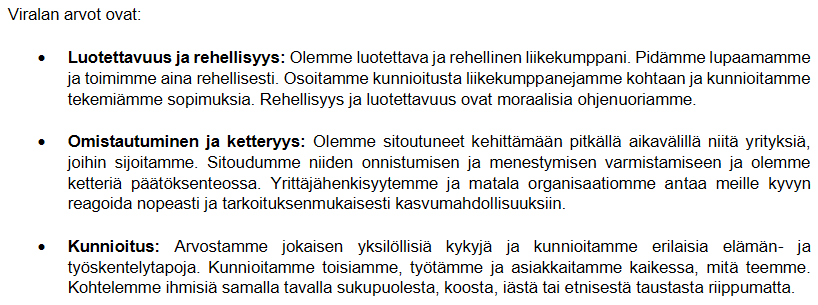
Virala’s values have surely become completely clear by now. Take the retail investors’ money at the peak of the stock market cycle and make good money when the opportunity finally arises.

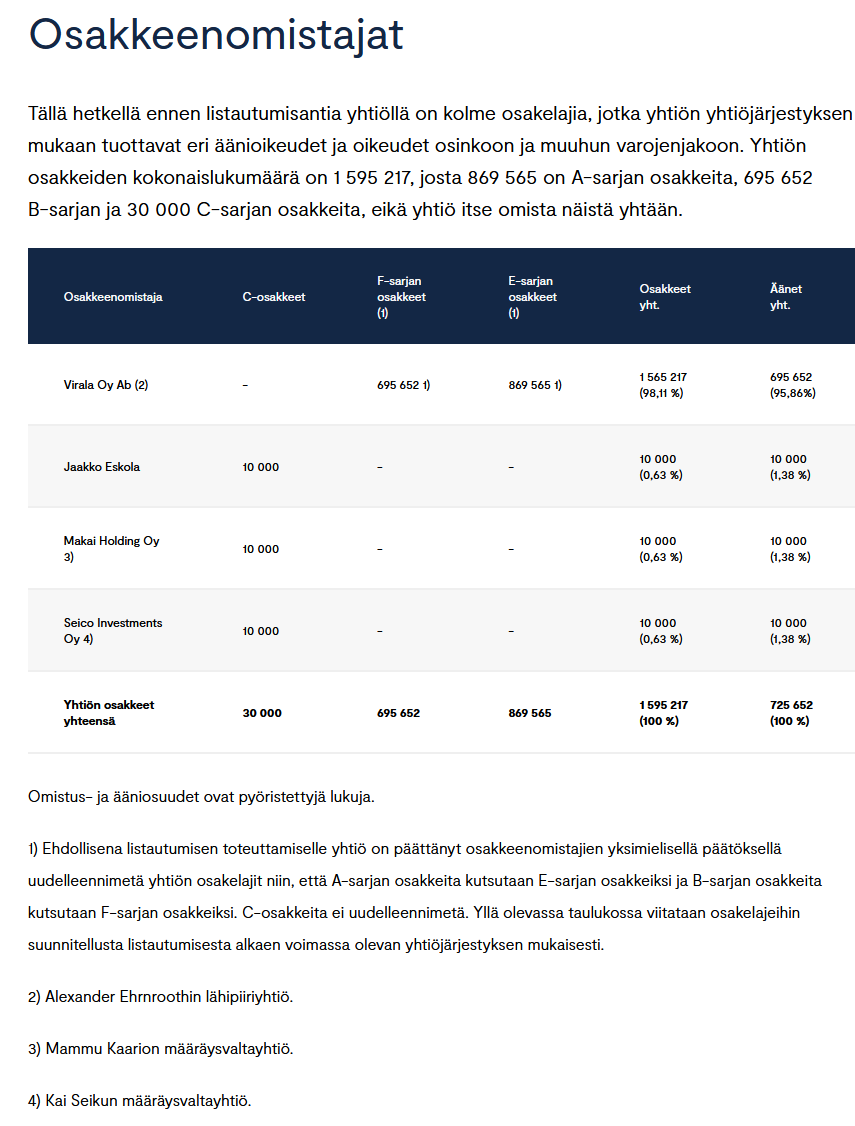
Edit: The number of Series E shares is mentioned on Virala’s website. A total of 869,565 shares, which are convertible into Series F shares, which are convertible into Series C shares at some ratio.

image

165 Likes

Leveraging the earnings season and IPO (Initial Public Offering) craze. Not moving forward.

32 Likes

I would really like to hear from Virala why it’s exactly 10%, and not, for example, a smaller slice (in SPACs, usually 1-3% remains outside). The costs cannot be that high. But otherwise, perhaps the comments give too rosy a picture of SPACs in relation to this arrangement. In SPACs, dilution ultimately comes in many different forms.

In my opinion, Virala has directly eliminated its own downside from the whole picture here, but perhaps also limited its own upside. They also have a lot of their own capital at stake. I wouldn’t get too fixated on SPACs here; I’d see this as a hybrid between a PE fund and a SPAC.

On the positive side, I see that the whole thing is being done under Ehnrooth’s name, which perhaps offers some kind of reputation protection against that 10% going towards something frivolous.

Estimates suggest that money will be spent annually at about one percent of the capital.

the conversion of the E-series was defined as follows:

At most, Virala’s ownership percentage of the listed share class can increase by just under ten percentage points. This would require the VAC share price to rise from the listing price of 10 euros to 24 euros. There are seven years for this price increase to occur.

5 Likes

This sounds exactly like a slot machine from a betting company. :smiley:

12 Likes

Wouldn’t this tip the ownership stake over 50%? So, if things go well, they gain control of the company, and others are left with the unpleasant choice of remaining in the less-than-50% group or selling to a redemption offer. Or hey, would a redemption obligation even arise there? If, on the other hand, things go worse, they would roughly get their money back through these different series of shares? Did I understand correctly? A nice alternative to letting millions sit with negative interest rates :star_struck:

3 Likes

Hey, because that can only happen after the acquisition, when the ownership has already been significantly diluted.

3 Likes

Not everyone sees the Ehrnrooth “golden touch brothers” as a positive, and their reputation seems to have already taken a hit. :thinking:

“Amusingly, the first candidates to announce themselves are Alexander and Albert Ehrnrooth, known in investor circles as the Ehrnrooth family’s golden touch brothers after the bankruptcy of Tiimari (2013). They also have on their merit list an approximately year-long (2007-8) investment in the Juankoski-based cardboard company Stromsdal (R.I.P.).”

14 Likes

Come hear more about the company’s plans at the virtual company presentation

  • Date: 16.06.2021
  • Time: 18:00 - 19:00
4 Likes

That was a good and illuminating analysis of how to take money from fools. The terms here are such that you won’t get your own money back if VAC’s board messes up, unlike in the US. I definitely won’t participate.

5 Likes

Respecting @Pohjolan_Eka’s analysis, I’m skipping it too. Pretty harsh text.

4 Likes

I’m not participating. The arrangements are so complex that you won’t get your money back. Unlike US SPACs, you already lose 10% in listing fees during the offering, and when “management’s” investments aren’t really appealing, there’s nothing you can do, and your shares won’t be bought back like in the US.

3 Likes

The IPO books are open today.

1 Like

Virala’s Johannes had an interview. :slight_smile: I brought up several points based on the discussion in this thread, among other things. :sunglasses:

32 Likes

Confirms the “no-go” view, difficult questions are skillfully dodged instead of giving a reasonable explanation. It’s good that difficult questions were asked, even if the answers were gibberish.

So, they’re belatedly trying to milk everything they can from the SPAC hype and hoping that private investors won’t read the fine print.

25 Likes

Good interview and great work from Verneri. At least I wasn’t convinced by the CEO’s answers to the difficult questions posed from 27:00 onwards. (I only watched the latter half of the video as that’s where the interesting questions were.)

17 Likes

Great interview and it’s good that the CEO was challenged - it almost turned into a roast at the end, as there weren’t many answers and questions were visibly avoided. I’ll have to take a closer look at the prospectus and company presentation, but it looks pretty dismal right now.

19 Likes

At first, this seemed like an interesting case, but the more I look into it, the less interested I become.

Have you found any information about Class A and Class B shares and their rights?

3 Likes