Green Transition from an Investment Perspective

EK maintains a listing related to green investments, where one can see the investors, project description, phase, monetary estimate, and so on. The user interface might not be the best, however…

From a stock investor’s perspective, I looked at that site and started to ponder which listed company one should invest in to get the greatest benefit from the practical applications of future investments. From the list, for example, SSAB (hydrogen), Freyr Battery (Battery technology), Neste (hydrogen), UPM (hydrogen), Kempower (transport) emerged, which I recognized immediately. PlugPower and Blastr Green Steel also due to big news headlines. Wärtsilä benefits as an equipment supplier. MeriAura also has its own hydrogen project (a ship using ammonia as fuel) underway, as does Fortum. Certainly others, but these at a quick glance.

I think that investments made in (offshore) wind power largely flow into hydrogen production. Wind power would therefore not be a more value-generating investment target (primary production) than, correspondingly, those that either produce hydrogen or use hydrogen.

Battery technologies would create the most jobs. I can’t determine if this is a cost burden or how it should be interpreted.

How/where are you currently investing in the green transition?
19 Likes

In Helsingin Sanomat today—at least based on my own limited knowledge—a fairly professional overview of the green transition investments planned for Finland (no paywall). The article seems to be rooted in the Green Investment Data Window linked by Mantu above.

Petja Pelli HS: Of the pot of investment intentions listed by EK (Confederation of Finnish Industries), over a hundred billion euros, or more than two-thirds, is directed toward wind power. The shares of offshore and onshore wind power are nearly equal.

Wind power also involves the construction of new power lines, i.e., the transmission grid.

The next largest entity, at approximately 30 billion euros, consists of industrial investments, i.e., factories. Hydrogen plants are at the top of the list in terms of amounts. They are followed by fossil-free steel and batteries.

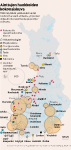
One perspective in the story is the regional distribution of the projects. Wind power intentions are known to be concentrated in Western Finland, but solar power plans are more evenly distributed, including in Eastern Finland.

The timeline for the projects is quite long; for instance, regarding offshore wind projects, the estimated completion time for known projects is 2030 or later. Onshore wind projects are set to be completed earlier.

On the solar power side, key initiators include the listed Swedish company OX2 and the Finnish company Ilmatar. Do you remember, by the way, that Ilmatar was supposed to list on Finland’s First North list back in 2012, but ultimately Ilmatar canceled its listing plans.

Naturally, the projects are subject to great uncertainties:

JUST staring at the billions does not give a full picture of the green transition.

Large sums involve large uncertainties. Of the thirty most expensive investment intentions, only two have an investment decision. One is an expansion of existing operations. Eighteen are at the planning stage, and nine are only in the preliminary study phase.

The maps compiled for the story are interesting. Here is a sample map from the article showing the overall picture of the planned projects:

image

PS: @Sijoittaja-alokas or @Verneri_Pulkkinen If this went into the wrong thread, could you move it to a better one? The title of this thread does fit the topic, but since there’s only one previous message in the thread, it might not be very widely read.

11 Likes