If we go down this path, similar claims can also be made about lithium-based cells. Even the electrode materials haven’t been published, and the selectability of voltage implies that those are also parameters in this kind of marketing (and a composite is possible via printing). If cycle life is based on a light load, then reliably modeling calendar aging is practically impossible.
Regarding the trinity you mentioned, li-ions are indeed already technically optimizable to at least the 30k cycle level. There are LTO cells on the market with 30k cycles @ 1C that are capable of even 100C, but their energy density is low.
Electric Viking provides what I think is a good overview of yesterday’s test results and some comparison with other competing technologies. TLDR:
The 11C charging test is a very good result. Temperatures rose high in the single-cell laboratory test. A tightly packed battery pack in a car, with hundreds or thousands of cells side-by-side, is a different matter and will certainly require active cooling. Lehtimäki’s claim that it won’t require active cooling can’t be correct.
The guy is getting some flak in the comments, and for good reason; the 90°C limit was VTT’s own safety limit, not the battery pack’s. Lehtimäki mentioned somewhere that the battery can definitely withstand significantly higher temperatures, and as seen from the graphs, the battery was charging at a blistering pace the whole time before the test bench limit was reached.
Almost all EVs have active cooling for the batteries, even those that only charge at a maximum rate of 2-4C. At a 5C charging rate, that battery might fare quite well without any active cooling. Additionally, it must be remembered that while it takes 11C when charging, the C-rates are much lower during discharge (e.g., during full acceleration on a motorcycle), meaning a smaller heat load.
Do you have a link or something for this claim? I don’t remember seeing that—i.e., that it wouldn’t need active cooling even with 11C charging. I’m not saying Lehtimäki didn’t make such a claim, but it would be nice to see the original source to see the context. In theory, for motorcycles, for example, it could be very possible that active cooling isn’t needed even with 11C charging.
These days, there seem to be as many “neutral experts” and other critics on YouTube as there are in market square cafes or workplace canteens. Better to just let them blather on and wag their tongues. Wait for more information from the actual source. There are as many opinions as there are people.
90C is probably VTT’s own safety limit, and Donut’s own presentation in the battery launch video stated that the battery can operate okay at 100 degrees. However, it is clear that if a single cell rises to 90 degrees during 11C charging, having many cells tightly packed side-by-side heating up simultaneously will require efficient cooling. If that isn’t available, the heat in the middle of the pack will quickly rise to hundreds of degrees if it has no way to escape.
Of course, passive cooling might suffice at lower charging rates, but likely not at the advertised 12C rate.
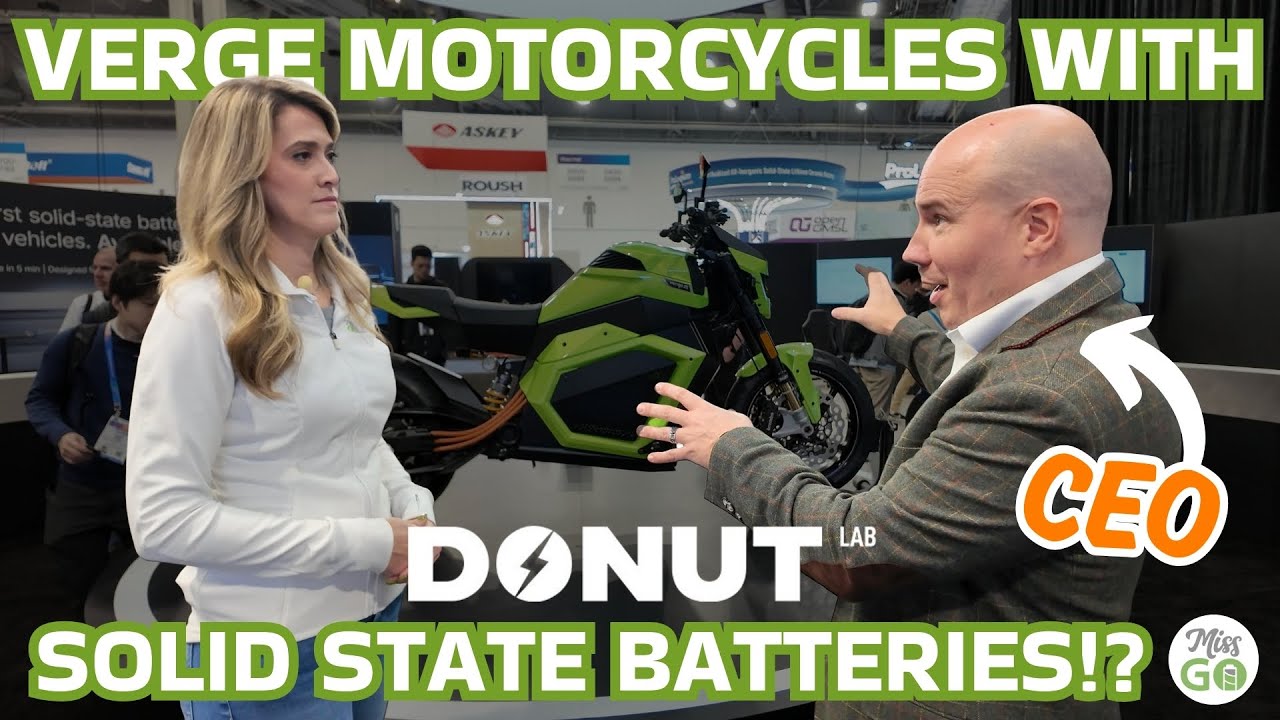
That mention about the lack of need for active cooling was actually from the CES interview video below that I saw last month, so it was Verge CEO Tuomo Lehtimäki who said something along those lines.
In our motorcycles we have 5C and 7C charging speeds, that is with passive air cooling.
At the 5:15 mark in the video below.
So, good point. Donut Lab hasn’t (probably?) claimed that 11C charging would work with passive cooling. And that 5C - 7C passive cooling works for a motorcycle pack. For cars, it’s still a question mark.
Reddit is blowing up as Sana Energy’s boss Javier Celdran Kuhl came forward to announce that Donut Lab’s nanopaste and production line come from them (and therefore from CT Coating). He started answering people’s questions on several different forums yesterday. He seems to be active on LinkedIn and Reddit.
Evidence for this connection was presented a week ago in this comment.
Very interesting. I read that Reddit thread and it’s still unclear what Nordic Nano’s role is.
If CT-Coating makes the production line equipment and the “nano-paste,” does NN have some role in the composition of this paste? CT/Sana’s CEO says that Donut Lab owns all the IP regarding the batteries; CT/Sana is just a “printer and ink supplier, Donut is the one who wrote the book.”
CT has apparently tried to solve the problem with different partners before, without success. What has changed now?
An incredible case in any event.
EDIT: Statement from the CT/Sana CEO:
CT Coating does not own the IP for Donut Lab’s battery. That’s not the case. They own the machinery that makes those batteries possible. Donut Lab is free to patent its specific use. It’s like if I sell you a printer and you make a book. The book is your creation, and its content is your intellectual property. Please don’t confuse the two.
Someone on Reddit had estimated the cell size relative to a test device they recognized:
“I did some rough measurements (assumption climate test chamber is vt 42021). Volumetric energy density could be around 800 Wh/L (Nominal Energy 94 Wh and Voluem ~0,11L)”
This would seem to correspond to an energy density of around 300–350 Wh/kg. So not quite the reported 400 Wh/kg, but very good nonetheless, if true. The battery heated up but didn’t fail at high temperatures, so perhaps it doesn’t contain lithium after all. Aalto’s battery professor apparently considered sodium a possibility as well, which would of course be a more preferable option in many respects. Hopefully, VTT has been allowed to disclose in future tests whether the cell used is always the same.
The statements are a bit contradictory, as VTT says the client only provided one cell for testing, while Donut claims that VTT chose the cells to be tested from several cells themselves.
The subsequent reports will then reveal if there are multiple cells and whether they were selected by VTT or just delivered to them for testing.
Hmm. Akkutohtori is quite sure that it’s an NMC cell, which apparently always contains lithium. Donut, on the other hand, if I recall correctly, said that there is no lithium in the cell (and apparently no cobalt, nickel, etc., either?). Would Siilasmaa allow an outright lie in the name of marketing?
And the saga just gets more incredible. Now that Reddit thread has been deleted, supposedly at the request of Sana Energy. Marko Lehtimäki says on LinkedIn, referring to Sana and the CEO in question: “Never heard from these guys”.
An article from Yle about Donut Lab attracting investors with questionable claims, titled: Confidential messages reveal Donut Lab’s wild promises to investors: ”Elite companies want donuts”
This is certainly an interesting setup, as the technology apparently comes from CT-coating with Nordic Nano acting as an intermediary/nanotechnology refiner. Lehtimäki himself has “never even heard” of Sana Energy because they worked with a German operator.
A slight doubt remains as to how well Donut Lab has performed its due diligence on the technology. It is also baffling what Nordic Nano’s contribution is in this, as they don’t seem to have a significant technical background – and why has CT-coating ended up offering its revolutionary technology specifically to Nordic Nano?
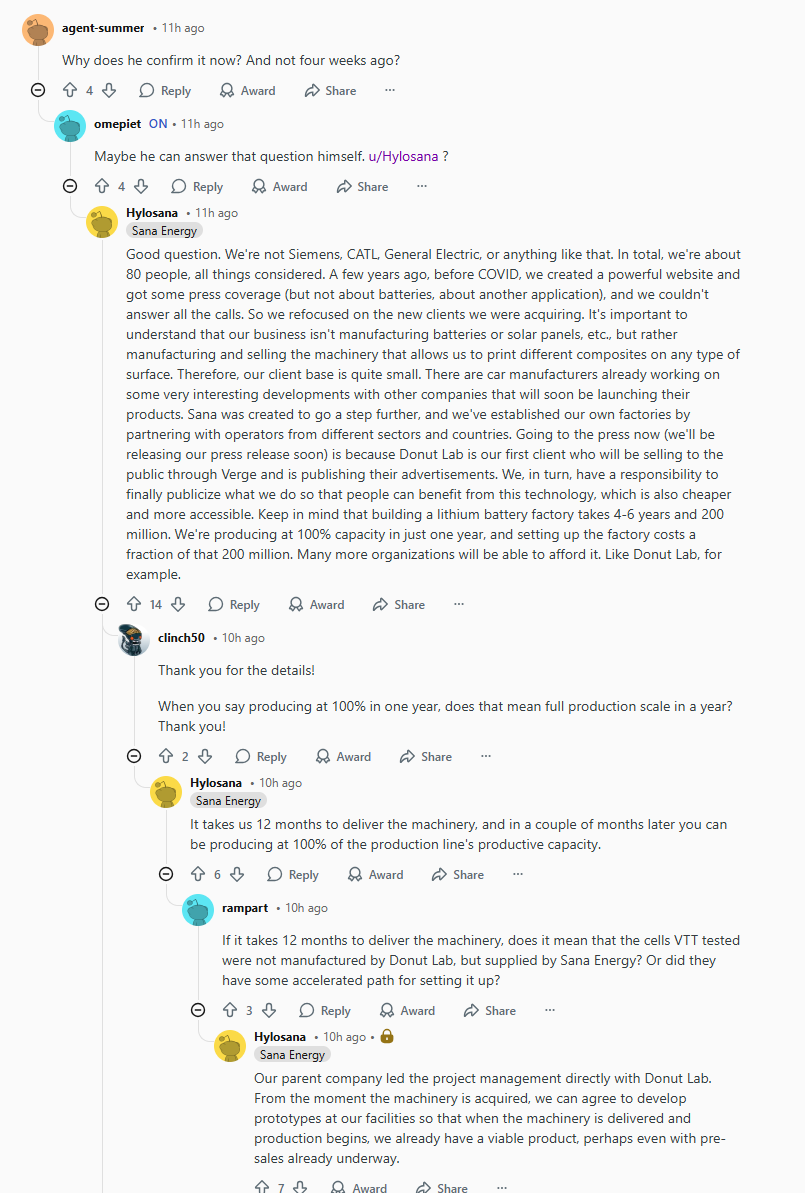
Apparently I still had a Reddit tab open, I took some screenshots… this was one of the most interesting parts, where Sana’s Javier (“Hylosana”) provides some background:
So it was confirmed there that the printing equipment comes from Sana Energy and Dobut is one of their first customers, but Lehtimäki had never even heard of the company?
Additionally, they offer manufacturing services for the 12-month period it takes to deliver the equipment to the customer. Well, once again, new information that gets deleted, but these twists seem to keep coming and the whole thing is just getting more and more confusing.
Personally, ever since the news about the VTT testing broke, and combined with a few other factors, I’ve had the feeling that this might not be a 100% intentional scam. Plus, I’ve thought it’s really interesting to follow—I don’t have a single euro at stake—so let’s just wait for all the tests and expert opinions and see.
Now, however, as the initial excitement has faded, I’m starting to get tired of it. I can’t really be bothered to follow the whole thing anymore. There are too many vague twists, and the “Donut Firm’s” public statements are somehow childish anyway; they just fuel the skepticism because it feels like they don’t actually understand the subject they’re talking about—they’re just babbling. Every now and then, they should put those supposedly smarter background figures in the spotlight, if such people even exist there. It doesn’t really matter if playing dumb is all just part of some clever marketing strategy.
Of course, my own boredom or the annoyance caused by the CEO’s behavior isn’t an argument against the technology itself, and I’m not claiming it is. Maybe I just need to go on a news blackout regarding this topic for a while; enough is enough.
Based on, among other things, the information and observations presented in this thread, I would consider it extremely likely that this is a scam and the company does not have a revolutionary battery. However, anything is possible, and it is always a matter of probabilities.